Cheap Oil Gets Cheaper

Dear Clients, Prospects & Friends:

The economic news that everybody is talking about lately is the sudden unexpected drop in oil prices.  One type of oil, West Texas Intermediate crude, has fallen from over $140 a barrel in the summer of 2008, and $115 a barrel as recently as June, down to $91, and there is no sign that the decline will stop there.

The price drop seems to be the result of a perfect storm of factors, both on the supply and demand side.  On the supply side, U.S. production has risen to the point where only Saudi Arabia extracts more oil from its soil.  In the recent past, America’s additional production was offset by sharp declines in production caused by the civil war in Libya, plus production declines in Iraq, Nigeria and the Sudan.  Those countries are now back in business, adding the production equivalent of 3 million barrels a day, a significant fraction of the 75 million barrels a day of global production.

On the demand side, meanwhile, China’s growth has fallen by half, European economies are weakening, and people everywhere are driving more fuel-efficient cars and living in more energy-efficient homes.

As always, a major shift in global economics is producing some winners and losers.  American consumers are among the most prominent winners, since they consume more oil and gas per capita than the citizens of any other country.  The stiff drop in oil prices this year has resulted in U.S. gasoline prices falling 26¢ to an average of $2.88 per gallon, down from $3.14 a month ago. That’s equivalent to a $40-billion tax cut that will benefit various the transportation sector, energy-dependent manufacturers and, of course, the handful of Americans who drive automobiles.

Lower energy prices are also a boon for countries that import a significant amount of crude, including India, which brings in roughly 85% of its oil, and Japan, which is importing oil again now that its nuclear reactor industry is on hiatus.

Losers?  You can expect the major oil companies to report lower profits in the months ahead, and the Russian economy which is heavily dependent on energy exports and already feeling the impact of an impending recession, is being crushed.  Surprisingly, some believe the biggest loser is Iran, whose social program spending and high costs of extraction imply a break-even well above today’s prices, estimated as high as $130 a barrel.

As mentioned earlier, oil prices could—and probably will—drop further.  But don’t believe the predictions that have popped up in the newspapers and on the financial TV stations of a new era of oil abundance.  Oil prices almost certainly won’t fall to pre-2007 prices, which can be seen on the accompanying chart.

Why?  According to the International Energy Agency, the capital cost of producing a unit of energy—that is, the cost of finding oil and gas, drilling for it (and hiring the people who will do these things, who are some of the best-paid workers in the world), moving it from the well to the refinery and refining it have doubled since 2000, and the rise in these costs increases yearly.  If oil prices drop much further, shale oil producers in North Dakota and Texas will find it unprofitable to keep drilling.

Another floor under prices is the OPEC cartel, which together supplies about 40 percent of the world’s oil.  A Bloomberg report noted that OPEC nations—particularly Saudi Arabia—have been surprisingly relaxed about the supply/demand shifts.  The cartel nations pumped 30.97 million barrels a day in October, exceeding their collective output target of 30 million barrels for a fifth straight month.  However, if oil prices were to dip closer to $80 a barrel, the cartel could well turn down the spigot and change the equation back in favor of higher prices. An OPEC meeting scheduled on Thanksgiving Day should have market moving implications for oil prices.

What should you do about all this?  Enjoy it!  When was the last time you saw prices fall dramatically on an item that you use every day, and that you could hardly function without?  Chances are you’ve been whacked by higher gas prices a few times in your life; this is your chance to enjoy a different dynamic—while it lasts.

Oh…  And don’t spend a lot of time worrying about the big oil companies.  Somehow they’ll manage to muddle through and stay profitable long enough to reap big gains the next time prices jump in the opposite direction.

If you would like to discuss any financial planning matters, please don’t hesitate to contact us or visit our website at http://www.ydfs.com. We are a fee-only fiduciary financial planning firm that always puts your interests first.

Sources:
http://www.theglobeandmail.com/report-on-business/industry-news/energy-and-resources/increased-spending-required-to-meet-future-demand/article18953856/
http://oilprice.com/Energy/Gas-Prices/Why-Despite-the-Boom-in-Oil-Production-are-Gasoline-Prices-Still-High.html
http://oilprice.com/Energy/Oil-Prices/Why-Oil-Prices-Are-About-To-Settle.html
http://www.vox.com/2014/10/7/6934819/oil-prices-falling-russia-OPEC-shale-boom-gasoline-prices

Rollover Rules

One of the oddest things about tax law is the fact that often the rules and regulations are decided by the many court cases that are brought by taxpayers who didn’t follow the rulebook. This happened once again in a recent tax court case, where the Tax Court decided that people can only do one IRA rollover in any one-year period, no matter how many other IRA accounts they happen to have. Never mind that the decision directly contradicted the IRS’s own guidance in its Publication 590 and a number of private-letter rulings issued by the IRS.

Since the so-called Bobrow decision (which may be appealed), a common way to move money from one IRA account to another now has to be monitored closely. The ruling affects situations where an IRA owner takes a distribution from an IRA and then rolls those same funds over to another IRA within 60 days. So long as the same amount of money is put back into an IRA account within that time period, no taxes have to be paid on the distribution of funds (and no 10% additional penalty, if the IRA owner is under age 59 1/2). But now you WILL have to pay taxes–and the penalty, if applicable–if you try to do this again with the same or other IRAs during the same 365-day period.

Fortunately, this rule doesn’t apply to direct transfers, which is the way most professionals prefer to move money between IRA accounts. A direct transfer is exactly what it sounds like: the trustee of one IRA moves the money directly from that account into the hands of a trustee for another IRA account; that is, the money flows directly from one account to the other without the taxpayer ever touching it or putting it into his or her own checking account. Under current rules, even with the Bobrow decision, these kinds of transfers can be done all day long, all year long.

It has always been good advice to use only direct transfers to move IRA funds from one IRA to another. Now it’s even more so.

Incidentally, this once-per-year IRA rollover rule doesn’t apply to rollovers from an IRA to a Roth IRA (commonly known as a Roth IRA conversion). But most advisors prefer to handle those on a trustee-to-trustee basis anyway, to avoid confusion and potential problems with the 60-day rule. Mistakes on transfers can be costly from a tax standpoint, and the way things stand, they can’t be fixed after the fact–unless you decide to take the case to court and hope to reverse the current rule of law, which is far more costly still.

If you’d like to know more about rollover rules or if you want to discuss other financial planning matters, please don’t hesitate to contact us or visit our website at http://www.ydfs.com. We are a fee-only fiduciary financial planning firm that always puts your interests first.

Source:
http://www.investmentnews.com/article/20140413/REG/304139996/irs-only-one-ira-rollover-per-year

What Is the Difference Between Disability Insurance and Long-Term Care Insurance?

Disability insurance addresses lost wages that stem from an inability to work. Long-term care insurance, in contrast, addresses expenses associated with medical care provided to you in your home, a nursing home, a rehabilitation center, or an assisted living facility.

Disability insurance policies may address either short-term or long-term needs for income. Short-term disability policies provide coverage on a temporary basis, usually up to several months, while you recover from an accident or illness. Long-term disability insurance provides benefits when a disability is of a more permanent nature. Most long-term disability policies will cover you throughout your working years, usually until you reach age 65. Policies vary considerably in terms of the cost of premiums, the percentage of your prior salary paid out as a benefit and the definition of what constitutes a disability.

Long-term care insurance is designed to help cover costs of health care services provided to you in your home, a nursing home, a rehabilitation center, or an assisted living facility. Many long-term care insurance policies provide benefits when you require assistance with activities of daily living such as bathing, dressing, and feeding yourself. Loss of wages typically is not an issue with this type of coverage.

Long-term care insurance can be purchased at any time in your life. However, premiums tend to rise considerably with age and applicants can be turned down due to pre-existing medical conditions. Although individuals of any age may receive benefits from a long-term care insurance policy, these policies typically are intended to help finance the medical costs of the aged.

Why do many financial experts recommend their clients purchase both disability and long-term care insurance?

•    According to the Social Security Administration, a 20-something worker today has a 30% chance of becoming seriously disabled before reaching retirement.1
•    The average daily charge for a semi-private room at a nursing home is $207. The average monthly charge for care in an assisted living facility is $3,450. 2

If you’d like to know more about disability and long-term care insurance, or if you want to discuss other financial planning matters, please don’t hesitate to contact us or visit our website at http://www.ydfs.com. We are a fee-only fiduciary financial planning firm that always puts your interests first.

Sources:
1 Social Security Administration.
2 Genworth, 2013 Cost of Care Survey, March 2013.

Trading Places: Baby Boomers More Aggressive Than Millennials in Retirement Goals

Popular investing wisdom states that the younger you are, the more time you have to ride out market cycles and therefore the more aggressive and growth-oriented you can be in your investment choices. But that is not how individuals surveyed recently are thinking or behaving with regard to their retirement investments.

In fact, the new study sponsored by MFS Investment Management suggests that Baby Boomers take a more aggressive approach to retirement investing than the much younger Millennials — those who are 18 to 33 years old. Further, each group’s selected asset allocation is inconsistent with what financial professionals would consider to be their target asset allocation, given their age and investment time horizon.

For example, Baby Boomers, on average, reported holding retirement portfolio asset allocations of 40% equities, 14% bonds, and 21% cash, while Millennials allocated less than 30% of their retirement assets to equities, and had larger allocations to bonds and cash than their much older counterparts — 17% and 23% respectively.

Further, when asked about their retirement savings priorities, 32% of Baby Boomers cited “maximizing growth” as the most important objective, while two-thirds of Millennials cited conservative objectives for their retirement assets — specifically, 31% said “generating income” was a top concern and 29% cited “protecting capital” as their main retirement savings goal.

Perception Is Reality

The study’s sponsors infer that the seemingly out-of-synch responses from survey participants reflect each group’s reactions — and perhaps overreactions — to the recent financial crisis. For Baby Boomers, the loss of retirement assets brought on by the Great Recession has made them more aggressive in their attempts to earn back what they lost. Fully half of this group reported being concerned about being able to retire when they originally planned. For Millennials, the Great Recession was a wake-up call that investing presents real risks — and their approach is to take steps to avoid falling foul to that risk even though they have decades of investing ahead of them.

Educating Investors: An Opportunity for Advisors

The study’s findings suggest that there is a considerable opportunity for advisors to dispel fears and misperceptions by educating investors of all ages about the importance of creating and maintaining an asset allocation and retirement planning philosophy that is appropriate for their investor profile.

If you have any questions or concerns about asset allocation, retirement and financial planning or investment management, please don’t hesitate to contact us or visit our website at http://www.ydfs.com. We are a fee-only fiduciary financial planning firm that always puts your interests first.

Towards Better Social Security Income Planning

As you approach your social security retirement age, your thoughts turn to deciding when you should begin receiving social security benefits. With over 2,700 rules in the social security manual, you’d be forgiven (and, for that matter, so would most social security case workers) for being bewildered and confused about all of the options available to claim social security. In this article, I attempt to distill the most frequently asked questions and help reduce confusion about claiming social security benefits (SSB).

The crux of this article is to discuss the advantages of planning the payout of your (or your spouse’s) benefits to maximize your ultimate financial payoff. Coordinating your benefits with your spouse’s benefits introduces complexities that must be understood to maximize your overall benefits. Combined with the ability to file for benefits, then suspend them or filing for benefits using your ex-spouse’s earnings records, planning for social security benefits can be quite complex.

I realize that, as a financial planner, it’s somewhat self-serving to say that each person’s situation is unique and requires a personalized and thorough analysis of the facts and circumstances to determine the optimal timeframe to claim SSB. Nonetheless, no article, however detailed, can take into account all individual situations.

Note that this article doesn’t attempt to discuss the viability of the social security system or whether benefits will be available in the future (I believe that they will be, perhaps on a somewhat reduced basis).

Social Security Basics

In general, if you’ve worked and sufficiently paid into the social security system for at least 40 quarters of work in your lifetime, you probably have some SSB coming to you when you retire. Calculation of the level of your benefit is quite complicated, but mostly affected by your lifetime earnings.

Even if you’ve never worked a day in your life, your spouse’s (or ex-spouse’s) earnings and qualifications may be your “ticket” to qualify for benefits. If you’ve earned little money in your lifetime (as is the case for a stay-at-home spouse), you can often qualify for a much higher benefit if you file based on your spouse’s (or ex-spouse’s) earnings.

There are three dates in which to begin drawing social security: early retirement age (ERA), full retirement age (FRA) and deferred retirement age (DRA), each one being a later date in life than the previous. Your ERA and FRA vary depending on your birthday, and are generally higher for younger retirees (for anyone born after 1959, their FRA is 67).  For general discussion purposes, let’s assume that age 62, 67, and 70 are the ERA, FRA, and DRA respectively.

Deferring the date that you begin receiving benefits obviously means that you (and your spouse) may receive higher benefits per month until your date of death. Currently, less than 50% of filers wait until their FRA to claim benefits, and less than 6% wait until their DRA to claim benefits, despite the much higher DRA benefit (about 75% higher). The DRA benefit is generally about 30% higher than the FRA benefit. Reasons people cite for not deferring benefits include financial need, bad health, fear of social security insolvency, dying early, or plain ignorance about the overall benefits of waiting.

Once you begin receiving benefits, you may have options to suspend them within 12 months of starting them to qualify for a higher later benefit. This mostly involves repaying all of the benefits received. As more fully described below, there may be circumstances where you might want to file for SSB and immediately suspend them at FRA (without receiving payments) to allow your spouse to receive a higher (spousal) benefit or to receive a higher benefit at DRA.

Deferring Benefits

In general, deferring SSB as long as possible makes a lot of sense if you can afford to do so. The significant increase in benefits is primarily due to the additional years of compounding that occurs when you defer benefits.

At its very core, social security is exactly like taking the sums that you contributed into the system over your working years and continuing to invest it. Just like any investment, the primary factors that affect the payout are the length of time for compounding and the rate of return applied. The longer you wait for benefits, the larger the invested sum grows.

Making a decision to begin or defer benefits is an exercise in making a best guess on how long you (and your spouse if you’re married) will live. “Gaming” social security is about maximizing the benefits you collect over your lifetime. Deciding to defer social security until age 70 is a losing proposition if you’re in bad health and don’t have much of a chance to make it to or much past that age. Conversely, if you’re healthy and your family has a past history of living well into their nineties, deferring benefits may or may not lead to a higher overall lifetime payout. Obviously, the “game” ends when you die, since your benefits cease then. So just like investing, the outcome of the decision to defer isn’t known until the investing and disbursement period is over.

Essential Rules/Facts

Given the forgoing background, here are some of the essential rules/facts to know about filing for SSB and some potential tax planning points:

1.    At full retirement age (FRA), one may receive the higher of their own retirement benefit or a spousal benefit equal to 50% of their spouse’s retirement benefit.  Many do not realize that in order to claim that spousal benefit, the spouse on whose record the 50% payment is based must be receiving or have filed for (and perhaps suspended) retirement benefits.

2.    If a worker starts benefits prior to his/her FRA, and his/her spouse is receiving retirement benefits, the worker does not get to choose between their retirement benefit and a spousal benefit. They are automatically deemed to have begun their retirement benefit, and if their spouse is receiving retirement benefits, a supplement is added to reach the spousal benefit amount.  All this is reduced for starting early. The total will be less than half the normal retirement benefit.If you start your retirement early and your spouse has not claimed or suspended his/her retirement benefit, you cannot get a spousal supplement until they do file.

3.    A person needs to have been married to an ex-spouse for at least ten years immediately before a divorce is final, in order to be eligible to receive a spousal benefit based on a former spouse’s record. The ex-spouse need not approve this and may never know this is the benefit being claimed.If you marry again, you are no longer eligible for a spousal benefit on your ex’s record and a new 10-year clock starts on the marriage to your new spouse. If you are over 60 when you get married again, you will still be able to claim survivor benefits on your ex.

4.    If you take your retirement early, it not only reduces your retirement benefits, benefits for your survivor (if any) are also based on that permanently reduced amount.

5.    If you have claimed your retirement benefit early, when you reach your FRA, if your spouse then files for his/her retirement and you want to switch to a spousal benefit, you will not get 50 percent. The formula is (A-B) + C where A= ½ the worker’s Primary Insurance Amount (PIA, their benefit at their FRA), B= 100 percent of the spouse’s PIA, and C= the spouse’s EARLY retirement benefit. Since starting early means C is less than B, the total is less than 50%.  One only gets half their spouse’s benefit if the spousal benefit is claimed at FRA.

6.    Spousal benefits do not receive delayed credits. In other words, if taking the spousal benefit is good for a couple, delaying the claim for spousal benefits past the recipient’s FRA has no additional benefit.  The same applies for widow/widower benefits. They can be started early but there is no benefit to delaying past FRA as no delayed credits apply. Before a worker dies, delaying does increase the potential survivor’s benefit.

7.    Taxpayers whose income is low can find that some forms of tax planning can result in higher than expected taxation. Many retirees will make distributions from IRAs or qualified retirement plans prior to age 70½ to have a low tax rate applied. Roth conversions are often done for the same reason. A relatively small amount of taxable income can cause up to 85% of Social Security payments to become taxable.

8.    Because the income thresholds that determine how much of one’s Social Security is taxable are not indexed for inflation, over time, more and more of the benefits can become taxable.

9.    New this year, an increase in taxable income as just described can also cause a reduction or elimination of subsidies available to lower income households under the new health insurance law. Social Security payments, even the tax-exempt portions, are included in this evaluation. Supplemental Security Income (SSI) is excluded.

10.    With today’s mobile workforce, it is not unusual to find some taxpayers that worked at a job and earned a pension benefit but were not subject to withholding for Social Security taxes and another job that was subject to Social Security taxes. Many such folks are unpleasantly surprised that their Social Security benefits may be reduced due to the Windfall Elimination Provision.

11.    If you “file and suspend” for SSB, Medicare premiums cannot be paid automatically from Social Security income and must be paid directly to the Center for Medicare & Medicaid Services (CMS). Affected taxpayers should be sure to get billed properly by CMS. If it is not paid timely, you can lose your Medicare Part B coverage.

12.    When collecting retirement benefits, increases in Medicare Part B premiums are capped to the same rate of increase of the retirement benefits under a “hold harmless” provision.  This is tied to actual receipts so while delaying past your FRA earns delayed credits, there is no cap on the Medicare increases. Worse yet, the uncapped increase is locked into every future premium. This hold harmless quirk is not relevant to high income taxpayers. Hold harmless does not apply to high income taxpayers paying income-related Medicare B premiums.

13.    Because it used to be allowable to pay back all of your retirement benefits and start over, many people think that they can change their minds about starting SSB early. Withdrawing your claim this way basically erased the claim as though it never happened and future benefits would therefore be higher. Today, if you regret your choice, you can only withdraw your claim and pay back benefits within 12 months of your early start. After 12 months, you are stuck with your choice until your FRA, at which point you can suspend and earn delayed credits up to age 70. The credits are applied to your reduced benefit.

Some Strategies and Conclusion

Here are some final considerations to make when deciding to file a claim for SSB (by necessity, these are generalities that must take into account each individual’s/couple’s facts and circumstances):

•    Assess your own life expectancy, and, if married, your joint life expectancy.
•    If married, and either spouse is healthy, delay the higher earner’s benefits as long as possible.
•    If married and one spouse is unhealthy, get the lower payout as soon as possible.
•    Supplement benefits with spousal amounts, if within FRA.

As mentioned above, the decision of when to file for social security benefits can become very complex and requires assessment of many factors. Since the determination can involve differences of thousands of dollars per person, per year, it’s worthwhile to carefully assess and model all of the facts and circumstances before starting benefits.  Even though a total SSB re-do is no longer available, there are some options still available to modify benefit payouts.

It may be tempting or convenient to utilize a simplified web-based social security calculator to help you make an estimate, but be wary of any program that doesn’t model multiple scenarios or doesn’t require entry of many variables that may ultimately affect your optimum benefit. In the end, there’s no perfect answer, but perhaps a “best fit” for your situation is good enough.

If you have any questions about social security planning or any other financial planning matter, please don’t hesitate to contact me or visit our website at http://www.ydfs.com. We are a fee-only fiduciary financial planning firm that always puts your interests first.

Bequest or Beneficiary: In Estate Planning, the Difference Is Crucial

When planning your estate, be sure you understand the differences between bequests spelled out in a will and beneficiary designations incorporated in retirement accounts.

The scenario plays out over and over again in attorneys’ offices: A family brings a parent’s will to be probated. The will is complete, well-thought-out, and takes into consideration current tax law. But under closer examination, the attorney discovers that the deceased’s estate plan doesn’t work. Why? Because a substantial portion of the parent’s assets pass by beneficiary designation and are not controlled by a will.

Increasingly, investors have the opportunity to name beneficiaries directly on a wide range of financial accounts, including employer-sponsored retirement savings plans, IRAs, brokerage and bank accounts, insurance policies, U.S. savings bonds, mutual funds, and individual stocks and bonds.

The upside of these arrangements is that when the account holder dies, the monies go directly to the beneficiary named on the account, bypassing the sometimes lengthy and costly probate process. The “fatal flaw” of beneficiary-designated assets is that because they are not considered probate assets, they pass “under the radar screen” and trump the directions spelled out in a will. This all too often leads to unintended consequences — individuals who you no longer wish to inherit property do, some individuals receive more than you intended, some receive less, and ultimately, there may not be enough money available to fund the bequests you laid out in your will.

Unnamed or Lapsed Beneficiaries

Not naming beneficiaries or failing to update forms if a beneficiary dies can have its own unintended repercussions, which can be particularly damaging in the case of retirement accounts. For instance, if the beneficiary of an IRA is a spouse and he or she predeceases the account holder and no contingent (second in line) beneficiary(ies) are named, when the account holder dies, the IRA typically would pass to the estate instead of the children directly as the account holder likely would have preferred. This not only would generate a tax bill for the children, it would also prevent them from stretching IRA distributions out over their lifetime.

Planning Priorities

Given these very real consequences, it is important to work with an estate planning professional to ensure coordination between your beneficiary-designated assets and the disposition of property as it is spelled out in your will.

You should also review your beneficiary designations on a regular basis — at least every few years — and/or when certain life events occur, such as the birth of a child, the death of a loved one, a divorce or a marriage, and update them, as necessary, in accordance with your wishes.

Evidence for Time Diversification

One area where many professional advisors disagree with academics is whether stock investments tend to become less risky as you go out in time. Advisors say that the longer you hold stocks, the more the ups and downs tend to cancel each other out, so you end up with a smaller band of outcomes than you get in any one, two or five year period. Academics beg to disagree. They have argued that, just as it is possible to flip a coin and get 20 consecutive “heads” or “tails,” so too can an unlucky investor get a 20-year sequence of returns that crams together a series of difficult years into one unending parade of losses, something like 1917 (-18.62%), 2000 (-9.1%), 1907 (-24.21%), 2008 (-37.22%), 1876 (-14.15%), 1941 (-9.09%), 1974 (-26.95%), 1946 (-12.05%), 2002 (-22.27%), 1931 (-44.20%), 1940 (-8.91%), 1884 (-12.32%), 1920 (-13.95%), 1973 (-15.03%), 1903 (-17.09%), 1966 (-10.36%), 1930 (-22.72%), 2001 (-11.98%), 1893 (-18.79%), and 1957 (-9.30%).

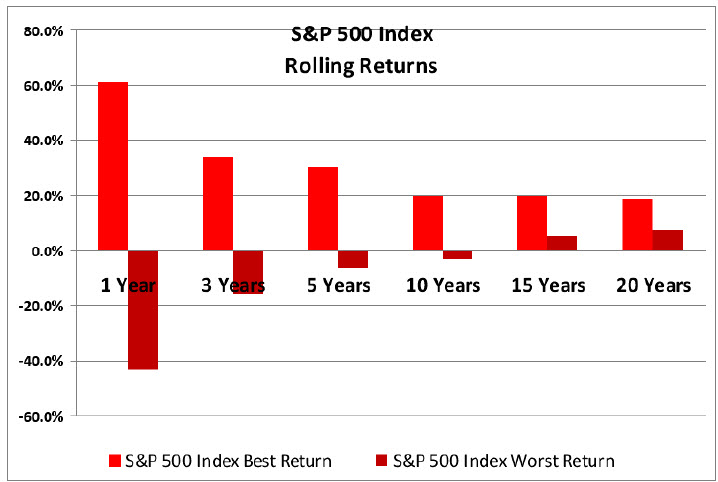
Based purely on U.S. data, the professional advisors seem to be getting the better of the debate, as you can see in the below chart, which shows rolling returns from 1973 through mid-2009.

dd342ee2-d38b-40ef-b622-583f11f0b02c

The outcomes in any one year have been frighteningly hard to predict, ranging anywhere from a 60% gain to a 40% loss. But if you hold that stock portfolio for three years, the best and worst are less dramatic than the best and worst returns over one year, and the returns are flattening out gradually over 10, 15 and 20 years. No 20-year time period in this study showed a negative annual rate of return.

But this is a fairly limited data set. What happens if you look at other countries and extend this research over longer time periods? This is exactly what David Blanchett at Morningstar, Michael Finke at Texas Tech University and Wade Pfau at the American College did in a new paper, as yet unpublished, which you can find here:
http://papers.ssrn.com/sol3/papers.cfm?abstract_id=2320828.

The authors examined real (inflation-adjusted) historical return patterns for stocks, bonds and cash in 20 industrialized countries, each over a 113-year time period. The sample size thus represents 2,260 return years, and the authors parsed the data by individual time periods and a variety of rolling time periods, which certainly expands the sample size beyond 87 years of U.S. market behavior.

What did they find? Looking at investors with different propensities for risk, they found that in general, people experienced less risk holding more stocks over longer time periods. The only exceptions were short periods of time for investors in Italy and Australia. The effect of time-dampened returns was particularly robust in the United Kingdom, Japan, Denmark, Austria, New Zealand, South Africa and the U.S.

Overall, the authors found that a timid investor with a long-term time horizon should increase his/her equity allocation by about 2.7% for each year of that time horizon, from whatever the optimal allocation would have been for one year. The adventurous investor with low risk aversion should raise equity allocation by 1.3% a year. If that sounds backwards, consider that the timid investor started out with a much lower stock allocation than the dare-devil investor–what the authors call the “intercept” of the Y axis where the slope begins.

Does that mean that returns in the future are guaranteed to follow this pattern? Of course not. But there seems to be some mechanism that brings security prices back to some kind of “normal” long-term return. It could be explained by the fact that investors tend to be more risk-averse when valuations (represented by the P/E ratios) are most attractive (when stocks, in other words, are on sale, but investors are smarting from recent market losses), and most tolerant of risk during the later stages of bull markets (when people are sitting on significant gains). In other words, market sentiment seems to view the future opportunity backwards.

Is it possible that stocks are not really fairly priced at all times, but instead are constantly fluctuating above and below some hard-to-discern “true” or “intrinsic” value, which is rising far more steadily below the waves? That underlying growth would represent the long-term geometric investment return, more or less–or, at least, it might have a relationship with it that is not well-explored. The old saw that stocks eventually return to their real values, that the market, long-term, is a weighing machine, might be valid after all.

If you have any questions about financial or investment planning and management, please don’t hesitate to contact us or visit our website at http://www.ydfs.com. We are a fee-only fiduciary financial planning firm that always puts your interests first.

What, We Worry?

So far this year, the investment markets have held up pretty well, which doesn’t always happen after a year of big returns like we experienced in 2013.  But based on experience, you know that something will spook investors at some point this year, the way the markets took a dive when Congress decided to choke off the U.S. federal budget, or when investors realized that Greece had somehow managed to borrow ten times more than it could possibly pay back to its bondholders.

Professional investors have learned to create a mental “watch list” of possible market-shaking events, and they were helped recently when Noriel Roubini, chairman of Roubini Global Economics, former Senior Economist for International Affairs at the U.S. Council of Economic Advisors, compiled his own worry list.  Roubini said that we’re past the time when people should be fearful of a breakup of the Eurozone, or (for now) any Congressional tinkering with the debt ceiling.  The public debt crisis in Japan seems to be fading in the optimism of Japanese Prime Minister Shinzo Abe’s monetary easing and fiscal expansion, and the war between Israel and Iran over Iranian nuclear technology, once thought to be imminent, now appears to be on the back burner.

So what does today’s worry list look like?  Roubini starts off with China, which is trying to shift its growth away from exports toward private consumption.  Chinese leaders, he says, tend to panic whenever China’s economic growth slows toward 7% a year, at which time they throw more money at capital investment and infrastructure, creating more bad assets, a lot of industrial capacity that nobody can use, and a bunch of commercial and industrial buildings which sit empty along the skyline.  By the end of next year, something will have to be done about the growing debt at the same time that investors face a potential crash in inflated real estate prices.  Think: five or six 2008 real estate crises piled on top of each other, all of it happening in one country.

Numbers two and three on Roubini’s worry list involve the U.S. Federal Reserve, which could (worry #2) cease its massive purchases of real estate mortgages and government bonds too quickly, causing interest rates to rise and sending financial shockwaves around the world.  Or, on the other hand (worry #3) the Fed might keep rates low for so long that the U.S. experiences new bubbles in real estate, stocks and credit–and then experiences the consequences when the bubbles burst.

Roubini also worries about emerging market nations being able to manage their debt and capital inflows if interest rates go up, and of course the situation in the Ukraine has significant market-spooking potential.  Finally, he notes that China has significant unresolved territorial disputes with Japan, Vietnam and the Philippines, which could escalate into military conflict.  If the U.S. were drawn into a maritime confrontation, alongside Japan, with Chinese warships, investors might think it’s a good time to retreat to the sidelines.

None of these scenarios are guaranteed to happen, and some of them seem unlikely.  But these periodic, headline-related spookings come with the investment territory.  If and when one of these events grabs the global headlines, it might be helpful to remember that the stock markets have weathered far worse and have always come out ahead.  Think: World War II, a presidential assassination, two wars in the Middle East, 9/11 and a Wall Street-created global economic meltdown.  If we can survive and even profit, long-term, from a stay-the-course investment mentality through those events, then we might be able to weather the next big headline on (or off) the worry list.

If you have any financial planning questions you would like to discuss, please don’t hesitate to contact us at (734) 447-5305 or visit our website athttp://www.ydfs.com. We are a fee-only fiduciary financial planning and money management firm that always puts your interests first. Our first consultation is complimentary and free of any pressure or sales pitches.

Enjoy your weekend,
Sam

Sam H. Fawaz CPA, CFP
YDream Financial Services

Source:
http://www.project-syndicate.org/commentary/nouriel-roubini-warns-that-even-as-many-threats-to-the-world-economy-have-receded–new-ones-have-quickly-emerged#TA08zJsftAXboy7Y.99

Retirement Spending Revisited

How much are you going to spend in retirement?  What once seemed like a simple question has become incredibly complicated in recent years.
 
Why?  First of all, a diminishing number of people actually plan to leave work and embrace leisure on a full-time basis, and those who do, seem to be doing it later than people from earlier generations.  Of the oldest baby boomers, who are now age 68, only 52% are actually retired;  21% are still working full-time.   According to a Gallup survey, 37% of Americans say they plan to work full-time past the age of 65, but that may be underestimating the actual shift in preference.  A 2012 survey conducted by Transamerica found that just 19% of workers expect to retire full-time by age 65.
 
When people DO leave the workplace, it now appears that some of the assumptions about their spending habits will have to be revisited.  The default assumption for many retirement plans is that what you spend now for things like food, clothing etc. will remain pretty much the same the day after retirement as they were the day before.  Your home mortgage may or may not go away in retirement and the expenses related to commuting to and from work will diminish.  When you sort it all out, you end up with a baseline spending plan, which includes a new car every few years, dining out occasionally, making home improvements and other basic necessities.  These expenses have traditionally been assumed to increase each year roughly with the inflation rate.
 
On top of that, it was assumed that in the vigorous early years of retirement, people would spend more on travel and country club memberships than they did when they were working, so their overall expenses would go up the day after they retire and gradually diminish as they found it harder and harder to play 18 holes of golf every day.  At some point in the age curve, health expenses would start to rise.  The people who study retirement expenditures talked about a “smile” graph of expenses, where it cost more to live and play in the earlier and later years of retirement than in the middle years.
 
What’s wrong with that?  For one thing, when you look at the Bureau of Labor Statistics data on what people actually spend in their later years, it contradicts this comfortable smile pattern.  People between the ages of 65 and 74 tended, on average, to increase their annual spending levels between 1.11 percentage points and 1.78 percentage points more per year more than the inflation rate.  Over that decade of their lives, any assumption that used the inflation rate would undercount their aggregate spending by somewhere between 11% and 19%.  People age 75 and older accelerated their actual spending to (again over the course of the next decade) between 13% and 22% more than the inflation statistics would suggest.  After that, healthcare costs would start to dominate the spending pattern.
 
To make things more complicated, the statistics suggest that retirees tend to cut back on their spending whenever the investment markets go down.  In 2009, people age 75 and older, on average, spent less than they did the year before, and they actually spent less than that in 2010.  That same year, the average spending of people age 65-75 declined a remarkable 3.55%.  As your wealth goes down, so too does your spending.
 
How can we predict these things in advance?  We can’t.  And it’s important to remember that these broad statistics don’t apply to your individual circumstances; they just suggest things that most of us should watch out for.  The only clear conclusion of the research, thus far, is that we should probably make conservative assumptions about spending, and hope we’re pleasantly surprised as the years go on.

If you have any questions about retirement spending or planning or would like to discuss your personal circumstances, please don’t hesitate to contact us, or go tohttp://www.ydfs.com.  We are a fiduciary fee-only financial planning firm that always puts your interests first.
 
Sources:
 
Retirement:
http://capricorn.bc.edu/agingandwork/database/browse/facts/fact_record/5670/all
 
Spending:
http://www.marketwatch.com/story/hedonic-pleasure-index-going-beyond-the-cpi-2013-01-23
 
http://www.advisorperspectives.com/newsletters12/47-fallacies2.php

Is myRA Your Next Retirement Plan?

Chances are, you’ve heard about the new myRA retirement savings program that was proposed by President Obama during his State of the Union speech.  But what is it, and how does it relate to the array of other retirement savings options you already have–including, of course, traditional and Roth IRAs, 401(k) or 403(b) plans?  Is this something you need to be looking at in addition to, or instead of one of these other options?
 
The new account, which is scheduled to be introduced later this year, will be offered to workers who currently don’t have access to any kind of retirement program through their employers.  Remarkably, this underserved population is actually about half of all workers, mostly those who work for small companies which have trouble affording the cost of creating and administering a 401(k) plan.  The idea is that a myRA would be so easy to install and implement (employers don’t have to administer the invested assets), and cost so little (virtually nothing), that all of these smaller companies would immediately give their employees this savings option.
 
Only some of the employees would be eligible, however.  Married couples earning more than $191,000, or singles earning more than $129,000, would be excluded from making myRA contributions.  And there is currently no law which says that employers would be required to offer these plans.
 
So the first thing to understand is that people who already have a retirement plan at work, or who earn more than the thresholds, shouldn’t give the myRA option a second thought.
 
Nor, frankly, would those people want to shift over to this option.  Why?  myRA functions much like a Roth IRA, which means that contributions are taxed before they go into the account just like the rest of a person’s salary, but the money will come out tax-free.
 
Anybody can make annual contributions to a Roth IRA; the 2014 maximum is $5,500 for persons under age 50; $6,500 if you’re 50 or older–and these are the same limits that will be imposed on the myRA.  BUT–and this is a big issue–the myRA is not really an investment account.  Any funds that are contributed to a myRA account earns interest from the federal government at the same rate that federal employees earn through the Thrift Savings Plan Government Securities Investment Fund–which is another way of saying that the money will be invested in government bonds.
 
Why does that matter?  Retirement accounts that invested solely in the stock market earned close to 30% from their stock investments last year.  The government bond investments that would have gone into a myRA earned 1.89% last year–which is below the inflation rate.  In real dollars, that was a losing investment.
 
Another big issue is the employer match.  Many workers who have a traditional 401(k) account get some of their contributions matched by their company, which effectively boosts their earnings.  myRA accounts will get no such match.
 
The Obama Administration clearly understands the difference between saving in a government bond account and actual investing.  Accordingly, there is a provision that whenever a myRA account reaches $15,000, it has to be rolled into a Roth IRA, where the money can be deployed in stocks, bonds or anywhere else the account holder chooses.  The program seems to be designed to encourage younger workers to start saving much earlier than they currently do.  Statistics show that the median retirement account for American workers age 25-32 is just $12,000, and 37% have less than $5,000. 
 
Will they be motivated to save when myRAs roll out at the end of the year?  Some commentators have noted that the money can be taken out of the account, for any reason, at any time, with no tax consequences.  That’s not a great formula for long-term savings.  But it does make the myRA account a convenient way for a worker just starting out to build up a cash reserve which could serve as a cushion against job loss or unexpected expenses like car repairs.  If it is not needed, the account could eventually grow into a retirement nest egg.
 
If you have any questions about the myRA or any other investment, retirement or financial planning matter, please don’t hesitate to ask.  We are a fee-only financial planning firm that always puts your interests first.