Shouldn’t gas prices be going up?

Iraq is one of the world’s largest oil producers, so when the ISIS militants rolled in from Syria and took over Iraq’s largest oil refinery, global oil traders and gas companies braced for a sharp spike in prices.  Consumers expected to see higher prices at the pump in short order.

Instead, oil and gasoline prices are lower than they were a year ago.  As you can see from the chart below, “regular” grade gasoline prices in different parts of the U.S. fell during the winter and have risen again in the summer months.  If you happen to live on the West Coast and suspected that you paid more for gas than the rest of the country, well, this chart confirms it; the prices in California and the West Coast generally are more than 50 cents a gallon higher than the cost at the pump along the Gulf Coast, where the U.S. has the bulk of its refineries.  People in the Northeast, Mid-Atlantic and Southern states generally fill up their tanks at cheaper prices.

If you want a longer-term view, review charts that show the cost of “regular” grade gasoline since 1990.  They show prices hovering around a dollar a gallon for most of the 1990s. (The good old days!)  Since then, the price has gradually crept upwards, with greater volatility and a deep price drop during the Great Recession.  Since the beginning of this decade, prices have remained fairly level, and indeed today’s gasoline prices are almost exactly what they were in early 2008.

Prices have held steady despite the turmoil in the Middle East, in part because most of the Iraqi oil fields are located in the southern part of the country, a safe distance (so far) from the ISIS insurgency.   The other main oil fields are located in Kurdish-controlled areas in the northern part of the country, and the Kurds have managed to protect their ethnic border with great effectiveness.  Add to that a recent agreement in Libya between the central government and a regional militia that will add 150,000 barrels a day to that country’s crude oil exports.

The moderation in prices, from $4.00 at the pump two years ago to roughly less than $3.00 today, is acting as a kind of stealth stimulus for the U.S. economy.  U.S. drivers are expected to use roughly 133 billion gallons of gasoline this year, so the price break adds $53 billion of savings to peoples’ balance sheets.  This, added to the lower costs for factories, airlines and electric power plants, could add half a percentage point to U.S. economic growth in 2014.

If you have any questions or concerns about financial planning or investment management, please don’t hesitate to contact us or visit our website at http://www.ydfs.com. We are a fee-only fiduciary financial planning firm that always puts your interests first.

Evidence for Time Diversification

One area where many professional advisors disagree with academics is whether stock investments tend to become less risky as you go out in time. Advisors say that the longer you hold stocks, the more the ups and downs tend to cancel each other out, so you end up with a smaller band of outcomes than you get in any one, two or five year period. Academics beg to disagree. They have argued that, just as it is possible to flip a coin and get 20 consecutive “heads” or “tails,” so too can an unlucky investor get a 20-year sequence of returns that crams together a series of difficult years into one unending parade of losses, something like 1917 (-18.62%), 2000 (-9.1%), 1907 (-24.21%), 2008 (-37.22%), 1876 (-14.15%), 1941 (-9.09%), 1974 (-26.95%), 1946 (-12.05%), 2002 (-22.27%), 1931 (-44.20%), 1940 (-8.91%), 1884 (-12.32%), 1920 (-13.95%), 1973 (-15.03%), 1903 (-17.09%), 1966 (-10.36%), 1930 (-22.72%), 2001 (-11.98%), 1893 (-18.79%), and 1957 (-9.30%).

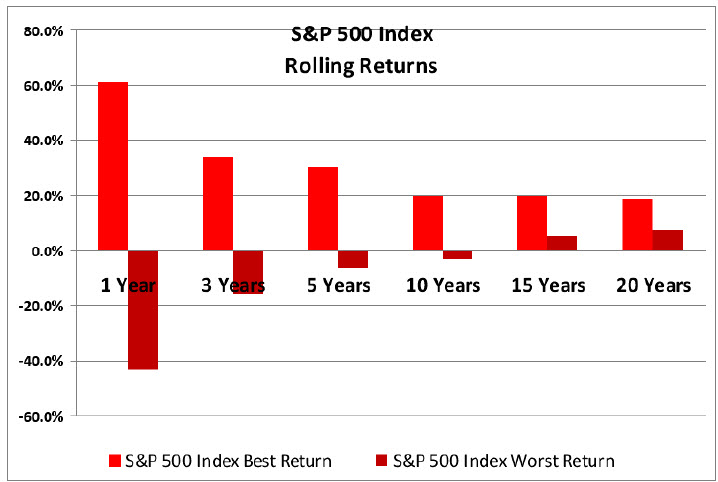
Based purely on U.S. data, the professional advisors seem to be getting the better of the debate, as you can see in the below chart, which shows rolling returns from 1973 through mid-2009.

dd342ee2-d38b-40ef-b622-583f11f0b02c

The outcomes in any one year have been frighteningly hard to predict, ranging anywhere from a 60% gain to a 40% loss. But if you hold that stock portfolio for three years, the best and worst are less dramatic than the best and worst returns over one year, and the returns are flattening out gradually over 10, 15 and 20 years. No 20-year time period in this study showed a negative annual rate of return.

But this is a fairly limited data set. What happens if you look at other countries and extend this research over longer time periods? This is exactly what David Blanchett at Morningstar, Michael Finke at Texas Tech University and Wade Pfau at the American College did in a new paper, as yet unpublished, which you can find here:
http://papers.ssrn.com/sol3/papers.cfm?abstract_id=2320828.

The authors examined real (inflation-adjusted) historical return patterns for stocks, bonds and cash in 20 industrialized countries, each over a 113-year time period. The sample size thus represents 2,260 return years, and the authors parsed the data by individual time periods and a variety of rolling time periods, which certainly expands the sample size beyond 87 years of U.S. market behavior.

What did they find? Looking at investors with different propensities for risk, they found that in general, people experienced less risk holding more stocks over longer time periods. The only exceptions were short periods of time for investors in Italy and Australia. The effect of time-dampened returns was particularly robust in the United Kingdom, Japan, Denmark, Austria, New Zealand, South Africa and the U.S.

Overall, the authors found that a timid investor with a long-term time horizon should increase his/her equity allocation by about 2.7% for each year of that time horizon, from whatever the optimal allocation would have been for one year. The adventurous investor with low risk aversion should raise equity allocation by 1.3% a year. If that sounds backwards, consider that the timid investor started out with a much lower stock allocation than the dare-devil investor–what the authors call the “intercept” of the Y axis where the slope begins.

Does that mean that returns in the future are guaranteed to follow this pattern? Of course not. But there seems to be some mechanism that brings security prices back to some kind of “normal” long-term return. It could be explained by the fact that investors tend to be more risk-averse when valuations (represented by the P/E ratios) are most attractive (when stocks, in other words, are on sale, but investors are smarting from recent market losses), and most tolerant of risk during the later stages of bull markets (when people are sitting on significant gains). In other words, market sentiment seems to view the future opportunity backwards.

Is it possible that stocks are not really fairly priced at all times, but instead are constantly fluctuating above and below some hard-to-discern “true” or “intrinsic” value, which is rising far more steadily below the waves? That underlying growth would represent the long-term geometric investment return, more or less–or, at least, it might have a relationship with it that is not well-explored. The old saw that stocks eventually return to their real values, that the market, long-term, is a weighing machine, might be valid after all.

If you have any questions about financial or investment planning and management, please don’t hesitate to contact us or visit our website at http://www.ydfs.com. We are a fee-only fiduciary financial planning firm that always puts your interests first.

What, We Worry?

So far this year, the investment markets have held up pretty well, which doesn’t always happen after a year of big returns like we experienced in 2013.  But based on experience, you know that something will spook investors at some point this year, the way the markets took a dive when Congress decided to choke off the U.S. federal budget, or when investors realized that Greece had somehow managed to borrow ten times more than it could possibly pay back to its bondholders.

Professional investors have learned to create a mental “watch list” of possible market-shaking events, and they were helped recently when Noriel Roubini, chairman of Roubini Global Economics, former Senior Economist for International Affairs at the U.S. Council of Economic Advisors, compiled his own worry list.  Roubini said that we’re past the time when people should be fearful of a breakup of the Eurozone, or (for now) any Congressional tinkering with the debt ceiling.  The public debt crisis in Japan seems to be fading in the optimism of Japanese Prime Minister Shinzo Abe’s monetary easing and fiscal expansion, and the war between Israel and Iran over Iranian nuclear technology, once thought to be imminent, now appears to be on the back burner.

So what does today’s worry list look like?  Roubini starts off with China, which is trying to shift its growth away from exports toward private consumption.  Chinese leaders, he says, tend to panic whenever China’s economic growth slows toward 7% a year, at which time they throw more money at capital investment and infrastructure, creating more bad assets, a lot of industrial capacity that nobody can use, and a bunch of commercial and industrial buildings which sit empty along the skyline.  By the end of next year, something will have to be done about the growing debt at the same time that investors face a potential crash in inflated real estate prices.  Think: five or six 2008 real estate crises piled on top of each other, all of it happening in one country.

Numbers two and three on Roubini’s worry list involve the U.S. Federal Reserve, which could (worry #2) cease its massive purchases of real estate mortgages and government bonds too quickly, causing interest rates to rise and sending financial shockwaves around the world.  Or, on the other hand (worry #3) the Fed might keep rates low for so long that the U.S. experiences new bubbles in real estate, stocks and credit–and then experiences the consequences when the bubbles burst.

Roubini also worries about emerging market nations being able to manage their debt and capital inflows if interest rates go up, and of course the situation in the Ukraine has significant market-spooking potential.  Finally, he notes that China has significant unresolved territorial disputes with Japan, Vietnam and the Philippines, which could escalate into military conflict.  If the U.S. were drawn into a maritime confrontation, alongside Japan, with Chinese warships, investors might think it’s a good time to retreat to the sidelines.

None of these scenarios are guaranteed to happen, and some of them seem unlikely.  But these periodic, headline-related spookings come with the investment territory.  If and when one of these events grabs the global headlines, it might be helpful to remember that the stock markets have weathered far worse and have always come out ahead.  Think: World War II, a presidential assassination, two wars in the Middle East, 9/11 and a Wall Street-created global economic meltdown.  If we can survive and even profit, long-term, from a stay-the-course investment mentality through those events, then we might be able to weather the next big headline on (or off) the worry list.

If you have any financial planning questions you would like to discuss, please don’t hesitate to contact us at (734) 447-5305 or visit our website athttp://www.ydfs.com. We are a fee-only fiduciary financial planning and money management firm that always puts your interests first. Our first consultation is complimentary and free of any pressure or sales pitches.

Enjoy your weekend,
Sam

Sam H. Fawaz CPA, CFP
YDream Financial Services

Source:
http://www.project-syndicate.org/commentary/nouriel-roubini-warns-that-even-as-many-threats-to-the-world-economy-have-receded–new-ones-have-quickly-emerged#TA08zJsftAXboy7Y.99

Are Daughters a Better “Investment?”

As Father’s Day has now passed for this year, a new survey from the online account aggregation firm Yodlee.com and Harris Interactive tells us that the financial relationship between fathers (and parents) can be very different for their sons vs. their daughters.  The survey found that an astonishing 75% of young adult men (age 18-34) are receiving financial aid from their parents, compared with 59% for comparable age daughters.  The financial dependency extends deep into adulthood; among sons aged 35-44, fully 32% are still living at home, while only 9% of women in that age bracket sleep in their former bedroom.  Even those numbers understate the disparity, because more than a third of the women who are living with their parents are doing so to support them in old age, something that sons are, according to the report, far less likely to do.
 
Overall, daughters are 32% less likely to need their parents’ money, and twice as likely to move back home because they’re unemployed.  By age 45, the survey found, most of these stark differences in financial independence have faded; sons lag only a few percentage points behind daughters in these two areas.  But then a new discrepancy emerges.  The survey found that older sons are half as likely as daughters to support their parents in old age. 

If you have any questions about any financial planning or money management services, please don’t hesitate to contact us or visit our web site athttp://www.ydfs.com. As a fee-only fiduciary financial planning firm, we always put your interests first, and there’s never a charge for an initial consultation or any sales pitches.
 
Sources:  

http://www.businessinsider.com/daughters-require-less-financial-support-2014-6
 
http://time.com/money/2861530/daughter-better-investment-than-son/

Expiring Tax Provisions: How You Probably WON’T Be Affected

Happy Thanksgiving! I hope that your families and you have an enjoyable holiday and (hopefully) extended weekend.

You may have read that the last day of 2013 is scheduled to be the last day for an estimated 57 different tax deductions–unless the U.S. Congress turns its attention away from the next potential government shutdown and extends some or all of them.  All of these deductions will be available to the 2013 tax return that you file by April 15.  But as it stands now, they won’t be available next year, creating another potential stealth tax increase in 2014.
 
How will this impact you?  Only a few of the 57 are relevant to you at all, unless you qualify for the American Samoa Economic Development Credit, the “special expensing” rules for film and television production, the mine rescue team training credit or special three-year depreciation for your race horses that happen to be two years or younger.
 
You probably do, however, claim deductions for state and local taxes, which expire at the end of the year, and people with kids and/or grandkids in college might miss the above-the-line deduction for tuition and related educational expenses.  Many Americans will be at least slightly affected by the loss of the deduction for mortgage insurance premiums, and some retired Americans over age 70 1/2 will be distressed to learn that they can no longer make tax-free distributions of up to $100,000 from an IRA account to their favorite charity.  School teachers will lose their classroom expense deductions of up to (a whopping) $250 for un-reimbursed expenses.
 
And thousands of homeowners whose homes are listing below what they paid for them should realize that, at the end of December, they will lose a provision that lets them exclude from their taxable income any reduction in their mortgage obligation (through debt modification or a short sale) up to a maximum of $2 million.
 
Other expiring tax breaks that may affect some people reading this:
 
-Enhanced tax breaks for people who donate property (or easements on their property) to the Nature Conservancy or a local land trust.
 
-Tax credits for the purchase of 2- or 3-wheeled electric vehicles and a separate credit of $7,500 for those who buy certain 4-wheeled electric vehicles like the Ford Focus Electric and the Nissan Leaf.
 
-A maximum $500 tax credit for making certain energy-efficiency improvements in your home (like adding insulation), plus other credits for constructing new energy-efficient homes and a credit for energy-efficient appliances.
 
The biggest expiring corporate tax break is the research and development tax credit.  At the end of the year, companies will also lose the additional first-year depreciation for 50% of the basis of qualified property.
 
In the past, Congress has allowed tax provisions to expire and then, retroactively, extended them for another year or two–and many tax observers believe this will almost certainly happen with the state/local tax deduction and corporate R&D tax credits, and quite possibly for the tuition tax credit as well. 

So when you read about the 57 expiring provisions, and you are not in the biodiesel fuel business (four expiring credits) or planning to claim the electricity production credit for building a renewable power plant, or actively mining coal on Indian lands, you shouldn’t get too worried.  Chances are you aren’t going to get hammered on next year’s taxes–and Congress may even get around to extending the provisions that you really care about, at the very last minute of course.

Whether you’re looking for year-end tax planning, financial planning or money management help, please get in touch with us for unbiased, fiduciary advice that always puts your interests first.

I welcome your feedback, questions and comments. Have a great long weekend!

Source: https://www.jct.gov/publications.html?func=startdown&id=4499


My thanks to Bob Veres, publisher of Inside Information, for his help with this post


Possible Consequences of the Government Shutdown & Default

It’s possible that you’ve heard a news report or two about the government shutdown  that started October 1, and now a dispute over raising the U.S. debt ceiling and possibly defaulting on the government’s debt obligations as soon asOctober 17.  The question for an increasingly nervous investing public is: how will this affect the U.S. economy and (not to be too selfish here) my retirement portfolio?
 
Interestingly, it is starting to look like the government shutdown, if it runs for weeks instead of months, might have almost no effect on the economy at all.  Why?  The economic impact that had economists worried was the loss of income suffered by tens of thousands of federal employees.  But the Defense Department has continued paying all of its civilian personnel, simply by declaring all of them “essential employees.”  Not only were the leaders of the House of Representatives not inclined to argue; they have quietly passed legislation that would give back-pay to all federal workers who have been furloughed, just as soon as the stalemate ends.  The Senate and the President are likely to go along, giving the country the worst of all worlds: paying most government employees for staying home and not providing a wide variety of services to the public.
 
Ironically, the way the politics are working, one can almost guarantee that there will continue to be a stock market selloff before the shutdown ends.  For the Republican leaders in the House, there is little cost to holding their ground so long as there is not a public outcry and loss of voter confidence.  One of the sources of that pain would be a big drop on Wall Street.  Indeed, if you listen closely to the speeches by President Obama and the Democratic leadership, you hear dire warnings of a market drop as a result of the shutdown–which is their way of focusing the public’s attention on who to blame as it happens. 
 
What is interesting about that is that the markets often deliver corrections after long, accelerating uptrends like what we have experienced in the U.S. since March of 2009, and with the 20+% returns that Wall Street has delivered so far this year.  It wouldn’t have surprised anyone to see some kind of a quick downturn this Fall regardless of whether the government was operating at full capacity or at a standstill.  A week of small leaks in stock prices could lead to something larger as people realize they are sitting on nice gains and have no idea what Congress will or won’t do next.  The last time the government was shut down, stocks dropped almost 20%, the Republican leadership realized it wasn’t winning any popularity contests and the stalemate ended.  We’ve seen this script before.
 
A more consequential issue is the debt ceiling.  Congress must raise the total amount that the U.S. government can borrow (by selling Treasury bonds) to pay its various obligations, including, of course, interest on its current Treasury bonds.  Contrary to popular belief, raising the debt ceiling does not increase the federal debt; that debt exists whether or not Congress authorizes additional borrowing.
 
Failure to authorize the government to pay its legal obligations would create a self-induced fiscal crisis–ironic for a country whose representatives claim that they never want to become another Greece, and then talk about voluntarily defaulting on the nation’s debt obligations, which even Greece has avoided. 
 
One recent article suggested that a default on Treasuries would ripple through the global economy, among other things, causing anxious investors to demand higher interest rates and dramatically raise U.S. borrowing costs.  That, in turn, would raise rates on mortgages, credit cards and student loans, pushing the U.S. toward or into recession, and putting pressure on the stock market.  One report suggests that if the U.S. misses just one interest payment, the downward impact on stock prices would be greater than the Lehman Brothers bankruptcy.  In THAT aftermath, the stock market lost more than half its value.
 
Bigger picture, a default would undermine the role of the U.S. in the world economy.
 
As I previously wrote, the irony of the debt ceiling debate is that the gap between government spending and tax revenues has been closing rapidly on its own.  In July, the Congressional Budget Office reported that the deficit had fallen by 37.6%, the result of tax increases and sequester-related cuts in spending.  As a percentage of America’s GDP, the deficit has fallen from more than 10% at the end of 2009 to somewhere around of 4% currently.  Last June, the government actually posted a surplus of $117 billion, paying down the overall deficit, and the Congressional Budget Office has projected that September will also bring government surpluses.
 
Most observers seem to think that all of this will get worked out.  After all, what rational person–in Congress or elsewhere–wants to self-impose these problems when we have plenty of economic challenges already?  The stock market’s relatively calm trading days tell us that investors expect a compromise on the government shutdown in the near future.  Nonetheless, it may take a sharp day of selling to prod Congress off the dime.  Foreign investors are still lending to the U.S. government at astonishingly low interest rates (despite modest increases over the past week), which tells us they aren’t worried about a default.
 
The previous times we went through events similar to this, the stock market plunges proved to be buying opportunities for investors.  One of the great things about uncertainty and volatility is that it causes investments to periodically go on sale, and creates such anxiety that only disciplined (and perhaps brave) investors are able to take advantage.  There’s no reason to think this won’t be more of the same.

Sources:
 
http://www.washingtonpost.com/blogs/wonkblog/wp/2013/10/06/maybe-the-government-shutdown-wont-clobber-the-economy-after-all/
 
http://www.cbsnews.com/8301-505123_162-57606253/debt-ceiling-understanding-whats-at-stake/
 
http://krugman.blogs.nytimes.com/2013/08/13/what-people-dont-know-about-the-deficit/
 
http://www.moneynews.com/newswidget/default-Catastrophe-lehman-demise/2013/10/07/id/529564?promo_code=125A8-1&utm_source=125A8Moneynews_Home&utm_medium=nmwidget&utm_campaign=widgetphase1


My thanks to Bob Veres of Inside Information for his help with this post

The Value of Education

Now that college graduation exercises are upon us, you are no doubt hearing reports that young people matriculating from this or that prestigious alma mater are having trouble finding jobs.  The easy conclusion seems to be that a college degree doesn’t matter very much anymore in the new economy.  But that, of course, is a short-term view; younger people have fewer job-related skills than people who have been employed for a few years, so they generally have trouble getting that first job no matter what their education level.

You can see this in the first chart below; older workers, who have presumably more experience in the workplace, tend to have lower unemployment rates than their younger competition.  A recession like 2008-2009 simply reinforced a long-term pattern; it made the jobs situation worse for everybody.  Today’s difficult job market continues to allow employers to put a premium on experience.

Longer-term, however, a college degree does seem to confer huge advantages for getting employment.  Consider the most recent jobless statistics, broken down by education level:

Jobless rate for persons who have not earned a high school degree:  11.6%

Jobless rate for high school graduates with no college training: 7.4%

Jobless rate for persons with some college training or an associate degree: 6.4%

Jobless rate for persons who have earned a bachelor’s degree or higher: 3.9%

Longer-term, as you can see from the second chart below, people who are educated at every level tend to be less likely to be unemployed than those with lower educational attainment.  The better-educated also tend to earn higher incomes over their lifetimes–the most recent statistics compiled by the Pew Research Center suggests that the average high school graduate with no further education will earn about $770,000 over a 40-year worklife, compared with $1.4 million for a worker with a bachelor’s degree.

Image

Parents reading this article, and graduates who are paying off enormous student loans, are no doubt wondering whether Pew was able to factor in the upfront costs of getting the college degree, plus the opportunity cost of four years (or more) spent on campus rather than in the workforce.  Even when these considerable costs are factored in, the net gain for a student who graduated from an in-state four-year public university is about $550,000 over a person’s worklife.  The third chart shows the various disparities in yearly earnings at different ages; you can see that at age 25, the differences are not huge, but over time, college education begins to create significant income separation.

Image

Bottom line?  Ignore the gloomy reports of college graduates having trouble finding work. This has always been a problem, admittedly made worse by today’s weak job market, but not an indictment of the value of a college education.  Education, as George Washington Carver once remarked, is still the golden key that unlocks the doors of opportunity.

Sources:

http://www.pewresearch.org/daily-number/the-monetary-value-of-a-college-education/

http://www.pewsocialtrends.org/2011/05/15/is-college-worth-it/6/#chapter-5-the-monetary-value-of-a-college-education?src=prc-number

TheMoneyGeek thanks Bob Veres, publisher of Inside Information for this guest post.

How to Choose a Financial Advisor

You know the importance of saving for retirement, but do you have the time and know-how to accomplish your financial goals? In an increasingly busy world, it’s possible that keeping close tabs on your investment accounts isn’t exactly realistic.

Seeking the help of financial professionals has become more important to investors according to a recent survey conducted by Harris Interactive on behalf of TD Ameritrade Holding Corporation, as nearly one quarter (22 percent) of investors report relying more on a professional investment advisor following the recession.

Even if you have a good handle on your investments, you may find that hiring a financial advisor — who can put the time and energy into making sure you and your family plan for a secure financial future — may be a worthwhile investment. By hiring an independent registered investment advisor — commonly referred to as an RIA — you can make sure your investments are managed on a full-time basis by a professional advisor, while still having control.

Of course deciding to put someone in charge of your hard-earned money is not a process to be taken lightly.  Our preferred custodian, TD Ameritrade,  and we offer these tips to consider as you choose an independent financial advisor or RIA:

* Just as it is wise to do research on the background of anyone who would take care of your children, you should investigate the person or company you enlist to handle your money. The Securities and Exchange Commission, Inc. (www.adviserinfo.sec.gov), Financial Industry Regulatory Authority (www.finra.org), Certified Financial Planner Board of Standards (www.cfp.net), National Association of Personal Financial Advisors (findanadvisor.napfa.org/Home.aspx), and Financial Planning Association (http://www.fpanet.org/PlannerSearch/PlannerSearch.aspx), as well as your own state securities agency all collect background information on financial professionals that can be accessed through their websites. Use these sites to make sure the advisors you are considering haven’t faced disciplinary action for dishonest practices and are in good standing with regulators.

* Know the difference between working with an independent RIA and a stock broker, or other financial services provider. Independent RIAs, for example, are bound by law to act in their clients’ best interest. Brokers, on the other hand, are held to a “suitability” standard, meaning the advice they give must be suitable to that client’s situation. If you are looking for objective, comprehensive money management, you might want to consider an RIA.

* While RIAs are required by law to act in your best interest, there are other ways that you can ensure they will do what is best for you. One is to ask how they are compensated. Fee-only compensation generally minimizes conflicts of interest and means that your advisor is paid only for the management services and advice he or she offers, and only by you, not by investment product providers. When an advisor is paid on commission, there’s a greater chance he or she will make choices with your money that serve not only your interests, but their own as well. That’s not to say that advisors do not work fairly under this model, but potential conflicts of interest are something to consider as you choose an advisor.

* When looking for referrals from friends or relatives, the most valuable referrals may come from those in similar situations. It’s also a good idea to ask potential advisors if they specialize in working with certain types of clients and choose one that fits your unique profile.

* A third party custodian should also handle all your deposits, to ensure checks and balances. An independent custodian like TD Ameritrade can help ensure the safety and security of your assets, and will provide you with a clear, concise statement every month. A duplicate monthly statement is also sent to your advisor. Make sure this is also a legitimate and upstanding business.

Working with a trusted independent fee-only RIA can help you realize your financial goals, while allowing you to spend less time worrying about and managing your investments. If you need help and would like to talk to a fee-only planner with no sales pressure, cost  or obligation, please visit our web site at http://www.ydfs.com or call YDream Financial Services, Inc. at (615) 395-2010 or (734) 447-5305.

What’s Going on With the Markets-March 10, 2011

Since the beginning of last September, the stock markets have enjoyed a nearly uninterrupted bull uptrend which has been unprecedented in market history.  Fueled by improving economics and Federal Reserve actions, the uptrend has withstood many geopolitical, fiscal and news driven setbacks.  But today the political unrest in the Middle East, issues with Spanish debt repayment and a higher than expected weekly first-time unemployment claim number (497,000) were the 1-2-3 punch that the markets could not recover from and therefore we suffered a 1.5-2.5% setback.  Be it stocks, gold, silver or oil today, they were all down today.

Normally, up-trending bull markets such as the one we’re in take rest periods, or “corrections” as they’re called, every couple of months while individuals and institutions take profits on stock positions and reset stock prices back to normal levels. Corrections (usually 10-20% of an index value such as the S&P 500) are healthy for the market and while uncomfortable if you watch them unfold from day to day, allow the markets to set up for the next leg up.  Two years to the day yesterday into this bull run have seen us move up about 100% from the March 9, 2009 lows on the S&P 500 index. Without a doubt, this has been an incredible run and I hope you’ve been participating.

As I’ve discussed with clients and prospects recently, a correction in the market has been long overdue and anticipated.  While today was the first big down day where we really tested key levels in the indexes, there have been several signs of exhaustion in the market. Despite this, I cannot say with certainty whether we’ve definitively entered into a correction period (technically we have, but it needs to be confirmed with follow-through on Friday and next week.)  If the bulls get their act together tomorrow and “rescue” the market by pushing it back up through heavy volume buying, then this decline may be “all she wrote.”  If not, we could head down to test the 1275 level of the S&P 500 index (we closed at 1295 today).  A failure to hold the 1275 level means that large institutions have decided to continue selling and a drop to 1240 may need to exhaust sellers.

With the “Day of Rage” demonstrations scheduled for Friday in Saudi Arabia, rocketing oil prices and sovereign debt issues, the odds of avoiding a deeper correction are not very high.  Besides, this correction is long overdue and may occur regardless of how peacefully the Middle East situation is resolved or even if oil prices come back down to earth.

What do I think? As I’ve mentioned before, the Federal Reserve has made investing in anything but the stock market earn near zero returns. That is, the government wants us to buy equities, push the stock market (and IRA’s and 401(k)’s) higher, to make us feel richer and more confident and therefore spend more.  Spending more creates demand which in turn creates jobs and so on.  So I believe that the gentle (if somewhat invisible) hand will come in to help support the market and avoid a protracted decline that might scare off the latest entrants into the market. While my crystal ball is still in the shop, I believe that a decline beyond 1275 in the S&P 500 (another 1.5%) is a stretch.  While that would make it a very shallow correction, it may be enough to breathe new life into the stock market and help resume the uptrend.

So what should you do now in light of a possible correction?  Basically, you shouldn’t do much if anything since nothing is confirmed.  If you’re investing on your own, trying to time your “in’s and out’s” of the markets is nearly impossible and not recommended unless you’re an experienced trader.  If you have a profitable position and worry about it turning into a loss, you may decide to sell a portion or all of it.  More savvy investors may be able to hedge their positions with options or inverse ETF’s if the decline proves to be protracted.  From our end for our clients, I’m watching the market technical levels on a daily basis like a hawk and already have begun to harvest some profits and protect some positions. If a protracted downturn does materialize, I may also hedge portfolios with inverse ETF’s and selectively liquidate partial positions.  But we’re not there yet and I’m not making any recommendations.  And by no means do I think we’re entering another bear market (by definition, a bear market begins when we decline 20% from the last peak in a major index).  Non-clients should consult their current advisor (or me) if you’re unsure what to do in the event of a protracted decline and should not treat this as a recommendation to buy or sell anything (see disclaimer below).

Last year we declined nearly 15% from May through August amid sovereign debt worries and economic uncertainty and then proceeded to push up nearly 25% over the next six months. I still believe that we will end 2011 with double-digit gains in the markets as this economy matures from recovery to expansion.  All economic indicators point positively and last month we even added nearly 200,000 new jobs.  We may even see housing perk up a bit later this year.  Without a doubt, sustained oil prices above $125 per barrel and $4 gasoline for an extended period (6 months or more), will put a crimp into the expansion, but I don’t believe we’re heading for a long term spike in oil prices.  Let’s just say that the oil producing countries learned what supply constraints and speculation did to oil demand the last time oil spiked to $145 a barrel. More electric and hybrid cars is just one example of how we are learning to live with less demand for foreign oil.

I hope this message helps alleviate any anxiety over the recent down days in the market.  Remember that the media loves good negative stories to help sell newspapers and advertising. Avoid the noise and try to keep your sanity during the days when it seems like there’s always something bad going on in the world.  Middle Eastern concerns have been a worry for decades, if not centuries now, and likely won’t be resolved during our lifetimes.  Like every other world incident, the markets get back to normal and we get through them.

Enjoy the upcoming weekend and don’t hesitate to contact me if I can be of any help.  If you’re not a client, your consultation with me is complimentary, no-pressure and with no obligation.  I’d love to talk to you whether or not you’re considering hiring a financial planner or money manager.

Sam H. Fawaz CFP®, CPA is president of YDream Financial Services, Inc., a registered investment advisor. Sam is a Certified Financial Planner (CFP®), Certified Public Accountant and registered member of the National Association of Personal Financial Advisors (NAPFA) fee-only financial planner group.  Sam has expertise in many areas of personal finance and wealth management and has always been fascinated with the role of money in society.  Helping others prosper and succeed has been Sam’s mission since he decided to dedicate his life to financial planning.  He specializes in entrepreneurs, professionals, company executives and their families.

All material presented herein is believed to be reliable, but we cannot attest to its accuracy.  Investment recommendations may change and readers are urged to check with their investment advisors before making any investment decisions.  Opinions expressed in this writing by Sam H. Fawaz are his own, may change without prior notice and should not be relied upon as a basis for making investment or planning decisions.  No person can accurately forecast or call a market top or bottom, so forward looking statements should be discounted and not relied upon as a basis for investing or trading decisions. This message was authored by Sam H. Fawaz CPA, CFP and is provided by YDream Financial Services, Inc.

My no-nonsense no-spam policy: If you’d prefer not to receive future updates, just reply and let me know by typing “unsubscribe” in the subject (please don’t hit the spam button-it just puts me on a universal spammer’s list which is tough to get off of.)I’ll take you off my list immediately and permanently.  I will never sell, share, rent or give away your e-mail address to anyone.  Period.

Market Update-Week Ended March 27, 2010

The stock markets have been enjoying several weeks of continued gains after a market correction that ended around mid-February.  Corporate earnings have been stellar, mostly on a net income basis, but many have also enjoyed sales growth as well, albeit from a low (2009) base.

We’ve had stock market indices that have run up to 18 month highs and we came within 100 points of 11,000 on the Dow Jones Industrial Average this week.  Down days in the market have been only very mildly down as investors enjoy more confidence that the economy is slowly improving and that the possibility of a double-dip recession this year is nil.  This has all happened despite bad news from Europe relating to Greece’s possible default on their sovereign debt, Fitch’s downgrade of Portugal’s sovereign debt, passage of “Obama Care”, poor sales of U.S. Treasury bills, record federal deficits, and still dismal (though improving) unemployment figures.  The news that a South Korean Navy ship experienced an explosion yesterday barely made the markets blink.  High inflation is currently nowhere in sight, though it’s a certainty that it will be here before we know it.

With any long string of stock market gains (with only minor down days) comes the inevitable correction in the market. During the latter part of this week, days that were up for the most part suffered downside reversals and profit-taking towards the end of the day.  This could be a sign of another correction coming (perhaps in the range of 5-10%), portfolio managers adjusting their quarter-end books, or just traders preparing for a week or so off for the Easter holiday.  Dwindling stock market volume certainly would indicate that many are planning some time off.  A correction would be healthy for the market, and would give those still sitting on the sidelines or mostly invested in bonds an opportunity to jump back into the stock market at a lower price.  Stories are abound about $3 trillion still on the sidelines in money market accounts earning less than 1-2% interest or invested in low-risk short-term bond funds.  I personally still believe that we will enjoy returns this year in the low to mid-teens while gross domestic product (GDP) growth will be in the 3-4% range, which is historically low.

Next Friday April 2nd, while the stock markets are closed (the bond markets are open), unemployment figures for March 2010 will be reported and they’re expected to show actual job growth for the first time since early to mid-2008.  The boost will be partially attributable to the hiring of census workers, though employers, who are enjoying record productivity levels, have been increasingly hiring temporary workers and will have no choice but to make permanent hires soon, as the existing workforce grows exhausted from one person doing the work previously done by two people.  Even General Motors announced this week that it is recalling 700 workers to its plant in Ontario Canada and plans to hire 60-70 new workers.  The employment trend is definitely in the up direction, but the speed is still at a snail’s pace.  For the unemployed, the pace is understandably far too slow.

For those taking some time off for spring break and the Easter holiday week (post or pre), I hope you enjoy your time off and have good weather wherever you go.   To all who have to work, enjoy a great holiday nonetheless.

I welcome your comments and feedback. If you have any questions, please feel free to get in touch with me and be sure to share this post with your friends and colleagues.  And please be sure to let them know about me if you think that they might benefit from my services.  As a CFP® and NAPFA registered investment advisor, we have a fiduciary responsibility to always put your interest ahead of ours and avoid conflicts of interest.  Most brokers and advisors cannot say this nor do they adhere to this very high standard of care.

A summary of the week’s market results :

Market Update For Week Ending 3/26/2010

Index Close Net Change % Change YTD YTD %
DJIA 10,850.36 +108.38 1.01 +422.31 4.05
NASDAQ 2,395.13 +20.72 0.87 +125.98 5.55
S&P500 1,166.59 +6.69 0.58 +51.49 4.62
Russell 2000 678.97 +5.08 0.75 +53.58 8.57
International 1,572.26 +0.17 0.01 -8.53 -0.54
10-year bond 3.86% +0.17% +0.05%
30-year T-bond 4.75% +0.17% +0.06%

International index is MSCI EAFE index. Bond data reflect net change in yield, not price. Indices are unmanaged and you cannot directly invest in an index.

Sam H. Fawaz CFP®, CPA is president of YDream Financial Services, Inc., a registered investment advisor. Sam is a Certified Financial Planner ( CFP ), Certified Public Accountant and registered member of the National Association of Personal Financial Advisors (NAPFA) fee-only financial planner group.  Sam has expertise in many areas of personal finance and wealth management and has always been fascinated with the role of money in society.  Helping others prosper and succeed has been Sam’s mission since he decided to dedicate his life to financial planning.  He specializes in entrepreneurs, professionals, company executives and their families.

All material presented herein is believed to be reliable, but we cannot attest to its accuracy.  Investment recommendations may change and readers are urged to check with their investment advisors before making any investment decisions.  Opinions expressed in this writing by Sam H. Fawaz are his own, may change without prior notice and should not be relied upon as a basis for making investment or planning decisions.  No person can accurately forecast or call a market top or bottom, so forward looking statements should be discounted and not relied upon as a basis for investing or trading decisions. This message was authored by Sam H. Fawaz CPA, CFP and is provided by YDream Financial Services, Inc.