What’s Going on in the Markets October 31, 2023

With so many global crosscurrents–another Middle East war, an uneven economy, stubborn inflation, and high interest rates, it’s no surprise that many will be happy to forget about October 2023. While nothing weighs as heavily as the horrific tragedies of the war in the Middle East, the stock markets saw their third consecutive down month after a terrific run up from the October 2022 bottom. Let’s look at what’s weighing on the markets and what might be ahead.

Stubborn Inflation

Over the past year, I’ve expected inflation to retreat from its historically high level. But I’ve also stated in past writings that inflation pressures would be more stubborn than many on Wall Street believed.

After easing to 3.0%, the Consumer Price Index (CPI) has increased for three consecutive months and is now at 3.7%. Furthermore, measures of underlying inflation have started to reaccelerate.

In the latest Personal Income and Outlays reports, inflation showed an unwillingness to continue its recent descent. On Friday, October 27, the Personal Consumption Expenditures (PCE) for September showed inflation up 0.3% monthly (3.7% annualized). The PCE is the Federal Reserve’s (AKA The Fed) preferred measure of inflation.

While both inflation numbers are much improved over the 5%+ rates we saw earlier this year and last, they are a far cry from the Federal Reserve’s 2% annual inflation target.

Sticky Price CPI, which measures prices that are slower to change, like medical care, education, and housing, has resumed its increase. The annualized 3-month rate of change has shot up from 3.4% in July to over 4.4% last month. This is one of its highest readings of the past three decades outside of the post-pandemic surge. This suggests The Fed may have trouble getting inflation back to its 2% target.

Inflation measures are important not only because they erode the buying power of our dollars but also because they affect consumer sentiment, and sentiment influences consumer spending. Unhappy or non-confident consumers spend less, and less consumer spending can lead to an economic recession (which does not help keep stock prices up.)

High Interest Rates

To control inflation, The Fed adjusts short-term interest rates to cool consumer and business spending. The thinking is that higher interest rates discourage borrowing, which leads to lower demand, and lower demand presumably tends to portend lower prices.

The Federal Reserve meets about every six weeks to decide whether it will raise, lower, or hold short-term interest rates, considering various economic reports and factors. The last time they met was in September when they held short-term interest rates at 5.0%-5.25%.

In a meeting that concludes on Wednesday, November 1, they are widely expected to continue holding rates at this level. Many will listen to Federal Reserve Chairman Jerome Powell’s comments to assess the prospect of future higher or lower short-term interest rates. I think they’re done hiking rates but won’t hint at any rate reductions, which Wall Street is looking for.

The good news is that higher interest rates mean that cash is no longer “trash.” You can earn a 4.5%-5.5%+ return on your money market savings, CDs, and bonds. The bad news is that higher interest rates mean lower bond prices and may lead to an unprecedented 3rd consecutive year of bond price declines (interest rates and bond prices are inversely correlated). In addition, higher interest rates on cash and bonds mean less of an urgency to take risks in the stock market, especially if one can get 5%-6% risk-free (no doubt that this sentiment has contributed to the pullback in the stock market over the last few months.)

Faltering Housing

Housing is one of the largest sources of wealth for consumers and a vital industry for the economy’s health.

New Home Sales increased in September as homebuilders offered price-cut incentives and mortgage rate buydowns to attract buyers. Pending Home Sales, which tracks unclosed transactions of existing homes, ticked up in September but remained at the third lowest reading in its history.

Like consumer and business sentiment, homebuilder confidence is a crucial indicator to follow. It takes the pulse of current attitudes and can be an excellent predictor of future housing activity. Despite its rebound in the first half of the year, the National Association of Home Builders (NAHB) Housing Market Index (Builder Confidence Survey) is again falling. Today’s low confidence levels indicate a much weaker outlook and reflect the effects of rapidly rising interest rates.

Today’s mortgage rates are at a 23-year high and heading toward 8.0%. This is a staggering increase of almost five percentage points since its record low in early 2021 and the second-quickest rise in history. The only faster increase in mortgage rates occurred in the early 1980s – a move only marginally steeper than today’s. Predictably, this has a significant impact on housing affordability.

Current multi-decade-high mortgage rates would be much more digestible to homebuyers if home prices weren’t still in a bubble. Unfortunately for them, prices have hardly budged. Home prices have surged by nearly 60% over the past five years, putting a significant strain on affordability. This problem has been exacerbated by rising mortgage rates, causing the average mortgage payment to increase by 134% since early 2018. And this doesn’t even include the increases in property taxes, insurance, repairs, maintenance, dues, etc. As a result, this is perhaps the most unaffordable time in U.S. history to buy a home.

Cooling Sentiment

Consumer and Business Sentiments are crucial to watch as their recent rebounds seem to be running out of steam. As mentioned above, consumer sentiment is essential to encourage spending and keep the economy “humming.” Small business sentiment is important because it encourages hiring, capital investments, and expansion. There are several surveys and measures of consumer and business sentiment, including widely followed surveys by the Conference Board and the University of Michigan.

October’s preliminary consumer sentiment readings plunged by more than forecast and were well below their 70-year average. Both Current Conditions and Future Expectations were down significantly. Inflation Expectations for the year ahead rose by 0.6 percentage points while expected business conditions for the next year dropped by 19%.

The latest and final October consumer sentiment readings from the University of Michigan finished October at 0.8 points higher than its preliminary reading yet is 4.1 points below September’s final reading. A significant reason for the decline in Consumer Sentiment this month was a rebound in consumers’ inflation expectations for the year ahead, which jumped from 3.2% to 4.2%.

The National Federation of Independent Businesses (NFIB) Small Business Optimism Index has been below its 49-year average for the last 21 months. Among small business owners, significant concerns remain regarding inflation, labor availability, and future economic conditions. As small businesses often need capital to grow, they are the most affected by high interest rates, and it is no surprise they are worried about the future.

I’m concerned about business and consumer sentiment because the readings I’m seeing have rarely occurred outside of an oncoming recession. Business owners are struggling, and there are signs that strong consumers are starting to tighten their belts.

Another Middle East War

As the horrific events in the Middle East continue to develop and command the attention of the world, economic issues may seem relatively unimportant. However, the Israel-Hamas conflict creates geopolitical risks with potential global economic consequences, and it may be helpful to consider early projections and analysis of how these consequences might unfold.

Any impact comes when the global economy is fragile, already strained by the ongoing Ukraine-Russia war, and facing challenges such as weak growth, economic fragmentation, high interest rates, and stubborn inflation.

On the other hand, the U.S. economy appears relatively strong by many measures, and the United States is the world’s largest oil producer and thus relatively insulated from small shifts in the global oil supply that usually occur during wartime.

While U.S. military support of Israel will add to expenditures that have already been increased by the Ukraine war, U.S. Treasury Secretary Janet Yellen has indicated that the United States can support both allies. Of course, that will lead to even more inflation, causing spending deficits.

Many U.S. technology companies have production or research and development facilities in Israel. However, work in those facilities is expected to continue except for employees called for reserve duty.

So far, the U.S. stock market reaction to the war has been relatively muted. Historically, wars outside U.S. borders tend not to create lasting trouble for the domestic stock market.

Clearly, it is still early, and the economic situation can change anytime. For now, while the Israel-Hamas conflict is a tragic humanitarian crisis, it is not a reason to change your personal financial or investing strategy.

Wobbling Stock Markets

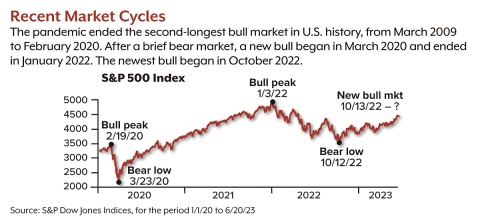
October has been living up to its reputation for being a volatile month in the stock markets and closing down for the third consecutive month (-2.2%). The S&P 500 index is down over 9% from the peak in July 2023. However, we are entering a seasonally favorable time of year in the markets. November to December tend to be stronger months of the year, but as a pre-election year, it has even more favorable seasonality. Finally, when the market is so strong as it was through July, historically, it has also portended a nice finish to the year.

But given the headwinds just discussed, any year-end rally could fail to meet expectations or, worse, not materialize.

There is a continuing debate about whether the October 2022 lows ended the bear (down trending) market that started in January 2022. Some assert that a new bull (up-trending) market was born and that we are in the early innings of an upward trend, the start of a new bull market. Others assert that the bear market is intact, and all that we’ve witnessed since October 2022 was an extended bear market rally, which is now over. Only in the fullness of time can we know which camp is right.

The bears will point out that it is unprecedented to have a 10% correction in the first year of a bull market. It’s also unusual to see small capitalization stocks struggle so much in the early stages of a new bull market. In fact, the small caps are down for the year and are at risk of undercutting their October 2022 lows. Thus, the outsized correction and narrowness of the rally from the October 2022 bottom gives me food for thought and leaves me a bit skeptical that we’re in a new bull market.

Currently, on the surface, the S&P 500 is up about 9.2% year to date. But if you take away the seven strongest tech stocks in the index, AKA the Magnificent Seven (Apple, Amazon, Meta, Microsoft, Microsoft, Nvidia, Tesla), the index would be only up slightly on the year. In fact, if you look at the equal-weighted S&P 500 index (where each stock gets an equal “vote” rather than being weighted by size), it is down 4.1% year-to-date. Clearly, most stocks are not participating in the “new bull market.”

By all accounts, so far, third quarter 2023 corporate earnings are strong and beating expectations, though revenue growth is somewhat tepid. Much of the earnings growth comes from higher profit margins, meaning that cost savings are the primary driver of higher earnings, not strong and improving consumer demand.

Until seasonality asserts itself and strength re-emerges in the stock market, I believe caution and defensiveness are warranted for short-term investors. For long-term investors, this may be a time to pick some favorite positions you plan to keep for 3-5 years or longer. While this is not a recommendation to buy or sell any securities, this is when taking advantage of a stock market sale works in the long term. For our client portfolios, we remain hedged and recently slightly reduced our exposure to stocks, considering the risks discussed above.

Recession or No Recession?

When it comes to economic recessions, it’s a matter of when not if. So, while pundits continue to debate whether we’ll have a soft landing (no recession) or a hard landing (recession), they both might be right—just at different times.

The last recession we had in 2020, post-COVID, was short-lived thanks to the extraordinary fiscal and monetary stimulus unleashed on the economy back then. This, in my opinion, has contributed to the inflation hangover we’re now experiencing. Pass the aspirin, please!

In my opinion, despite a still strong job market and robust consumer spending to date, the weight of evidence points to several areas of gradual deterioration in the economy that will lead to a recession by mid-2024. Admittedly, I thought we’d be in a recession with much lower housing prices by now. But I obviously underestimated the strength and durability of the consumer with wallets full of cash and credit cards looking to spend after an awful and extended COVID lockdown. And I clearly did not anticipate how fast mortgage interest rates would rise, taking existing homeowners with low-interest-rate mortgages out of the housing market and making the supply of homes as tight as it is.

Today, we have a federal reserve intent on taming inflation, so interest rates will be higher for longer, which is not stock-market friendly. While many might not dump their existing stocks in this new high-interest rate environment, they might not be as willing to take on more risk in a world where 5%-6% returns come “risk-free.” And while a stock market buyer’s strike might not be as bad as all-out selling, it certainly doesn’t help stock prices rise to the level of a new bull market.

If you would like to review your current investment portfolio or discuss any other financial planning matters, please don’t hesitate to contact us or visit our website at http://www.ydfs.com. We are a fee-only fiduciary financial planning firm that always puts your interests first.  If you are not a client yet, an initial consultation is complimentary and there is never any pressure or hidden sales pitch. We start with a specific assessment of your personal situation. There is no rush and no cookie-cutter approach. Each client is different, and so are your financial plan and investment objectives.

Source: InvesTech Research
Should the Government Shut Up or Shut Down?

As September ends, the U.S. government seems headed for a shutdown, which would begin on October 1st. Although it is possible that a last-minute agreement could keep the lights on, that becomes less likely with each passing day. With all the nonsense that comes from Washington, would we rather have our government shut up rather than shut down?

Regardless, here’s a look at the federal funding process, the current situation in Congress, and the potential consequences of a failure to fund government operations.

Twelve appropriations bills

The federal fiscal year begins on October 1, and under normal procedures, 12 appropriations bills for various government sectors should be passed by that date to fund activities ranging from defense and national park operations to food safety and salaries for federal employees.

These appropriations are considered discretionary spending, meaning that Congress has flexibility in setting the amounts.  Although discretionary spending is an ongoing source of conflict, it accounted for only 27% of federal spending in fiscal year (FY) 2023, and almost half of that was for defense, which is typically less of a point of conflict. Mandatory spending (including Social Security and Medicare), which is required by law, accounted for about 63%, and interest on the federal debt accounted for 10%.1

Obviously, it would be helpful for federal agencies to know their operating budgets in advance of the fiscal year, but all 12 appropriations bills have not been passed before October 1 since FY 1997. In 11 of the last 13 years, lawmakers have not passed a single spending bill in time.2 That is the situation as of September 27 this year (although, one bill, to fund military construction and the Department of Veterans Affairs, has been passed by the House but not the Senate.)3

Continuing resolutions and omnibus spending bills

To buy time for further budget negotiations, Congress typically passes a continuing resolution, which extends federal spending to a specific date, generally at or based on the same level as the previous year. These bills are essentially placeholders that keep the government open until full-year spending legislation is enacted. Since 1998, it has taken an average of almost four months after the beginning of the fiscal year for that year’s final spending bill to become law.4

Even with the extension provided by continuing resolutions, Congress seldom passes the 12 appropriations bills. Instead, they are often combined into massive omnibus spending bills that may include other provisions that do not affect funding.  For example, the SECURE 2.0 Act, which fundamentally changed the retirement savings rules, was included in the omnibus spending bill for FY 2023, passed in late December 2023, almost three months into the fiscal year.

Current Congressional situation

The U.S. Constitution gives the House of Representatives sole power to initiate revenue bills, so the House typically passes funding legislation and sends it to the Senate. There are often conflicts between the two bodies, especially when they are controlled by different parties, as they are now. These conflicts are typically settled through negotiations after a continuing resolution extends the budget process.

In a reversal of the typical process, the Senate acted first this year, releasing bipartisan legislation on September 26 that would maintain current funding through November 17 and provide additional funding for disaster relief and the war in Ukraine. Although this is likely to pass the Senate later in the week, it was unclear how the House would react to the legislation.5

Late on September 26, the House cleared four appropriation bills for debate (Agriculture, Defense, Homeland Security, and State Department). It is unknown whether these bills will pass the House, and if they do, it will likely be too late to negotiate the provisions with the Senate. A proposed continuing resolution that would extend government funding and include new provisions for border security had not been cleared for debate as of the afternoon of September 27.6

Effects of a shutdown

The effects of a government shutdown depend on its length, and fortunately, most are short. There have been 20 shutdowns since the current budget process began in the mid-1970s, with an average length of eight days. The longest by far was the most recent shutdown, which lasted 35 days in December 2018 and January 2019, and demonstrates some potential consequences of an extended closure.7 However, in 2018-19, five of the 12 spending bills had already passed before the shutdown — including large agencies like Defense, Education, and Health & Human Services — which helped limit the damage. The current impasse, with no appropriations passed, could lead to an even more painful situation.8

Here are some things that will not be affected: The mail will be delivered. Social Security checks will be mailed. Interest on U.S. Treasury bonds will be paid.9 However, some programs will stop immediately, including the Supplemental Nutrition Program for Women, Infants, and Children, which helps to provide food for about seven-million low-income mothers and children.10

Federal workers will not be paid. Workers considered “essential” will be required to work without pay, while others will be furloughed.  Lost wages will be reimbursed after funding is approved, but this does not help lower-paid employees who may be living paycheck to paycheck.11 In an extended shutdown, the greatest hardship would fall on lower-paid essential workers, which would include many military families. Furloughed workers would struggle as well, but they might look for other jobs, and in many states would be able to apply for unemployment benefits.12 Members of Congress, who are paid out of a permanent appropriation that does need renewal, would continue to be paid (shocked, aren’t you?).13

Air travel could be affected. In 2019, absenteeism more than tripled among Transportation Security Administration (TSA) workers, resulting in long lines, delays, and gate closures at some airports. According to the TSA, many workers took time off for financial reasons.14 Air traffic controllers, who are better paid, remained on the job without pay and without normal support staff. However, on January 25, 2019, an increase in absences by controllers temporarily shut down New York’s La Guardia airport and led to substantial delays at airports in Newark, Philadelphia, and Atlanta. This may have been the impetus to reopen the government later that day.15

Unlike federal employees, workers for government contractors are not guaranteed to be paid, and contractors often work side-by-side with federal employees in government agencies. In 2019, it was estimated that 1.2 million contract employees faced lost or delayed revenue of more than $200 million per day.16 A more widespread shutdown would put even more workers at risk.

While essential workers will maintain some federal services, furloughed workers would leave significant gaps. At this time, it’s unknown exactly how each agency will respond to a shutdown. In 2019, some national parks used alternate funding to maintain limited access, which caused problems with trash and vandalism and was deemed illegal by the Government Accounting Office. This year, all parks might be closed during an extended shutdown.17 Many other federal services may be delayed or suspended, ranging from food inspections to small business loans and economic reports.18 Delays in economic statistics could make it more difficult for the Federal Reserve to judge appropriate monetary policy.19

Although a shutdown would cause temporary hardship for workers and the citizens they serve, the long-term effect on the economy would be relatively benign, because lost payments are generally made up after spending is authorized. A shutdown might decrease gross domestic product (GDP) for the fourth quarter of 2023, but if the shutdown ends by the end of the year, GDP for the first quarter of 2024 would theoretically be increased. Even if delayed spending is recovered, however, lost productivity by furloughed workers will not be regained. And an extended shutdown could harm consumer and investor sentiment.20

Surprisingly, previous shutdowns generally have not hurt the broad stock market, other than short-term reactions. But the current market situation is delicate to begin with, and it is impossible to predict future market direction.21

For now, it’s wise to maintain a steady course in your own finances. Based on historical precedent, the shutdown is a non-event as far as your investment portfolio is concerned. But in the event of a shutdown, be sure to check the status of federal agencies and services that may affect you directly.

And the next time you see your favorite federal government politician, let them know you’d prefer them to shut up rather than shut down.

If you would like to review your current investment portfolio or discuss any other financial planning matters, please don’t hesitate to contact us or visit our website at http://www.ydfs.com. We are a fee-only fiduciary financial planning firm that always puts your interests first.  If you are not a client yet, an initial consultation is complimentary and there is never any pressure or hidden sales pitch. We start with a specific assessment of your personal situation. There is no rush and no cookie-cutter approach. Each client is different, and so are your financial plan and investment objectives.

Sources:

1) Congressional Budget Office, May 2023

2, 4, 8) Pew Research Center, September 13, 2023

3) Committee for a Responsible Federal Budget, September 27, 2023

5, 6, 9, 18, 19) The Wall Street Journal, September 26, 2023

7, 11) CNN, September 21, 2023

10) MarketWatch, September 26, 2023

12) afge.org, September 25, 2023 (American Federation of Government Employees)

13) CBS News, September 25, 2023

14) Associated Press, January 21, 2019

15) The Washington Post, January 25, 2019

16) Bloomberg, January 17, 2019

17) Bloomberg Government, September 12, 2023

20) Congressional Research Service, September 22, 2023

21) USA Today, September 26, 2023

Protecting Yourself from the Latest Cyber Scams

Technology is ever-changing, and so are cybercriminals’ strategies.

What can you do to help prevent yourself from falling victim to new and trending scams? Read on to stay up-to-date on the latest cyber threats and ways to avoid them. 

1. Vishing and Voice Clone scams

Vishing, known as “voice phishing,” is a tactic where scammers leverage automated, computer-generated voice messages to call people and build trust in an attempt to obtain personal information. 

Vishing attacks are becoming more sophisticated as emerging artificial intelligence (AI) tools allow scammers to create audio content that can clone the voices of friends and family members.

If an alleged friend or family member calls frantically asking for money, hang up and call the person directly. You could also create a “safe word” that only you and your close family know. Should you ever receive a desperate call, you can quickly verify the validity with the safe word.

2. Phone scams: Smishing, SIM Swapping and OTP Bots, Contest or Crypto scams

We rely on our smartphones for almost everything. Unfortunately, there are more than a few ways scammers can reach unsuspecting victims through their smartphones. 

Cybercriminals are always looking for new ways to go “phishing” for your personal information. When tried and true methods grow tired and easy to spot, they’ll often shift their approach. Their latest tactics? Text message and social media scams.

Smishing: Smishing, or SMS phishing, is when a scammer sends a text pretending to be from a legitimate company (i.e. USPS, FedEX, etc.) in order to get sensitive information like your credit card or social security number. The text also often has a link asking you to confirm information. If there are typos in the message or if you’re suspicious, never click on the link. 

Fast Fact: Smishing is on the rise, costing victims a significant amount of money. In 2021, consumers lost an estimated $131 million because of SMS phishing attacks.

You may be aware of the security risks involved with phishing scams and clicking unknown URLs in emails, but the dangers are less well known when it comes to texts. Don’t be inclined to trust a text message any more than you do an email. Unfortunately, it’s just the latest trick.

You also need to watch out for job hoaxes, deposit scams and tax fraud.

SIM swapping: Another way hackers can use your phone is by “SIM swapping”. It’s actually similar to the process of getting a new phone and SIM card from your provider. From there, the scammer can get access to multiple accounts by inputting a verification code or starting an account password reset.

Reach out to your mobile phone provider and ask about additional security measures to protect yourself from SIM swapping. 

One Time Password (OTP) bots: Another tactic scammers use is OTP bots, which trick people into sharing authentication codes received by text or email. You might receive a robocall or text from someone posing as a legit company like your bank. 

Remember, no legitimate company will contact you to ask for your username, password or full card number over the phone.

3. Student Loan Payment scams

Scammers can take advantage of those who owe student loans by posing as federal loan servicers or seemingly legitimate businesses. They call and email to offer solutions such as loan consolidation or lower monthly payments. 

As part of the application form to qualify for these services, they might ask for sensitive information like your Social Security number or banking information.

If you receive an unexpected phone call or email from someone who says they’re with your loan servicer, hang up and contact your servicer instead. 

With federal student loan payments resuming in October, student loan payment scams are on the rise. Therefore, I will have a more detailed write-up on student loan payment scams coming in September.

4. Social Media scams

Popular movies and streaming services often depict shocking social media schemes where cybercriminals scam millions from unsuspecting victims. These scams may seem obvious when viewing them on screen — giving you a feeling of immunity against these attacks. But, social media scams can be subtle and difficult to detect, despite becoming increasingly common.

Be extremely wary when people you’re connected to on social networks ask for money through instant message (IM) or email. Fraudsters have been known to hack social networks and assume the identity of real users, then send messages to their contacts stating the person has been robbed or is stranded somewhere and needs you to wire money in order to get home.

If you receive one of these requests, contact the person by phone and verify the request is real.

5. Investment, Contest or Crypto scams

Illegitimate contests, prizes and early investment opportunities are often at the center of crypto scams. They often target people who have already fallen for a crypto scam, so don’t let yourself be a repeat victim. They may offer you a refund if you pay an upfront fee or for access to your crypto wallet. 

If you hear about an investment opportunity that sounds too good to be true, it’s wise to think twice.

6. Digital Payment App scams

Third-party payment apps are convenient but beware of scammers when using them. While you can usually contest an illegitimate payment with your bank, it’s much more difficult to get a refund from a payment app.

Some common scenarios include accidentally overpaying, fake fraud alerts as well as phishing emails or texts. If you get a message that looks like it’s from a payment app, verify it by logging into your account through the app or website.

While it may be convenient, you should think twice before using payment apps while you’re connected to public Wi-Fi. These networks often have low security and may leave your personal information vulnerable to hackers and scammers. When you’re on the go, turn off both automatic Wi-Fi and Bluetooth connectivity on your phone to avoid automatically connecting to public Wi-Fi. 

7. Online Marketplace scams

Watch out for similar scams when selling or buying items through sites like Craigslist, Facebook Marketplace or eBay.

When you’re the seller, you might receive a fake payment receipt. Scammers may also overpay for an item you’re selling and then ask for a refund on that amount. When you send it, you may realize you never received their initial payment. Never ship the item until you have confirmation from your bank that payment has been received.

As a buyer, beware of bootlegs or broken items. If a deal seems too good to be true, it usually is. 

8. Work-from-Home scams

These typically start as an ad saying you can make big money working from home. Or maybe after posting your resume on a job search website, you’re contacted by an employer, who wants your driver’s license and bank account numbers before they even interview you.

What happens next? When you inquire about the job, the potential employer might ask for your sensitive personal information and subsequently swipe your identity and/or money.

9. Romance scams

In a romance scam, an unsuspecting person is tricked into believing they’re in a relationship with someone they met online — but in reality, it’s a con artist who often claims, conveniently, they can’t meet up IRL (in real life).

They’ll ask you to wire money for things like plane tickets, surgery or gambling debts. Their hope is that they can rely on the personal relationship they’ve built with you, though fraudulent, to guilt you into helping them in their time of need. 

If you’ve never met someone in real life, you should always view requests for payment and loans as potential red flags.

10. Suspicious “spoofing” Websites

Criminals create fake websites that look like real company websites in order to steal your personal information. Be cautious of links sent to you in emails. Phishing emails and smishing texts include links to these fake sites.

The best way to know that you are going to the real website is to type the URL directly in your browser or use favorites/bookmarks to access the website.

As a rule of thumb, look at the website address to be sure it starts with “https:” before entering personal information on a site. A green security status bar and padlock icon next to the web address are additional visual indicators that confirm you are on a secure site.

For additional protection, activate the additional web protection features of your anti-malware software such as Norton Cybersecurity.

Stay Active, Stay Safe

In addition to these scams, would-be cybercriminals also have more traditional tricks up their sleeves. Help keep yourself protected by remaining vigilant and remembering that if something sounds too good to be true, it usually is. By playing an active role in your safety and cybersecurity, you can stay ahead of even the craftiest of cybercriminals.

Also, don’t hesitate to report a suspected scam: 

  • If you suspect fraud, you can file a complaint with the Federal Trade Commission at reportfraud.ftc.gov.
  • To report suspected identity fraud, report it to identitytheft.gov and the social security administration at 800-269-0271.
  • For Online crime or cyber scams, you can report it to the Internet Crime Complaint Center (IC3) at ic3.gov or the Cybersecurity and Infrastructure Security Agency at cisa.gov/uscert/report
  • For Phishing scams, report it to the National Cybersecurity Communications and Integration Center (NCCIC) at us-cert.gov/report
  • For suspicious text messages, copy the message and forward it to 7726, a centralized spam reporting service among all wireless carriers. 

If you suspect fraud or your credentials are stolen or compromised, change your password(s) immediately. Changing your password regularly to a long and complicated password keeps you one step ahead of the cyber scammers.
 
Most of us become victims of cyber scams because of complacency or laziness. We don’t want to bother with a long or complicated password, we skip the privacy settings on social media sites, we fail to activate two-factor authentication, or we don’t double check our monthly statements and transactions.
 
Unfortunately, getting in the habit of doing all these things on a regular basis is the only way to protect ourselves from potentially expensive losses of money, time and sanity.

If you would like to review your current investment portfolio or discuss any other financial planning matters, please don’t hesitate to contact us or visit our website at http://www.ydfs.com. We are a fee-only fiduciary financial planning firm that always puts your interests first.  If you are not a client, an initial consultation is complimentary and there is never any pressure or hidden sales pitch. We start with a specific assessment of your personal situation. There is no rush and no cookie-cutter approach. Each client is different, and so are your financial plan and investment objectives.

Sources: FTC.gov, Ally Bank, consumerfinance.gov

Is a Recession Looming?

With inflation falling, the housing market stabilizing, and consumer spending showing surprising resiliency in the face of rising interest rates, both Wall Street and Main Street are passionately embracing the outlook for an economic soft landing.

Despite enthusiastic buying in the stock market of late, some major recession warning flags have not disappeared, consumer financial stress is increasing, and the Federal Reserve has just increased short-term interest rates by another 0.25% to 5.25%, and signaled that they may not be done raising interest rates.

The question on everyone’s mind: is a recession looming?

To answer that question, with help and data from InvesTech Research, let’s look at both sides: the economic “soft-landing” camp and the “hard-landing” camp, and see if we can’t draw any conclusions using a weight-of-evidence approach.

Evidence Supporting a Soft Landing

Inflation is Coming Down: The Consumer Price Index (CPI) is leading the optimistic charge in the media, with reports of decreasing inflation over the last twelve months. Headline CPI fell from 4.0% to 3.0% in June on a year-over-year basis. While much of this decline was driven by cyclical factors like energy costs, it still increases the odds of a soft landing.

Contributing to the decrease in overall prices are both the manufacturing and services sectors. The services sector saw inflationary pressures subside starting in early 2022. The Institute for Supply Management Services Prices Paid Index has declined by 30.4 points from its all-time high in December 2021. It has been down for the last seven out of eight months and remains in expansion territory (for now). This, too, supports a possible soft landing.

With decreasing inflation comes decreasing inflation psychology. Recently, consumers have reduced their expectations of inflation over the next year significantly. This measure fell in June to 3.3%, its largest decline since 2008, while the longer-term 5-year expectations remain more firmly anchored at 3.0%.

Actual inflation partially depends on what consumers expect it to be. If consumers expect inflation to be lower next year, businesses will plan to price their goods or services accordingly. It’s likely that the expected inflation rate will continue its downtrend and make a soft landing more likely.

Parts of the economy remain surprisingly resilient: In addition to easing inflation pressures, persistent strength in parts of the economy also supports a potential soft landing. Specifically, the service sector appears to remain resilient.

Services: The Institute for Supply Management Services Index (Non-Manufacturing) remains solidly in expansion territory with a reading of 53.9 last month (any reading above 50 is considered expansionary) and only one month of contraction in the last decade (outside of the pandemic). With services accounting for over 75% of U.S. gross domestic product (GDP), the current Index levels show continued growth. While there is no guarantee this will be maintained, its recent strength provides recession-free hope.

Labor: The relentlessly tight labor market has remained a stronghold of the economy for the last few years. June’s Non-Farm Payrolls report showed 209,000 new jobs created, another banner month for this indicator. The monthly average of new jobs added since January 2022 is almost twice as high as it was during the same period in 2018-2019 prior to the pandemic. In addition, the unemployment rate is currently at 3.6%, just fractionally above its 50-year low. With job growth holding up so well, it doesn’t point to a recession, despite being a heavily revised figure.

Housing: The last bit of soft-landing evidence is one of its strongest – New Home Sales. Sales of new construction have rebounded sharply. New homes currently account for a near-record 29% of all homes for sale, while the historical average is less than half that at just 13%. This recent rebound is driven by a resurgence in enthusiastic buyer psychology, reflected in a rise in traffic of prospective buyers and a reluctance by existing homeowners to sell their homes because of: 1) their current ultra-low mortgage interest rates, 2) higher home replacement costs and 3) potential capital gains taxes on highly appreciated primary residences. Whether this increase is sustainable will be clearer in the coming months.

Evidence Supporting a Hard Landing

A recession may nonetheless be in the cards: While I’ve laid out the evidence in support of a soft landing, many significant indicators just don’t add up, and therefore a recession may still be in the cards.

Leading Economic Index (LEI): The most glaring evidence against a soft landing is the Conference Board’s LEI, which has fallen for 15 consecutive months. Declines of this magnitude have always corresponded to a hard landing, and when the LEI falls below its 18-month moving average, a recession almost invariably follows. Additionally, the LEI’s 6-month rate of change (ROC) is deeply negative, further solidifying this warning flag (red flags are when the 6-month ROC breaks through the zero level prior to a recession). The LEI is historically a reliable indicator, and it is not sending an optimistic signal.

Yield Spreads: Another indicator that is screaming hard landing is the Federal Reserve’s Yield Spread model, which measures the risk of recession in the next 12 months. It’s based on the difference between long-term and short-term Treasury bond yields and recently hit a 42-year high of 71% before retreating slightly to 67% in June. This highly dependable indicator has never reached this level without a resulting recession, although lead times can vary significantly.

Consumer Spending: Lastly, consumer spending has supported the economy for much of the last few years, bolstered by trillions of dollars in stimulus payments and other benefits. Excess savings and lockdowns have helped fuel this strength, though it may be starting to slow.

Within retail sales, “Same-Store Sales” measures growth in revenue from existing (not new) store locations.  Johnson Redbook’s latest Same-Store Sales year-over-year figure went negative, indicating fewer purchases compared to a year ago. If this continues to deteriorate, it implies consumers are spending less overall than before, and a recession becomes more probable.

The Federal Reserve’s (a.k.a. The Fed) job is far from over: A potential soft landing combined with some weak economic indicators is a conundrum that puts the Fed in a tight spot. In addition, while headed in the right direction, inflation is still well above the Fed’s 2% target.

Sticky inflation, which tracks items that change in price very slowly, has not come down as rapidly as overall measures. Sticky Price CPI from the Atlanta Fed has started to decline on a 12-month ROC basis but is still quite elevated, with the current reading at 5.8%.

The shorter, 3-month annualized ROC is much lower but still not close enough to the Fed’s target. It’s very likely that Sticky CPI will continue to decline, but the elusive 2.0% will take much longer to reach than the Fed would like.

Core PCE: Yet another, perhaps more important, inflation indicator is the Core Personal Consumption Expenditures (PCE) Price Index, which measures PCE excluding food and energy. This is the Fed’s preferred measure of inflation and remains at more than twice of the 2.0% inflation target. On Friday, the latest PCE measure came in at 4.1% YoY for June, declining from 4.6% in May.

Making the situation even worse, Core PCE has been flat for the past year and is falling very slowly. Even if it does start to trend lower, it will take quite a long time to reach the target level, putting pressure on the Fed to keep interest rates higher for longer.

Wage Growth: When it comes to inflation, one of the stickiest components is wage growth. The labor market remains tight, there are still more job openings than available employees, and wages continue to rise. The Atlanta Fed’s Wage Growth Tracker is off its all-time high, but at 5.6%, it is still far above its historical average. While increasing wages are beneficial for consumers, it’s a problem for the Fed as failure to control wage growth could risk another inflation surge.

Consumer Distress as a Potential Systemic Risk: Consumers amassed over $2 trillion in excess savings after the pandemic, primarily due to government support and lockdowns. This backlog of cash has helped smooth over many underlying problems in the economy.  After lockdowns ended, consumers spent as if they had unlimited funds. Tack on a decades-high level of inflation, and they’ve now burned through over 80% of their excess savings. Based on current trends, these savings will be completely exhausted by the end of this year. Once savings are depleted, some consumers will likely resort to what is now very expensive revolving debt.

And some already have. Despite the amassed excess savings in some households, consumers still took on more debt than ever after the pandemic. As a result, the combination of auto loans, credit card debt, student loans, and other debt is now at a record high – 72% higher than during the Great Financial Crisis.

Regarding student loan debt, the Consumer Financial Protection Bureau reported that half of borrowers whose payments are scheduled to restart soon have other debts that are at least 10% more expensive now than before the pandemic. If these trends persist, consumers may struggle to bring their savings back to pre-pandemic levels.

Those who have opened new credit cards in recent years or regularly carry credit card debt are quickly coming under more severe financial stress. Monetary tightening has driven average credit card interest rates to over 22% in May – the highest rate since the Federal Reserve began tracking the data in late 1994. Extremely high credit card interest rates combined with record consumer debt outstanding could prove to be an ominous combination.

Consumer spending is the ultimate driver of the economy, making up almost 70% of GDP. If consumers can no longer afford to spend, this systemic risk can become a reality.

The Weight of Evidence

While the evidence is compelling in both the economic soft-landing and the hard-landing camps, more upcoming near-term economic data will help tip the scale solidly into one of the camps.

While it’s easy to say that a recession is inevitable, one could make that statement anytime during our lifetimes. Indeed, it’s not a matter of whether we’ll have a recession because we will. It’s all about the “when” of the recession.

In my opinion, the weight of current evidence supports a recession starting within six months. To be honest, I personally thought we were already in a recession, but the economic data has not supported that opinion, which means I have been wrong so far.

Regardless, a continued deterioration in consumer spending, increasing debt levels, growing layoffs, and higher short-term interest rates will have a detrimental impact on consumer confidence, which constitutes a negative feedback loop that will lead to even further reduced consumer spending and increasing layoffs.

The next few months will be very revealing…. if not exciting!

If you would like to review your current investment portfolio or discuss any other financial planning matters, please don’t hesitate to contact us or visit our website at http://www.ydfs.com. We are a fee-only fiduciary financial planning firm that always puts your interests first.  If you are not a client, an initial consultation is complimentary and there is never any pressure or hidden sales pitch. We start with a specific assessment of your personal situation. There is no rush and no cookie-cutter approach. Each client is different, and so are your financial plan and investment objectives.

Source: Investech Research

Is the Bull Market Really Ready to Charge?

On June 8, 2023, the S&P 500 index closed at 4,293.93, just over 20% higher than its lowest recent closing value of 3,577.03 reached on October 12, 2022.(1) According to a common definition of market cycles, this indicated that the benchmark index was officially in a bull market (uptrend) after a bear market (downtrend) that began in January 2022. By this definition, the current bull market began on October 13, 2022, the day after the bear market ended at its lowest point.

In more general terms, a bull market is an extended period of rising stock values. Bull markets tend to last longer than bear markets, and bull gains tend to be greater than bear losses. Since the end of World War II, the average bull market has lasted more than five years with a cumulative gain of 177%. By contrast, the average bear market has lasted about a year with a cumulative loss of 33%.(2)

Although a bull market is typically a time for celebration by investors, the current bull is being met cautiously, and it is unclear whether it will keep charging or shift into retreat. While it is impossible to predict market direction,  here are some factors to consider.

It’s important to understand that while a 20% rally off last October’s bottom technically qualifies as a new bull market by Wall Street standards, it does not signal clear sailing ahead.

Over the past 100 years, a dozen bear market rallies of 20% or more occurred in protracted long-term bear markets. Not so surprisingly, five of these occurred in the 1929-32 slide into the Great Depression. A not-so-humorous anecdote from that era was that seven months after the October 1929 Crash, the stock market had recovered over half of its loss, and exuberant confidence had returned to both Wall Street and Main Street.

“While the crash only took place six months ago, I am convinced we have now passed the worst, and with continued unity of effort we shall rapidly recover.” President Hoover – May 1, 1930

Yet the majority of the 1929-32 bear market still lay ahead.

Likewise, more recently, the 2000-02 bear market was interrupted by two very alluring back-to-back bear market rallies. One was +49%, that technically, by Wall Street standards– would have qualified for new bull market status.

It’s important to consider how long every major stock market bottom has taken to achieve the 20% status to qualify as a “new” bull market. Since 1932, the median length of time to reach a 20% “liftoff” has been 64 days.

Today’s bull market required a lengthy 164 trading days to reach a +20% gain. Instead of a V-shaped bottom from extreme oversold and undervalued levels, this has turned into a grueling struggle. Ironically, the longest period in the past 100 years was in the 1947 bull market (281 days), which peaked with only a +24.4% gain just one month after reaching the 20% level. Real bull markets charge forward and are not timid.

Still lagging behind the high

One reason the new bull might not seem convincing is that (as of late June) the S&P 500 remains well below the record bull market peak in early January 2022. (3) Investors who hold positions in the broader market are still looking at paper losses and could face real losses if they choose to sell, a situation that may not generate the kind of widespread confidence that often drives extended rallies.

The current bull market is already eight months old, and it’s unknown how much longer it might take to recover the total bear loss of about 25%, but recent history offers contrasting possibilities (remember, a 25% loss requires a 33% gain just to get back to even).

The last bull market regained the pandemic bear loss of 34% in five months and went on to a cumulative gain of 114%. The long bull market that followed the Great Recession of 2007-2009 took more than four years to recover an even steeper loss of 57%. But that bull kept charging and went on to a cumulative gain of 400%. (4–5)

A more pressing question is whether the recent surge could be a temporary bear market rally that quickly slips back into bear territory. This happened during the bear markets of 2000–2002 and 2007–2009. However, in 12 other “bear exits” since World War II, a gain of 20% from the most recent low was the beginning of a solid bull market. (6)

A narrow rally

Another key concern is that the current rally has been driven by large technology companies, which have posted big gains, due in part to excitement over the future of artificial intelligence. (7) The S&P 500  is a market-cap-weighted index, which means that companies with larger market capitalization (number of shares multiplied by share price) have an outsized effect on index performance.  As of May 31, the ten biggest companies, including eight technology companies, accounted for more than 30% of the index value. (8) Fewer than one out of four S&P 500 stocks have beaten the index in 2023, and nearly half have dropped in value. While it is not unusual for a relatively small number of companies to drive a rally, the current situation is more imbalanced than usual, and it remains to be seen whether exuberance for Big Tech will spread to the broader market. (9–10)

The market and the economy

While the stock market sometimes seems to have a mind of its own, it is anchored over the longer term to the U.S. economy, and the current economy continues to send mixed signals. The long-predicted recession has failed to materialize, and consumer spending and the job market remain strong. (11) On the other hand, inflation, while improving, is still too high for a healthy economy. Although the Fed paused its aggressive rate hikes in June — one reason for the market rally — a majority of Fed officials projected two more increases by the end of the year, and Fed Chair Jerome Powell confirmed the prospect of higher rates in Congressional testimony on June 21. (12)

Higher interest rates are intended to slow the economy and inflation by making it more expensive for consumers and businesses to borrow, which should slow consumer spending and business growth — and could send the economy into a recession. Although it may seem counterintuitive, bull markets usually begin during a recession, or to look at it another way, the market usually hits bottom while the economy is down and recovers along with the broader economy. Along the same lines, a bull market typically begins when the Fed is lowering interest rates to stimulate the economy, not when it’s raising them to slow it down. (13) The current bull will have to buck both of these trends to sustain momentum.  And if a recession does develop, it could turn the bull into a bear.

Corporate earnings

Although investor enthusiasm can carry the market a long way, corporate earnings are the most fundamental factor in market performance, and the earnings picture is also mixed. Earnings declined by 2%  in Q1 2023 — less of a loss than analysts expected but the second consecutive quarter of earnings declines. The slide is expected to continue with a 6.4% projected decrease in Q2, which would be the largest decline since the pandemic rocked the market in Q2 2020.  The good news is that earnings growth is expected to return in the second half of the year, with robust growth of 8.2% in Q4. However, as with the current market rally, the surge is projected to be driven by large technology companies. (14)

Clearly, this bull market faces serious headwinds, and it may be some time before its true character emerges. While market cycles are important, it’s generally not wise to overreact to short-term shifts, and it’s better to focus on a long-term investment strategy appropriate for your personal goals, time frame, and risk tolerance.

If you would like to review your current investment portfolio or discuss any other financial planning matters, please don’t hesitate to contact us or visit our website at http://www.ydfs.com. We are a fee-only fiduciary financial planning firm that always puts your interests first.  If you are not a client yet, an initial consultation is complimentary and there is never any pressure or hidden sales pitch. We start with a specific assessment of your personal situation. There is no rush and no cookie-cutter approach. Each client is different, and so is your financial plan and investment objectives.

Disclaimer: The return and principal value of stocks fluctuate with changes in market conditions. Shares, when sold, may be worth more or less than their original cost. The S&P 500 index is an unmanaged group of securities that is considered to be representative of the U.S. stock market in general. The performance of an unmanaged index is not indicative of the performance of any specific investment. Individuals cannot invest directly in an index. Past performance is no guarantee of future results. Actual results will vary. Forecasts are based on current conditions, are subject to change, and may not come to pass.

1, 3–4, 8) S&P Dow Jones Indices, 2023

2, 5) Yardeni Research, October 28, 2022

6) MarketWatch, June 8, 2023

7, 9) CNN, June 9, 2023

10)  Associated Press, June 8, 2023

11) Fitch Ratings, June 8, 2023

12) CNBC, June 21, 2021

13)  Bloomberg, June 5, 2023

14) FactSet, June 9, 2023

Working while Collecting Social Security Benefits Increases Lifetime Benefits

The rules governing working while collecting social security benefits are complicated and voluminous. Many people think they can’t work once they start collecting social security or they must return all benefits received. That’s simply not the case.

In some cases, you can earn unlimited income from work and keep 100% of your social security benefits. In other cases, you may have to re-pay some or all your social security benefits if you earn too much money.

In short, anyone can get Social Security retirement or survivors benefits and work at the same time. But, if you’re younger than full retirement age (see below), and earn more than certain amounts, your benefits will be reduced.

The amount that your benefits are reduced, however, isn’t truly lost. Your benefit will increase at your full retirement age to account for benefits withheld due to earlier earnings. Note that spouses and survivors who receive benefits because they care for children who are minors or have disabilities, don’t receive increased benefits at full retirement age if benefits were withheld because of work.
 
NOTE: Different rules apply if you receive Social Security disability benefits or Supplemental Security Income payments. If so, then you must report all earnings to the Social Security Administration (SSA). Also, different rules apply if you work outside the United States.
 
How much can you earn and still get benefits?
If you were born after January 1, 1960, then your full retirement age for retirement insurance benefits is 67.

If you work, and are at full retirement age or older, you keep all your benefits, no matter how much money you earn.

If you’re younger than full retirement age, there is a limit to how much you can earn and still receive full Social Security benefits.

  • If you’re younger than full retirement age during all of 2023, the SSA must deduct $1 from your benefits for each $2 you earn above $21,240.
  • If you reach full retirement age in 2023, the SSA will deduct $1 from your benefits for each $3 you earn above $56,520 until the month you reach full retirement age.

The following two examples show how the rules might affect you:

Example #1: Let’s say that you file for Social Security benefits at age 62 in January 2023 and your payment will be $600 per month ($7,200 for the year). During 2023, you plan to work and earn $23,920 ($2,680 above the $21,240 limit). The SSA would withhold $1,340 of your Social Security benefits ($1 for every $2 you earn over the limit). To do this, SSA would withhold all monthly benefit payments from January 2023 through March 2023 ($1,800 total). Beginning in April 2023, you would receive your full $600 benefit and this amount would be paid to you each month for the remainder of the year. In 2024, SSA would pay you the additional $460 ($1,800 minus $1,340) over-withheld in March 2023.

Example #2: Let’s say you aren’t yet at full retirement age at the beginning of the year but reach it in November 2023. You expect to earn $57,000 in the 10 months from January through October. During this period, SSA would withhold $160 ($1 for every $3 you earn above the $56,520 limit). To do this, SSA would withhold the full benefit payment for January 2023 ($600), your first check of the year. Beginning in February 2023, you would receive your $600 benefit, and this amount would be paid to you each month for the remainder of the year. In 2024, SSA would pay you the additional $440 over-withheld in January 2023.

NOTE: If you receive survivors’ benefits, SSA uses your full retirement age for retirement benefits when applying the annual earnings test (AET) for retirement or survivors’ benefits. Although the full retirement age for survivors’ benefits may be earlier, for AET purposes, SSA uses your full retirement age for retirement benefits. This rule applies even if you are not entitled to your own retirement benefits.

What Income Counts and When is it Counted?
If you work for an employer, only your wages count toward Social Security’s earnings limits. If you’re self-employed, only your net earnings from self-employment count. For the earnings limits, SSA doesn’t count income such as other government benefits, investment earnings, interest, pensions, annuities, and capital gains. However, SSA does count an employee’s contribution to a pension or retirement plan (i.e., 401(k) or 403(b) plan) if the contribution amount is included in the employee’s gross wages.

If you earn salary or wages, income counts when it’s earned, not when it’s paid. If you have income that you earned in one year, but the payment was made in the following year, it should be counted as earnings for the year you earned it, not the year paid to you. Some examples include year-end earnings paid in January, accumulated sick pay, vacation pay, or bonuses.
 
If you’re self-employed, income counts when you receive it, not when you earn it. This is not the case if it’s paid in a year after you become entitled to social security benefits but earned before you became entitled to benefits.

Special Rule for the First Year You Retire
Sometimes people who retire in mid-year have already earned more than the annual earnings limit. That’s why there is a special rule that applies to earnings for one year– usually the first year of retirement.
 
Under this rule, you can get a full Social Security check for any whole month you’re retired, regardless of your yearly earnings. In 2023, a person younger than full retirement age for the entire year is considered retired if monthly earnings are $1,770 or less (1/12th of the annual earnings limit).

Example: Someone retires at age 62 on October 30, 2023 and has earned $45,000 through October. He/she takes a part-time job beginning in November earning $500 per month. Although their earnings for the year substantially exceed the 2023 annual limit ($21,240), they will receive a full Social Security payment for November and December. This is because their earnings in those months are $1,770 or less, the monthly limit for people younger than full retirement age. If they earn more than $1,770 in either November or December, they won’t receive a benefit for that month. Beginning in 2024, only the annual limit will apply.
 
If you’re self-employed, SSA considers how much work you do in your business to determine whether you’re retired. One way is by looking at the amount of time that you spend working. In general, if you work more than 45 hours a month in a self-employment venture, you’re not retired. If you work less than 15 hours a month, you’re considered retired. If you work between 15 and 45 hours a month, you won’t be considered retired if it’s in a job that requires a lot of skill, or you’re managing a sizable business.

Should You Report Changes in Your Earnings?
SSA adjusts the amount of your Social Security benefits in 2023 based on what you told them you would earn in 2023. If you think your earnings for 2023 will be different from what you originally told the SSA, let them know right away.

If other family members get benefits based on your work, your earnings from work you do after you start getting retirement benefits could reduce their benefits, too. If your spouse and children get benefits as family members, however, earnings from their own work affect only their own benefits.

Will You Receive Higher Monthly Benefits Later if Benefits are Withheld Because of Work?
Yes, if some of your retirement benefits are withheld because of your earnings, your monthly benefit will increase starting at your full retirement age. This is to consider those months in which benefits were withheld.

Example: Let’s say you claim retirement benefits upon turning 62 in 2023, and your payment is $910 per month. Subsequently, you return to work and have 12 months of benefits withheld.

In that case, SSA would recalculate your benefit at your full retirement age of 67 and pay you $975 per month (in today’s dollars). Or maybe you earn so much between the ages of 62 and 67 that all benefits in those years are withheld. In that case, SSA would pay you $1,300 a month starting at age 67.

Are There Other Ways That Work Can Increase Your Benefits?
Yes. Each year the SSA reviews the records for all Social Security recipients who work. If your latest year of earnings turns out to be one of your highest years, the SSA refigures your benefit and pays you any increase due. This is an automatic process, and benefits are paid in December of the following year. For example, in December 2023, you should get an increase for your 2022 earnings if those earnings raised your benefit. The increase would be retroactive to January 2023.

The number of possible work and social security benefit scenarios are many and varied. If your situation is unique or complicated, it may be worth a call to your local social security office to find out how the rules affect your situation.

The bottom line is that working while receiving social security benefits may temporarily reduce your benefits, but may, in fact, increase your overall lifetime benefits. If you plan to claim social security benefits before your full retirement age, you should talk to your financial advisor or contact us for help.

If you would like to review your current investment portfolio or discuss any other financial planning or social security benefit matters, please don’t hesitate to contact us or visit our website at http://www.ydfs.com. We are a fee-only fiduciary financial planning firm that always puts your interests first.  If you are not a client yet, an initial consultation is complimentary and there is never any pressure or hidden sales pitch. We start with a specific assessment of your personal situation. There is no rush and no cookie-cutter approach. Each client is different, and so are your financial plan and investment objectives.

Source: SSA.gov, “How Work Affects Your Benefits”

SECURE 2.0 Adds New Early Withdrawal Exceptions

Normally, an early withdrawal (distribution) from a pre-tax retirement account comes with a 10% federal income tax penalty, but under certain conditions, the tax code has always provided a few exceptions.

The 10% penalty tax generally applies to withdrawals prior to age 59½ from IRAs, employer-sponsored plans such as 401(k) and 403(b) plans, and traditional pension plans, unless an exception applies. The penalty is assessed on top of ordinary income taxes.

For example, exceptions to penalty taxes apply in hardship cases, or if you agree to withdraw substantially equal payments for a minimum length of time. Note that you avoid the 10% tax penalty but not any regular taxes due on the distribution.

The SECURE 2.0 Act, passed as part of an omnibus spending bill in December 2022, added new exceptions to the 10% federal income tax penalty for early withdrawals from tax-advantaged retirement accounts. The Act also expanded an existing exception that applies specifically to employer plans. These exceptions are often called 72(t) exceptions, because they are listed in Section 72(t) of the Internal Revenue Code.

New exceptions

Here are the new exceptions with their effective dates. Withdrawals covered by these exceptions can be repaid within three years to an eligible retirement plan. If repayment is made after the year of the distribution, an amended return would have to be filed to obtain a refund of any taxes paid.

  • Disaster relief — up to $22,000 for expenses related to a federally declared disaster if the distribution is made within 180 days of the disaster occurring; the distribution is included in gross income equally over three years, beginning with the year of distribution, unless the taxpayer elects to report the full amount in the year of distribution (effective for disasters on or after January 26, 2021)
  • Terminal illness — defined as a condition that will cause death within seven years as certified by a physician (effective 2023)
  • Emergency expenses — one distribution per calendar year of up to $1,000 for personal or family emergency expenses to meet unforeseeable or immediate financial needs; no further emergency distributions are allowed during the three-year repayment period unless the funds are repaid or new contributions are at least equal to the withdrawal (effective 2024)
  • Domestic abuse — the lesser of $10,000 (indexed for inflation in future years) or 50% of the account value for an account holder who certifies that he or she has been the victim of domestic abuse (physical, psychological, sexual, emotional, or economic abuse) during the preceding one-year period (effective 2024)

Expanded exception for employer accounts

The 10% penalty does not apply for distributions from an employer plan to an employee who leaves a job after age 55, or age 50 for qualified public safety employees. SECURE 2.0 extended the exception to public safety officers with at least 25 years of service with the employer sponsoring the plan, regardless of age, as well as to state and local corrections officers and private-sector firefighters.

Previously established exceptions

These exceptions to the 10% early withdrawal penalty were in effect prior to the SECURE 2.0 Act. They cannot be repaid unless indicated. Exceptions apply to distributions relating to:

  • Death or permanent disability of the account owner
  • A series of substantially equal periodic payments for the life of the account holder or the joint lives of the account holder and designated beneficiary
  • Unreimbursed medical expenses that exceed 7.5% of adjusted gross income
  • Up to $5,000 for each spouse (from individual accounts) for expenses related to the birth or adoption of a child; can be repaid within three years to an eligible retirement plan
  • Distributions taken by an account holder on active military reserve duty; can be repaid up to two years after end of active duty to an individual retirement plan
  • Distributions due to an IRS levy on the account
  • (IRA only) Up to $10,000 lifetime for a first-time homebuyer to buy, build, or improve a home
  • (IRA only) Health insurance premiums if unemployed
  • (IRA only) Qualified higher education expenses

These exceptions could be helpful if you are forced to tap your retirement account prior to age 59½. However, keep in mind that the greatest penalty for early withdrawal from retirement savings may be the loss of future earnings on those savings. Some employer plans allow loans that might be a better solution than an early withdrawal.

Retirement account withdrawals can have complex tax consequences and other costs. Consider calling on us for advice and possible alternative sources of funds before taking specific action with your retirement plan assets.

If you would like to review your current investment portfolio or discuss any other financial planning matters, please don’t hesitate to contact us or visit our website at http://www.ydfs.com. We are a fee-only fiduciary financial planning firm that always puts your interests first.  If you are not a client yet, an initial consultation is complimentary and there is never any pressure or hidden sales pitch. We start with a specific assessment of your personal situation. There is no rush and no cookie-cutter approach. Each client is different, and so are your financial plan and investment objectives.

There’s Still Time to Fund an IRA for 2022

The tax filing deadline is fast approaching, which means time is running out to fund an IRA for 2022.

If you had earned income as an employee or self-employed person last year, you may be able to contribute up to $6,000 for 2022 ($7,000 for those age 50 or older by December 31, 2022) up until your tax return due date, excluding extensions. For most people, that date is Tuesday, April 18, 2023.

You can contribute to a traditional IRA, a Roth IRA, or both. Total contributions cannot exceed the annual limit or 100% of your taxable compensation, whichever is less. You may also be able to contribute to an IRA for your spouse for 2022, even if your spouse didn’t have earned income.

Traditional IRA contributions may be deductible

If you and your spouse were not covered by a work-based retirement plan in 2022, your traditional IRA contributions are fully tax deductible.

If you were covered by a work-based plan, you can take a full deduction if you’re single and had a 2022 modified adjusted gross income (MAGI) of $68,000 or less, or if married filing jointly, with a 2022 MAGI of $109,000 or less. You may be able to take a partial deduction if your MAGI fell within the following limits:

Filing as:MAGI is between:
Single/Head of household$68,000 and $78,000*
Married filing jointly$109,000 and $129,000*
Married filing separately$0 and $10,000*
*No deduction is allowed if your MAGI is more than the above listed maximum MAGI.

If you were not covered by a work-based plan but your spouse was, you can take a full deduction if your joint MAGI was $204,000 or less, a partial deduction if your MAGI fell between $204,000 and $214,000, and no deduction if your MAGI was $214,000 or more.

Consider Roth IRAs as an alternative

If you can’t make a deductible traditional IRA contribution, a Roth IRA may be a more appropriate alternative. Although Roth IRA contributions are not tax-deductible, investment earnings and qualified distributions** are tax-free.

You can make a full Roth IRA contribution for 2022 if you’re single and your MAGI was $129,000 or less, or if married filing jointly, with a 2022 MAGI of $204,000 or less.

Partial contributions may be allowed if your MAGI fell within the following limits:

Filing as:MAGI is between:
Single/Head of household$129,000 and $144,000*
Married filing jointly$204,000 and $214,000*
Married filing separately$0 and $10,000*
*You cannot contribute if your MAGI is more than the above listed maximum MAGI.

Tip: If you can’t make an annual contribution to a Roth IRA because of the income limits, there is a workaround, often referred to as a “Backdoor Roth IRA” contribution. You can make a nondeductible contribution to a traditional IRA and then immediately convert that traditional IRA to a Roth IRA. Keep in mind, however, that you’ll need to aggregate all traditional IRAs and SEP/SIMPLE IRAs you own — other than IRAs you’ve inherited — when you calculate the taxable portion of your conversion.

**A qualified distribution from a Roth IRA can be made after the account is held for at least five years and the account owner reaches age 59½, becomes disabled, or dies. Under this so called 5-year rule, if you make a contribution  — no matter how small — to a Roth IRA for 2022 by your tax return due date, and it is your first Roth IRA contribution, your five-year holding period starts on January 1, 2022. Regardless of your Roth contribution’s holding period, in an emergency, you can withdraw your Roth IRA contributions (not the earnings) without penalty at any time.

If you would like to review your current investment portfolio or discuss any other financial planning matters, please don’t hesitate to contact us or visit our website at http://www.ydfs.com. We are a fee-only fiduciary financial planning firm that always puts your interests first.  If you are not a client yet, an initial consultation is complimentary and there is never any pressure or hidden sales pitch. We start with a specific assessment of your personal situation. There is no rush and no cookie-cutter approach. Each client is different, and so is your financial plan and investment objectives.

SECURE 2.0 Changes the Required Minimum Distribution Rules

The SECURE 2.0 legislation included in the $1.7 trillion appropriations bill passed late last year builds on changes established by the original “Setting Every Community Up for Retirement Enhancement Act” (SECURE 1.0) enacted in 2019. SECURE 2.0 includes significant changes to the rules that apply to required minimum distributions from IRAs and employer retirement plans. Here’s what you need to know.

What Are Required Minimum Distributions or RMDs?

Required minimum distributions, sometimes referred to as RMDs or minimum required distributions, are amounts that the federal government requires you to withdraw annually from traditional IRAs and employer retirement plans after you reach a certain age or, in some cases, retire. You can withdraw more than the minimum amount from your IRA or plan in any year, but if you withdraw less than the required minimum, you will be subject to a federal tax penalty.

The RMD rules are designed to spread out the distribution of your entire interest in an IRA or plan account over your lifetime. The RMD rules aim to ensure that funds are utilized during retirement instead of remaining untouched and benefiting from continued tax deferral until left as an inheritance. RMDs generally have the effect of producing taxable income during your lifetime.

These lifetime distribution rules apply to traditional IRAs, Simplified Employee Pension (SEP) IRAs, and Savings Incentive Match Plan for Employees (SIMPLE) IRAs, as well as qualified pension plans, qualified stock bonus plans, and qualified profit-sharing plans, including 401(k) plans. Section 457(b) plans and Section 403(b) plans are also subject to these rules. If you are uncertain whether the RMD rules apply to your employer plan, you should consult your plan administrator or us.

Here is a brief overview of how the new legislation changes the RMD rules.

1. Applicable Age for RMDs Increased

Before the passage of the SECURE 1.0 legislation in 2019, RMDs were generally required to start after reaching age 70½. The 2019 legislation changed the required starting age to 72 for those who had not yet reached age 70½ before January 1, 2020.

SECURE 2.0 raises the trigger age for required minimum distributions to age 73 for those who reach age 72 after 2022. It increases the age again to age 75, starting in 2033. So, here’s a summary of when you have to start taking RMDs based on your date of birth:

Date of BirthAge at Which RMDs Must Commence
Before July 1, 194970½
July 1, 1949, through 195072
1951 to 195973
1960 or later175

Your first RMD is for the year you reach the age specified in the chart and generally must be taken by April 1 of the year following the year you reached that age. Subsequent required distributions must be taken by the end of each calendar year. So, if you wait until April 1 of the year after you attain your required beginning age, you’ll have to take two required distributions during that calendar year. If you continue working past your required beginning age, you may delay RMDs from your current employer’s retirement plan until after you retire.

1 A technical correction is needed to clarify the transition from age 73 to age 75 for purposes of the RMD rule. As currently written, it is unclear what the correct starting age is for an individual born in 1959 who reaches age 73 in the year 2032.

2. RMD Penalty Tax Decreased

The penalty for failing to take a RMD is steep — historically, a 50% excise tax on the amount by which you fell short of the required distribution amount.

SECURE 2.0 reduces the RMD tax penalty to 25% of the shortfall, effective this year. Still steep, but better than 50%.

Also effective this year, the Act establishes a two-year period to correct a failure to take a timely RMD distribution, with a resulting reduction in the tax penalty to 10%. Basically, if you self-correct the error by withdrawing the required funds and filing a return reflecting the tax during that two-year period, you can qualify for the lower penalty tax rate.

3. Lifetime RMDs from Roth Employer Accounts Eliminated

Roth IRAs have never been subject to lifetime RMDs. That is, a Roth IRA owner does not have to take RMDs from the Roth IRA while he or she is alive. Distributions to beneficiaries are required after the Roth IRA owner’s death, however.

The same has not been true for Roth employer plan accounts, including Roth 401(k) and Roth 403(b) accounts. Plan participants have been required to take minimum distributions from these accounts upon reaching their RMD age or avoid this requirement by rolling over the funds in the Roth employer plan account to a Roth IRA.

Beginning in 2024, the SECURE 2.0 legislation eliminates the lifetime RMD requirements for all Roth employer plan account participants, even those participants who had already commenced lifetime RMDs. Any lifetime RMD from a Roth employer account attributable to 2023 but payable in 2024 is still required.

4. Additional Option for Spouse Beneficiaries of Employer Plans

The SECURE 2.0 legislation provides that, beginning in 2024, when a participant has designated his or her spouse as the sole beneficiary of an employer plan, a special option is available if the participant dies before RMDs have commenced.

This provision will permit a surviving spouse to elect to be treated as the employee, similar to the already existing provision that allows a surviving spouse who is the sole designated beneficiary of an inherited IRA to elect to be treated as the IRA owner. This will generally allow a surviving spouse the option to delay the start of RMDs until the deceased employee would have reached the appropriate RMD age or until the surviving spouse reaches the appropriate RMD age, whichever is more beneficial. This will also generally allow the surviving spouse to utilize a more favorable RMD life expectancy table to calculate distribution amounts.

5. New Flexibility Regarding Annuity Options

Starting in 2023, the SECURE 2.0 legislation makes specific changes to the RMD rules that allow for some additional flexibility for annuities held within qualified employer retirement plans and IRAs. Allowable options may include:

  • Annuity payments that increase by a constant percentage provided certain requirements are met.
  • Lump-sum payment options that shorten the annuity payment period
  • Acceleration of annuity payments payable over the ensuing 12 months
  • Payments in the nature of dividends
  • A final payment upon death that does not exceed premiums paid less total distributions made

It is important to understand that purchasing an annuity in an IRA or an employer-sponsored retirement plan provides no additional tax benefits beyond those available through the tax-deferred retirement plan. If you plan to purchase an annuity in your IRA, you should talk to us or your financial planner first. Qualified annuities are typically purchased with pre-tax money, so withdrawals are fully taxable as ordinary income, and withdrawals before age 59½ may be subject to a 10% federal tax penalty.

These are just a few of the many provisions in the SECURE 2.0 legislation. The rules regarding RMDs are complicated. While the changes described here provide significant benefits to individuals, the rules remain difficult to navigate, and you should consult a tax professional like us to discuss your individual situation.

If you would like to review your current investment portfolio or discuss any RMD planning matters, please don’t hesitate to contact us or visit our website at http://www.ydfs.com. We are a fee-only fiduciary financial planning firm that always puts your interests first.  If you are not a client yet, an initial consultation is complimentary and there is never any pressure or hidden sales pitch. We start with a specific assessment of your personal situation. There is no rush and no cookie-cutter approach. Each client is different, and so are your financial plan and investment objectives.

Are Interest Rates Signaling a Recession?

According to Investopedia, the yield curve shows the relationship between bond yields (the interest rates on the vertical axis) and bond maturity (the time on the horizontal axis).

Long-term bonds generally provide higher yields than short-term bonds because investors demand higher returns to compensate for the risk of lending money over an extended period. Occasionally, however, this relationship flips, and investors are willing to accept lower yields in return for the relative safety of longer-term bonds. This is called a yield curve inversion because a graph showing bond yields in relation to maturity is essentially turned upside down.

Imagine going to the bank and being told that a 1-year certificate of deposit yields 4.0%, but the 5-year CD only yields 3.0%. Few people would lock up their money for five times as long and earn a lower rate. This is an example of a yield inversion.

A yield curve could also apply to any bonds that carry similar risk, but the most studied curve is for U.S. Treasury securities, and the most common focal point is the relationship between the two-year and 10-year Treasury notes. Although Treasuries are often referred to as bonds, maturities up to one year are called bills, while maturities of two to 10 years are called notes. Only 20- and 30-year Treasuries are officially called bonds.

The two-year yield has been higher than the 10-year yield since July 2022, and beginning in late November, the difference has been at levels not seen since 1981. The biggest separation in 2022 came on December 7, when the two-year was 4.26%, and the 10-year was 3.42%, a difference of 0.84%. Other short-term Treasuries have also offered higher yields;  the highest yields in early 2023 were for the six-month and one-year Treasury bills. (1) 

Predicting Recessions

An inversion of the two-year and ten-year Treasury notes has preceded each recession over the past 50 years, reliably predicting a recession within the next one to two years. (2)  A 2018 Federal Reserve study suggested that an inversion of the three-month and ten-year Treasuries may be an even more reliable indicator, predicting a recession within about 12 months. (3) The three-month and ten-year Treasuries have been inverted since late October 2022, and in December 2022 and early January 2023, the difference was often greater than the inversion of the two- and 10-year notes. (4)

Weakness or Inflation Control?

Yield curve inversions do not cause a recession; rather they indicate a shift in investor sentiment that may reflect underlying economic weakness. A normal yield curve suggests investors believe the economy will continue to grow and interest rates will likely rise with the growth. In this scenario, an investor typically would want a premium to tie up capital in long-term bonds and potentially miss out on other opportunities in the future.

Conversely, an inversion suggests that investors see economic challenges that are likely to push interest rates down and typically would instead invest and lock in longer-term bonds at today’s yields. This increases demand for long-term bonds, driving prices up and yields down.

Note that bond prices and yields move in opposite directions; the more you pay for a bond that pays a given coupon interest rate, the lower the yield will be, and vice-versa.

The current situation is not so simple. The Federal Reserve has rapidly raised the benchmark federal funds rate (short-term) to combat inflation, increasing it from near 0% in March 2022 to 4.50%–4.75% today. The fed funds rate is the rate charged for overnight loans within the Federal Reserve System.  The funds rate directly affects other short-term rates, which is why yields on short-term Treasuries have increased rapidly. The fact that 10-year Treasuries have lagged the increase in the federal funds rate may mean that investors believe a recession is coming. But it could also reflect the confidence that the Fed is winning the battle against inflation and will lower rates over the next few years. This is in line with the Federal Reserve’s (The Fed) projections, which see the funds rate peaking at 5.0%–5.25% by the end of 2023 and then dropping to 4.0%–4.25% in 2024 and 3.0%–3.25% in 2025. (5)

Inflation has been slowing somewhat in October-December, but there is a long way to go to reach the Fed’s target of 2% inflation for a healthy economy. (6)  The fundamental question remains the same as it has been since the Fed launched its aggressive rate increases: Will it require a recession to control inflation, or can it be controlled without shifting the economy into reverse?

Other Indicators and Forecasts

The yield curve is one of many indicators that economists consider when making economic projections. Among the most closely watched are the ten leading economic indicators published by the Conference Board, with data on employment, interest rates, manufacturing, stock prices, housing, and consumer sentiment. The Leading Economic Index, which includes all ten indicators, fell for nine consecutive months through November 2022. Conference Board economists predict a recession beginning around the end of 2022 and lasting until mid-2023. (7) Recessions are not officially declared by the National Bureau of Economic Research until they are underway. The Conference Board view would suggest the United States may already be in a recession.

In The Wall Street Journal’s October 2022 Economic Forecasting Survey, most economists believed the United States would enter a recession within the next 12 months, with an average expectation of a relatively mild 8-month downturn. (8) More recent surveys of economists for the Securities Industry and Financial Markets Association and Wolters Kluwer Blue Chip Economic Indicators also found a consensus for a mild recession in 2023. (9)

For now, the economy appears strong despite high inflation, with a low December 2022 unemployment rate of 3.5% and an estimated 2.9% 4th quarter growth rate for real gross domestic product (GDP). Nonetheless, the indicators and surveys discussed above suggest an economic downturn in the next year or so. This would likely cause some job losses and other temporary financial hardship, but a brief recession may be the necessary price to tame inflation and put the U.S. economy on a more stable track for future growth.

If you would like to review your current investment portfolio or discuss any other financial planning matters, please don’t hesitate to contact us or visit our website at http://www.ydfs.com. We are a fee-only fiduciary financial planning firm that always puts your interests first.  If you are not a client yet, an initial consultation is complimentary and there is never any pressure or hidden sales pitch. We start with a specific assessment of your personal situation. There is no rush and no cookie-cutter approach. Each client is different, and so are your financial plan and investment objectives.

(1), (4) U.S. Treasury, 2023

(2)  Financial Times, December 7, 2022

(3) Federal Reserve Bank of San Francisco, August 27, 2018

(5) Federal Reserve, 2022

(6) U.S. Bureau of Labor Statistics, 2022

(7)  The Conference Board, December 22, 2022

(8) The Wall Street Journal, October 16, 2022

(9) SIFMA, December 2022