Evidence for Time Diversification

One area where many professional advisors disagree with academics is whether stock investments tend to become less risky as you go out in time. Advisors say that the longer you hold stocks, the more the ups and downs tend to cancel each other out, so you end up with a smaller band of outcomes than you get in any one, two or five year period. Academics beg to disagree. They have argued that, just as it is possible to flip a coin and get 20 consecutive “heads” or “tails,” so too can an unlucky investor get a 20-year sequence of returns that crams together a series of difficult years into one unending parade of losses, something like 1917 (-18.62%), 2000 (-9.1%), 1907 (-24.21%), 2008 (-37.22%), 1876 (-14.15%), 1941 (-9.09%), 1974 (-26.95%), 1946 (-12.05%), 2002 (-22.27%), 1931 (-44.20%), 1940 (-8.91%), 1884 (-12.32%), 1920 (-13.95%), 1973 (-15.03%), 1903 (-17.09%), 1966 (-10.36%), 1930 (-22.72%), 2001 (-11.98%), 1893 (-18.79%), and 1957 (-9.30%).

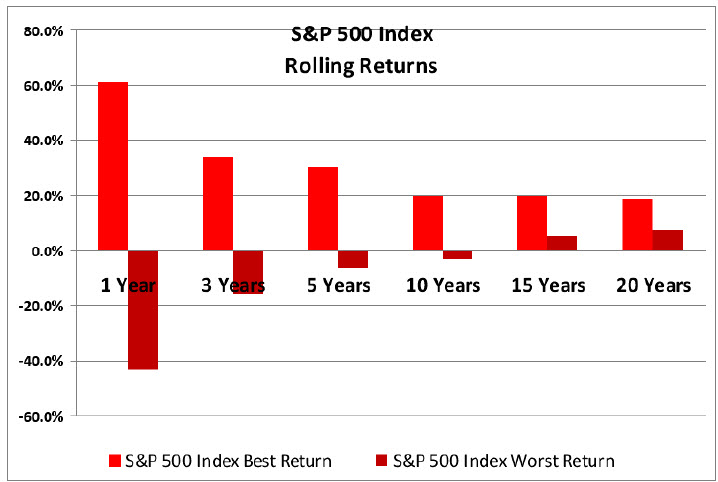
Based purely on U.S. data, the professional advisors seem to be getting the better of the debate, as you can see in the below chart, which shows rolling returns from 1973 through mid-2009.

dd342ee2-d38b-40ef-b622-583f11f0b02c

The outcomes in any one year have been frighteningly hard to predict, ranging anywhere from a 60% gain to a 40% loss. But if you hold that stock portfolio for three years, the best and worst are less dramatic than the best and worst returns over one year, and the returns are flattening out gradually over 10, 15 and 20 years. No 20-year time period in this study showed a negative annual rate of return.

But this is a fairly limited data set. What happens if you look at other countries and extend this research over longer time periods? This is exactly what David Blanchett at Morningstar, Michael Finke at Texas Tech University and Wade Pfau at the American College did in a new paper, as yet unpublished, which you can find here:
http://papers.ssrn.com/sol3/papers.cfm?abstract_id=2320828.

The authors examined real (inflation-adjusted) historical return patterns for stocks, bonds and cash in 20 industrialized countries, each over a 113-year time period. The sample size thus represents 2,260 return years, and the authors parsed the data by individual time periods and a variety of rolling time periods, which certainly expands the sample size beyond 87 years of U.S. market behavior.

What did they find? Looking at investors with different propensities for risk, they found that in general, people experienced less risk holding more stocks over longer time periods. The only exceptions were short periods of time for investors in Italy and Australia. The effect of time-dampened returns was particularly robust in the United Kingdom, Japan, Denmark, Austria, New Zealand, South Africa and the U.S.

Overall, the authors found that a timid investor with a long-term time horizon should increase his/her equity allocation by about 2.7% for each year of that time horizon, from whatever the optimal allocation would have been for one year. The adventurous investor with low risk aversion should raise equity allocation by 1.3% a year. If that sounds backwards, consider that the timid investor started out with a much lower stock allocation than the dare-devil investor–what the authors call the “intercept” of the Y axis where the slope begins.

Does that mean that returns in the future are guaranteed to follow this pattern? Of course not. But there seems to be some mechanism that brings security prices back to some kind of “normal” long-term return. It could be explained by the fact that investors tend to be more risk-averse when valuations (represented by the P/E ratios) are most attractive (when stocks, in other words, are on sale, but investors are smarting from recent market losses), and most tolerant of risk during the later stages of bull markets (when people are sitting on significant gains). In other words, market sentiment seems to view the future opportunity backwards.

Is it possible that stocks are not really fairly priced at all times, but instead are constantly fluctuating above and below some hard-to-discern “true” or “intrinsic” value, which is rising far more steadily below the waves? That underlying growth would represent the long-term geometric investment return, more or less–or, at least, it might have a relationship with it that is not well-explored. The old saw that stocks eventually return to their real values, that the market, long-term, is a weighing machine, might be valid after all.

If you have any questions about financial or investment planning and management, please don’t hesitate to contact us or visit our website at http://www.ydfs.com. We are a fee-only fiduciary financial planning firm that always puts your interests first.

What, We Worry?

So far this year, the investment markets have held up pretty well, which doesn’t always happen after a year of big returns like we experienced in 2013.  But based on experience, you know that something will spook investors at some point this year, the way the markets took a dive when Congress decided to choke off the U.S. federal budget, or when investors realized that Greece had somehow managed to borrow ten times more than it could possibly pay back to its bondholders.

Professional investors have learned to create a mental “watch list” of possible market-shaking events, and they were helped recently when Noriel Roubini, chairman of Roubini Global Economics, former Senior Economist for International Affairs at the U.S. Council of Economic Advisors, compiled his own worry list.  Roubini said that we’re past the time when people should be fearful of a breakup of the Eurozone, or (for now) any Congressional tinkering with the debt ceiling.  The public debt crisis in Japan seems to be fading in the optimism of Japanese Prime Minister Shinzo Abe’s monetary easing and fiscal expansion, and the war between Israel and Iran over Iranian nuclear technology, once thought to be imminent, now appears to be on the back burner.

So what does today’s worry list look like?  Roubini starts off with China, which is trying to shift its growth away from exports toward private consumption.  Chinese leaders, he says, tend to panic whenever China’s economic growth slows toward 7% a year, at which time they throw more money at capital investment and infrastructure, creating more bad assets, a lot of industrial capacity that nobody can use, and a bunch of commercial and industrial buildings which sit empty along the skyline.  By the end of next year, something will have to be done about the growing debt at the same time that investors face a potential crash in inflated real estate prices.  Think: five or six 2008 real estate crises piled on top of each other, all of it happening in one country.

Numbers two and three on Roubini’s worry list involve the U.S. Federal Reserve, which could (worry #2) cease its massive purchases of real estate mortgages and government bonds too quickly, causing interest rates to rise and sending financial shockwaves around the world.  Or, on the other hand (worry #3) the Fed might keep rates low for so long that the U.S. experiences new bubbles in real estate, stocks and credit–and then experiences the consequences when the bubbles burst.

Roubini also worries about emerging market nations being able to manage their debt and capital inflows if interest rates go up, and of course the situation in the Ukraine has significant market-spooking potential.  Finally, he notes that China has significant unresolved territorial disputes with Japan, Vietnam and the Philippines, which could escalate into military conflict.  If the U.S. were drawn into a maritime confrontation, alongside Japan, with Chinese warships, investors might think it’s a good time to retreat to the sidelines.

None of these scenarios are guaranteed to happen, and some of them seem unlikely.  But these periodic, headline-related spookings come with the investment territory.  If and when one of these events grabs the global headlines, it might be helpful to remember that the stock markets have weathered far worse and have always come out ahead.  Think: World War II, a presidential assassination, two wars in the Middle East, 9/11 and a Wall Street-created global economic meltdown.  If we can survive and even profit, long-term, from a stay-the-course investment mentality through those events, then we might be able to weather the next big headline on (or off) the worry list.

If you have any financial planning questions you would like to discuss, please don’t hesitate to contact us at (734) 447-5305 or visit our website athttp://www.ydfs.com. We are a fee-only fiduciary financial planning and money management firm that always puts your interests first. Our first consultation is complimentary and free of any pressure or sales pitches.

Enjoy your weekend,
Sam

Sam H. Fawaz CPA, CFP
YDream Financial Services

Source:
http://www.project-syndicate.org/commentary/nouriel-roubini-warns-that-even-as-many-threats-to-the-world-economy-have-receded–new-ones-have-quickly-emerged#TA08zJsftAXboy7Y.99

Are Daughters a Better “Investment?”

As Father’s Day has now passed for this year, a new survey from the online account aggregation firm Yodlee.com and Harris Interactive tells us that the financial relationship between fathers (and parents) can be very different for their sons vs. their daughters.  The survey found that an astonishing 75% of young adult men (age 18-34) are receiving financial aid from their parents, compared with 59% for comparable age daughters.  The financial dependency extends deep into adulthood; among sons aged 35-44, fully 32% are still living at home, while only 9% of women in that age bracket sleep in their former bedroom.  Even those numbers understate the disparity, because more than a third of the women who are living with their parents are doing so to support them in old age, something that sons are, according to the report, far less likely to do.
 
Overall, daughters are 32% less likely to need their parents’ money, and twice as likely to move back home because they’re unemployed.  By age 45, the survey found, most of these stark differences in financial independence have faded; sons lag only a few percentage points behind daughters in these two areas.  But then a new discrepancy emerges.  The survey found that older sons are half as likely as daughters to support their parents in old age. 

If you have any questions about any financial planning or money management services, please don’t hesitate to contact us or visit our web site athttp://www.ydfs.com. As a fee-only fiduciary financial planning firm, we always put your interests first, and there’s never a charge for an initial consultation or any sales pitches.
 
Sources:  

http://www.businessinsider.com/daughters-require-less-financial-support-2014-6
 
http://time.com/money/2861530/daughter-better-investment-than-son/

Retirement Spending Revisited

How much are you going to spend in retirement?  What once seemed like a simple question has become incredibly complicated in recent years.
 
Why?  First of all, a diminishing number of people actually plan to leave work and embrace leisure on a full-time basis, and those who do, seem to be doing it later than people from earlier generations.  Of the oldest baby boomers, who are now age 68, only 52% are actually retired;  21% are still working full-time.   According to a Gallup survey, 37% of Americans say they plan to work full-time past the age of 65, but that may be underestimating the actual shift in preference.  A 2012 survey conducted by Transamerica found that just 19% of workers expect to retire full-time by age 65.
 
When people DO leave the workplace, it now appears that some of the assumptions about their spending habits will have to be revisited.  The default assumption for many retirement plans is that what you spend now for things like food, clothing etc. will remain pretty much the same the day after retirement as they were the day before.  Your home mortgage may or may not go away in retirement and the expenses related to commuting to and from work will diminish.  When you sort it all out, you end up with a baseline spending plan, which includes a new car every few years, dining out occasionally, making home improvements and other basic necessities.  These expenses have traditionally been assumed to increase each year roughly with the inflation rate.
 
On top of that, it was assumed that in the vigorous early years of retirement, people would spend more on travel and country club memberships than they did when they were working, so their overall expenses would go up the day after they retire and gradually diminish as they found it harder and harder to play 18 holes of golf every day.  At some point in the age curve, health expenses would start to rise.  The people who study retirement expenditures talked about a “smile” graph of expenses, where it cost more to live and play in the earlier and later years of retirement than in the middle years.
 
What’s wrong with that?  For one thing, when you look at the Bureau of Labor Statistics data on what people actually spend in their later years, it contradicts this comfortable smile pattern.  People between the ages of 65 and 74 tended, on average, to increase their annual spending levels between 1.11 percentage points and 1.78 percentage points more per year more than the inflation rate.  Over that decade of their lives, any assumption that used the inflation rate would undercount their aggregate spending by somewhere between 11% and 19%.  People age 75 and older accelerated their actual spending to (again over the course of the next decade) between 13% and 22% more than the inflation statistics would suggest.  After that, healthcare costs would start to dominate the spending pattern.
 
To make things more complicated, the statistics suggest that retirees tend to cut back on their spending whenever the investment markets go down.  In 2009, people age 75 and older, on average, spent less than they did the year before, and they actually spent less than that in 2010.  That same year, the average spending of people age 65-75 declined a remarkable 3.55%.  As your wealth goes down, so too does your spending.
 
How can we predict these things in advance?  We can’t.  And it’s important to remember that these broad statistics don’t apply to your individual circumstances; they just suggest things that most of us should watch out for.  The only clear conclusion of the research, thus far, is that we should probably make conservative assumptions about spending, and hope we’re pleasantly surprised as the years go on.

If you have any questions about retirement spending or planning or would like to discuss your personal circumstances, please don’t hesitate to contact us, or go tohttp://www.ydfs.com.  We are a fiduciary fee-only financial planning firm that always puts your interests first.
 
Sources:
 
Retirement:
http://capricorn.bc.edu/agingandwork/database/browse/facts/fact_record/5670/all
 
Spending:
http://www.marketwatch.com/story/hedonic-pleasure-index-going-beyond-the-cpi-2013-01-23
 
http://www.advisorperspectives.com/newsletters12/47-fallacies2.php

Bad Money Moves to Avoid

What are truly the very worst investments and financial products you can buy with your money? Those things that when all things are considered provide you the lowest chance for profit. 

According to the AARP, they include five primary types: alternative investments, time-shares, equity-indexed annuities, private and non-traded REITs, and oil drilling partnerships. You can read why each are to be avoided right here. To that list I would add most permanent (whole, universal, variable) life insurance policies, deferred annuities and non-publicly traded partnerships. 
 
In that same article, AARP also provided five clues to watch for to tell you when something isn’t right about an investment that is being sold to you. These are all good things to watch for:
 
1. An impossible promise: There’s no such thing as high returns with little or no risk. The best opportunities typically go to institutional investors: it’s much easier to raise money from a few big fish than to solicit thousands of small fry.
 
2. Complex terms: Perhaps the offer comes with hundreds of pages of technical and legal disclosure, and you’re required to sign a document saying you read and understood it all. Good investments are easy to grasp. My rule is never to buy anything I couldn’t explain to an 8-year-old. Ask yourself: would they write hundreds of (legal) pages to protect you or themselves?
 
3. A ticking clock: If you hear that this investment opportunity is available only for a short time, it’s the reddest of flags. The salesperson doesn’t want you to think it over or ask others for their opinion. Run, don’t walk away from these investments.
 
4. Fancy language: That would be words such as “structured,” “managed,” “deferred,” “derivative,” “collateralized” and even “guaranteed.” Of course, there is nothing wrong with an FDIC guarantee on your CD. But leaving cash at a bank or brokerage firm is a bad investment if you are earning 3 percent or less: you’re losing ground to inflation. A higher-paying CD is a better option if you’re not willing to take risk with your money.
 
5. A stranger calls: Be very careful of accepting a free-lunch “educational seminar.” I have yet to meet someone unknown to me who truly wanted to and could make me rich. Someone once said that you truly can’t afford “free”, and I have come to believe it.
 
Millions of investors fall prey to bad investments usually out of fear or ignorance. In addition, no matter how smart you may be or how much experience you have, studies also show that all of us can be very gullible and blinded by our greed.

Nevertheless, knowing what to avoid is an important part of being successful with investing and managing risk. Most of the time, anything sold to you by others as terrific alternatives to equities and fixed income, especially those with lots of hype, complexity and outrageous fees, must be avoided. Eliminating these bad investments from your consideration and portfolios is a must if you desire to give yourself the best chance for long-term investing and financial success.

If you have any questions about any investments or insurance products you might be considering, please don’t hesitate to contact us or visit our web site athttp://www.ydfs.com. As a fee-only fiduciary financial planning firm, we always put your interests first, and there’s never a charge for an initial consultation.

Sources:

AARP

The Kirk Report

What is Uncle Sam doing with your tax money?

Now that your tax money is in the hands of Uncle Sam, what will he do with it?  How will the government allocate your contribution to the overall budget?
 
Your Social Security payments are easy; they go to pay Social Security benefits to current retirees, and for now (the future is another matter), they fully fund that obligation. Some of that money also goes to cover a portion of Medicare’s expenses; the remainder is covered by general federal revenue.
 
Your income taxes are divided among several broad budgetary categories.  A surprisingly large chunk is spent on the military (27%) and military-related veteran’s benefits (5.1%).  Another 22.7% goes to various forms of healthcare for U.S. residents, including the rest of the Medicare bill plus Medicaid.  13.9% of your tax money goes to pay interest on Uncle Sam’s debt–paid out to Treasury bill and bond holders every six months.  Unemployment benefits take up another 9.8%.
 
In the “Everything Else” category on the government spending pie chart, a surprisingly low 4.5% is spent on running the government, including various agencies such as the FBI and immigration services.  A total of 4% goes to housing programs, community development and block grants, while education gets a 2% slice of the pie–for programs like Head Start, and also the Pell Grants for college students.  Less than 2% is spent on scientific research, international affairs, transportation and energy.
 
If you’d like to get a receipt from the government for your taxes paid, which itemizes how that money is spent, well, good luck petitioning the IRS.  But you can get a fairly accurate receipt from the National Priorities Project here: http://nationalpriorities.org/interactive-data/taxday/. Just type in this year’s tax payment from your 1040, find your state, click a button and you’ll see what you paid for in terms of government services, interest and overhead.  Depending on how you feel about our government spending priorities, it may make your tax experience more or less painful.

If you have any questions about how to plan to pay less in taxes through tax and financial planning, please don’t hesitate to contact or visit us at www.ydfs.com.
 
 
Sources:
 
http://money.cnn.com/2014/04/11/pf/taxes/how-federal-income-taxes-are-spent/index.html
 
http://nationalpriorities.org/interactive-data/taxday/

Employers Ramping Up Retirement Plan Features

Employers are enhancing their retirement plans and increasing access to professional investment advice in an attempt to bolster employee retirement readiness.

A new study by Aon Hewitt, which polled more than 400 plan sponsors serving 10 million plan participants, revealed a number of initiatives being taken to strengthen employee ability to achieve greater financial security in retirement. Key actions include the following:

  • Boosting employer matching funds: The percentage of employers offering dollar-for-dollar matches on the first 6% of employee contributions, has nearly doubled in the past two years, from 10% in 2011 to 19% today. And virtually all employers now offer some level of matching contributions.
  • Offering immediate eligibility: Three out of four employers now allow employees to begin participating in a workplace retirement plan as of their hire date — a dramatic increase over the 45% of employers that offered immediate plan eligibility in 2001. In addition, more than half of employers also offer “day one” access to employer matching contributions.
  • Providing access to Roth-style plans: Giving plan participants the option of choosing between a standard defined contribution plan and a Roth-style plan has become a priority for more employers in the past several years. Now 50% of employers allow Roth contributions (up 11% since 2008), and of those who offer the Roth option, 27% currently allow in-plan Roth conversions. Another 16% will offer this feature within the year.
  • Offering access to a range of advisory services: One of the fastest-growing benefit trends is the availability of various types of professional guidance, which is now offered by three out of four plan sponsors. One-on-one financial counseling tops the list (with 59% of plans offering), followed by online guidance (55% of plans), and managed accounts (52% — a significant jump from just two years ago when only 29% of plans offered this feature). Target-date funds — another form of investment guidance — are well into the acceptance curve, with 86% of plan sponsors offering them.

If you have any questions about your employer retirement/benefit plans or any other fee-only fiduciary financial planning matters, please don’t hesitate to contact us or visit http://www.ydfs.com.

Source:  Aon Hewitt news release, October 30, 2013.

Should You Consider a Health Savings Account?

As health care costs continue to rise, consumers must find ways to ensure that they have the funds to pay for medical expenses not covered through their insurance. One way to save specifically for health care costs is to fund a health savings account, or HSA.

HSAs are tax-advantaged savings accounts set up in conjunction with high-deductible health insurance policies. Enrollees or their employers make tax-free (pre-tax) contributions to an HSA and typically use the funds to pay for qualified medical care until they reach their policy’s deductible. The contribution made to the health savings plan is made in addition to your health insurance premium.

HSAs are not for everyone, and it is important to understand how they work before considering them to help fund health care costs.

Understanding HSAs

You are eligible for an HSA if you meet all four of the following qualifying criteria:

  1. You are enrolled in a qualified high-deductible health insurance plan (known as an “HDHP”).
  2. You are not covered by any additional health plan(s).
  3. You are not eligible for Medicare benefits.
  4. You are not a dependent of another person for tax purposes.

HSAs are generally available through insurance companies that offer HDHPs. Many employer-sponsored health care plans also offer HSA options. Although most major insurance companies and large employers now offer an HSA option under their health plan, it’s important to remember that most health insurance policies are not considered HSA-qualified HDHPs, so you should check with your insurance company or employer to see how an HSA plan might differ from your current plan.

There are maximum contribution limits that are adjusted annually. Contributions are made on a before-tax basis, meaning they reduce your taxable income. Note that unlike IRAs and certain other tax-deferred investment vehicles, no income limits apply to HSAs.

HSAs offer investment options that differ from plan to plan, depending upon the provider, and allow users to carry account balances over from year to year. Earnings on HSAs are not subject to income taxes.

Any medical, dental, or ordinary health care expense that would qualify as a tax-deductible item under IRS rules can be covered by an HSA. A doctor’s bill, dental procedure, and most prescriptions are examples of covered items. See IRS Publication 502 for a definitive guide of covered costs. If funds are withdrawn for any purposes other than qualifying health care expenses, you will be required to pay ordinary income taxes on amounts withdrawn plus a 10% additional federal tax.

Here are some pros and cons of this product.

Pros

  • HSAs offer a significant annual tax deduction, making them particularly appealing to individuals in higher tax brackets.
  • Withdrawals for qualifying health care costs (including long-term care insurance) are tax free.
  • Investment income in HSAs also accumulates tax free.

Cons

  • Since HSAs must be tied to HDHPs, their ultimate savings must be weighed against how such plans stack up against more traditional plans, which may offer significantly better coverage.
  • HSAs may not offer the flexibility and portability that today’s mobile American family requires, especially given that health plan offerings differ significantly from employer to employer, and many smaller institutions have yet to offer an HSA option.
  • For more information on HSAs, see the U.S. Treasury’s Health Savings Account resource page.

If you have any questions about Health Savings Accounts or any other financial planning matters, please don’t hesitate to contact us or visit http://www.ydfs.com

Taking Distributions from 529 College Savings Plans

Parents looking to take advantage of the many benefits of saving for college with a 529 plan will want to know the full details of which educational expenses qualify for tax-free distribution status — and which do not.1 In Publication 970, the IRS gives detailed guidance on qualified expenses. Here are a few important points:

What’s Covered

 Tuition and fees are covered in full.

  • Room and board, if the student is enrolled at least half time. But such expense must be not more than the greater of (1) the allowance for room and board, as determined by the school, that was included in the cost of attendance; or (2) the actual amount charged if the student is residing in housing owned or operated by the school.
  • Food. If you spend a certain amount for a meal plan, that entire amount can be deducted, even if used for coffee or ice cream and not a full meal. Weekend meals can also be included if the dining halls are not open.
  • Books and supplies. Any fees associated with purchasing school textbooks are considered qualified, as are required equipment or supplies such as notebooks and writing tools.
  • Computers/laptops, but only if required by the school. If required, Internet fees and PDAs or “smartphones” may also qualify. The Savings Enhancement for Education in College Act (H.R. 529) that is currently being considered by Congress would expand this definition to apply to all computer technology used by the student.
  • Special needs services required by special-needs students that are incurred in connection with enrollment or attendance at school.

 What’s Not Covered

 Student loans. Interest on or repayment of student loans is not considered a qualified expense by the IRS.

  • Insurance, sports or club activity fees, and many other types of fees that may be charged to students but are not required as a condition of enrollment.
  • Transportation to and from school.
  • Concert tickets or other entertainment costs, unless attendance is requisite to a course or curriculum.
  • Note that expenses must apply to a qualified college, university, or vocational school for post-secondary educational expenses. Also keep in mind that taxes and a possible 10% additional federal tax will apply to all distributions that are not considered qualified educational expenses by the IRS, so be sure to check first.

If you have any questions about saving and investing for college, please don’t hesitate to contact us or visit http://www.ydfs.com

1By investing in a 529 plan outside of the state in which you pay taxes, you may lose the tax benefits offered by that state’s plan. Withdrawals used for qualified expenses are federally tax free. Tax treatment at the state level may vary.

Would You Pay Less Taxes in Another Country?

Tax day has passed in the U.S., along with the usual complaints about the complexity and financial burden that federal and state taxes (and FICA) impose on our lives. But have you ever wondered how U.S. taxes compare with what citizens in other countries have to pay?

Recently, the accounting firm PricewaterhouseCoopers calculated the tax burden, for tax year 2013, for people living in 19 of the G20 nations (the 20th member is the European Union, which has a variety of tax regimes). The report looked first at people who are in the upper-income levels–a person with a salary equivalent of $400,000, with a home mortgage of $1.2 million. After all income tax rates and Social Security (or equivalent) contributions have been taken out, what percentage of his/her income would this person have left over?

The people we should have the most sympathy for on our annual tax day live in Italy, where this person would get to keep $202,360 of that $400,000 income–or 50.59%. A comparable person living in India would keep 54.9%, while someone living in the United Kingdom would keep 57.28%.

Here’s the full list. Notice that the U.S. is about in the middle of the pack:

19. Italy – 50.59%
18. India – 54.90%
17. United Kingdom – 57.28%
16. France – 58.10%
15. Canada – 58.13%
14. Japan – 58.68%
13. Australia – 59.30%
12. United States – 60.45%
11. Germany – 60.61%
10. South Africa – 61.78%
9. China – 62.05%
8. Argentina – 64.02%
7. Turkey – 64.64%
6. South Korea – 65.75%
5. Indonesia – 69.78%
4. Mexico – 70.60%
3. Brazil – 73.32%
2. Russia – 87%
1. Saudi Arabia – 96.86%

Before you conclude that the U.S. is below average on this list, you should know that PricewaterhouseCoopers applied New York state (13.3%) and New York city (maximum 3.9%) taxes on the American calculation. If it had used Texas or Florida state tax rates instead, the U.S. would easily have ranked somewhere in the top ten.

And this list is somewhat skewed because so many European countries are left off, because they are lumped into the EU. It also doesn’t include Canada, which imposes a 29% top federal tax rate on its citizens, and then tacks on a maximum 25.75% rate at the province level.

PricewaterhouseCoopers did include many of the EU countries when it calculated the tax burdens on people with average incomes, and here the list looks somewhat different. The accounting firm assumed that a hypothetical married couple, with two children, earned the average income in each nation, and then calculated the overall tax rate the family would have to pay.

Denmark – 34.8%
Austria – 31.9%
Belgium – 31.8%
Finland – 29.4%
Netherlands – 28.7%
Greece – 26.7%
United Kingdom – 24.9%
Germany – 21.3%
United States – 10.4%
South Korea – 10.2%
Slovak Republic – 10%
Mexico – 9.5%
Chile – 7%
Czech Republic – 5.6%
(China, Russia, South Korea, Indonesia and Brazil would assess 0% taxes on this hypothetical family)

Does this mean that the U.S. tax system is fair? Or equitable? It depends on your perspective. Tax rates in the U.S. have been as high as 94% on all income over $200,000 (1944-45), and as low as 28% (1988-1990), with the bulk of years coming in between 40% and 70%. Meanwhile, some countries assess more taxes from corporations than from their citizens, while some have it the other way around. And some nations are evolving. At the beginning of World War II, individuals and families paid 38% of the total federal tax burden, and corporations picked up the other 62%. Today, thanks to aggressive lobbying, corporations have turned that around and then some. Individuals and families pay 82% of today’s total federal income tax haul, and corporations pay 18%.

We should also remember that high taxes don’t necessarily correlate with economic misery or poverty. Consistently, Belgium, which had the highest tax burden on average wage-earners (and imposes a top 50% rate on upper-income citizens) also consistently scores as one of the happiest countries in the world.

Sources:

http://www.bbc.com/news/magazine-26327114

http://billmoyers.com/2013/10/03/the-us-has-low-taxes-so-why-do-people-feel-ripped-off/

Click to access nyc_tax_rate_schedule.pdf

http://www.ntu.org/tax-basics/history-of-federal-individual-1.html