Hidden Risks of Naming a Trust as Your IRA or 401(k) Beneficiary

EXECUTIVE SUMMARY

Naming your trust as the beneficiary of your IRA or 401(k) can be a powerful estate planning tool, but it comes with significant complexities and trade-offs.

Recent IRS regulations, particularly the final regulations issued in July 2024, have made several significant changes affecting individuals who have named a trust as the beneficiary of their IRA or 401(k). These changes address required minimum distributions (RMDs), beneficiary classifications, documentation requirements, and tax implications.

If you have a trust, it may no longer be prudent to name your trust as your 401(k) or IRA beneficiary. You may need to consult with your estate planning attorney to confirm that naming your trust as the beneficiary is still a valid designation.

If your trust document is over five years old, you may need to consult your estate planning attorney to modify your trust or update your beneficiary designations to avoid unintended accelerated distribution timeframes or subject the distributions to steep trust tax rates.

Before discussing the latest tax regulations and the implications of naming a trust as your IRA or 401(k) beneficiary, let’s look at the pros and cons of doing so:

PROS OF NAMING A TRUST AS AN IRA BENEFICIARY

• Control Over Distributions: A trust allows you to set specific terms for how and when assets are distributed. This is particularly useful if your beneficiaries are minors, have special needs, or may not be financially responsible [9][10][11][12].

• Protection for Vulnerable Beneficiaries: Trusts can protect beneficiaries who are minors, disabled, or have issues with creditors, addiction, or poor financial decision-making [9][13][14][11][12].

• Asset Protection: A trust can safeguard assets from a beneficiary’s creditors, divorce, or lawsuits [10][12].

• Estate Planning for Blended Families: Trusts can ensure assets are distributed according to your wishes, such as providing for a spouse during their lifetime with the remainder going to children from a previous marriage [13][14][10][12].

• Privacy: Distributions through a trust avoid probate, keeping your estate details private [10].

• Special Needs Planning: A properly structured trust can provide for a beneficiary with special needs without disqualifying them from government benefits [14][10][11].

• Contingency Planning: Trusts can specify what happens if a beneficiary dies before receiving their full share, offering more control over the ultimate disposition of assets [12].

CONS OF NAMING A TRUST AS AN IRA BENEFICIARY

• Accelerated Taxation and RMD Rules: Trusts are subject to RMDs based on the oldest beneficiary’s life expectancy, which can accelerate withdrawals and taxes compared to naming individuals directly [9][13][11].

Under the SECURE Act, most non-spouse beneficiaries, including trusts, must withdraw the entire account within 10 years, eliminating the “stretch IRA” (explained below) in most cases [14][10][11].

• Potential for Higher Taxes: Trusts reach the highest federal income tax rate much faster than individuals. If the trust accumulates income instead of distributing it, this can result in significantly higher taxes [15][10].

• Loss of Spousal Rollover: Naming a trust as beneficiary means a surviving spouse cannot roll the account into their own IRA, losing the ability to defer taxes over their lifetime [14].

• Increased Complexity and Cost: Administering a trust as a retirement account beneficiary involves more paperwork, legal compliance, and potentially higher administrative costs [13][15][10].

• Risk of Non-Compliance: If the trust is not drafted correctly as a “see-through” (or “look-through”) trust (see below), it may trigger even more accelerated distribution rules, such as the five-year distribution rule [15][11].

• Plan Restrictions: Some employer plans may not allow trusts as beneficiaries or may require lump-sum distributions, which could trigger full immediate taxation [13].

• No Probate Avoidance for Trust Assets: While retirement accounts avoid probate when a beneficiary is named, naming a trust does not provide additional probate avoidance for the retirement account, though it does for assets distributed from the trust [11].

When Naming a Trust as Beneficiary Makes Sense

• You have minor, disabled, or financially irresponsible beneficiaries.

• You want to control the timing and amount of distributions.

• You need to protect assets from creditors or divorce.

• You have a blended family and want to ensure specific inheritance outcomes.

• You have a beneficiary who relies on government benefits.

When It May Not Be Advantageous

• Your beneficiaries are financially responsible adults.

• You want to maximize tax deferral and minimize complexity.

• Your spouse is the primary beneficiary and would benefit from rollover options.

KEY TAX CHANGES AND THEIR EFFECTS

Before the SECURE Act, passed in December 2019, IRA beneficiaries enjoyed a long “stretch” of time to take distributions from the IRAs they inherited. Beneficiaries could distribute the inherited IRA assets over the remainder of their lifetimes using the IRS RMD rules.

That stretch was largely eliminated for most IRA beneficiaries who inherited an IRA from a decedent starting in 2020. The IRS took over 4 1/2 years from the passage of the SECURE Act to finalize regulations surrounding distributions from post-2019 inherited IRAs.

1. Required Minimum Distributions (RMDs) and the 10-Year Rule

As mentioned above, the SECURE Act and its subsequent regulations essentially eliminated the “stretch IRA” for most non-spouse beneficiaries, including trusts, replacing it with a 10-year payout rule. This means that, in most cases, all funds in an inherited IRA or 401(k) must be distributed by the end of the 10th year following the account holder’s death.

If the account owner died after their required beginning date (RBD), annual RMDs must be taken during years 1–9, with the entire balance distributed by year 10.

If the account owner died before their required beginning date (RBD), annual required minimum distributions (RMDs) are not required in years 1–9. Instead, the entire inherited IRA or retirement account balance must be distributed by the end of the 10th year following the year of the original owner’s death. Depending on the size of the IRA and the beneficiary’s tax bracket, taking some distributions in years 1-9 may be prudent, even if not required.

The RBD for most IRA owners is age 70-1/2 to 73 (soon to be 75). Remember that the “M” in RMD is the minimum you must distribute. Depending on the size of the IRA, more than the minimum distribution will often make more sense.

Only “Eligible Designated Beneficiaries” (EDBs), such as spouses, minor children (until age 21), disabled or chronically ill individuals, or beneficiaries less than 10 years younger than the decedent, can still use the stretch distribution based on their life expectancy.

2. Trust Types and Beneficiary Analysis

The IRS continues to recognize “see-through” (or “look-through”) trusts, which allow the trust’s individual beneficiaries to be treated as the IRA’s beneficiaries for RMD purposes.

To qualify as a see-through trust under IRS rules, the trust must meet specific criteria that allow its beneficiaries to be treated as direct beneficiaries of an inherited IRA or 401(k). These requirements ensure the trust can utilize stretch distributions or the 10-year rule based on beneficiary status (i.e., EDB or non-EDB).

Here are the key requirements of a see-through trust:

a. Validity Under State Law

The trust must be legally valid in the state where it was created. This typically requires proper execution, witnessing, and notarization of the trust document.

b. Irrevocability Upon Death

The trust must be irrevocable from inception or upon the account owner’s death. Revocable trusts that convert to irrevocable status at death are acceptable.

c. Identifiable Beneficiaries

All trust beneficiaries must be clearly named, identifiable, and eligible individuals (e.g., people, not charities or other entities). This ensures the IRS can “see through” the trust to determine distribution timelines based on beneficiary life expectancies or the 10-year rule.

If a trust is not a see-through trust, it may be considered a:

  1. Conduit Trust: All IRA distributions must be immediately passed to beneficiaries. Taxes are paid at the beneficiaries’ individual rates, but the 10-year rule generally applies unless all beneficiaries are EDBs.

OR

  1. Accumulation (Discretionary) Trust: Distributions are retained in the trust, which pays taxes at higher trust tax rates. All trust beneficiaries are considered when determining the payout period, and the 10-year rule usually applies.

The Final Regulations allow trusts that split into separate subtrusts for each beneficiary upon the account holder’s death to apply RMD rules based on each subtrust’s beneficiary status. This can preserve stretch treatment for EDBs even if other beneficiaries are subject to the 10-year rule.

3. Documentation Requirements

For IRAs, the IRS has eliminated the requirement for trustees to provide detailed trust documentation to the IRA custodian. Now, only a list of trust beneficiaries and their entitlements may be required, greatly simplifying compliance for see-through trusts.

Some documentation requirements remain for 401(k) and other employer plans, but they have been simplified.

4. Tax Consequences

As mentioned above, trusts reach the top income tax bracket much faster than individuals. In 2024, trust income over $15,200 is taxed at 37%, whereas individuals do not hit this rate until much higher income levels. This can result in significantly higher tax bills if IRA distributions are accumulated in a trust rather than paid to beneficiaries.

Lump-sum distributions or failing to comply with the new rules can result in accelerated taxation and potential penalties.

5. Special Provisions and Clarifications

The IRS clarified that if a trust divides into separate subtrusts immediately upon the account owner’s death, each subtrust is analyzed separately for RMD purposes.

If trust terms or beneficiaries are modified after the account owner’s death (by September 30 of the following year), these changes will affect RMD calculations as if they were always part of the original trust.

Payments made “for the benefit of” a beneficiary (such as to a custodial account for a minor) are treated as direct payments to the beneficiary for RMD purposes.

PRACTICAL CONSIDERATIONS

Most trusts named as IRA or 401(k) beneficiaries will now face the 10-year payout rule, with fewer opportunities for long-term tax deferral.

Under the new rules, trusts must be carefully analyzed and possibly restructured to maximize tax efficiency and achieve estate planning goals.

Simplifying documentation requirements reduces administrative burdens for IRA trusts, but not necessarily for employer plans.

High trust tax rates make accumulation trusts less attractive for holding retirement assets over the long term.

ACTION MAY BE REQUIRED

If your IRA or 401(k) names your trust as a beneficiary, it’s advisable to consult with your estate planning attorney to ensure that, in light of the recent tax regulations, naming the Trust as beneficiary is still prudent.

If you’re unsure whether your trust is considered a see-through trust, consult with your estate planning attorney to determine if the trust must be modified to ensure that the 10-year distribution for beneficiaries remains intact. Otherwise, that 10-year period might be inadvertently shortened to five years, or worse, subject distributions to overly steep trust tax rates.

Whether you have a trust or have named your trust as a beneficiary of your IRA or 401(k), now is a good time to check the beneficiary designations on all of your retirement accounts and insurance policies to ensure they are up to date and reflect all of your recent life changes. If something should happen to you, your loved ones will be most grateful.

Sam H. Fawaz is the President of YDream Financial Services, Inc., a fee-only investment advisory and financial planning firm serving the entire United States. If you would like to review your current investment portfolio or discuss any other tax or financial planning matters, please don’t hesitate to contact us or visit our website at http://www.ydfs.com. We are a fiduciary financial planning firm that always puts your interests first, with no products to sell. If you are not a client, an initial consultation is complimentary, and there is never any pressure or hidden sales pitch. We start with a specific assessment of your personal situation. There is no rush and no cookie-cutter approach. Each client and their financial plan and investment objectives are different.

1-8. Deleted

9. https://www.voya.com/blog/retirement-account-pros-and-cons-naming-trust-beneficiary

10. https://www.markruizlaw.com/should-your-living-trust-be-the-beneficiary-of-your-ira-or-401-k-pros-and-cons-explained

11. https://www.investopedia.com/ask/answers/09/trust-beneficiaries.asp

12. https://www.drobnylaw.com/articles/designating-a-trust-as-beneficiary-of-individual-retirement-account-benefits

13. https://www.myubiquity.com/resources/can-a-trust-be-a-beneficiary-of-a-401-k-plan

14. https://www.katz-law-firm.com/can-a-trust-be-the-beneficiary-of-an-ira/

15. https://caryestateplanning.com/blog/should-i-have-a-trust-as-my-ira-beneficiary/

Markets & Macroeconomic Summary for the Week Ended December 27, 2024

The S&P 500 index closed 0.65% higher in a volatile, shortened holiday trading week. The NASDAQ index gained 0.75%, while the small caps were slightly positive, up 0.21%. The Microcap index outperformed for the week, bouncing up 1.3%. Additional signs of bearish distribution appeared this week.

Another holiday-shortened trading week is ahead, with the stock markets closed on New Year’s Day. Whether Santa can right his sleigh and deliver further gains in his traditional year-end rally remains to be seen.

Durable Goods, a volatile data series, was better than expected. It showed that new orders for key U.S.-manufactured capital goods surged in November, up 0.7%, amid strong demand for machinery. However, new orders were down 1.1% month-over-month, missing expectations.

The Conference Board’s consumer confidence reading was down from last month’s reading and notably lower than forecast. The Present Situation and Expectations Indexes fell, with the Expectations Index just slightly above the Conference Board’s 80.0 “recession threshold.” This was surprising given the renewed post-election euphoria and optimism expected to continue.

While only a single monthly data point, it is surprising that the post-election rebound in Consumer Confidence was not sustained. If consumer attitudes continue to sour and spending slows dramatically, it can significantly impact the stock market and economy in 2025.

New Home Sales from the Census Bureau were up 5.9% in November. Sales rose despite decades-high mortgage rates, mainly due to a drop in the median sales price, which saw its lowest price tag since February 2022. New home inventory was down slightly and represents a supply of 8.9 months at current prices.

Key housing-related stocks have continued to suffer due to rising interest rates. The 30-year mortgage rate from Freddie Mac rose to 6.9% this week, notably higher than its interim low of 6.1% in late September. Continued housing weakness could also indicate impending economic and stock market weakness.

Source: InvesTech Research

Corporate Transparency Act (CTA) Enjoined and Stay Issued

Beneficial Ownership Interest (BOI) Reporting is now on hold.

In an early November article, I wrote about the CTA and how BOI reporting was required by many entities by January 1, 2025.

A court ruling last week found the CTA unconstitutional, paving the way for an appeal by the Department of Justice and FinCEN.

In a statement issued by FinCEN over the weekend, FinCEN announced that it will comply with the order issued by the District Court in the Texas Top Cop Shop case “so long as it is in effect.” Therefore, reporting companies are not currently required to file their beneficial ownership information with FinCEN and will not be liable if they fail to do so “while the preliminary injunction remains in effect.”

FinCEN also disclosed that the Department of Justice filed a Notice of Appeal on December 5, 2024, and reminded the public that voluntary compliance with the CTA reporting requirements can continue.

We do not know what will happen on appeal, although we think it’s unlikely that the initial required filing date for January 1, 2025, will stand. Similarly, the filing deadlines applicable to newly formed reporting companies are also on hold while the injunction is applicable.

However, if you formed a new company and the reporting deadline was imminent when the stay was issued, it is probably prudent to ensure that you have all the information necessary to file a BOI immediately if the injunction is lifted with no change in requirements, in case additional time to file is not granted. FinCEN’s seeming emphasis on the fact that enforcement of the CTA is stayed “so long as the order is in effect” may indicate that the government does not intend to grant additional time to file.

Thus, for instance, it is possible that if a decision to lift or vacate the injunction is made on or after January 2, 2025, all reporting companies with a January 1 reporting deadline would need to file immediately. Although it does seem likely that additional time to file would be granted upon the possible lifting of the stay, it may well be that such additional time may not be lengthy, given that existing reporting companies have had almost an entire year to report before the preliminary injunction is granted.

As such, until and unless FinCEN indicates that an extension of time to file will be granted, it is prudent that all information necessary for reporting is gathered and ready to file if you do not wish to file voluntarily by your original deadline.

The decision about whether to file voluntarily may be a difficult one. On one hand, it ensures that if the injunction is vacated and there is a need to file quickly, you will already be in compliance. On the other, many may not want their information submitted to the government if there is no requirement to do so (and some may not want to pay for professional help to file their BOI report(s).)

If you are unsure what to do, please check with your entity’s attorney or CPA for the latest information about your situation if you have not yet filed a BOI report and are required to do so by the CTA.

YDream Financial Services is an investment advisory and financial planning firm serving the entire United States. If you would like to review your current investment portfolio or discuss any other financial planning matters, please don’t hesitate to contact us or visit our website at http://www.ydfs.com. We are a fee-only fiduciary financial planning firm that always puts your interests first. If you are not a client, an initial consultation is complimentary, and there is never any pressure or hidden sales pitch. We start with a specific assessment of your personal situation. There is no rush and no cookie-cutter approach. Each client and your financial plan and investment objectives are different.

Source: InterActive Legal

Essential Year-End Tax Planning Tips for 2024

Tax planning becomes essential for individuals and businesses as the year ends. Proactively managing your finances before the calendar flips to 2025 can help minimize your tax burden and set you up for a financially secure new year.

Many clients submit their information yearly to have us optimize their 2024 and future years’ taxes. Proactively estimating and making side-by-side multi-year tax projections has permanently saved some clients thousands of dollars in taxes.

Here are some things to consider as you weigh potential tax moves between now and the end of the year.

1. Consider deferring income to next year

The old rule used to be “defer income.” The new rule is “time income.”

Consider opportunities to defer income to 2025, especially if you may be in a lower tax bracket next year.

For example, you may be able to defer a year-end bonus or delay the collection of business debts, rent, and payments for services. Doing so may enable you to postpone tax payments on the income until next year.

If you have the option to sell real property on a land contract rather than an outright sale, that can spread your tax liability over several years and be subject to a lower long-term capital gain rate (which could be as low as 0%.) On the other hand, if you’re concerned about future tax rate hikes, an outright sale or opting out of the installment method for a land contract sale can ease the uncertainty that you’ll pay higher rates on the deferred income.

If your top tax rate in 2024 is lower than what you expect in 2025 (say, because you are retiring or because of significant gains or a big raise or bonus expected in 2025), it might make sense to accelerate income instead of deferring it.

Be mindful of accelerating or bunching income, which can potentially 1) increase the taxability of social security income, 2) increase Medicare premiums, 3) raise your long-term capital gains rate from 0% to 20%, or 4) decrease your ACA health insurance premium credit.

2. Time your deductions

Once again, the old rule used to be “accelerate deductions.” The new rule is “time deductions.”

If appropriate, look for opportunities to accelerate deductions into the current tax year, especially if your tax rate will be higher this year than next.

If you own a business and are in a high tax bracket, consider accelerating business equipment purchases and electing up to a full expense deduction (via bonus depreciation or Section 179 expensing.)

If you itemize deductions, making payments for deductible expenses such as qualifying interest, state, and local taxes (to the extent they don’t already exceed $10,000), and medical expenses before the end of the year (instead of paying them in early 2025) could make a difference on your 2024 return.

For taxpayers who typically itemize their deductions, the strategy of “bunching” deductions can significantly impact them. Instead of spreading charitable contributions, medical expenses, and other deductible costs across multiple years, consider consolidating them into one year. By “bunching” these deductions, you may exceed the standard deduction threshold and maximize your itemized deductions for the year.

For example, if you typically donate $2,000 annually to charity but are not receiving a tax benefit because you are utilizing the standard deduction, consider making multiple years of contributions in 2024. This could help you exceed the standard deduction amount, allowing you to itemize your deductions and providing more tax benefits (see below.)

For those with significant medical expenses, it’s important to note that only the portion of medical expenses exceeding 7.5% of your adjusted gross income (AGI) can be deducted. If you’re close to reaching that threshold, consider scheduling medical procedures, doctor visits, or purchasing necessary medical equipment before the year ends. Remember that medical expenses are only deductible in the year they are paid, so timing matters.

3. Make deductible charitable contributions

Making charitable donations can reduce your taxable income while supporting causes that matter to you.

If you itemize deductions on your federal income tax return, you can generally deduct charitable contributions, but the deduction is limited to 60%, 50%, 30%, or 20% of your adjusted gross income, depending on the type of property you give and the type of organization to which you contribute. Excess amounts can be carried over for up to five years.

You can use checks or credit cards to make year-end contributions even if the check does not clear until shortly after year-end or the credit card bill does not have to be paid until next year.

As you consider year-end charitable giving, there are a few strategies to keep in mind:

  • Qualified Charitable Distributions (QCDs): If you’re 70½ or older, you can direct up to $105,000 (2024 limit) from your IRA to a charity as a QCD. This donation counts toward your required minimum distribution (RMD) and is excluded from your taxable income (and can reduce the taxation of social security income.) QCDs cannot be counted as deductible charitable donations.
  • Donor-Advised Funds (DAFs): DAFs allow you to make a significant charitable contribution in 2024 and receive the tax deduction now while deciding which charities to support over the next several years. This is a strategy to help with the bunching of itemized deductions described earlier.
  • Appreciated Stock Donations: Donating appreciated stocks that have been held for over one year instead of cash generally provides a double benefit. It allows you to avoid paying capital gains tax on the appreciation while receiving a charitable deduction equal to the investment’s fair market value.

4. Bump up withholding to cover a tax shortfall

If it looks as though you will owe federal income tax for the year, consider increasing your withholding on Form W-4 for the remainder of the year to cover the shortfall. Time may be limited for employees to request a Form W-4 change and for their employers to implement it in 2024.

The most significant advantage in doing so is that withholding is considered to have been paid evenly throughout the year instead of when the dollars are taken from your paycheck. This approach can help you avoid or reduce possible underpayment of estimated tax penalties.

Those taking distributions from their IRAs can also request that up to 100% of the distribution be paid toward federal and state income tax withholding to help avoid underpayment of estimated tax penalties.

These increased withholding strategies can compensate for low or missing quarterly estimated tax payments.

5. Save more for retirement

Deductible contributions to a traditional IRA and pretax contributions to an employer-sponsored retirement plan such as a 401(k) can reduce your 2024 taxable income. Consider doing so if you still need to contribute up to the maximum amount allowed.

For 2024, you can contribute up to $23,000 to a 401(k) plan ($30,500 if you’re age 50 or older) and up to $7,000 to traditional and Roth IRAs combined ($8,000 if you’re age 50 or older). The window to make 2024 employee contributions to an employer plan generally closes at the end of the year, while you have until April 15, 2025, to make 2024 IRA contributions.

Various income limitations exist for eligibility to make traditional and Roth IRA contributions. Regardless of your income, however, you can make a non-deductible IRA contribution. Such a contribution can be subsequently converted to a Roth IRA at little or no tax cost for many (this is known by many as the “back-door” Roth.) If a Roth IRA conversion doesn’t make sense, the non-deductible contribution adds cost basis to your traditional IRA, reducing future taxation of IRA distributions or Roth conversions. Note that Roth contributions are not deductible and Roth-qualified distributions are not taxable.

Speaking of Roth Conversions, if you expect your tax rate to be higher in future years, or you’re in a low tax bracket in 2024, converting some or all your traditional (pre-tax) IRA or 401(k) funds into a Roth IRA in 2024 may be beneficial. While this conversion triggers taxes now, it can reduce future tax liabilities, as qualified withdrawals from a Roth IRA are tax-free.

Owners of small businesses with retirement plans may have until the due date of their tax returns (plus extensions) to make some retirement plan contributions. Check with your tax advisor for your particular small-business retirement plan.

Some small business retirement plans must be set up by 12/31/2024 to allow for a deduction for the 2024 tax year.

If you have a small business, check with your tax advisor to ensure your retirement plan deductions are correctly balanced with the qualified business income deduction, assuming your small business is eligible.

6. Take required minimum distributions

If you are 73 or older, you generally must take required minimum distributions (RMDs) from traditional IRAs and employer-sponsored retirement plans (special rules may apply if you’re still working and participating in your employer’s retirement plan.)

If you reach 73 in 2024, you must begin taking minimum distributions from your retirement accounts (traditional IRAs, 401(k)s, etc.) by April 1, 2025. However, delaying the 2024 RMD until 2025 will require you to include both the 2024 and 2025 RMDs into 2025 income.

You must make the withdrawals by the required date—the end of the year for most individuals. The penalty for failing to do so is substantial: 25% of any amount you failed to distribute as required (10% if corrected promptly).

In 2024, the IRS finalized somewhat complicated regulations relating to RMDs from inherited IRAs after December 31, 2019.

In general, under the SECURE Act, unless an exception applies, the entire balance of a traditional or Roth IRA must be fully distributed by the end of the 10th year after the year of death.

In addition, depending on the age of the original IRA owner, heirs must take an RMD every year until the 10th year, when the remaining account balance must be distributed. These rules require careful and sometimes complex, multi-year planning for large inherited IRAs, so it’s essential to consult your tax advisor.

Review your accounts to ensure you’ve met your RMD requirement for the year, and if applicable, consider making charitable contributions through a QCD.

7. Weigh year-end investment moves

I often tell folks, “You should not let the tax tail wag the investment dog.” That means that you shouldn’t let tax considerations drive your investment decisions.

With that in mind, lower-income taxpayers may be subject to a 0% long-term capital gains rate for up to about $47K of taxable income for single filers and $94K for joint filers. For “kids” under 26, up to $2,600 of long-term capital gains are taxed at 0% if filed on their own tax returns (not filed with parents’ returns.)

Regardless, it’s worth considering the tax implications of any year-end investment moves that you make. For example, if you have realized net capital gains from selling securities at a profit, you might avoid being taxed on some or all those gains by selling losing positions (also known as tax loss harvesting.)

Any capital losses over and above your capital gains can offset up to $3,000 of ordinary income ($1,500 if your filing status is married filing separately) or be carried forward to reduce your taxes in future years.

Wash sale rules prevent investors from selling an investment at a loss and re-purchasing the same or substantially similar security within 30 days in any of their or spouse’s accounts (including retirement accounts). Doing so invalidates the loss for the current year, and the loss deduction is suspended until the new security is ultimately sold. If you wait 31 days to repurchase the same (or substantially similar security), the wash sale rules do not apply.

Digital assets like Bitcoin are not subject to wash sales rules, so there’s no harm in harvesting a loss and then immediately re-purchasing the same digital asset if desired.

8. Contribute to 529 Education Savings Plans

If you’re planning to save for education expenses, the end of the year is an excellent time to consider contributions to a 529 education savings plan. There is no federal tax deduction for 529 plan contributions, but the account grows tax-free if the funds are used for qualifying educational purposes.

Many states offer a limited tax deduction or credit for 529 plan contributions (some states even allow for a deduction for a 529 plan rollover from another state’s 529 plan.) In many states, contributing to a 529 plan you don’t own (say for a sibling, grandkid, nephew, niece, cousin, or friend) also allows for a state tax deduction.

There’s a five-year “super-funding” strategy for those needing to accelerate their college funding. This strategy allows you to contribute up to five years’ worth of gifts to a 529 plan in a year ($90,000 for individuals, $180,000 for married couples). A gift tax return must be filed, but it may not be taxable if this is the only gift made to that person in the current year. This can be a great way to accelerate your child’s education savings.

With the ability to 1) fund private K-12 education, 2) repay some student loans up to $10,000, and 3) rollover some leftover 529 plan funds to a Roth IRA after college graduation, worries about overfunding a 529 education savings plan are far less than they used to be.

In summary, year-end tax planning is a valuable opportunity to control your finances and reduce your taxable income for the year. Reviewing your financial situation, consulting with your tax advisor, and implementing these year-end strategies will ensure that you enter 2025 knowing you’ve made proactive decisions to optimize your tax savings.

Don’t hesitate to contact us if you would like to discuss a tax plan that fully utilizes all available strategies.

If you would like to review your current investment portfolio or discuss any other financial planning matters, please don’t hesitate to contact us or visit our website at http://www.ydfs.com. We are a fee-only fiduciary financial planning firm that always puts your interests first. If you are not a client, an initial consultation is complimentary, and there is never any pressure or hidden sales pitch. We start with a specific assessment of your personal situation. There is no rush and no cookie-cutter approach. Each client and your financial plan and investment objectives are different.

Understanding Beneficial Ownership Information (BOI) Reporting Requirements

Starting January 1, 2024, many businesses and non-business entities must comply with the Corporate Transparency Act (CTA). The CTA was enacted into law as part of the National Defense Act for Fiscal Year 2021. The CTA requires disclosing the beneficial ownership information (BOI) of certain entities from people who own or control a company.

It is anticipated that 32.6 million businesses will be required to comply with this reporting requirement. The intent of the BOI reporting requirement is to help U.S. law enforcement combat money laundering and the financing of terrorism and other illicit activity.

The CTA is not part of the tax code. Instead, it is part of the Bank Secrecy Act, a set of federal laws that require record-keeping and report filing on certain types of financial transactions. Under the CTA, BOI reports will not be filed with the IRS but with the Financial Crimes Enforcement Network (FinCEN), another agency of the Department of the Treasury.

Below is some preliminary information for you to consider as you approach the implementation period for this new reporting requirement. This information is meant to be general in nature. It should not be applied to your specific facts and circumstances without consultation with competent legal counsel or other retained professional adviser.

What entities are required to comply with the CTA’s BOI reporting requirement?

Entities organized both in the U.S. and outside the U.S. may be subject to the CTA’s reporting requirements. Domestic companies required to report include corporations, limited liability companies (LLCs), or any similar entity created by filing a document with a secretary of state or any similar office under the law of a state or Indian tribe. This may even include seemingly innocuous entities like the homeowner’s associations (HOA) and HOA board members.

Domestic entities not created by filing a document with a secretary of state or similar office are not required to report under the CTA.

Foreign companies required to report under the CTA include corporations, LLCs, or any similar entity formed under the law of a foreign country and registered to do business in any state or tribal jurisdiction by filing a document with a secretary of state or similar office.

Are there any exemptions from the filing requirements?

There are 23 categories of exemptions. Among the exemptions are publicly traded companies, banks and credit unions, securities brokers/dealers, public accounting firms, tax-exempt entities, and certain inactive entities. Please note that these are not blanket exemptions, and many of these entities are already heavily regulated by the government and thus already disclose their BOI to a government authority.

In addition, certain “large operating entities” are exempt from filing. To qualify for this exemption, the company must:

  1. Employ more than 20 people in the U.S.;
  2. Have reported gross revenue (or sales) of over $5M on the prior year’s tax return; and
  3. Be physically present in the U.S.

Who is a beneficial owner?

Any individual who, directly or indirectly, either:

  • Exercises “substantial control” over a reporting company, or
  • Owns or controls at least 25 percent of the ownership interests of a reporting company

An individual has substantial control of a reporting company if they direct, determine, or exercise substantial influence over its important decisions. This includes any senior officers of the reporting company, regardless of formal title or if they have no ownership interest in the reporting company.

The detailed CTA regulations define “substantial control” and “ownership interest” further.

When must companies file?

Different filing timeframes apply depending on when an entity is registered/formed or if the beneficial owner’s information changes.

  • New entities (created/registered in 2024) — must file within 90 days of creation/registration
  • New entities (created/registered after 12/31/2024) — must file within 30 days
  • Existing entities (created/registered before 1/1/24) — must file by 1/1/25
  • Reporting companies that have changes to previously reported information or discover inaccuracies in previously filed reports — must file within 30 days

Entities dissolved or terminated during 2024 may still be obligated to file a BOI.

To date, FinCEN has issued five notices extending the filing deadlines for certain reporting companies to submit BOI reports in response to Hurricanes Milton, Helene, Debby, Beryl, and Francine.

What sort of information is required to be reported?

Companies must report the following information:

  1. The full name of the reporting company
  2. Any trade name or doing business as (DBA) name
  3. Business address, state or Tribal jurisdiction of formation
  4. IRS taxpayer identification number (TIN).

Additionally, information on the entity’s beneficial owners and, for newly created entities, the company applicants is required. This information includes the name, birth date, address, and unique identifying number and issuing jurisdiction from an acceptable identification document (e.g., a driver’s license or passport) and an image of such document.

What is the Cost of Filing and Risk of Non-compliance

There is no fee for filing the BOI report, which can only be filed online.

Penalties for willfully not complying with the BOI reporting requirement can result in criminal and civil penalties of $591 per day and up to $10,000 with up to two years of jail time. For more information about the CTA, visit Beneficial Ownership Information.

Beware of BOI Fraudulent Scams

FinCEN has learned of fraudulent attempts to solicit information from individuals and entities who may be subject to reporting requirements under the CTA.

These fraudulent scams may include:

  • Correspondence referencing a “Form 4022” or “Form 5102” is fraudulent. FinCEN does not have a “Form 4022” or a “Form 5102.” Do not send BOI to anyone by completing these forms.
  • Correspondence or other documents referencing a “US Business Regulations Dept.” This correspondence is fraudulent; there is no government entity by this name.

Please be on the lookout for anything that may indicate that the correspondence you receive is fraudulent. For example, be cautious of any of the following:

  • Correspondence requesting payment. There is NO fee to file BOI directly with FinCEN. FinCEN does NOT send correspondence requesting payment to file BOI. Do not send money in response to any mailing regarding filing your beneficial ownership information report that claims to be from FinCEN or another government agency.
  • Correspondence that asks the recipient to click on a suspicious URL or to scan a suspicious QR code. Those e-mails or letters could be fraudulent. Do not click suspicious links or attachments or scan any suspicious QR codes.
  • Correspondence regarding penalties. FinCEN does NOT send initial correspondence regarding CTA penalties via e-mail or phone. Do not submit payments via phone, mail, or websites, as requests/directions are fraudulent.

Use caution when you receive correspondence from an unknown party. Verify the sender. Never give anyone personal information, including beneficial ownership, unless you know and trust the other party.

For more information, FinCEN has prepared Frequently Asked Questions (FAQs) in response to inquiries about the Beneficial Ownership Information Reporting Rule and Beneficial Ownership Information Access and Safeguards Rule.

Google Securities Class Action Settlement

If you received a notice via U.S. mail last month regarding a securities class action settlement for Alphabet/GOOGL, it is because you are or were an Alphabet (GOOGL) Shareholder and purchaser of shares between April 23, 2018, and April 30, 2019.

As an affected shareholder, you can file a claim to recover (a yet undetermined but estimated) amount from the fund.

If you’re interested in doing so, for your convenience, I have compiled the below instructions describing background information and steps you need to take to file your claim.

I reviewed the GOOGL securities class action settlement, and depending on the number of shares you bought during the above period, you may conclude that the effort required to collect your portion of the claim not be worth the payoff. You should make this decision for yourself.

The settlement entitles “Persons that purchased or otherwise acquired Alphabet Class A and/or Class C stock from April 23, 2018, through April 30, 2019, inclusive” a portion of the settlement. 

“Members of the class here will recover an average distribution per common share, under the Plan of Allocation, approximately $6.41 per Class A share and $5.90 per Class C share.”

The above distribution plan relates to the number of pre-split shares of GOOGL. In July 2022, GOOGL shares underwent a 20 for 1 split, so based on the above distribution plan, you would receive approximately $0.32 per current Class A share and $0.295 per Class A share post-split.

Given the time it takes to complete the online claim and the documentation you must attach/upload (trade confirmations and statements proving ownership), this may or may not be worth your time.

However, if you’d like to file a claim, you can do so online at Alphabet Securities Settlement.

Shareholders have until July 25, 2024 to file a claim. Claim processing will likely take several months, so I would not expect reimbursement until early to mid-2025.

What Persistent Inflation Could Mean for the U.S. Economy

Economic reports of late seem to point to a weakening economy and stubborn inflation.

On April 30, the Employment Cost Index for the first calendar quarter of 2024 showed a 1.2% increase (4.2% year-over-year); that was 25% higher than the consensus estimate of 0.9%.

The FHFA House Price Index for February 2024 was much hotter than expected, coming in at 1.2% versus 0.1% expected (7.0% year-over-year.) Similarly, the February Case-Shiller 20-City Home Price Index came in at 0.6% versus 0.1% expected (7.3% year-over-year.)

At the same time, two more economic reports were released on April 30.

The Chicago Purchasing Managers’ Index (PMI) was 37.9 (versus 45 expected).

The Conference Board’s Consumer Confidence Index also came in far below expectations (97 versus 104 expected).

The stock markets were understandably confused: Normally, lower economic activity means lower inflation. Instead, what we got was higher inflation and lower economic activity.

In the stock markets, confusion equals selling now and asking questions later. That’s what we are seeing now.

Persistent Inflation

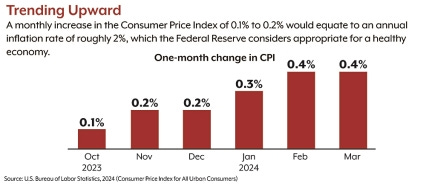
On April 10, 2024, the U.S. Bureau of Labor Statistics released the Consumer Price Index (CPI) for March, and the increase in CPI — the most commonly cited measure of inflation — was higher than expected. The rate for all items (headline inflation) was 3.5% over the previous year, while the “core CPI” rate, which strips out volatile food and energy prices, was even higher at 3.8%. The month-over-month change was also higher than anticipated at 0.4%. (1)

The stock market then dropped sharply on this news and continued to slide over the following days, while economists engaged in public handwringing over why their projections had been wrong and what the higher numbers might mean for the future path of interest rates. Most projections were off by just 0.1% — core CPI was expected to increase by 3.7% instead of 3.8% — which hardly seems earth-shattering to the casual observer. But this small difference suggested that inflation was proving more resistant to the Federal Reserve’s high interest-rate regimen (raising interest rates is one of the most common ways to curb spending and corporate investing to reduce inflationary pressures.) (2)

It’s important to remember that the most dangerous battle against inflation seems to have been won. CPI inflation peaked at 9.1% in June 2022, and there were fears of runaway inflation similar to the 1980s. That did not happen; inflation declined steadily through the end of 2023. The issue now is that there has been upward movement during the first three months of 2024.(3) This is best seen by looking at the monthly rates, which capture the current situation better than the 12-month rates. March 2024 was the third increase month that points to higher inflation (see chart).

High for longer

While price increases hit consumers directly in the pocketbook, the stock market reacted primarily to what stubborn inflation might mean for the benchmark federal funds rate and U.S. businesses. From March 2022 to July 2023, the Federal Open Market Committee (FOMC or AKA the Fed) raised the funds rate from near-zero to the current range of 5.25%–5.5% to slow the economy and hold back inflation.

At the end of 2023, with inflation moving firmly toward the Fed’s target of 2%, the FOMC projected three quarter-percentage point decreases in 2024, and some observers expected the first decrease might be this spring. Now it’s clear that the Fed will have to wait to reduce rates. (4)(5)

Higher interest rates make it more expensive for businesses and consumers to borrow. For businesses, this can hold back expansion and cut into profits when revenue is used to service debt. This is especially difficult for smaller companies, which often depend on debt to grow and sustain operations. Tech companies and banks are also sensitive to high rates. (6)

As mentioned above, in theory, high interest rates should hold back consumer spending and help reduce prices by suppressing demand. So far, however, consumer spending has remained strong. In March 2024, personal consumption expenditures — the standard measure of consumer spending — rose at an unusually strong monthly rate of 0.8% in current dollars or 0.5% when adjusted for inflation. (7)

The job market has also stayed strong, with unemployment below 4% for 26 consecutive months and wages rising steadily. (8)

The fear of keeping interest rates too high for too long is that it could slow the economy, but that is not the case, making it difficult for the Fed to justify rate cuts.

What’s driving inflation?

The Consumer Price Index measures price changes in a fixed market basket of goods and services, and some inputs are weighted more heavily than others.

The cost of shelter is the largest single category, accounting for about 36% of the index and almost 38% of the March increase in CPI. (9) The good news is that measurements of shelter costs — primarily actual rent and estimated rent that homeowners might receive if they rented their homes — tend to lag current price changes, and other measures suggest that rents are leveling or going down. (10)

Two lesser components contributed well above their weight. Gas prices, which are always volatile, comprised only 3.3% of the index but accounted for 15% of the overall increase in CPI. Motor vehicle insurance prices comprised just 2.5% of the index but accounted for more than 18% of the increase. Together, shelter, gasoline, and motor vehicle insurance drove 70% of March CPI inflation. On the positive side, food prices comprised 13.5% of the index and rose by only 0.1%, effectively reducing inflation. (11)

While the Fed pays close attention to the CPI, its preferred inflation measure is the personal consumption expenditures (PCE) price index, which places less emphasis on shelter costs, includes a broader range of inputs, and accounts for changes in consumer behavior. Due to these factors, PCE inflation tends to run lower than CPI. The annual increase in March was 2.7% for all items and 2.8% for core PCE, excluding food and energy. The monthly increase was 0.3% for both measures. (12)

Although these figures are closer to the Fed’s 2% target, they are not low enough, given strong employment and consumer spending, to suggest that the Fed will reduce interest rates anytime soon. It’s also unlikely that the Fed will raise rates.

The Fed seems poised to give current interest rates more time to push inflation to a healthy level, ideally without slowing economic activity. (13)

And since higher interest rates mean more competition for investment dollars and lower corporate earnings, stock markets don’t tend to react favorably, especially when 3-4 interest rate cuts were expected earlier this year.

The Fed issues its next interest rate decision on Wednesday afternoon, May 1, 2024. No change in interest rates is all but a given. However, what Federal Reserve Chairman Jerome Powell says about the recent economic data and the Fed’s stance on when future rate cuts are coming will no doubt be parsed word for word for clues when the press conference is convened.

Please pass the popcorn.

If you would like to review your current investment portfolio or discuss any other retirement, tax, or financial planning matters, please don’t hesitate to contact us at 734-447-5305 or visit our website at http://www.ydfs.com. We are a fee-only fiduciary financial planning firm that always puts your interests first. If you are not a client, an initial consultation is complimentary, and there is never any pressure or hidden sales pitch. We start with a specific assessment of your personal situation. There is no rush and no cookie-cutter approach. Each client and your financial plan and investment objectives are different.

Footnotes:

1, 3, 8–9, 11) U.S. Bureau of Labor Statistics, 2024

2)The New York Times, April 10, 2024

4) Federal Reserve, 2023

5) Forbes, December 5, 2023

6) The Wall Street Journal, April 15, 2024

7, 12) U.S. Bureau of Economic Analysis, 2024

10) NPR, April 18, 2024

13) Bloomberg, April 19, 2024

What You Must Know About the Tax Return Deadline

It’s that time of year, folks, and I wish I were talking about spring. The federal income tax filing deadline for individuals is fast approaching—generally Monday, April 15, 2024. For taxpayers living in Maine or Massachusetts, you get a couple of extra days to procrastinate—your deadline is April 17, 2024.

The IRS has also postponed the deadline for certain disaster-area taxpayers to file federal income tax returns and make tax payments. The current list of eligible localities and other details for each disaster are always available on the IRS website’s Tax Relief in Disaster Situations page. Interest and penalties are suspended until the postponed deadline for affected taxpayers.

If I refer to the April 15 deadline in this article, you can assume I also mean any other postponed original deadline that applies to you.

Need More Time?

If you cannot file your federal income tax return by the April (or other) due date, you can file for an extension by the April 15 due date using IRS Form 4868, “Application for Automatic Extension of Time to File U.S. Individual Income Tax Return.” Most software packages can electronically file this form for you and, if necessary, remit a payment.

Filing this extension gives you until October 15, 2024, to file your federal income tax return. You don’t have to explain why you’re asking for the extension, and the IRS will contact you only if your extension is denied and explain the reason(s). There are no allowable extensions beyond October 15 unless extended by law, or you’re affected by a federally declared disaster area.

Assuming you owe a payment on April 15, you can file for an automatic extension electronically without filing Form 4868. Suppose you make an extension payment electronically via IRS Direct Pay or the Electronic Federal Tax Payment System (EFTPS) by April 15. In that case, no extension form has to be filed (see Pay What You Owe below for more information).

An extension of time to file your 2023 calendar year income tax return also extends the time to file Form 709, “Gift and generation-skipping transfer (GST) tax returns” for 2023.

Special rules apply if you’re a U.S. citizen or resident living outside the country or serving in the military outside the country on the regular due date of your federal income tax return. If so, you’re allowed two extra months to file your return and pay any amount due without requesting an extension. Interest, currently at 8% (but not penalties), will still be charged on payments made after the regular due date without regard to the extended due date.

You can pay the tax and file your return or Form 4868 for additional filing time by June 17, 2024. If you request an extension because you were out of the country, check the box on line 8 of the form.

If you file for an extension, you can file your tax return any time before the extension expires. And there’s no need to attach a copy of Form 4868 to your filed income tax return.

Tip #1: By statute, certain federal elections must be made with a timely filed return or extension and cannot be made after the original due date has passed. For example, if you’re a trader and want to elect trader tax status for the current tax year (2024), it must be made by April 15, 2024, with your timely filed return or attached to your extension. Once April 15 has passed, you are barred from making the election until the following tax year. Some elections may be permanently barred after the regular due date, so check with your tax advisor to see if you need a timely filed election with your return or extension.

Tip #2: For proof of a timely snail-mailed extension, especially for those with a relatively large payment, be sure to mail it by certified mail, return receipt requested (always request proof of delivery regardless of the method of transportation.)

Caveat: Generally, the IRS has three years from the original due date of your return to examine it and assess additional taxes (six years if fraud is suspected). If you extend your return, the three (or six) year “clock” does not start ticking until you file it, so essentially, by extending your return, you are extending the statute of limitations. But contrary to popular belief, requesting an extension does NOT increase your odds of an examination.

Pay What You Owe

One of the biggest mistakes you can make is not filing your return because you owe money. If the bottom line on your return shows that you owe tax, file and pay the amount due in full by the due date if possible. If you cannot pay what you owe, file the return (or extension) and pay as much as you can afford. You’ll owe interest and possibly penalties on the unpaid tax, but you will limit the penalties assessed by filing your return on time. You may be able to work with the IRS to pay the unpaid balance via an installment payment agreement (interest applies.)

It’s important to understand that filing for an automatic extension to file your return does not provide additional time to pay your taxes. When you file for an extension, you must estimate the amount of tax you will owe; you should pay this amount (or as much as you can) by the April 15 (or other) filing due date.  If you don’t, you will owe interest, and you may owe penalties as well. If the IRS believes that your estimate of taxes was not reasonable, it may void your extension, potentially causing you to owe failure to file penalties and late payment penalties as well.

There are several alternative ways to pay your taxes besides via check. You can pay online directly from your bank account using Direct Pay or EFTPS, a digital wallet such as Click to Pay, PayPal, Venmo, or cash using a debit or credit card (additional processing fees may apply). You can also pay by phone using the EFTPS or debit or credit card. For more information, go to Make a Payment.

Tax Refunds

The IRS encourages taxpayers seeking tax refunds to file their tax returns as soon as possible. The IRS anticipates most tax refunds being issued within 21 days of the IRS receiving a tax return if 1) the return is filed electronically, 2) the tax refund is delivered via direct deposit, and 3) there are no issues with the tax return. To help minimize delays in processing, the IRS encourages people to avoid paper tax returns whenever possible.

To check on your federal income tax refund status, wait five business days after electronic filing and go to the IRS page: Where’s My Refund? Your state may provide a similar page to look up state refund status.

State and Local Income Tax Returns

Most states and localities have the same April 15 deadline and will conform with postponed federal deadlines due to federally declared disasters or legal holidays. Accordingly, most states and localities will accept your federal extension automatically (to extend your state return) without filing any state extension forms, assuming you don’t owe a balance on the regular due date. Otherwise, your state or locality may have its own extension form you can use to send in with your payment. Most states also now accept electronic payments online instead of a filed extension form with payment. Never assume that a federal extension will extend your state return; some do not. Always check to be sure.

Tip: If you want to cover all your bases, if your federal extension is lost or invalidated for any reason, you may want to file a state paper or online extension to extend the return correctly. It rarely happens, but sometimes, it is better to be safe than sorry.

IRA Contributions

Contributions to an individual retirement account (IRA) for 2023 can be made up to the April 15 due date for filing the 2023 federal income tax return (this deadline cannot be extended except by statute). However, certain disaster-area taxpayers granted relief may have additional time to contribute.

If you had earned income last year, you may be able to contribute up to $6,500 for 2023 ($7,500 for those age 50 or older by December 31, 2023) up until your tax return due date, excluding extensions. For most people, that date is Monday, April 15, 2024.

You can contribute to a traditional IRA, a Roth IRA, or both. Total contributions cannot exceed the annual limit or 100% of your taxable compensation, whichever is less. You may also be able to contribute to an IRA for your spouse for 2023, even if your spouse had no earned income.

Making a last-minute contribution to an IRA may help reduce your 2023 tax bill. In addition to the potential for tax-deductible contributions to a traditional IRA, you may also be able to claim the Saver’s Credit for contributions to a traditional or Roth IRA, depending on your income.

Even if your traditional IRA contribution is not deductible, and you are ineligible for a Roth IRA contribution (because of income limitations), the investment income generated by the contribution becomes tax-deferred, possibly for years, and the contribution builds cost basis in your IRA, making future distributions a little less taxing.

If you make a nondeductible contribution to a traditional IRA and shortly after that convert that contribution to a Roth IRA, you can get around the income limitation of making Roth contributions. This is sometimes called a backdoor Roth IRA. Remember, however, that you’ll need to aggregate all traditional IRAs and SEP/SIMPLE IRAs you own — other than IRAs you’ve inherited — when you calculate the taxable portion of your conversion. If your traditional IRA balance before the non-deductible contribution is zero, then you’ll owe no tax on the conversion, and voila! You have just made a legal Roth IRA contribution.

Making a last-minute contribution to an IRA may help reduce your 2023 tax bill. In addition to the potential for tax-deductible contributions to a traditional IRA, you may also be able to claim the Saver’s Credit for contributions to a traditional or Roth IRA, depending on your income.

If you would like to review your current investment portfolio or discuss any other retirement, tax, or financial planning matters, please don’t hesitate to contact us at 734-447-5305 or visit our website at http://www.ydfs.com. We are a fee-only fiduciary financial planning firm that always puts your interests first. If you are not a client, an initial consultation is complimentary, and there is never any pressure or hidden sales pitch. We start with a specific assessment of your personal situation. There is no rush and no cookie-cutter approach. Each client is different, and so are your financial plan and investment objectives.

New Retirement Options Starting in 2024

The SECURE 2.0 Act, passed in December 2022, made wide-ranging changes to U.S. tax laws related to retirement savings. While some provisions were effective in 2023, others did not take effect until 2024. Here is an overview of some important changes for this year:

Matching student loan payments

Employees who make student loan repayments may receive matching employer contributions to a workplace retirement plan as if the repayments were employee contributions to the plan. This applies to 401(k), 403(b), and government 457(b) plans and SIMPLE IRAs. Employers are not required to make matching contributions in any situation, but this provision allows them to offer student loan repayment matching as an additional benefit to help address the fact that people paying off student loans may struggle to save for retirement.

New early withdrawal exceptions

Withdrawals before age 59½ from tax-deferred accounts, such as IRAs and 401(k) plans, may be subject to a 10% early distribution penalty on top of ordinary income tax. There is a long list of exceptions to this penalty, including two new ones for 2024.

Emergency expenses — one penalty-free distribution of up to $1,000 is allowed in a calendar year for personal or family emergency expenses; no further emergency distributions are allowed during a three-year period unless funds are repaid or new contributions are made that are at least equal to the withdrawal.

Domestic abuse — a penalty-free withdrawal equal to the lesser of $10,000 (indexed for inflation) or 50% of the account value is allowed for an account holder who certifies that he or she has been the victim of domestic abuse during the preceding one-year period.

Emergency savings accounts

Employers can create an emergency savings account linked to a workplace retirement plan for non-highly compensated employees.  Employee contributions are after-tax and can be no more than 3% of salary, up to an account cap of $2,500  (or lower as set by the employer). Employers can match contributions up to the cap, but any matching funds go into the employee’s workplace retirement account.

Clarification for RMD ages

SECURE 2.0 raised the initial age for required minimum distributions (RMDs) from traditional IRAs and most workplace plans from 72 to 73 beginning in 2023 and 75 beginning in 2033. However, the language of the law was confusing. Congress has clarified that age 73 initial RMDs apply to those born from 1951 to 1959, and age 75 applies to those born in 1960 or later. This clarification will be made official in a law correcting a number of technical errors, expected to be passed in early 2024.

No more RMDs from Roth workplace accounts

Under previous law, RMDs did not apply to original owners of Roth IRAs, but they were required from designated Roth accounts in workplace retirement plans. This requirement will be eliminated beginning in 2024.

Transfers from a 529 college savings account to a Roth IRA

Beneficiaries of 529 college savings accounts are sometimes “stuck” with excess funds that they did not use for qualified education expenses. Beginning in 2024, a beneficiary can execute a direct trustee-to-trustee transfer from any 529 account in the beneficiary’s name to a Roth IRA, up to a lifetime limit of $35,000. The 529 account must have been open for more than 15 years. These transfers are subject to Roth IRA annual contribution limits, requiring multiple transfers to use the $35,000 limit. The IRS is still working on specific guidance on this law change, so it might pay to wait a few months before making this type of transfer.

Increased limits for SIMPLE plans

Employers with SIMPLE IRA or SIMPLE 401(k) plans can now make additional nonelective contributions up to the lesser of $5,000 or 10% of an employee’s compensation, provided the contributions are made to each eligible employee in a uniform manner. The limits for elective deferrals and catch-up contributions, which are $16,000 and $3,500, respectively, in 2024, may be increased by an additional 10% for a plan offered by an employer with no more than 25 employees. An employer with 26 to 100 employees may allow higher limits if it provides either a 4% match or a 3% nonelective contribution.

Inflation indexing for QCDs

Qualified charitable distributions (QCDs) allow a taxpayer who is age 70½ or older to distribute up to $100,000 annually from a traditional IRA to a qualified public charity. Such a distribution is not taxable and can be used in lieu of all or part of an RMD. Beginning in 2024, the QCD amount is indexed for inflation, and the 2024 limit is $105,000.

SECURE 2.0 created an opportunity (effective 2023) to use up to $50,000 of one year’s QCD (i.e., one time only) to fund a charitable gift annuity or charitable remainder trust. This amount is also indexed to inflation beginning in 2024, and the limit is $53,000.

Catch-up contributions: indexing, delay, and correction

Beginning in 2024, the limit for catch-up contributions to an IRA for people ages 50 and older will be indexed to inflation, which could provide additional saving opportunities in future years. However, the limit did not change for 2024 and remains $1,000. (The catch-up contribution limit for 401(k)s and similar employer plans was already indexed and is $7,500 in 2024.)

The SECURE 2.0 Act includes a provision — originally effective in 2024 — requiring that catch-up contributions to workplace plans for employees earning more than $145,000 annually must be made on a Roth basis. In August 2023, the IRS announced a two-year “administrative transition period” that effectively delays this provision until 2026. In the same announcement, the IRS affirmed that catch-up contributions in general will be allowed in 2024, despite a change related to this provision that could be interpreted to disallow such contributions. The error will be corrected in the 2024 technical legislation.

If you would like to review your current investment portfolio or discuss any other retirement, tax, or financial planning matters, please don’t hesitate to contact us at 734-447-5305 or visit our website at http://www.ydfs.com. We are a fee-only fiduciary financial planning firm that always puts your interests first. If you are not a client yet, an initial consultation is complimentary, and there is never any pressure or hidden sales pitch. We start with a specific assessment of your personal situation. There is no rush and no cookie-cutter approach. Each client is different, and so are your financial plan and investment objectives.

Last Minute Year-End Tax Planning for 2023

The window of opportunity for many year-end tax-saving moves closes on December 31, so it’s important to evaluate your tax situation now, while there’s still time to affect your bottom line for the 2023 tax year.

Timing is Everything

Consider any opportunities you may have to defer income to 2024. Doing so may allow you to postpone paying tax on the income until next year. If there’s a chance that you’ll be in a lower income tax bracket next year, deferring income could mean paying less tax on the income as well.

Some examples:

·       Check with your employer to see if there is an opportunity to defer year-end bonuses.

·       Defer the sale of capital gain property (or take installment payments rather than a lump-sum payment)

·       Postpone receipt of distributions (other than required minimum distributions) from retirement accounts.

Similarly, consider ways to accelerate deductions into 2023. If you itemize deductions, you might accelerate some deductible expenses by making payments before year-end.

Some examples:

·       Consider paying medical expenses or bills in December rather than January, if doing so will allow you to qualify for the medical expense deduction (must be more than 7.5% of your income).

·       Prepay deductible interest by accelerating your January mortgage payment into December.

·       Make January alimony payments in December

·       Make next year’s charitable contributions in December

·       Pay state and local taxes (income taxes, property taxes, use taxes, etc.) if you’re below the $10,000 maximum allowed itemized deduction for state and local taxes

·       Purchase that piece of equipment or vehicle needed in your business and place it in service by year-end

Sometimes, however, it may make sense to take the opposite approach — accelerating income into 2023 and postponing deductible expenses to 2024. That might be the case, for example, if you can project that you’ll be in a higher tax bracket in 2024; paying taxes this year instead of next might be outweighed by the fact that the income would be taxed at a higher rate next year.

Factor in the Alternative Minimum Tax (AMT)

Although the number of taxpayers subject to the AMT is much lower than in prior years, make sure that you factor in the alternative minimum tax when deciding to accelerate any deductions. If you’re subject to the AMT, traditional year-end maneuvers, like deferring income and accelerating deductions, can have a potentially negative effect. That’s because the AMT — essentially a separate, parallel income tax with its own rates and rules — effectively disallows several itemized deductions. For example, if you’re subject to the AMT in 2023, prepaying 2024 state and local taxes won’t help your 2023 tax situation but could potentially hurt your 2024 bottom line.

Special Concerns for Higher-Income Individuals

The top marginal tax rate (37%) applies if your taxable income exceeds $578,125 in 2023 ($692,750 if married filing jointly, $346,875 if married filing separately, $578,100 if head of household). Your long-term capital gains and qualifying dividends could be taxed at a maximum 20% tax rate if your taxable income exceeds $492,300 in 2023 ($553,850 if married filing jointly, $276,900 if married filing separately, $523,050 if head of household).

Additionally, a 3.8% net investment income tax (unearned income Medicare contribution tax) may apply to some or all of your net investment income if your modified AGI exceeds $200,000 ($250,000 if married filing jointly, $125,000 if married filing separately).

High-income individuals are subject to an additional 0.9% Medicare (hospital insurance) payroll tax on wages exceeding $200,000 ($250,000 if married filing jointly or $125,000 if married filing separately).

Charitable Contribution Planning

If you are planning to donate to a charity, it’s likely better to make your contribution before the end of the year to potentially save on taxes. There are many tax planning strategies surrounding charitable giving:

·       Consider donating appreciated property (such as securities, real estate, or artwork) that has been held for more than one year, rather than cash. Note that an appraisal may be needed for certain properties. Not only do you get a deduction for the fair market value (FMV) of your appreciated stock, but you save on taxes by not recognizing the capital gains on the appreciation.

·       Opening and funding a donor-advised fund (DAF) is appealing to many as it allows for a fully tax-deductible gift in the current year and the ability to dole out those funds to charities over multiple years. Again, if you donate appreciated securities to a DAF, not only do you get a deduction for the FMV of your appreciated stock, but you save on taxes by not recognizing the capital gains on appreciation.

·       Qualified charitable distributions (QCDs) up to $100,000 are another option for certain older taxpayers (age 70-1/2 or older) who don’t typically itemize on their tax returns. If you don’t have a required minimum distribution (RMD) from your retirement accounts (see below), this will help reduce future RMDs and taxable income. If you do have an RMD requirement from your retirement accounts, this could be an even better strategy for you to reduce your current taxable income.

Note that it’s important to have adequate documentation of all claimed donations, including a letter from the charity for donations of $250 or more.

Required Minimum Distributions (RMDs)

Unfortunately, you cannot keep retirement funds in your account indefinitely. RMDs are the minimum amount you must annually withdraw from your retirement accounts once you reach a certain age (generally now age 73). Failure to do so can result in significant penalties (special rules apply if you’re still working and participating in your employer’s retirement plan). You must make the withdrawals by the date required — the end of the year for most individuals.

As described above, there are also opportunities to distribute retirement funds to a qualified charity to satisfy the RMD without incurring taxes. Missed RMDs are subject to steep excise tax penalties (25%), although recent rules greatly reduce the penalty (to 10%) if the missed RMD is taken within two years.

Digital Assets and Virtual Currency

Digital assets are defined under the U.S. income tax rules as any digital representation of value that may function as a medium of exchange, a unit of account, or a store of value. Digital assets may include virtual currencies such as Bitcoin and Ether, Stablecoins such as Tether and USD Coin (USDC), and non-fungible tokens (NFTs).

The sale or exchange of virtual currencies, the use of such currencies to pay for goods or services, or holding such currencies as an investment, generally have tax impacts –– and the IRS continues to increase its scrutiny in this area. The trading and use of digital assets must be disclosed on your tax returns and, since they are considered property rather than investments, different tax rules apply to their sales and exchanges.

Energy tax credits

From electric vehicles to home car chargers to solar panels, “going green” continues to provide tax incentives. The Inflation Reduction Act of 2022 included new and newly expanded tax credits for solar panels, electric vehicles (EV), and energy-efficient home improvements. The rules are complex but there is still time for these credits to be beneficial in the current and next year. The most notable change to the EV credits is the requirement that the vehicle has final assembly in North America. If you are planning an EV purchase, please ask the dealer whether the vehicle you’re eyeing is on the list of qualifying vehicles, which has changed significantly in the past years. See if they can advance the credit to you as an offset to the vehicle purchase price (you’ll have to sign a form to assign the credit to the dealer.)

Bump Up Withholding to Avoid 2024 Underpayment

If it looks as though you will owe federal income tax for the year, consider increasing your withholding on Form W-4 for 2024 with your employer (also consider doing the same on the appropriate state withholding forms). The biggest advantage in doing so is that withholding is considered as having been paid evenly throughout the year instead of when the dollars are taken from your paycheck. This strategy can be used instead of making quarterly estimated tax payments.

If you’re collecting social security, a pension, or taxable IRA distributions, update your Form W-4P with the appropriate payor to ensure you’ve paid in enough to avoid underpayment penalties.

Beneficial Ownership Interest (BOI) Reporting

The Corporate Transparency Act (CTA) requires the disclosure of the beneficial ownership information of certain entities to the Financial Crimes Enforcement Network (FinCEN) starting in 2024. This is not a tax filing requirement, but an online report to be completed if applicable to FinCEN. There are severe penalties for businesses who willingly do not comply with the requirements. The details of this reporting requirement are still being written, so it’s best to get in touch with your business attorney to determine whether your corporation, partnership, or LLC must file this report.

Additional Tax and Financial Planning Considerations

We recommend you review your retirement plans at least annually. That includes making the most of tax-advantaged retirement saving options, such as traditional individual retirement accounts (IRAs), Roth IRAs, and company retirement plans. It’s also advisable to take advantage of health savings accounts (HSAs) that can help you reduce your taxes and save for medical-related expenses. Once you become eligible or sign up for Medicare, you are no longer entitled to make HSA contributions.

IRAs and Retirement Plans

Make sure you’re taking full advantage of tax-advantaged retirement savings vehicles. Traditional IRAs and employer-sponsored retirement plans such as 401(k) plans allow you to contribute funds on a deductible (if you qualify) or pre-tax basis, reducing your 2023 taxable income. Contributions to a Roth IRA (assuming you meet the income requirements) or a Roth 401(k) aren’t deductible since they are made with post-tax dollars, so there’s no tax benefit for 2023, but qualified Roth distributions are completely free from federal income tax, which can make these retirement savings vehicles appealing.

For 2023, you can contribute up to $22,500 to a 401(k) plan ($30,000 if you’re age 50 or older) and up to $6,500 to a traditional IRA or Roth IRA ($7,500 if you’re age 50 or older). The window to make 2023 contributions to an employer plan typically closes at the end of the year, while you generally have until the April tax return filing deadline (April 15, 2024) to make 2023 IRA contributions.

If you started a small business in 2023, talk to your financial or tax advisor about setting up a small business retirement plan before year-end. Most plans must be set up before year-end, but contributions may not be required every year, and they don’t have to be made until the due date of the return (plus extensions). Some small business retirement plans can be set up at tax return time (e.g., SEP-IRA), but they have less contribution flexibility and more stringent rules than other plans (e.g., a solo 401(k)).

Roth IRA Conversions

Year-end is a good time to evaluate whether it makes sense to convert a tax-deferred savings vehicle like a traditional IRA or a 401(k) account to a Roth account. When you convert a traditional IRA to a Roth IRA, or a traditional 401(k) account to a Roth 401(k) account, the converted funds are generally subject to federal income tax in the year that you make the conversion (except to the extent that the funds represent nondeductible after-tax contributions).

If a Roth conversion does make sense, you’ll want to give some thought to the timing of the conversion. For example, if you believe that you’ll be in a better tax situation this year than next (e.g., you will pay tax on the converted funds at a lower rate this year), you might think about acting now rather than waiting. Whether a Roth conversion is appropriate for you depends on many factors, including your current and projected future income tax rates and whether you have the funds to pay the taxes outside of the IRA. Ask your financial or tax advisor whether a Roth Conversion is appropriate for this year or next.

Other Ideas

·       Life changes –– Any major changes in your life such as marriages or divorces, births or deaths in the family, job or employment changes, starting a business, and significant expenditures (real estate purchases, college tuition payments, etc.) can significantly impact the taxes you owe, so be sure to discuss them with your tax or financial advisor.

·       Capital gains/losses –– Consider tax benefits related to using capital losses to offset realized gains –– and move any gains to the lowest tax brackets, if possible. Also, consider selling portfolio investments that are underperforming before the end of the year. Net capital losses can offset up to $3,000 of the current year’s ordinary income. The unused excess net capital loss can be carried forward to use in subsequent years.

·       Estate and gift tax planning –– Make sure you’re appropriately planning for estate and gift tax purposes. There is an annual exclusion for gifts ($17,000 per donee in 2023, $34,000 for married couples) to help save on potential future estate taxes. If your estate/trust is worth over $5 million, it’s imperative to discuss your options with a dedicated estate planning attorney to review lifetime gift and generation-skipping transfer (GST) opportunities to use and plan additional exclusions and exemption amounts.

·       State and local taxes –– Remote working arrangements or moving your residency could potentially have state and local tax implications to consider. Be sure to discuss your working arrangements with your tax advisor.

·       Education planning –– Save for education with Section 529 education savings plans. There can be state income tax benefits to do so, and there have been changes in the way these funds can be used for private K-12 school expenses, paying down some student loans, or contributing leftover funds to Roth IRAs.

·       Updates to financial records –– Determine whether any updates are needed to your insurance policies or beneficiary designations. This should be checked at least once a year, and year-end is a good time to do so.

·       Estimated tax payments –– With underpayment interest rates being on the rise (currently at 8% for federal), you must review withholding and estimated tax payments and assess any requirements for any additional payments. The 4th quarter 2023 estimated income tax payment is due by January 16, 2024.

Hopefully one or more of the above tips helps you save a few dollars on your tax bill. By necessity, many of the tips are abbreviated, so be sure to check with your financial or tax advisor to ensure that they’re appropriate for your tax situation, both currently and in the future.

If you would like to review your current investment portfolio or discuss any other tax or financial planning matters, please don’t hesitate to contact us or visit our website at http://www.ydfs.com. We are a fee-only fiduciary financial planning firm that always puts your interests first.  If you are not a client yet, an initial consultation is complimentary and there is never any pressure or hidden sales pitch. We start with a specific assessment of your personal situation. There is no rush and no cookie-cutter approach. Each client is different, and so are your financial plan and investment objectives.