Understanding Invesco’s Aggressive QQQ Proxy Push

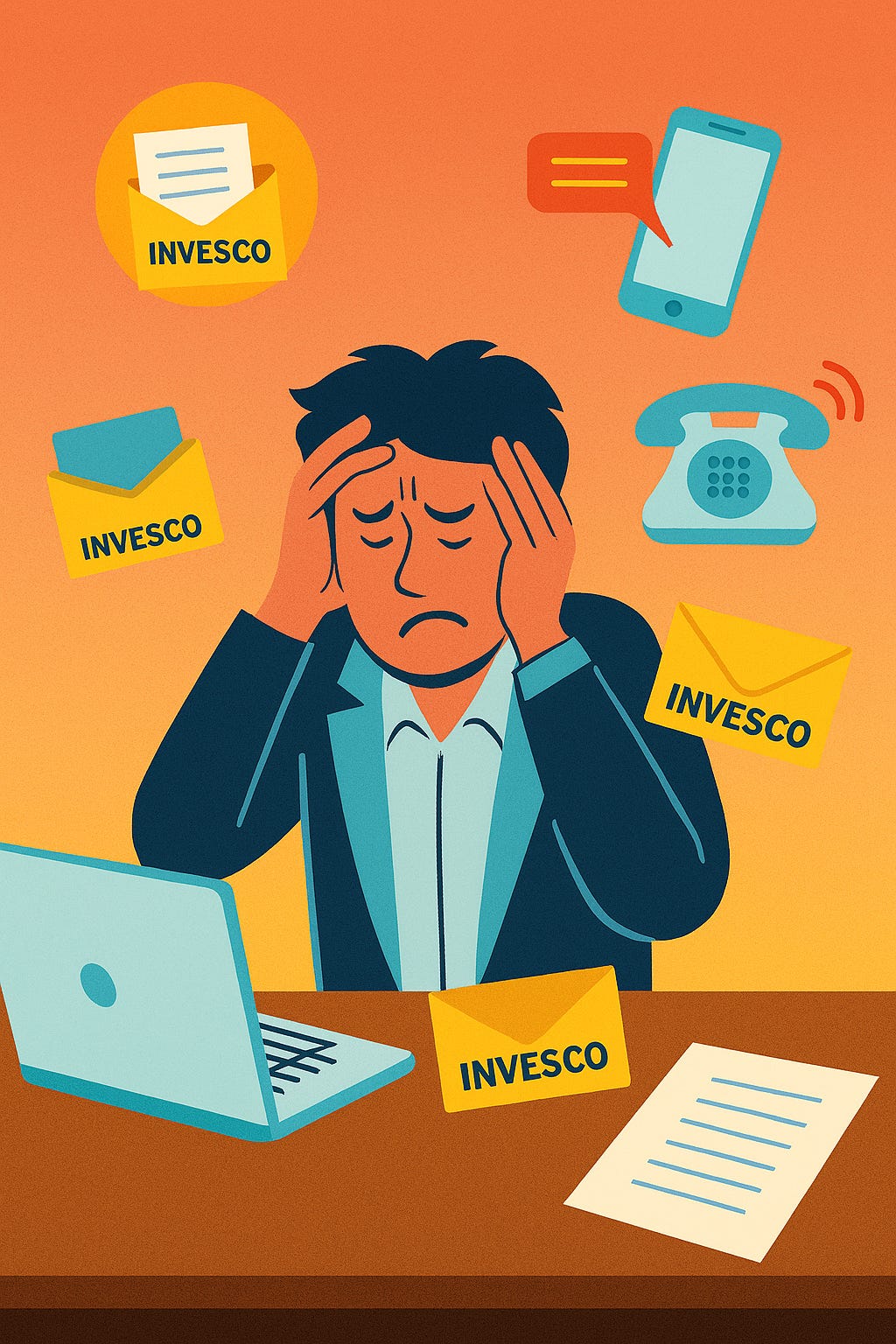
Several clients have written to me inquiring about the barrage of calls, emails, and messages from Invesco regarding the ETF QQQ’s push to gather proxy votes. Here’s an excerpt of one client’s question and my response (greatly expanded for this article):

“…not the most consequential message you’ll receive this year, but my curiosity has been piqued … by the campaign from Invesco QQQ to cast a proxy vote. I’ve never seen anything like it – the mailings, the calls, and so on – for a process that, in my experience, has always been ultra-routine and pretty meaningless for someone like me. Can you explain, and do you have any advice?”

Thanks for reading Uncommon Cents! Subscribe for free to receive new posts and support my work.

Here’s how I responded

Regarding the campaign, you’re not alone. Many clients have noticed the unusually intense campaign from Invesco regarding the proxy vote for Invesco QQQ, and you’re right that it stands out from what’s usually a routine process for most fund shareholders.

Early on, my business partner suggested that I write and send an email to clients about this. Not realizing the intensity of Invesco’s push, I decided we didn’t need to, which turned out to be a mistake. In all my years in the business, I’ve never seen or heard of any company launching such an intense and aggressive proxy gathering campaign.

Here’s what’s really going on

Invesco is proposing to convert the ETF QQQ from its current structure (a unit investment trust, which dates back to the earliest ETFs) into a modern, open-ended exchange-traded fund. The primary rationale is to enhance flexibility, oversight, and reduce costs. Specifically, if shareholders approve, the QQQ expense ratio would decrease by 10% (from 0.20% to 0.18%), resulting in tens of millions of dollars in yearly savings across the fund. Importantly, this change won’t impact QQQ’s strategy, holdings, or tax characteristics, nor will it change the fund’s manager or its index-tracking approach.

The reason you’ve gotten multiple mailings and calls? Invesco requires a high level of shareholder participation: by law, converting QQQ’s trust structure requires more than half of all shares to be actively voted “yes.” Unlike typical votes where non-responses are ignored, in this case, non-votes count as “no” votes—which is why the fund is spending so much to encourage participation and obtain a quorum. With so many retail investors holding QQQ, this is a true logistical challenge.

Details of the push

  • Three separate proposals must all pass: shareholders are voting on three linked items: conversion from a unit investment trust to an open-ended ETF, associated changes to the management/advisory structure, and the creation of a board of directors. If any proposal fails, none of the changes will be implemented.​
  • Non-votes count as “No” votes: Unlike routine proxy votes, shareholders who do not respond are counted against the proposals, making high participation essential.​
  • Shareholder benefits include:
    • Lower expense ratio (from 0.20% to 0.18%, estimated savings ~$70 million/year).​
    • Enhanced governance via a new board overseeing the fund for the first time; greater reporting and transparency, including summary prospectuses and semi-annual reports.​
  • No change to investment objective, index, or tax treatment: The fund will continue to track the Nasdaq-100® Index. The conversion is a tax-free event for shareholders.​
  • Huge outreach effort: Invesco is spending an estimated $40 million on proxy solicitation to ensure quorum, highlighting the unusual scale and importance of this campaign.​
  • Record date: August 15, 2025. Only shareholders of record as of this date are eligible to vote.​
  • If approved, conversion is likely to happen by year-end or early 2026.

Potential downsides of shareholder approval

  • Increased Operational Flexibility Means More Managerial Discretion: The move to an open-ended fund structure allows Invesco and its new board greater latitude in making changes, such as fee adjustments or introducing derivatives, that previously required more restrictive oversight under the unit investment trust (UIT) format. This future flexibility depends on the intentions and discipline of the board and managers, and could shift if there’s turnover in leadership.​
  • Invesco Begins Collecting Direct Management Fees: The new format allows Invesco to collect a “unitary management fee” that the trust structure previously didn’t permit. This creates an incentive to grow profits and, potentially, alter expenses down the line, despite the initial fee reduction.​
  • Board Compensation and Governance Costs: A nine-member board will be introduced, which adds an additional cost layer (director compensation and overhead) that could offset some savings or shift incentives compared to a strictly trustee-based approach.​
  • Liquidity Risk in Market Downturns: Open-ended funds may be forced to sell portfolio assets at unfavorable prices if a large number of investors redeem shares during periods of stress, potentially impacting performance. The UIT structure allows shares to trade among investors without requiring the sale of underlying assets, a mechanism that some investors value for stability during volatile times.​
  • Shareholder Risk in Securities Lending: Invesco may expand its securities lending activities under the new structure, and any resulting risks or losses would be borne directly by shareholders, not by Invesco.​
  • No Guarantee Future Fees Will Remain Lower: While initial projections indicate a 10% reduction in the expense ratio, future changes to fee schedules are possible under the new open-ended structure, subject to board approval.​

While many see these risks as manageable, they should be evaluated alongside the promised benefits. It’s important for shareholders to understand both sides before casting a vote.

What major institutional holders think

Major institutions that hold QQQ have generally leaned in support of the conversion vote, viewing the restructuring as beneficial for both operational efficiency and cost reduction. However, the fund has an unusually large retail investor base, making institutional votes influential but insufficient to guarantee passage, which is why Invesco has mounted such an aggressive campaign.​

  • Institutional Sentiment: Proxy advisory firms and ETF strategists have publicly supported the move, highlighting reduced expense ratios, improved governance via a new board, and enhanced transparency as positives for shareholders. Major institutional holders—including major brokerage platforms, asset managers, and pension funds—are widely expected to vote in favor due to these clear-cut advantages, as their own portfolios will directly benefit from fee savings.​
  • Voting Weight: Institutions typically vote their shares, but approximately 40–50% of QQQ ownership is held by retail investors, and a majority of the outstanding shares must vote “yes” for the conversion to occur.​
  • No Institutional Opposition Spotted: As of now, there is no reported campaign of institutional opposition to the change; the proposal is seen industry-wide as a modernization step that aligns QQQ with other large ETFs.

What I think

This change appears to be designed to benefit shareholders by offering lower costs and greater transparency. Despite the potential downsides, it is unlikely to introduce major surprises or large additional risks.

If you agree, I’d suggest voting in favor; however, you won’t be at any disadvantage if you simply ignore the campaign—the fund will continue regardless. Invesco’s push is simply a matter of meeting the voting threshold they need.

Timing of the vote postponed

The original QQQ conversion proxy vote was scheduled for October 24, 2025. After failing to reach a quorum at the original meeting, the vote was postponed to December 5, 2025.

It sounds like the phone calls, emails, snail mail, and text messages will continue for a few more weeks. Or as they say, “the beatings will continue until morale improves.” Maybe casting your vote will stop all the messages. In any case, it’s worth a try.

Sam H. Fawaz CFP®, CPA, PFS is the President of YDream Financial Services, Inc., a fee-only investment advisory and financial planning firm serving the entire United States. If you would like to review your current investment portfolio or discuss any other retirement, college, tax, or financial planning matters, please don’t hesitate to contact us or visit our website at http://www.ydfs.com. We are a fiduciary financial planning firm that always puts your interests first, with no products to sell. If you are not a client, an initial consultation is complimentary, and there is never any pressure or hidden sales pitch. We begin with a thorough assessment of your unique personal situation. There is no rush and no cookie-cutter approach. Each client’s financial plan and investment objectives are unique.

The High Ground: Why AI Will Never Replace Human Financial Planners

Introductory Note: I was inspired to write this based on a recent rant by one of the fathers of the financial planning profession and author of “Inside Information”, Bob Veres. I’ve used his rant (with his express written permission) to expand on this topic.

Every few months, the same headline resurfaces—“Artificial intelligence (AI) won’t replace human financial planners.” It’s meant to reassure, but perhaps we should also ask: why does this declaration keep needing to be made?

These forecasts of inevitable obsolescence have circulated through our profession for decades. We heard them when the first planning programs rolled out in the early 1980s. We heard them again in the 2010s, when “robo‑advisors” promised efficient algorithms would do the same work for a fraction of the cost. Today, with artificial intelligence reshaping industries from law to logistics, we’re told—yet again—that technology will soon do it all… but “not yet.”

My position is simpler: not ever.

Am I being naive or perhaps ignorant of where AI is headed? Perhaps.

Many don’t know this, but the roots of the “geek” in my financial planning moniker, “themoneygeek,” stem from my strong interest and decades-long professional background and expertise working in technology as a software product manager, technology consultant, and educator.

I got my start in the financial planning profession by first consulting with other financial planners on their technology architecture needs to get that proverbial foot in the door. So, as a self-declared technogeek since the 1980s, I have some credibility when making this statement.

What Technology Really Does Best

Let’s be clear—technology is not the enemy of good advice. It’s an amplifier. AI‑driven tools can already integrate real‑time market data, automate rebalancing, flag tax‑loss harvesting opportunities, model cash flow across multiple scenarios, and surface insights about spending or risk that would take hours to identify manually.​

A fee‑only fiduciary who embraces these tools can deliver faster answers, cleaner reporting, and deeper analytics. In that sense, technology actually gives human advisors more leverage to serve their clients—just as earlier innovations like portfolio management and financial planning software once did.​

But algorithms can’t build trust, navigate life events, or calm a shaken client during a market shock. A spreadsheet doesn’t hear the fear in someone’s voice. A chatbot doesn’t see a spouse’s expression at the thought of retiring early or funding a child’s education.

The True Frontier of Advice

The maturation of our profession has always followed an upward path—from product sales, to planning, to personalized professional advice. The next step is coaching: helping clients clarify what they truly want from this one precious life they’ve been given.

That process involves conversations about purpose, family, trade‑offs, and meaning—topics that no predictive model can quantify. Many clients, given the tools, still won’t set priorities or pursue their deeper goals without a trusted nudge from a human advisor. They’ll plan for others before they plan for themselves. And that’s where the real value of our work lies: helping people live their money, not just manage it.​

Where the “High Ground” Lies

The safest territory from automation is not in number‑crunching but in connection—the human partnership that turns goals into action.

Technology can see patterns. Only people can see you.

Artificial intelligence will make planners faster, smarter, and more efficient—but never replace the relationship that gives planning its meaning.

So rather than defending our values against technology, let’s stand firmly on higher ground:

Empathy. Context. Coaching. Accountability.

Those are the edges no algorithm can reach.

Sam H. Fawaz CFP®, CPA, PFS is the President of YDream Financial Services, Inc., a fee-only investment advisory and financial planning firm serving the entire United States. If you would like to review your current investment portfolio or discuss any other retirement, college, tax, or financial planning matters, please don’t hesitate to contact us or visit our website at http://www.ydfs.com. We are a fiduciary financial planning firm that always puts your interests first, with no products to sell. If you are not a client, an initial consultation is complimentary, and there is never any pressure or hidden sales pitch. We begin with a thorough assessment of your unique personal situation. There is no rush and no cookie-cutter approach. Each client’s financial plan and investment objectives are unique.
U.S. Government Shutdown 2025: What It Means and How Long It Could Last

The federal government officially shut down many of its operations at 12:01 a.m. on October 1, 2025. (1) This is the 15th government shutdown since 1980. Most were short, lasting one to three days. The longest lasted 34 full days, from December 2018 to January 2019. (2)

It’s impossible to predict how long the current shutdown might last, but it may be helpful to know more about why it happened and what you can expect if it continues.

Zero out of 12 appropriations bills

The federal fiscal year begins on October 1, and under normal procedures, twelve appropriations bills for various government sectors are expected to be passed by that date to fund activities ranging from federal employee salaries to national park operations and food safety inspections.

These appropriations are considered discretionary spending, meaning that Congress has the flexibility to set the amounts. Obviously, it would be helpful for federal agencies to know their operating budgets in advance of the fiscal year, but all 12 appropriations bills have not been passed before October 1 (or any time during the year) since FY 1997. (3)

In 2018–19, five of the twelve appropriations bills had passed prior to the shutdown, which helped limit the damage. (4) This year, no appropriations bills have been passed. However, some agencies — primarily in the Department of Defense and Department of Homeland Security — received new funding from the One Big Beautiful Bill Act passed this summer, which may allow certain programs and functions to continue. (5)

Continuing resolutions and omnibus spending bills

To buy time for further negotiations, Congress typically passes a continuing resolution, which extends federal spending to a specific date, generally at or based on the level of the previous year. These bills are essentially placeholders that keep the government open until full-year spending legislation is enacted.

Even with the extensions provided by continuing resolutions, Congress seldom passes individual appropriations bills. Instead, they are often combined into massive omnibus spending bills that may include other provisions unrelated to funding.

The current situation

The U.S. Constitution gives the House of Representatives sole power to initiate revenue bills, so the House typically passes funding legislation and sends it to the Senate. Whereas the House can pass legislation with a simple majority, the Senate generally requires 60 votes to pass legislation due to the filibuster rule. This, in turn, typically requires cooperation from both political parties.

The House approved a continuing resolution that would extend funding for seven weeks at current levels of spending. Senate Republicans, with one exception, voted for the bill late on the night of September 30, joined by three Democrats for a total of 55 votes, five votes short of the 60 votes needed to pass. Earlier in the evening, a Democrat-sponsored continuing resolution also failed to pass. (6)

Although a larger group of Senate Democrats provided support for a similar continuing resolution in March, they have refused to support this resolution unless it includes an extension of Affordable Care Act (ACA) health insurance subsidies that are scheduled to expire on December 31, 2025.

Allowing the ACA subsidies to lapse could significantly raise health insurance premiums for many Americans, and Republican leadership has expressed a willingness to consider extending them, but not as part of the continuing resolution. Democrats also seek to reverse spending cuts to Medicaid. (7)

Effects of the shutdown

According to the law, the U.S. Treasury cannot spend money that has not been approved by Congress. Therefore, agencies that rely on discretionary spending cannot pay their employees or maintain essential services.

Each agency has its own shutdown plan. Certain “essential services” — primarily related to public safety — will continue and be funded retroactively after funding has been authorized. Here are the potential effects on some key services. (8–12)

· Mail will continue to be delivered because the U.S. Postal Service is self-funded.

· Social Security, Medicare, and Medicaid will continue to make payments because the funds for these programs do not require annual appropriations. However, other services, such as benefit verifications and application processing, may cease.

· Interest on Treasury securities will continue to be paid.

· Federal workers will not be paid. Workers considered “essential” will be required to work without pay, while others would typically be furloughed. However, the Trump administration has issued instructions that agencies should use the shutdown as an opportunity to reduce their workforces, an action that has not occurred during previous shutdowns. Lost wages for essential and furloughed employees will be reimbursed after funding is approved.

· Unlike federal employees, private contractors who often work side-by-side with federal employees are not guaranteed to be paid.

· Air travel could be affected. In 2019, high absenteeism among Transportation Security Administration (TSA) workers, who were required to work without pay, resulted in long lines, delays, and gate closures at some airports.

· Environmental and food inspections could stop.

· “Accessible areas” of national parks, such as roads, trails, and open-air memorials, will remain open, as will locations and services supported directly by visitor fees. Other areas may be closed, and visitor services may be unavailable.

· The Internal Revenue Service has special funding that will allow it to maintain operations for the first five business days of the shutdown. It’s unclear what would happen after that, but if a large number of workers are furloughed, the IRS would be unable to perform verifications for income and Social Security numbers, which could delay mortgage and other loan applications. Tax refunds could also be delayed.

· Key economic reports, like the monthly jobs report, may be delayed, making it more difficult for the Federal Reserve to gauge economic activity when making decisions.

· The National Flood Insurance Program will stop issuing policies or renewals.

· Federal student loan disbursements and grants to local school districts should continue, along with processing the Free Application for Federal Student Aid (FAFSA). However, an extended shutdown could cause delays in processing and support activities, and schools located on federal land, such as Indian reservations or military bases, could temporarily lose funding.

· The Supplemental Nutrition Assistance Program (SNAP or food stamps) and the Special Supplemental Nutrition Program for Women, Infants, and Children (WIC) will continue for now, but it is unclear how long they can be sustained.

While any shutdown causes hardship for federal workers and the citizens they serve, a brief shutdown typically has a minimal effect on the broader U.S. economy, because lost payments are generally made up after spending is authorized. However, an extended shutdown can be costly.

The Congressional Budget Office estimated that the 2018–19 shutdown reduced gross domestic product (GDP) by $11 billion, including $3 billion that was never recovered. Even so, this was a tiny fraction of GDP. (13)

Previous shutdowns have generally not significantly impacted global markets, except for some moderate short-term volatility. However, a prolonged shutdown could have a greater temporary impact. (14)

If the shutdown continues, be sure to check the status of federal agencies and services that may directly affect you.

Shutdown effects on markets and the debt ceiling

The current shutdown has sparked little more than a yawn among investors. On the first two days of the shutdown, the S&P 500 index closed higher, suggesting that many people are barely aware of what is happening or the potential ramifications.

Although the current debate is not directly related to the debt ceiling, we will likely confront that issue again in January.

The debt ceiling was temporarily suspended in August 2023 through December 31, 2024. However, once the suspension expired, the debt ceiling was reinstated to approximately $36.1 trillion to account for obligations incurred during the suspension period.

Congress raised the statutory debt ceiling by $5 trillion in July 2025, increasing the limit from $36.1 trillion to $41.1 trillion. Interestingly, the national debt is projected to surpass $39.4 trillion by January 1, 2026.

While it appears that markets are largely ignoring this current shutdown, if it drags on, it could become a bigger problem than most expect. The longer this issue continues, the closer we come to facing the same situation with the debt ceiling at the start of 2026.

Note: Projections are based on current conditions, are subject to change, and may not materialize as expected.

Sam H. Fawaz CFP®, CPA, PFS is the President of YDream Financial Services, Inc., a fee-only investment advisory and financial planning firm serving the entire United States. If you would like to review your current investment portfolio or discuss any other retirement, college, tax, or financial planning matters, please don’t hesitate to contact us or visit our website at http://www.ydfs.com. We are a fiduciary financial planning firm that always puts your interests first, with no products to sell. If you are not a client, an initial consultation is complimentary, and there is never any pressure or hidden sales pitch. We begin with a thorough assessment of your unique personal situation. There is no rush and no cookie-cutter approach. Each client’s financial plan and investment objectives are unique.

Footnotes: 1) The Hill, October 1, 2025; 2, 5, 13) CBS News, September 29, 2025; 3) The New York Times, September 29, 2025; 4, 10) Committee for a Responsible Federal Budget, September 16, 2025; 6) The New York Times, September 30, 2025; 7) Associated Press, September 29, 2025, and October 1, 2025; 8) The Wall Street Journal, October 1, 2025; 9, 14) CNBC, October 1, 2025; 11) The New York Times, October 1, 2025; 12) ABC News, October 1, 2025

2025 College Funding Changes: What You Need to Know

Back-to-school season is here, making it the perfect time to unpack sweeping changes to college funding, student loans, and new ways families can maximize college savings. As students prepare for a new academic year, parents, grandparents, and graduates alike should take note—these updates will shape how education is funded and financed in the years ahead. So grab your pencils and notebooks: class is in session, and the new rules are set to make a major impact.

The One Big Beautiful Bill Act (OBBBA), signed into law in July 2025, includes multiple provisions that affect higher education. The number and magnitude of the college funding changes could have been the subject of a standalone bill. Even if you’re past your college years (or college funding years), the provisions of the bill could still have an impact on your finances for years to come.

Key changes in the bill include new borrowing limits for students and parents under federal loan programs, streamlined student loan repayment plans, stricter rules on the ability of borrowers to pause student loan repayment, the promotion of workforce training programs, expanded qualified expenses for 529 plans, and an increased endowment tax on wealthy colleges and universities, among other items.

New borrowing limits under federal loan programs

The legislation imposes new borrowing caps on Parent PLUS Loans and Direct Loans and eliminates the Grad PLUS Loan program. These changes take effect July 1, 2026, unless otherwise noted.

Parent PLUS Loans

Currently, parents can borrow up to the full cost of their child’s undergraduate education, minus any financial aid received. Under the new law, Parent PLUS Loans will have an annual limit of $20,000 and a total limit of $65,000 per dependent student.

There is a three-year grace period on the new borrowing limits for parents who have borrowed under this program before June 30, 2026 — essentially allowing parents of current undergraduate students to continue borrowing up to the full cost of college if they need to.

Grad PLUS Loans

The Grad PLUS Loan program, which allows graduate students to borrow up to the full cost of their education (minus any aid received), has been eliminated.

It will be replaced with graduate loans under the existing federal Direct Loan program, but with new loan limits: $20,500 per year and $100,000 total for graduate students and $50,000 per year and $200,000 total for professional students (e.g., medicine, law). These new limits do not include undergraduate loans (current graduate student Direct Loan limits are $20,500 per year and $138,000 total).

The new law allows current graduate and professional students to continue borrowing under the current Grad PLUS Loan program during their remaining schooling or for three years, whichever is less, provided they are enrolled in a graduate or professional program as of June 30, 2026, and they have received at least one loan under the Grad PLUS program.

Direct Loans

There is a new lifetime student loan borrowing cap of $257,500 — this limit applies to undergraduate and graduate loans, not Parent PLUS Loans.

Loan Planning Tips

Review New Loan Limits

Carefully project borrowing needs, as Parent PLUS and new Direct Loan limits are much stricter; plan for out-of-pocket costs to avoid surprises.

Time Borrowing Strategically

If eligible, use the three-year grace period to maximize old borrowing rules before caps take effect, especially for parents or graduate/professional students already in school.

New student loan repayment plans and hardship rules

The legislation significantly alters the landscape of federal student loan repayment programs. The Saving on a Valuable Education (SAVE) Repayment Plan, the Pay As You Earn (PAYE) Repayment Plan, and the Income Contingent Repayment (ICR) Plan will be phased out and eliminated by July 1, 2028. Borrowers currently enrolled in one of these plans must transition to a new repayment plan by July 1, 2028, as described below.

Additionally, as of July 1, 2026, the legislation introduces two new repayment plans: the Standard Repayment Plan and the Repayment Assistance Plan.

Standard Repayment Plan

Under this plan, borrowers pay a fixed amount each month over a specified period. Before July 1, 2026, payments were made over a 10-year period. Under the Standard Repayment Plan, the amount of time a borrower has to repay a student loan depends on the loan balance:

· Less than $25,000 — 10 years

· $25,000 to less than $50,000 — 15 years

· $50,000 to less than $100,000 — 20 years

· $100,000 and over — 25 years

There is no prepayment penalty; borrowers can pay off their loans early without incurring any additional fees or penalties.

Repayment Assistance Plan

The Repayment Assistance Plan (RAP) is a new income-based repayment plan that bases monthly loan payments on a borrower’s adjusted gross income (AGI). This plan is only available to undergraduate and graduate students, not parents. Under RAP, a borrower’s monthly payment will be set as follows based on AGI:

· $10,000 or less — flat payment of $10 per month ($120 per year)

· $10,001 to $20,000 — 1%

· $20,001 to $30,000 — 2%

· $30,001 to $40,000 — 3%

· $40,001 to $50,000 — 4%

· $50,001 to $60,000 — 5%

· $60,001 to $70,000 — 6%

· $70,001 to $80,000 — 7%

· $80,001 to $90,000 — 8%

· $90,001 to $100,000 — 9%

· $100,001 and over — 10%

Payments are applied first to interest, then to fees, and then to principal. If the required payment is less than the accrued interest, the additional interest is waived. After 30 years of on-time payments, all remaining debt is forgiven (current income-based plans forgive remaining debt after 20 or 25 years).

For single borrowers, only the borrower’s AGI is used to determine the monthly payment. For married borrowers, joint AGI is used if the couple files a joint federal income tax return; otherwise, for married borrowers who file separate income tax returns, only the borrower’s AGI is used. For borrowers with dependents, the monthly payment will be reduced by $50 for each dependent listed on a borrower’s federal income tax return.

Payments made under RAP qualify for the federal Public Service Loan Forgiveness (PSLF) program.

Which repayment plan applies?

Borrowers who obtain new loans on or after July 1, 2026, will repay them under either the new Standard Repayment Plan or the Repayment Assistance Plan.

Existing borrowers who are currently enrolled in the SAVE, PAYE, or ICR Plan must transition to a new repayment plan by July 1, 2028. They can choose either the federal government’s remaining income-driven plan, called the Income-Based Repayment (IBR) Plan, or the new Repayment Assistance Plan. More information is expected to be available from the Department of Education in the coming months.

Repayment Planning Tips

Repayment Selection Preparation

Existing borrowers in SAVE, PAYE, or ICR should evaluate future repayment plan options and anticipate being switched to the new Repayment Assistance or Income-Based Repayment plan by 2028.

Income and Dependent Planning

Use the RAP’s dependent deduction ($50/month per dependent) and joint AGI strategies to lower student loan payments for families

Changes to deferment and forbearance rules

The new law tightens the ability of borrowers to pause repayment on their federal student loans.

· New deferment rule: Starting July 1, 2027, the economic hardship deferment and the unemployment deferment will be eliminated.

· New forbearance rule: For new loans issued July 1, 2027, and later, a forbearance (a payment pause due to short-term financial difficulty) will be limited to a single nine-month pause every 24 months.

Expanded workforce training focus

The legislation seeks to encourage non-traditional post-secondary education paths in two ways.

Workforce Pell Grant

Starting with the 2026–2027 school year, a new Workforce Pell Grant will be available to students enrolled in accredited, short-term (8–15 weeks in duration) job-focused programs, such as certificate programs at community colleges. Funding will be pro-rated based on the program’s length, meaning a Workforce Pell Grant will be less than a standard Pell Grant (the maximum standard Pell Grant for the 2025–2026 year is $7,395).

Planning Tip

Consider Workforce Programs

Take advantage of new Workforce Pell Grants for short-term, career-focused programs; these may offer a quicker return on investment versus traditional degrees.

Expanded qualified expenses for 529 plans

Starting with the 2026 tax year, the new law expands the list of qualified 529 plan expenses to include tuition, fees, books, and expenses for workforce credentialing programs (as defined in the law as a “recognized post-secondary credential program”). This includes programs that may not have fit under the existing vocational or apprenticeship allowed use cases.

In addition, starting in 2026, the limit on K-12 qualified expenses has been increased from $10,000 to $20,000 per year and additional expenses are now qualified at the K-12 level, including instructional materials (both hard copy and online), tuition for tutoring or educational classes outside of school, fees for dual enrollment at an institution of higher education, standardized test fees, and educational therapies for students with disabilities (e.g., occupational therapy, speech therapy).

The new law also permanently allows rollovers from a 529 plan to an ABLE account (a tax-advantaged savings account for individuals with disabilities).

Planning Tip

Plan your 529 withdrawals to cover expanded credentials, increased K-12 expenses, and rollovers to ABLE accounts for dependents with disabilities, starting in 2026.

Expanded endowment tax on wealthy colleges

The new law increases the excise tax on the endowments of wealthier colleges and universities. Currently, private schools with at least 500 tuition-paying students and an endowment of at least $500,000 per student are subject to a 1.4% excise tax on net investment income from their endowments. This tax was enacted as part of the Tax Cuts and Jobs Act of 2017.

Under the new law, starting in tax year 2026, colleges with more than 3,000 tuition-paying students will pay excise tax on net investment income from their endowments based on an “endowment dollars per student” model as follows:

· $500,000 to $750,000 endowment per student — 1.4%

· $750,001 to $2,000,000 endowment per student — 4%

· Over $2,000,000 endowment per student — 8%

Why should you care? Because many colleges rely on income from their endowments to fund student financial aid programs, colleges and universities impacted by this new endowment tax could potentially reduce their aid under these programs.

Planning Tip

Watch for changes to college financial aid at well-endowed institutions; review or ask how new taxes could affect grants and scholarships at target schools.

Miscellaneous provisions

The legislation includes several other education-related provisions, including:

· Pell Grant eligibility: The new law adjusts the way Pell Grant eligibility is determined based on the Student Aid Index calculation in the FAFSA (Free Application for Federal Student Aid) and on the amount of private full-ride scholarships received, which is expected to result in fewer students qualifying for a traditional Pell Grant. This adjustment takes effect starting with the 2026–2027 school year.

· FAFSA changes on small businesses and family farms: Starting July 1, 2026, the FAFSA will no longer count the net worth of small businesses (100 employees or fewer), family farms, and commercial fishing businesses when calculating aid eligibility. This change will take effect with the 2026–2027 school year.

· Employer-provided student loan repayment assistance: The legislation permanently extends the $5,250 tax-free employer-provided student loan repayment assistance starting with the 2026 tax year. The $5,250 threshold will be indexed for inflation starting in 2027.

· Claiming the American Opportunity Tax Credit and Lifetime Learning Credit: Starting with the 2026 tax year, taxpayers who claim either of these education tax credits on their federal income tax return must include their Social Security number and, where applicable, the college’s employer identification number (EIN).

Planning Tips

FAFSA Strategy for Families with Small Businesses/Farms

Beginning 2026-27, families with small businesses or farms may see more favorable federal aid calculations—you may want to revisit FAFSA filings to optimize eligibility.

Employer Loan Repayment

Seek employers offering tuition or student loan repayment benefits, with up to $5,250 annually now tax-free and indexed for inflation.

Track New Documentation Needs

Prepare to provide Social Security numbers and college EINs when claiming education credits starting in 2026.

Conclusion

There’s no doubt that the sweeping changes to college funding will affect most families and students returning to school, as well as some of those already out of school. Understanding and adopting the included tips will help families and students adjust to the tax law’s new rules, prepare for several less generous provisions, and take advantage of other expanded education benefits.

Sam H. Fawaz CFP®, CPA, PFS is the President of YDream Financial Services, Inc., a fee-only investment advisory and financial planning firm serving the entire United States. If you would like to review your current investment portfolio or discuss any other retirement, college, tax, or financial planning matters, please don’t hesitate to contact us or visit our website at http://www.ydfs.com. We are a fiduciary financial planning firm that always puts your interests first, with no products to sell. If you are not a client, an initial consultation is complimentary, and there is never any pressure or hidden sales pitch. We begin with a thorough assessment of your unique personal situation. There is no rush and no cookie-cutter approach. Each client’s financial plan and investment objectives are unique.

New Tax Bill Requires Updated Planning Approach

President Trump signed into law the One Big Beautiful Bill Act (OBBBA) on July 4, 2025, after months of deliberation in the House and Senate. The legislation includes multiple tax provisions that will guide individuals, business owners, and investors in planning their finances for many years to come.

The OBBBA makes permanent most of the 2017 Tax Cuts and Jobs Act (TCJA) tax provisions that were set to expire at the end of this year, while delivering several new deductions and changes.

Many of the new and modified provisions seem simple on the surface, but will require new approaches to tax planning to optimize the benefits of various tax breaks.

On behalf of all CPA’s and accountants, and before delving into the various provisions below, I want to thank Congress for renewing the “CPA Full Employment Act,” also known as GOFA (Guaranteed Overtime for Accountants), proving once again that while tax breaks may expire, job security for tax professionals is eternal.

TCJA Expiring provisions that are now permanent

Rates and structure

The TCJA reduced the applicable tax rates for most brackets from 2018 through 2025, while increasing the income range covered by each bracket. The new legislation makes the TCJA rates and structure permanent. Individual marginal income tax brackets will remain at 10%, 12%, 22%, 24%, 32%, 35%, and 37%.

Standard deduction amounts

The TCJA established larger standard deduction amounts. The OBBBA includes an additional increase, and for 2025, the standard deduction amounts are:

  • $31,500 for married filing jointly
  • $23,625 for head of household
  • $15,750 for single and married filing separately

Personal exemptions

The TCJA eliminated the deduction for personal exemptions. The last year it was available was 2017 at $4,050 per exemption. This deduction is now permanently eliminated.

Child tax credit

Prior temporary increases to the child tax credit, the refundable portion of the credit, and income phase-out ranges are made permanent. The OBBBA increases the child tax credit to $2,200 for each qualifying child starting in 2025.

Mortgage interest deduction

The TCJA imposed a limit of $750,000 ($375,000 for married filing separately) on qualifying mortgage debt for purposes of the mortgage interest deduction. It also made interest on home equity indebtedness nondeductible. Both provisions are now permanent.

The OBBBA reinstates the previously expired provision allowing for the deduction of mortgage insurance premiums as interest (subject to income limitations), beginning in 2026.

Estate and gift tax exemption

The TCJA implemented a larger estate and gift tax exemption amount (essentially doubled it). The OBBBA increases it to $15 million in 2026 ($30 million for married couples), and it will be indexed for inflation in subsequent years.

Alternative minimum tax (AMT)

The TCJA implemented significantly increased AMT exemption amounts and exemption income phase-out thresholds. The OBBBA makes them permanent.

Itemized deduction limit

The OBBBA replaces the previously suspended (from 2018 to 2025) overall limit on itemized deductions. This was known as the “Pease limitation.”

For taxpayers with adjusted gross income (AGI) above a specified threshold (for example, in 2017, $254,200 for single filers and $305,050 for married filing jointly), the Pease limitation reduced total itemized deductions by 3% of the amount by which AGI exceeded the threshold. The haircut could not exceed 80% of the total itemized deductions.

The Pease limitation is now replaced with a percentage reduction that applies to individuals in the highest tax bracket (37%), effectively capping the value of each $1.00 of itemized deductions at $0.35.

Most taxpayers will find the new limitation more generous, as the cap only affects the highest earners.

Qualified business income deduction (Section 199A)

The TCJA created the deduction for qualified business income. The OBBBA additionally increases the phase-in thresholds for the deduction limit. A new minimum deduction of $400 is now available for specific individuals with at least $1,000 in qualified business income.

TCJA Existing provisions with material changes

The One Big Beautiful Bill Act also makes significant changes to other provisions, some of which are temporary, while others are permanent. Two of the changes that received substantial coverage leading up to passage and enactment include a temporary increase in the limit on allowable state and local tax deductions and the rollback of existing energy tax incentives.

State and local tax deduction (SALT)

The new legislation temporarily increases the cap on the SALT deduction from $10,000 to $40,000 through 2029. This increased cap is retroactively effective for the entire year 2025. The $40,000 cap will increase to $40,400 in 2026 and by 1% for each of the following three years.

The cap is reduced for those with modified adjusted gross incomes (AGI) exceeding $500,000 (tax year 2025, adjusted for inflation in subsequent years), but the limit is never reduced below $10,000. In 2030, the SALT deduction cap will return to $10,000.

Careful income and deduction planning for taxpayers around the $500,000 AGI level will be critical going forward.

Repeal and phase-out of clean energy credits

The new legislation significantly rolls back energy-related tax incentives. Provisions include:

  • The Clean Vehicle Credit (Internal Revenue Code or IRC Section 30D), the Previously Owned Clean Vehicle Credit (IRC Section 25E), and the Qualified Commercial Clean Vehicles Credit (IRC Section 45W) are eliminated effective for vehicles acquired after September 30, 2025.
  • The Energy Efficient Home Improvement Credit (IRC Section 25C) and the Residential Clean Energy Credit (IRC Section 25D) are repealed for property placed in service after December 31, 2025.
  • The New Energy Efficient Home Credit (Section 45L) will expire on June 30, 2026; the credit cannot be claimed for homes acquired after that date.
  • The Alternative Fuel Vehicle Refueling Property Credit (IRC Section 30C) will not be available for property placed in service after June 30, 2026.

Gambling losses

The new law changes the treatment of gambling losses, effective as of 2026.

Before the legislation, individuals could deduct 100% of their gambling losses against winnings (the deduction could never exceed the amount of gambling winnings). Now, a new cap limits deductions to 90%.

Bonus depreciation and Section 179 expensing

Before this legislation, the additional first-year “bonus” depreciation was being phased out, with the maximum deduction dropping to 40% by 2025.

The new legislation permanently establishes a 100% additional first-year depreciation deduction for qualifying property, allowing businesses to deduct the full cost of such property in the year of acquisition. The 100% additional first-year depreciation deduction is available for property acquired after January 19, 2025.

Effective for property placed in service in 2025, the legislation also increases the limit for expensing under IRC Section 179 from $1 million of acquisitions (indexed for inflation) to $2.5 million, and it increases the phase-out threshold from $2.5 million (indexed for inflation) to $4 million.

OBBBA New provisions

The One Big Beautiful Bill Act includes several new tax deductions intended to represent a step toward fulfilling campaign promises that eliminate taxes on Social Security, tips, and overtime. Some of these new deductions are temporary, others are permanent.

Deduction for seniors

Effective for tax years 2025–2028, the legislation creates a new $6,000 deduction for qualifying individuals who reach the age of 65 during the year. The deduction begins to phase out when modified adjusted gross income exceeds $75,000 ($150,000 for married filing jointly).

Tip income deduction, AKA “no tax on tips”

Effective for tax years 2025–2028, for the first time, tip-based workers can deduct a portion of their cash tips for federal income tax purposes. Individuals who receive qualified cash tips in occupations that customarily received tips before January 1, 2025, may exclude up to $25,000 in reported tip income from their federal taxable income. A married couple filing a joint return may each claim a deduction of up to $25,000.

The deduction phases out at a modified adjusted gross income of $150,000 for single filers and $300,000 for joint filers. This provision applies to a broad range of service occupations, including restaurant staff, hairstylists, and hospitality workers.

Overtime deduction, AKA “no tax on overtime”

A new temporary deduction of up to $12,500 ($25,000 if married filing jointly) is established for qualified overtime compensation. The deduction is phased out for individuals with a modified adjusted gross income of over $150,000 ($300,000 if married filing jointly).

The deduction is reduced by $100 for each $1,000 of modified adjusted gross income exceeding the threshold. To claim the deduction, a Social Security number must be provided. The deduction is available for tax years 2025 through 2028.

Investment accounts for children, AKA “Trump accounts”

A new tax-deferred account for children under the age of 18 is created, effective January 1, 2026. With limited exceptions, up to $5,000 in total can be contributed to an account annually (the $5,000 amount is indexed for inflation). Parents, relatives, employers, and certain tax-exempt, nonprofit, and government organizations are eligible to make contributions. Contributions are not tax-deductible.

For children born between 2025 and 2028, the federal government will contribute $1,000 per child into eligible accounts. Distributions generally cannot be made from the account before the account holder reaches the age of 18, and there are restrictions, limitations, and tax consequences that govern how and when account funds can be used. To have an account, a child must be a U.S. citizen and have a Social Security number.

Charitable deduction for non-itemizers and itemizers

The legislation reinstates a tax provision that was previously effective for tax year 2021.

A deduction for qualifying charitable contributions is now permanently established for individuals who do not itemize deductions. The deduction is capped at $1,000 ($2,000 for married filing jointly). Contributions must be made in cash to a public charity and meet other specific requirements. This deduction is available starting in tax year 2026.

For itemizers, the legislation introduces a “haircut” to charitable contributions, equivalent to 0.5% of adjusted gross income, similar to the 7.5% haircut for medical expenses.

These provisions possibly make donor-advised funds and qualified charitable distributions (from IRAs for those age 70.5 or older) more critical than ever to incorporate into charitable giving strategies and planning.

Car loan interest deduction, AKA “no tax on car loan interest”

For tax years 2025–2028, interest paid on car loans is now deductible for certain buyers.

Beginning in 2025, taxpayers who purchase qualifying new vehicles assembled in the United States for personal use may deduct up to $10,000 in annual interest on a qualifying loan.

The deduction is phased out at higher incomes, starting at a modified adjusted gross income of $100,000 (single filers) or $200,000 (joint filers).

529 Education Savings Plans

Section 529 college savings accounts are expanded in three critical ways:

First, you can withdraw up to $20,000 per year tax-free for K-12 schooling beginning in 2026, an increase of $10,000 from the current annual cap. As always, there is no limit on the amount of tax-free withdrawals that can be used to pay for college.

Second, more K-12 expenses are covered. It used to be that distributions for K-12 education were tax-free only if used to cover tuition. Now covered are costs of tuition, materials for curricula and online studying, books, educational tutoring, fees for taking an advanced placement test or any exam related to college admission, and educational therapies provided by a licensed provider to students with disabilities. This easing begins with distributions from 529 accounts made after July 4, 2025.

Third, certain post-high school credentialing program costs are eligible for payment via 529 plans. This expansion supports individuals pursuing alternative educational and career pathways outside of traditional degree programs. Eligible costs typically include:

  • Tuition, books, and required fees for credentialing and licensing programs.
  • Testing fees to obtain or maintain a professional certification or license.
  • Continuing education costs needed to renew or maintain specific credentials.
  • Supplies and equipment required for a recognized credentialing program.

1099 Reporting

A 2021 law required third-party settlement networks to send 1099-Ks to payees who were paid more than $600 for goods and services. The OBBBA repeals this change and restores the prior reporting rule. Third-party networks are now required to send 1099-Ks only to payees with over 200 transactions who were paid more than $20,000 in a calendar year.

The filing threshold for 1099-MISC and 1099-NEC forms increases from $600 to $2,000, effective with forms sent out in 2027 for tax year 2026. This figure will be indexed for inflation. The $600 reporting threshold has not changed since 1954, even though prices have increased by about 1095% since then.

But wait….there’s more …

The One Big Beautiful Bill Act includes broad and sweeping changes that will have a profound impact on tax planning. The legislation is over 800 pages long, and we have only scratched the surface here.

While income and estate tax provisions are highlighted in this summary, the legislation also makes fundamental changes that impact areas such as healthcare, immigration, and border security, as well as additional tax changes. Further information and details will be forthcoming in the coming weeks and months. There are numerous unanswered questions that will be addressed through Congressional technical corrections, IRS Bulletins, and upcoming regulations.

As always, if you have questions about how these changes affect your specific situation, please don’t hesitate to contact us. Although I expect a jump in my overtime this year as a result of this tax bill, the no-tax-on-overtime provision does not apply to yours truly. I guess that’s the price to pay for having a job for life.

Sam H. Fawaz is the President of YDream Financial Services, Inc., a fee-only investment advisory and financial planning firm serving the entire United States. If you would like to review your current investment portfolio or discuss any other tax or financial planning matters, please don’t hesitate to contact us or visit our website at http://www.ydfs.com. We are a fiduciary financial planning firm that always puts your interests first, with no products to sell. If you are not a client, an initial consultation is complimentary, and there is never any pressure or hidden sales pitch. We begin with a thorough assessment of your unique personal situation. There is no rush and no cookie-cutter approach. Each client’s financial plan and investment objectives are unique.

Does the new Social Security ID Verification Affect You?

This spring, the Social Security Administration (SSA) announced that some individuals who want to claim Social Security benefits or change their direct deposit account information will need to prove their identity in person at a local Social Security field office.

According to the SSA, stronger identity verification procedures are needed to prevent fraud. The new rule is already confusing, partly because of its hasty rollout, so here are answers to some common questions and links to official SSA information.

Who will need to visit a Social Security office to verify their identity?

This new rule only affects people without or who can’t use their personal mySocialSecurity account. If you already have a mySocialSecurity account, you can continue to file new benefit claims, set up direct deposit, or make direct deposit changes online — you will not need to visit an office.

You must visit an office to verify your identity if you do not have a mySocialSecurity account and you are:

· Applying for retirement, survivor, spousal, or dependent child benefits

· Changing direct deposit information for any type of benefit

· Receiving benefit payments by paper check and need to change your mailing address

You don’t need to visit an office to verify your identity if you are applying for Medicare, Social Security disability benefits, or Supplemental Security Income (SSI) benefits — these are exempt from the new rule, and you can complete the process by phone.

If you’re already receiving benefits and don’t need to change direct deposit information, you will not have to contact the SSA online or in person to verify your identity. According to the SSA, “People will continue to receive their benefits and on time to the bank account information in Social Security’s records without needing to prove their identity.” There’s also no need to visit an office to verify your identity if you are not yet receiving benefits.

The SSA has also announced that requests for direct deposit changes (online or in person) will be processed within one business day. Before this, online direct deposit changes were held for 30 days.

What if you don’t have a mySocialSecurity account?

You can create an account anytime on the SSA website, ssa.gov/myaccount. A mySocialSecurity account is free and gives you access to SSA tools and services online. For example, you can request a replacement Social Security card, view your Social Security statement that includes your earnings record and future benefit estimates, apply for new benefits and set up direct deposit, or manage your current benefits and change your direct deposit instructions.

To start the sign-up process, you will be prompted to create an account with one of two credential service providers, Login.gov or ID.me. These services meet the U.S. government’s identity proofing and authentication requirements and help the SSA securely verify your identity online, so you won’t need to prove your identity at an SSA office. You can also use your existing Login.gov or ID.me credentials if you have already signed up with one of these providers elsewhere.

If you’re unable or unwilling to create a mySocialSecurity account, you can call the SSA and start a benefits claim; however, if you’re filing an application for retirement, survivor, spousal, or dependent child benefits, your request can’t be completed until your identity is verified in person. You may also start a direct deposit change by phone and subsequently visit an office to complete the identity verification step. You can find your local SSA office using the Social Security Office Locator at ssa.gov.

To complete your transaction in one step, the SSA recommends scheduling an in-person appointment by calling the SSA at (800) 772-1213. However, you may face delays. According to SSA data (through February), only 44% of benefit claim appointments are scheduled within 28 days, and the average time you’ll wait on hold to speak to a representative (in English) is 1 hour and 28 minutes, though you can request a callback (74% of callers do). These wait times will vary, but are likely to worsen as the influx of calls increases and the SSA experiences staffing cuts.

What if your Social Security account was created before September 18, 2021?

Last July, the SSA announced that anyone who created a mySocialSecurity account with a username and password before September 18, 2021, would need to begin using either Login.gov or ID.me to continue accessing their Social Security account. If you haven’t already completed the transition, you can find instructions at ssa.gov/myaccount.

How can you help protect yourself against Social Security scams?

Scammers may take advantage of confusion over this new rule by posing as SSA representatives and asking individuals to verify their identity to continue receiving benefits. Be extremely careful if you receive an unsolicited call, text, email, or social media message claiming to be from the SSA or the Office of the Inspector General.

Although SSA representatives may occasionally contact beneficiaries by phone for legitimate business purposes, they will never contact you via text message or social media. Representatives will never threaten you, pressure you to take immediate action (including sharing personal information), ask you to send money, or say they need to suspend your Social Security number. Familiarize yourself with the signs of a Social Security-related scam by visiting ssa.gov/scam.

Sam H. Fawaz is the President of YDream Financial Services, Inc., a fee-only investment advisory and financial planning firm serving the entire United States. If you would like to review your current investment portfolio or discuss any other tax or financial planning matters, please don’t hesitate to contact us or visit our website at http://www.ydfs.com. We are a fiduciary financial planning firm that always puts your interests first, with no products to sell. If you are not a client, an initial consultation is complimentary, and there is never any pressure or hidden sales pitch. We start with a specific assessment of your personal situation. There is no rush and no cookie-cutter approach. Each client and their financial plan and investment objectives are different.

What’s Going on in the Markets April 6, 2025

Last week was no fun. It was a big downer.

Major indexes were down between 9% (S&P 500 index) and almost 10% (NASDAQ and Russell 2000 indexes) last week as the stock market continues its tariff tantrum. The only market components up last week were United States Treasury instruments and the volatility index (which more than doubled last week). Even gold, which had been on a tear to the upside, succumbed to the selling pressure last week.

Institutions are selling stocks (called distribution) at a pace not seen since the COVID crisis. Even during the bear (downtending) market in 2022, we did not see the kind of selling pressure we saw on Thursday and Friday. That smacks of a genuine concern about the tariff’s effects on corporate earnings. In the age of algos and high-speed traders, markets move faster than ever.

Earlier this year, I wrote that stock valuations were at record highs and that the rubber band was getting stretched thin after two years of 20%+ gains in the S&P 500 index.

When analysts announce that corporate earnings are coming down due to tariffs, institutions sell the stocks to bring down stock market valuations to a fairer value. Legendary investor Warren Buffet was in the news late last year and early this year because of his cash stockpile. He’s probably waiting for an opportunity like we see in today’s deflated markets.

The only thing that stopped the selling on Friday afternoon was the closing bell.

Unfortunately, as I write this on Sunday night, a vacuum of positive news on the tariff front has sellers picking up where they left off at Friday’s close (in the thinly traded overnight futures markets). So Monday morning’s open is already not looking too good.

GIVE ME THE BAD NEWS FIRST

More Country Responses: Friday’s sell-off began pre-market when China announced retaliatory tariffs of 34%, equal to our newly imposed tariffs on China. Other countries have made rumblings about not sitting still and will announce retaliatory tariffs of their own. We haven’t heard from the Eurozone, but I’m betting they’re preparing a backlash of their own.

CEO Optimism at Lows: Because of the lack of clarity on tariffs and their impact on their companies, most CEOs have not figured out what to expect for their companies, employees, and operations. If tariffs are to be absorbed, employees will undoubtedly have to be laid off, and perhaps locations or offices will be closed to maintain decent profit margins. Of course, this can be a precursor to a recession. The coming second-quarter earnings calls will be very telling.

Technical Support Areas May Not Hold: Just because prior institutional support in certain price areas of the markets has held before doesn’t guarantee it will hold up again. Sure, we may bounce at upcoming support points, but how long and to what amplitude? Markets that have declined as they did on Thursday and Friday don’t just turn around on a dime, so further weakness should be expected.

Slowing Growth: The Institute for Supply Management (ISM) Manufacturing Purchasing Managers Index (PMI) fell into contraction territory (< 50%) last month at 49%, while the leading New Orders component dropped to a 22-month low, and the Prices Paid Index leapt seven percentage points, warning of increasing price pressures.

Last week, the ISM Services report indicated slowing growth and increasing prices, with four fewer industries reporting growth than during the previous two months. A continued downward trend would be problematic for the broader economy, as services contribute the majority of GDP.

Job Market Wobbles: Challenger Job Cuts rose 60% in March, a 205% increase from one year ago. This marks the highest level for the series outside of the COVID recession. Cuts in government, technology, and retail jobs lead to these numbers.

Friday’s Monthly Employment Situation Report from the Bureau of Labor Statistics, though better than expected with 228,000 jobs created in March, also showed the unemployment rate ticking up to 4.2% (from 4.1%). Nonfarm payrolls increased more than expected, partly due to workers’ return following a strike. A continued increase in the unemployment rate would indicate serious trouble for the U.S. economy.

WHERE’S THE GOOD NEWS?

Potential Dealmaking: Signs that Vietnam and a few other countries want to negotiate lower tariffs are positive and could spark a rally. Suppose the Trump administration becomes overwhelmed with requests for meetings from countries to renegotiate tariffs. In that case, the President may hit the pause button on tariffs to allow enough time for the players to come to the table.

We’re Oversold: Markets are grossly oversold after last week’s barrage of selling, and the rubber band is therefore stretched to the downside. We only need one bit of good news to see a 200-400 point rally in the S&P 500 index. Markets this oversold tend to see a violent bounce (some call it a face ripping rally), though I doubt we’ll see another “V” bottom like we saw post-COVID.

Lower Interest Rates: The betting markets have increased the odds of up to four rate cuts this year by the Federal Reserve, up from one or two expected last month. Stock markets love lower rates and tend to rally on this news. In addition, the yield on the 10-year Treasury Bill is back under 4%, which helps lower government interest costs on its massive debt load, not to mention consumers’ debt load.

Nearby Technical Support: The market indexes are approaching long-term areas where institutions have been willing to buy and support them in the past. At a minimum, it should be an area where we see a robust bounce, if not a one —to three-week rally. Seasonally, April is a positive month for the stock market.

Opportunities abound: You’re getting to buy some of the market’s best stocks at price levels we haven’t seen in years. Some stocks have lost 30%-50% of their value over the last few months. It’s better than a sale at Target Stores!

Still Up Almost 30%: Though the S&P 500 is down 17% from February’s all-time high, we’re still about 30% higher than where we traded at the start of the bull market in October 2022. This puts us back to levels where we traded in April 2024, about a year ago, so essentially, we’ve given back the last year of gains (no, it’s never fun, but no one said the stock market was a one-way ticket upward).

Quantitative Studies: When studying past periods when we had such intense selloffs as we saw on Thursday and Friday, markets tended to be higher 1-12 months out almost every time. While the past is not prologue, in this business of typically 50/50 odds, higher probabilities are the best tool to guide you on what’s more likely than not to happen.

Lower Energy Prices: Oil supplies and recession fears are helping to bring down the price of oil and related energy products. Most recessions are associated with oil price spikes, a nail in the coffin of consumer spending after a long good run. Lower oil prices leave more money in consumers’ pockets for other discretionary spending, which tends to stave off recessions.

WHAT TO DO NOW?

As discussed in Where’s the “Markets in Turmoil” Special published last Thursday, it’s not about what you know in this market. It’s about how you behave or react to what’s happening.

I can’t pretend to know how exactly you’re feeling, but believe me, I’m carrying the weight of an untold number of families’ retirement life savings on my shoulders, so I understand your worry and pressure about what’s happening to your nest egg. As alluring as it sounds, the temptation to sell here and wait for a better time to invest is much harder to pull off than you think. I still know people who left the markets after the 2007-2009 financial crisis and can’t pull the trigger on stocks more than fifteen years later. If you’re truly worried, call your advisor and talk to her or him about the best way to reduce your overall risk.

Even though it’s OK to nibble a little here and there on stocks, it feels too early to go all in and yet too late to sell. While we finally saw signs of panic on Friday, Monday may bring in the laggard sellers who watched the Sunday news shows or logged on to their 401(k) over the weekend. Plus, we can expect some margin call selling for those unable to cover their leveraged positions on Friday.

People and the media casually use the word “crash” when they refer to markets. When I think of a crash, I still remember where I was and how I felt in October 1987, when the markets crashed 20%+ in one day. Sure, a 10% market decline in one week is dramatic, and it hurts, but is it a crash when we’re still up almost 30% from the last bear market bottom?

We have not seen a single-day market decline of 20% or more since the 1987 crash. Following the 22.6% drop in the Dow Jones Industrial Average (DJIA) on October 19, 1987 (Black Monday), market-wide circuit breakers were introduced to prevent such extreme losses. These rules halt trading if the S&P 500 index drops by 7%, 13%, or 20% in a single day.

Since then, the largest single-day percentage declines occurred during the COVID-19 market crash in March 2020, with the DJIA falling almost 13% and the S&P 500 dropping nearly 12%, both well below the 20% threshold.

BUY, SELL OR HOLD?

Ultimately, your retirement and investment future may be defined by:

A. The patience and discipline you exercise today by holding on and waiting for a better day to sell, or;

B. Your fear of the market going lower causes you to be one of the many architects of a coming market capitulation low that the rest of us enjoy, and you have to chase it at higher prices (if you still have the nerve to rejoin us).

As the trade war unfolds, I expect volatility to continue, but a sharp rally can’t be ruled out if key import taxes are renegotiated and adjusted.

While the tariffs announced on April 2nd were greater than markets had priced in, the effect of these levies has yet to be seen, and it will be essential to monitor the increasing recession warning flags in the coming months.

Finally, many who read my stuff know one of my favorite quotes from Peter Lynch, the renowned investor and former manager of the Fidelity Magellan Fund:

“The secret to making money in stocks is not to get scared out of them.”

Now you too know the secret.

Sam H. Fawaz is the President of YDream Financial Services, Inc., a fee-only investment advisory and financial planning firm serving the entire United States. If you would like to review your current investment portfolio or discuss any other tax or financial planning matters, please don’t hesitate to contact us or visit our website at http://www.ydfs.com. We are a fiduciary financial planning firm that always puts your interests first, with no products to sell. If you are not a client, an initial consultation is complimentary, and there is never any pressure or hidden sales pitch. We start with a specific assessment of your personal situation. There is no rush and no cookie-cutter approach. Each client and their financial plan and investment objectives are different.

Source: InvesTech Research

Where’s the “Markets in Turmoil” Special?

On the worst stock market day since June 2020, when the stock indexes all lost about 5%, I’m sitting around and wondering, “Hey, where’s the CNBC Markets in Turmoil Special?”

You may be thinking, “My portfolio is down bigly today, and you’re worried about a financial markets TV special?”

Well, yes.

According to financial analyst Charlie Bilello, the S&P 500 has historically generated a positive one-year return every time CNBC has aired one of these specials since 2010. On average, the S&P 500 has seen an impressive 40% one-year return following these episodes (1). “So bring on the Markets in Turmoil special!”

LIBERATION DAY WAS SUPPOSED TO BE GOOD. WHAT HAPPENED?

Kidding aside, the proximate cause of Thursday’s sell-off is President Trump’s announcement on Wednesday afternoon that tariffs on our international trading partners will be hefty.

At first, the markets celebrated when they thought he was only implementing 10% tariffs across the board, but they quickly deflated when, game show style, Trump trotted out his tariff country “score boards” showing the rates that many countries would be paying will be far more. Some countries like Cambodia face tariffs as high as 49%, while Vietnam, widely becoming a manufacturing hub for worldwide companies (such as Nike, Samsung, Unilever, and Intel), faces tariffs of 46%.

In my What’s Going on in the Markets from Sunday, I posited that we may get a post-Liberation Day rally if the tariffs turn out to be lighter than expected. Instead, we got the exact opposite: far worse than anticipated tariffs.

The stock market’s kryptonite is uncertainty. And with Trump’s tariff announcements, we have, dare I say, massive uncertainty. So traders and institutions did what they do when they’re unsure of the overall effect of tariffs on corporate earnings: they sold first and will ask questions later.

Call me crazy, but I don’t think Liberation Day as a coveted national holiday will be a thing anytime soon.

ARE WE THERE YET?

On a year-to-date basis, the S&P 500 index is down about 8.4% and is 12.2% from its intraday all-time high of February 19. The tech-heavy NASDAQ index has lost about 12% year to date, and Small-Cap stocks have had it far worse, down almost double the S&P 500 index.

Historically, the S&P 500 has experienced a 12% pullback approximately once every two years, so this is regular market action. Since this bull (uptrending) market started in October 2022, we had not seen a 12% pullback, so we were overdue for one. It never feels good when you’re in the middle of it.

The question, of course, on everyone’s mind: will it get better or worse?

And the answer is that nobody knows. But based on the steady selling we saw on Thursday, with just a slight pause for a 90-minute market bounce before selling resumed, I would guess that the selling is not yet over.

With many large market participants trading on margin (leverage), it tends to exasperate the selling when large firms overextend themselves. Then, their positions must be liquidated (at the wrong time).

It’s going to take weeks, if not months, to sort out the effects of the tariffs on corporate earnings. I would guess that statisticians will keep tabs on the number of “tariff” mentions on the first 2025 quarterly earnings conference calls starting in earnest next week. And if companies reduce their forward earnings estimates or warn of headwinds ahead, the markets will reprice stocks lower to reflect lower expected earnings. My cynical side forecasts that companies that miss their earnings estimates now have a convenient excuse tucked away in their back pocket.

SELL AND HEAD FOR THE HILLS?

You’ve probably heard the expression: No one ever made a dime panicking.

While uncertainty is the enemy of the stock market, and you don’t have to embrace it, you must also not react with knee-jerk selling because everyone else is. If you have a financial plan, your investing plan considers these occasional roller coaster rides in the markets. Therefore, you don’t throw away your plan at the first sign of volatility. Besides, when you sign up for the higher rates of return of the stock market, volatility is the price you agreed to pay for those higher rates.

One of the secrets to great investing is that you don’t have to know everything. And even if you do, it probably won’t make you a better investor.

Do you know what will?

Better behavior during a market selloff makes you a better investor. Resist the urge to give into your fear and follow the crowds out of the markets before your portfolio supposedly heads to zero (the same applies to resisting the fear of missing out). No wonder every Dalbar study of individual investors year after year shows that the majority never perform as well as the funds they own.

Nibbling here and there on the way down to take advantage of Wall Street’s sales makes for better behavior. Buying when stocks are down appreciably from nosebleed levels: that’s good investor behavior. And trimming positions that are at nosebleed levels, if you own them, is good investor behavior.

I was reminded today of a quote by well-known financial behaviorist and author Morgan Housel, who wrote in his book The Psychology of Money (highly recommended):

“Good investing is about how you behave, not what you know. Investing rewards those who can sit still when everyone else panics”.

THIS TOO SHALL PASS

If you already have a financial advisor and find the markets’ action worrisome, contact him or her (if not, feel free to contact us). Perhaps your risk tolerance is not as high as you thought when the markets kept going up. Sometimes, tweaking your investment allocations can help you sleep soundly again.

While I don’t know when things will turn around, I know that every day gets us closer to a durable bottom. Markets are oversold, and that bounce-back rally could start tomorrow, Monday, or the following week. Buying a little at these levels is almost always a good idea when you look back 12-18 months. And if you need to trim your positions, you can use any rally to help cut your losses.

We have continued to nibble on some added positions for our client portfolios, adjust our hedges (2), and sell option premiums into the elevated volatility. The day will come when we can jettison our hedges, but we’re keeping them for now…

At least until we get a Markets in Turmoil Special.

Disclaimer: None of the foregoing is a recommendation to buy or sell securities. Please consult with your financial advisor before taking any action.

Footnotes:

(1) However, it’s worth noting that this data is based on a limited sample size during a predominantly bullish market period. Bilello cautions that the results might not hold in a prolonged bear (i.e., a downtrending) market.

(2) Hedging is any approach to investing that reduces your overall market exposure risk and volatility.

Sam H. Fawaz is the President of YDream Financial Services, Inc., a fee-only investment advisory and financial planning firm serving the entire United States. If you would like to review your current investment portfolio or discuss any other tax or financial planning matters, please don’t hesitate to contact us or visit our website at http://www.ydfs.com. We are a fiduciary financial planning firm that always puts your interests first, with no products to sell. If you are not a client, an initial consultation is complimentary, and there is never any pressure or hidden sales pitch. We start with a specific assessment of your personal situation. There is no rush and no cookie-cutter approach. Each client and their financial plan and investment objectives are different.

What’s Going on in the Markets March 30, 2025

Consumers continued to sour on the economy in a week when the only components heading north were market volatility, precious metals, and energy prices. The stock market struggled to sustain positive momentum early in the week following its sharp drop into correction territory (1) earlier this month.

For the week, the S&P 500 index lost 1.5%, the tech-heavy NASDAQ slid 2.6%, and the small caps shrunk almost 2%. Even bonds of every kind showed weakness, which is uncharacteristic of a weak stock market, where treasury bonds tend to see an inflow of capital to “safety.” Institutions continued to press the sell button in a re-acceleration of distribution (2).

CONSUMERS LOSING CONFIDENCE

Economic news didn’t help things much last week.

New Home Sales from the U.S. Census Bureau rose marginally. However, the inventory of unsold new homes also increased to 500,000, the highest level on record outside the last housing bubble. Worse yet, most new homes for sale are still under construction, while only a quarter of the unsold new homes are completed.

This is a concerning sign for homebuilders that the inventory glut will likely continue to grow, and elevated inventory often precedes housing market slowdowns and economic downturns.

Pending Home Sales for Existing Homes from the National Association of Realtors also ticked up slightly, though they remain near the lowest level in the series’ history.

A confident consumer is a consumer who is willing to spend money, and spending money keeps the economy strong and helps to create new jobs.

Unfortunately, Consumer Confidence tumbled to 92.9, falling below its 2022 low. Most concerningly, the most significant drop was in the leading Future Expectations Index, which plummeted to 65.2, its lowest since 2013 and well below the Conference Board’s Recession Warning Threshold of 80.

The final reading for March’s Consumer Sentiment confirmed the crumbling of consumer attitudes, also declining more than expected. The Overall Index dropped to 57, its lowest level since 2022. It also showed the greatest weakness in the leading Future Expectations Index, which fell 11.4 points to 52.6 in its most significant single-month drop since August 2022.

A leading reason for the sharp reversal in consumer psychology is a concern over reheating inflationary pressures. Consumer Sentiment Inflation Expectations for the year ahead jumped from 4.3% to 5%, logging a third month of significant increases of 0.5 percentage points or more.

These inflation fears were validated on Friday as the Federal Reserve’s preferred inflation measure exceeded expectations. The Core Personal Consumption Expenditures (PCE) Price Index rose to 2.8% following an upwardly revised reading last month. This remains stubbornly above the Fed’s 2% target, indicating a reheating of inflation pressures and further complicating the Fed’s battle.

The administration’s trade and tariff battles will not help with inflation, which also weighs on the minds of consumers and businesses of every size.

GOOD RIDDANCE 1ST QUARTER OF 2025

With one trading day remaining in the first quarter of 2025 (Monday, March 31), besides a robust rally in precious metals and overseas markets, there’s not much to celebrate in U.S. Stocks.

After a solid 2024 (and not counting Monday’s trading activity), the S&P 500 index is on track to shed 5.1%, the NASDAQ will slide 10.3%, and the small caps will show losses of 9.6% for the first quarter of 2025. It’s not the start to the year that most were expecting with the optimism in the new incoming administration.

Energy and healthcare are the two strongest sectors year-to-date (up 8% and 5%, respectively), while technology and consumer discretionary, two of the largest sectors, are the weakest (down 12% and 11%, respectively).

In a sharp reversal from 2024, the United States is one of only six major global markets down year-to-date. Twenty-two global markets look to show gains, with ten up double-digit percentages year-to-date (Spain, Italy, and China are the best, while the United States, Taiwan, and Turkey are the worst).

Diversification outside the United States (and, for that matter, outside of domestic big cap technology) over the past couple of years has been a headwind, but it has now turned into a tailwind.

IS THERE ANY GOOD NEWS?

The good news is that we are entering the month of April, which tends to have market tailwinds at its back and is one of the most frequently positive months of the year (especially when January is positive, which it was). We also have signs of oversold conditions, but not overly so. But first, we must see the market show signs of stabilization and a let-up in the selling.

So far, what bounces have come along have been sold as investors sell first and ask questions later ahead of the April 2 “Liberation Day,” when many new tariffs are expected to take effect.

On a positive front, some think April 2nd will be a “buy the news” event after “selling the rumor.” Indeed, we should have more clarity after that date than now, and markets often celebrate less uncertainty.

The President’s announcement last week of 25% tariffs on all imported cars certainly didn’t help consumer sentiment or inflation expectations. But it did create a rush to car dealerships this weekend, where I imagine scenes akin to Black Friday sales to get ahead of the tariff deadline. That’s one way to pull forward car demand into a busy (springtime) month and quarter end. I don’t think these tariffs are going away.

If you’re in the market to sell your used vehicle, waiting a week or two could yield a higher selling price. On the other hand, if you’re in the market for a used vehicle, you may want to speed up that process because used car prices will likely move upward as new auto tariffs go into effect.

It’s widely cited among investing professionals that the bond market is smarter than the stock market. And if there are genuine recession or growth fears, corporate bonds certainly aren’t showing them, at least not yet.

One measure of bond sensitivity to economic conditions is the yield spread between the lowest-rated investment-grade bonds (AKA Incremental BBB-rated US corporate bonds) and yields on the Investment-Grade aggregate index. That differential is still quite low at 23 basis points (3). So, while stocks show signs of a growth scare, the corporate credit market does not, and that’s a positive for the markets overall.

SO WHAT SHOULD I DO NOW?

It’s often said that Wall Street is the only place on the planet where they throw a sale, and people run the other way. Not only that, but they line up at the return desk, toss their undesired merchandise at the clerk, and are willing to accept much less than they paid for the same merchandise still in its original packaging. Yes, I’m talking about stocks.

If you consider yourself a long-term investor and are not taking at least a slight advantage of the (10%-30% off) sale on Wall Street, then are you a real investor? Many of the market’s hottest stocks are selling for 10%-30% off. Will you regret not buying some of them when you look back 12-18 months from now, especially if April 2nd turns out to be the bottom?

Sure, the markets can go lower, and they will probably do so in the short term. But in six months or more, will you remember why you even thought of shedding most of your portfolio or couldn’t pull the trigger on some new buys? And if you look smart selling today and the market goes lower, when will you know it’s safe to return? Trust me; it’s a lot harder than it sounds.

We’ve been buying stocks and doing additional light hedging for our client portfolios. It’s not easy, but sometimes you have to hold your nose, close your eyes, and buy something good.

TURN OFF THE BOOB TUBE OR THE IDIOT BOX

If you’re watching or listening to the carnival barkers on financial media, they will try to scare you witless.

When you tune into the weather channel, are they interviewing people basking in the Hawaiian sunshine, smiling and sipping on a Mai Tai? Or are they looking at the worst weather disaster in the nation and making you feel like your region is next to get hit, only to try and keep you glued to your seat?

That’s right. Sounding pessimistic, forecasting market crashes, predicting a currency crisis, or warning of a deep financial depression ahead might keep you tuned in endlessly, but all it will get you is depressed and won’t make you a dime.

Besides, if things were ever as bad as they make them sound, do you care if your portfolio heads down another 5%-10% in the short term if you zoom out 6-18 months on any long-term index chart?

I don’t. And neither should you.

Disclaimer: None of the foregoing is a recommendation to buy or sell securities. Please consult with your financial advisor before taking any action.

(1) A correction is a pullback in a stock market index closing 10% or more below its all-time high.

(2) Distribution refers to selling or transferring large quantities of stocks or other securities by institutional investors, such as mutual funds, hedge funds, or pension funds.

(3) A basis point is 1/100th of a percent. One percent, therefore, equals 100 basis points.

Sam H. Fawaz is the President of YDream Financial Services, Inc., a fee-only investment advisory and financial planning firm serving the entire United States. If you would like to review your current investment portfolio or discuss any other tax or financial planning matters, please don’t hesitate to contact us or visit our website at http://www.ydfs.com. We are a fiduciary financial planning firm that always puts your interests first, with no products to sell. If you are not a client, an initial consultation is complimentary, and there is never any pressure or hidden sales pitch. We start with a specific assessment of your personal situation. There is no rush and no cookie-cutter approach. Each client and their financial plan and investment objectives are different.

Source: InvesTech Research and The Kirk Report

What’s Going on in the Markets March 16, 2025

All the major indexes, including the Dow Jones Industrial Average (30 stocks), S&P 500, Nasdaq, Russell 2000, and even the Wilshire 5000, closed at new 6-month lows on Thursday before a robust bounce on Friday.

Although at its worst moment on Thursday, the S&P 500 index was down almost 10.5% from its recent 52-week high, it managed a decent bounce on Friday but still closed down 8.3% from that peak. Year to date, the index is down 4.1%.

For the week, the S&P 500 lost 5.3%, the NASDAQ dropped 5.8%, and the small caps continued their persistent weakness, falling 5.5%.

Market leadership, especially among technology stocks, showed further deterioration this week, and bearish distribution (institutional selling) continued accelerating. By the end of the week, investor sentiment bordered on extreme fear, one element in the making of a robust market rally.

Though there’s not much to be happy about as an investor, keeping the current pullback in perspective is essential. The S&P 500 index is trading back where it was in mid-September 2024, a mere six months ago. The S&P 500 is still 60% higher than the low made at the start of the current bull market (uptrend) in mid-October 2022.

IT’S THE ECONOMY

Not helping things last Tuesday, the Small Business Optimism Index from the National Federation of Independent Business (NFIB) fell to 100.7 for February (from 102.8 in January and 105.1 in December). The Uncertainty Index rose to its second highest level in the series history—just below the reading reached in October last year.

Uncertainty on Main Street has led to fewer small business owners viewing this as a good time to expand or expecting better business conditions. Enthusiasm over the Trump administration’s expected pro-business policies has faded quite a bit.

More favorably, the Bureau of Labor Statistics’s Consumer Price Index (CPI) and Producer Price Index (PPI) came in slightly cooler than expected for February, reflecting inflation easing. However, underlying data in both inflation measures indicate that the Federal Reserve’s preferred inflation measure, the Core Personal Consumption Expenditures (or PCE, which comes out at the end of the month), will likely continue to be stubbornly elevated.

Consumer Sentiment drives consumer spending and buoys corporate earnings. Confident consumers are essential to a strong economy, or at least one that can avoid a recession.

Friday’s Overall Consumer Sentiment Index report from the University of Michigan fell dramatically (down 6.8 points to 57.9) for the third consecutive month on concerns ranging from personal finances and the stock market to inflation and labor markets. The Current Conditions Index slid to 63.5, and most concerningly, the Future Expectations Index tumbled 9.8 pts to 54.2, its lowest level since July 2022. Year-ahead inflation expectations spiked to 4.9%, the highest since November 2022.

All three sentiment indexes are now at historically low levels rarely seen outside of recessions. The rapid decline in Consumer Sentiment reflects increased uncertainty about individuals’ perceptions of their financial situation. Uncertainty regarding the future can quickly materialize into a slowdown if consumers cut back on spending or delay big purchases.

This sentiment report marks the most significant two-month increase in inflation expectations since 1980. Consumer attitudes have rapidly changed since the end of last year, and this report headlines the collapse of speculation and exuberance that drove the stock market last year.

IS EVERYTHING BAD OUT THERE?

By most measures, the current pullback has been somewhat orderly, with few signs of investor panic or institutional wholesale dumping of stocks. Some would prefer to see signs of investor panic and some kind of “whoosh” to the downside to signal that a bottom might be in. Instead, what’s happened is a slow “drip” lower akin to water torture that persists for an unknown duration.

As optimistic and pessimistic investors pray for a sustainable bounce, they tend to have opposite objectives. The optimist wants the market to go up to validate their “buy the dip” mentality and produce profits as rewards for their bravery. The pessimistic investors recall past severe market cycles and feel trapped in the market. They will use any bounce or rally to sell stocks and perhaps declare, “Never again!”

These opposing forces are at play on any market day. Still, when the markets decline persistently, as we’ve seen since February 20, the battle between optimists and pessimists can bring about strong emotions and perhaps opposite actions or reactions to the fear, uncertainty, and doubt surrounding a weak market.

So how has this resolved itself in similar scenarios in the past?

A COUPLE OF QUANT STUDIES

We can look to quantitative (quant) studies to help answer the foregoing question.

Analyzing past market historical statistics, often called quantitative analysis, can lead one to believe the market is predictable by studying past patterns. Nothing, and I mean nothing, has definitive predictive power, but humans tend to repeat behaviors repeatedly, making some of these quantitative measures somewhat valuable for review and consideration. They are mere data points in a collection that make up the bulk of market-generated information.

Here are summaries of a couple of quantitative studies from Carson Investment Research:

Quant Study 1: Since World War II, the S&P 500 index has experienced 48 market pullbacks of 10% or more (a 10% pullback is called a “correction” by many). If you subscribe to the notion that a 20% pullback constitutes a definitive bear (downtrending) market, then 12 of those 48 pullbacks (25%) went on to pull back 20% or more. That means that 75% of the time, a 10% pullback did not lead to a bear market.

Quant Study 2: In addition, if we are heading for a 20% pullback, this would be the third 20% pullback in less than five years, something that has never happened since 1950 (which doesn’t mean it can’t happen). Going back to 1950, the last time we had three bear markets this close to each other was between 1966 and 1973, a period spanning 6.9 years. So, another bear market in 2025 would be pretty rare.

So, while most 10% corrections don’t evolve into bear markets, the hot money traders’ continued complacency and quick-bounce expectations can often precede more significant downturns. Buying the dip, which has worked for years, works until it doesn’t.

GREEN SHOOTS OR BROWNOUTS?

Friday’s bounce notwithstanding, the current price action favors more potential downside unless the market immediately follows through on Friday’s rally to the upside. The market is now significantly oversold, which is historically associated with strong bounces or significant trend changes (from downside to upside). In addition, March corrections frequently stage oversold bounces into recoveries into the end of the calendar quarter.

On another positive note, the next few weeks are seasonably favorable for a continued bounce or rally. This means that historically, this time of the year has been favorable for the markets. If Friday was the spark for a bounce, it could entice more participants to join so they don’t miss the bounce. After all, a rout we’ve seen over the past four weeks deserves more than a one-day wonder rally like we saw on Friday. Indeed, we’ve seen strong reactions to past selloffs comparable to this one. But as they say, “past results don’t guarantee future performance.”

WHAT NOW?

If you’ve been anxious or nervous about market action over the past few weeks, you likely have too much exposure to the stock market. Therefore, it’s prudent to talk to your financial advisor about reducing your overall risk to the “sleeping point.”

If you are the chief investment advisor of your portfolio, take advantage of any rally or bounce to reduce your exposure to better suit your overall risk tolerance. (1)

I won’t repeat everything I said in last week’s What’s Going on in the Markets March 9, 2025. But it bears repeating that we anticipate having a correction of 10% or more at least 1.1 times per year, so this lousy action is normal and shall eventually pass.

A 10% correction turns into a 15% correction about every 40 months (0.3 times yearly). So sure, it could get worse before it gets better, but I’m still not seeing wholesale evidence of a full-on recession or bear market headed our way. We don’t yet have enough proof of that.

If this turns out to be a garden variety correction, and I think it is, taking advantage of the opportunity will pay off for those who have a long-term investing time horizon and are brave enough to step up and buy (it’s never easy to do so, but we did some light buying for our clients last week.) (1)

One of my favorite financial advisors, Keith Fitz-Gerald, often says, “History shows very clearly that missing opportunity is more expensive than trying to avoid risks you can’t control.”

I agree wholeheartedly. Focus on what you can control, and don’t miss the opportunities.

(1) Disclaimer: Nothing in this article recommends that you buy or sell any security. Please consult with your financial advisor before taking any action.

Sam H. Fawaz is the President of YDream Financial Services, Inc., a fee-only investment advisory and financial planning firm serving the entire United States. If you would like to review your current investment portfolio or discuss any other tax or financial planning matters, please don’t hesitate to contact us or visit our website at http://www.ydfs.com. We are a fiduciary financial planning firm that always puts your interests first, with no products to sell. If you are not a client, an initial consultation is complimentary, and there is never any pressure or hidden sales pitch. We start with a specific assessment of your personal situation. There is no rush and no cookie-cutter approach. Each client and their financial plan and investment objectives are different.

Source: InvesTech Research and The Kirk Report