Massive withdrawals from 401(k)s thwart Americans’ retirement planning efforts

As the IRS released the 401(k) contribution limits for 2015, attention turned, as it has in prior years, to the large number of plan participants who come nowhere close to contributing these amounts. In contrast, many individuals use their 401(k) accounts as a means to pay off loans and other current expenses.

The amounts withdrawn are not negligible. According to a recent study by Vanguard, the average withdrawal represents one-third of the participant’s account balance. Additionally, most withdrawals are not for hardship — non-hardship withdrawals outnumber hardship withdrawals 2-to-1, and the rate of new non-hardship withdrawals doubled between 2004 and 20131.

So, why are so many withdrawals occurring? One reason is to pay off debt, including student loans. Another may be to help make ends meet when people are between jobs. Fidelity reported earlier this year that 35% of participants took all or part of their 401(k) savings when leaving a job2.

No matter the reason, the long-term implications of early 401(k) withdrawals can be considerable. In withdrawing from the account, plan participants will miss out on tax-deferred compounding of that money, which can add up over time.

Alternatives to Raiding Your 401(k)

Withdrawing from a tax-deferred retirement plan to meet short-term needs should be a last resort. Before doing so, consider alternatives such as the following:

  • Savings accounts or other liquid investments, including money market accounts. With short-term investment rates at historically low levels, the opportunity cost for using these funds is relatively low.
  • Home equity loans or lines of credit. Not only do they offer comparatively low interest rates, but interest payments are generally tax deductible.
  • Roth IRA contributions. If there is no other choice but to withdraw a portion of retirement savings, consider starting with a Roth IRA. Amounts contributed to a Roth IRA can be withdrawn tax and penalty free if certain qualifications are met. See IRS Publication 590 for more information.

If withdrawing from a 401(k) is absolutely necessary, consider rolling it over to an IRA first and then withdrawing only what is needed. According to the Vanguard study, fewer than 10% of withdrawals were rolled into an IRA; more than 90% were taken in cash1, which typically generates withholding taxes and IRS penalties.

If you would like to discuss your retirement investments or any other financial planning matters, please don’t hesitate to contact us or visit our website at http://www.ydfs.com. We are a fee-only fiduciary financial planning firm that always puts your interests first.  If you are not a client yet, an initial consultation is complimentary and there is never any pressure or hidden sales pitch.

Sources:
1Vanguard Investment Group, How America Saves 2014, June 2014.
2The New York Times, “Combating a Flood of Early 401(k) Withdrawals,” October 24, 2014.

Relative Prosperity

You might have read that the U.S. investment markets are jittery on the news that Japan has experienced two consecutive quarters of economic decline—the official definition of a recession.  But if you turn the news around, it offers us a reminder that, however much we complain about slow-growth recovery from 2008, Americans are actually part of one of the most robust economies in the world.

The statistics tell an interesting story.  The U.S. economy is growing at a rate of about 2.95% for the year, which is (as the complainers correctly point out) slightly below its long-term pace.  But this doesn’t look so bad compared to the 2.16% growth average for the G7 nations in aggregate, and our growth numbers are well ahead of the European Union, whose economies are expanding at an anemic 1.28% rate this year.

Look deeper and our story looks even better.  The current recession is Japan’s fourth in six years, despite long-term stimulus efforts that make the Fed’s QE program look like a purchase at the candy store.  Europe is rumored to be teetering on the edge of recession, which would be its second since the 2008 meltdown.  The published GDP figures coming out of China (which are very unreliable due to heavy government editing) could drop to about half the long-term rate this year, and Brazil entered recession territory last summer.

But what about the 5.8% unemployment rate in the U.S.?  That’s better than the 10% rate at the end of 2008, but it’s not good—right?  Compared with the rest of the world, America’s jobs picture looks downright rosy.  The list, below, shows that only 13 countries have lower jobless rates than the American economy, and some of those (Malaysia, Russia, Saudi Arabia) may be giving out numbers that their leaders want to hear.  Yes, it would be nice if the long, sustained GDP growth we’ve enjoyed these last six years were faster, and we all hope that the unemployment rate continues dropping.  But compared with just about everywhere else, life in the U.S.—on the economic front, at least—is pretty good

Global unemployment rates

Malaysia (2.7%)
Switzerland (3.1%)
South Korea (3.5%)
Japan (3.6%)
Norway (3.7%)
Taiwan (3.9%)
Denmark (4.0%)
Brazil (4.9%)
Russia (4.9%)
Germany (5.0%)
Mexico (5.1%)
India (5.2%)
Saudi Arabia (5.5%)
UNITED STATES (5.8%)
Indonesia (5.9%)
Pakistan (6.0%)
United Kingdom (6.0%)
Australia (6.2%)
Israel (6.5%)
Canada (6.5%)
Chile (6.6%)
Philippines (6.7%)
Venezuela (7.0%)
Czech Republic (7.1%)
Argentina (7.5%)
Sweden (7.5%)
Netherlands (8.0%)
Austria (8.1%)
Colombia (8.4%)
Finland (8.5%)
Belgium (8.5%)
Iran (9.5%)
Turkey (10.1%)
France (10.2%)
Ireland (11.0%)
Poland (11.3%)
Egypt (12.3%)
Italy (12.6%)
Portugal (13.1%)
Iraq (15.1%)
Spain (23.7%)
Nigeria (23.9%)
South Africa (25.4%)
Greece (25.9%)

If you would like to discuss your current portfolio/asset allocation or any other financial planning matters, please don’t hesitate to contact us or visit our website at http://www.ydfs.com. We are a fee-only fiduciary financial planning firm that always puts your interests first.  If you are not a client yet, an initial consultation is complimentary and there is never any pressure or hidden sales pitch.

Sources:
http://www.washingtonpost.com/business/economy/japan-recession-europe-stagnation-cast-pall-over-global-economic-outlook/2014/11/17/5cd81612-6e8f-11e4-ad12-3734c461eab6_story.html

http://www.washingtonpost.com/world/japans-economy-tips-back-into-recession-in-another-blow-for-abe/2014/11/16/9a8f2e94-8c9c-44cf-a5e8-b57a470fd61f_story.html

http://www.washingtonpost.com/world/japans-abe-says-tpp-trade-talks-with-us-are-near-the-final-stage/2014/11/07/24ba0b42-63a8-11e4-ab86-46000e1d0035_story.html

http://www.washingtonpost.com/world/british-prime-minister-david-cameron-says-red-warning-lights-flashing-on-global-economy/2014/11/17/acc29d06-c38f-49a1-b478-30d334fd3389_story.html

http://www.tradingeconomics.com/country-list/unemployment-rate

http://www.economywatch.com/economic-statistics/year/2014/

http://vicshowplanet.blogspot.com/2014/08/brazils-economy-falls-into-recession.html

https://uk.news.yahoo.com/ebrd-says-russia-certain-fall-economic-recession-122646029–business.html#PklpsIB

http://online.wsj.com/articles/chinas-slowdown-raises-pressure-on-beijing-to-spur-growth-1413893980

What Is the Difference Between Disability Insurance and Long-Term Care Insurance?

Disability insurance addresses lost wages that stem from an inability to work. Long-term care insurance, in contrast, addresses expenses associated with medical care provided to you in your home, a nursing home, a rehabilitation center, or an assisted living facility.

Disability insurance policies may address either short-term or long-term needs for income. Short-term disability policies provide coverage on a temporary basis, usually up to several months, while you recover from an accident or illness. Long-term disability insurance provides benefits when a disability is of a more permanent nature. Most long-term disability policies will cover you throughout your working years, usually until you reach age 65. Policies vary considerably in terms of the cost of premiums, the percentage of your prior salary paid out as a benefit and the definition of what constitutes a disability.

Long-term care insurance is designed to help cover costs of health care services provided to you in your home, a nursing home, a rehabilitation center, or an assisted living facility. Many long-term care insurance policies provide benefits when you require assistance with activities of daily living such as bathing, dressing, and feeding yourself. Loss of wages typically is not an issue with this type of coverage.

Long-term care insurance can be purchased at any time in your life. However, premiums tend to rise considerably with age and applicants can be turned down due to pre-existing medical conditions. Although individuals of any age may receive benefits from a long-term care insurance policy, these policies typically are intended to help finance the medical costs of the aged.

Why do many financial experts recommend their clients purchase both disability and long-term care insurance?

•    According to the Social Security Administration, a 20-something worker today has a 30% chance of becoming seriously disabled before reaching retirement.1
•    The average daily charge for a semi-private room at a nursing home is $207. The average monthly charge for care in an assisted living facility is $3,450. 2

If you’d like to know more about disability and long-term care insurance, or if you want to discuss other financial planning matters, please don’t hesitate to contact us or visit our website at http://www.ydfs.com. We are a fee-only fiduciary financial planning firm that always puts your interests first.

Sources:
1 Social Security Administration.
2 Genworth, 2013 Cost of Care Survey, March 2013.

Trading Places: Baby Boomers More Aggressive Than Millennials in Retirement Goals

Popular investing wisdom states that the younger you are, the more time you have to ride out market cycles and therefore the more aggressive and growth-oriented you can be in your investment choices. But that is not how individuals surveyed recently are thinking or behaving with regard to their retirement investments.

In fact, the new study sponsored by MFS Investment Management suggests that Baby Boomers take a more aggressive approach to retirement investing than the much younger Millennials — those who are 18 to 33 years old. Further, each group’s selected asset allocation is inconsistent with what financial professionals would consider to be their target asset allocation, given their age and investment time horizon.

For example, Baby Boomers, on average, reported holding retirement portfolio asset allocations of 40% equities, 14% bonds, and 21% cash, while Millennials allocated less than 30% of their retirement assets to equities, and had larger allocations to bonds and cash than their much older counterparts — 17% and 23% respectively.

Further, when asked about their retirement savings priorities, 32% of Baby Boomers cited “maximizing growth” as the most important objective, while two-thirds of Millennials cited conservative objectives for their retirement assets — specifically, 31% said “generating income” was a top concern and 29% cited “protecting capital” as their main retirement savings goal.

Perception Is Reality

The study’s sponsors infer that the seemingly out-of-synch responses from survey participants reflect each group’s reactions — and perhaps overreactions — to the recent financial crisis. For Baby Boomers, the loss of retirement assets brought on by the Great Recession has made them more aggressive in their attempts to earn back what they lost. Fully half of this group reported being concerned about being able to retire when they originally planned. For Millennials, the Great Recession was a wake-up call that investing presents real risks — and their approach is to take steps to avoid falling foul to that risk even though they have decades of investing ahead of them.

Educating Investors: An Opportunity for Advisors

The study’s findings suggest that there is a considerable opportunity for advisors to dispel fears and misperceptions by educating investors of all ages about the importance of creating and maintaining an asset allocation and retirement planning philosophy that is appropriate for their investor profile.

If you have any questions or concerns about asset allocation, retirement and financial planning or investment management, please don’t hesitate to contact us or visit our website at http://www.ydfs.com. We are a fee-only fiduciary financial planning firm that always puts your interests first.

Towards Better Social Security Income Planning

As you approach your social security retirement age, your thoughts turn to deciding when you should begin receiving social security benefits. With over 2,700 rules in the social security manual, you’d be forgiven (and, for that matter, so would most social security case workers) for being bewildered and confused about all of the options available to claim social security. In this article, I attempt to distill the most frequently asked questions and help reduce confusion about claiming social security benefits (SSB).

The crux of this article is to discuss the advantages of planning the payout of your (or your spouse’s) benefits to maximize your ultimate financial payoff. Coordinating your benefits with your spouse’s benefits introduces complexities that must be understood to maximize your overall benefits. Combined with the ability to file for benefits, then suspend them or filing for benefits using your ex-spouse’s earnings records, planning for social security benefits can be quite complex.

I realize that, as a financial planner, it’s somewhat self-serving to say that each person’s situation is unique and requires a personalized and thorough analysis of the facts and circumstances to determine the optimal timeframe to claim SSB. Nonetheless, no article, however detailed, can take into account all individual situations.

Note that this article doesn’t attempt to discuss the viability of the social security system or whether benefits will be available in the future (I believe that they will be, perhaps on a somewhat reduced basis).

Social Security Basics

In general, if you’ve worked and sufficiently paid into the social security system for at least 40 quarters of work in your lifetime, you probably have some SSB coming to you when you retire. Calculation of the level of your benefit is quite complicated, but mostly affected by your lifetime earnings.

Even if you’ve never worked a day in your life, your spouse’s (or ex-spouse’s) earnings and qualifications may be your “ticket” to qualify for benefits. If you’ve earned little money in your lifetime (as is the case for a stay-at-home spouse), you can often qualify for a much higher benefit if you file based on your spouse’s (or ex-spouse’s) earnings.

There are three dates in which to begin drawing social security: early retirement age (ERA), full retirement age (FRA) and deferred retirement age (DRA), each one being a later date in life than the previous. Your ERA and FRA vary depending on your birthday, and are generally higher for younger retirees (for anyone born after 1959, their FRA is 67).  For general discussion purposes, let’s assume that age 62, 67, and 70 are the ERA, FRA, and DRA respectively.

Deferring the date that you begin receiving benefits obviously means that you (and your spouse) may receive higher benefits per month until your date of death. Currently, less than 50% of filers wait until their FRA to claim benefits, and less than 6% wait until their DRA to claim benefits, despite the much higher DRA benefit (about 75% higher). The DRA benefit is generally about 30% higher than the FRA benefit. Reasons people cite for not deferring benefits include financial need, bad health, fear of social security insolvency, dying early, or plain ignorance about the overall benefits of waiting.

Once you begin receiving benefits, you may have options to suspend them within 12 months of starting them to qualify for a higher later benefit. This mostly involves repaying all of the benefits received. As more fully described below, there may be circumstances where you might want to file for SSB and immediately suspend them at FRA (without receiving payments) to allow your spouse to receive a higher (spousal) benefit or to receive a higher benefit at DRA.

Deferring Benefits

In general, deferring SSB as long as possible makes a lot of sense if you can afford to do so. The significant increase in benefits is primarily due to the additional years of compounding that occurs when you defer benefits.

At its very core, social security is exactly like taking the sums that you contributed into the system over your working years and continuing to invest it. Just like any investment, the primary factors that affect the payout are the length of time for compounding and the rate of return applied. The longer you wait for benefits, the larger the invested sum grows.

Making a decision to begin or defer benefits is an exercise in making a best guess on how long you (and your spouse if you’re married) will live. “Gaming” social security is about maximizing the benefits you collect over your lifetime. Deciding to defer social security until age 70 is a losing proposition if you’re in bad health and don’t have much of a chance to make it to or much past that age. Conversely, if you’re healthy and your family has a past history of living well into their nineties, deferring benefits may or may not lead to a higher overall lifetime payout. Obviously, the “game” ends when you die, since your benefits cease then. So just like investing, the outcome of the decision to defer isn’t known until the investing and disbursement period is over.

Essential Rules/Facts

Given the forgoing background, here are some of the essential rules/facts to know about filing for SSB and some potential tax planning points:

1.    At full retirement age (FRA), one may receive the higher of their own retirement benefit or a spousal benefit equal to 50% of their spouse’s retirement benefit.  Many do not realize that in order to claim that spousal benefit, the spouse on whose record the 50% payment is based must be receiving or have filed for (and perhaps suspended) retirement benefits.

2.    If a worker starts benefits prior to his/her FRA, and his/her spouse is receiving retirement benefits, the worker does not get to choose between their retirement benefit and a spousal benefit. They are automatically deemed to have begun their retirement benefit, and if their spouse is receiving retirement benefits, a supplement is added to reach the spousal benefit amount.  All this is reduced for starting early. The total will be less than half the normal retirement benefit.If you start your retirement early and your spouse has not claimed or suspended his/her retirement benefit, you cannot get a spousal supplement until they do file.

3.    A person needs to have been married to an ex-spouse for at least ten years immediately before a divorce is final, in order to be eligible to receive a spousal benefit based on a former spouse’s record. The ex-spouse need not approve this and may never know this is the benefit being claimed.If you marry again, you are no longer eligible for a spousal benefit on your ex’s record and a new 10-year clock starts on the marriage to your new spouse. If you are over 60 when you get married again, you will still be able to claim survivor benefits on your ex.

4.    If you take your retirement early, it not only reduces your retirement benefits, benefits for your survivor (if any) are also based on that permanently reduced amount.

5.    If you have claimed your retirement benefit early, when you reach your FRA, if your spouse then files for his/her retirement and you want to switch to a spousal benefit, you will not get 50 percent. The formula is (A-B) + C where A= ½ the worker’s Primary Insurance Amount (PIA, their benefit at their FRA), B= 100 percent of the spouse’s PIA, and C= the spouse’s EARLY retirement benefit. Since starting early means C is less than B, the total is less than 50%.  One only gets half their spouse’s benefit if the spousal benefit is claimed at FRA.

6.    Spousal benefits do not receive delayed credits. In other words, if taking the spousal benefit is good for a couple, delaying the claim for spousal benefits past the recipient’s FRA has no additional benefit.  The same applies for widow/widower benefits. They can be started early but there is no benefit to delaying past FRA as no delayed credits apply. Before a worker dies, delaying does increase the potential survivor’s benefit.

7.    Taxpayers whose income is low can find that some forms of tax planning can result in higher than expected taxation. Many retirees will make distributions from IRAs or qualified retirement plans prior to age 70½ to have a low tax rate applied. Roth conversions are often done for the same reason. A relatively small amount of taxable income can cause up to 85% of Social Security payments to become taxable.

8.    Because the income thresholds that determine how much of one’s Social Security is taxable are not indexed for inflation, over time, more and more of the benefits can become taxable.

9.    New this year, an increase in taxable income as just described can also cause a reduction or elimination of subsidies available to lower income households under the new health insurance law. Social Security payments, even the tax-exempt portions, are included in this evaluation. Supplemental Security Income (SSI) is excluded.

10.    With today’s mobile workforce, it is not unusual to find some taxpayers that worked at a job and earned a pension benefit but were not subject to withholding for Social Security taxes and another job that was subject to Social Security taxes. Many such folks are unpleasantly surprised that their Social Security benefits may be reduced due to the Windfall Elimination Provision.

11.    If you “file and suspend” for SSB, Medicare premiums cannot be paid automatically from Social Security income and must be paid directly to the Center for Medicare & Medicaid Services (CMS). Affected taxpayers should be sure to get billed properly by CMS. If it is not paid timely, you can lose your Medicare Part B coverage.

12.    When collecting retirement benefits, increases in Medicare Part B premiums are capped to the same rate of increase of the retirement benefits under a “hold harmless” provision.  This is tied to actual receipts so while delaying past your FRA earns delayed credits, there is no cap on the Medicare increases. Worse yet, the uncapped increase is locked into every future premium. This hold harmless quirk is not relevant to high income taxpayers. Hold harmless does not apply to high income taxpayers paying income-related Medicare B premiums.

13.    Because it used to be allowable to pay back all of your retirement benefits and start over, many people think that they can change their minds about starting SSB early. Withdrawing your claim this way basically erased the claim as though it never happened and future benefits would therefore be higher. Today, if you regret your choice, you can only withdraw your claim and pay back benefits within 12 months of your early start. After 12 months, you are stuck with your choice until your FRA, at which point you can suspend and earn delayed credits up to age 70. The credits are applied to your reduced benefit.

Some Strategies and Conclusion

Here are some final considerations to make when deciding to file a claim for SSB (by necessity, these are generalities that must take into account each individual’s/couple’s facts and circumstances):

•    Assess your own life expectancy, and, if married, your joint life expectancy.
•    If married, and either spouse is healthy, delay the higher earner’s benefits as long as possible.
•    If married and one spouse is unhealthy, get the lower payout as soon as possible.
•    Supplement benefits with spousal amounts, if within FRA.

As mentioned above, the decision of when to file for social security benefits can become very complex and requires assessment of many factors. Since the determination can involve differences of thousands of dollars per person, per year, it’s worthwhile to carefully assess and model all of the facts and circumstances before starting benefits.  Even though a total SSB re-do is no longer available, there are some options still available to modify benefit payouts.

It may be tempting or convenient to utilize a simplified web-based social security calculator to help you make an estimate, but be wary of any program that doesn’t model multiple scenarios or doesn’t require entry of many variables that may ultimately affect your optimum benefit. In the end, there’s no perfect answer, but perhaps a “best fit” for your situation is good enough.

If you have any questions about social security planning or any other financial planning matter, please don’t hesitate to contact me or visit our website at http://www.ydfs.com. We are a fee-only fiduciary financial planning firm that always puts your interests first.

Evidence for Time Diversification

One area where many professional advisors disagree with academics is whether stock investments tend to become less risky as you go out in time. Advisors say that the longer you hold stocks, the more the ups and downs tend to cancel each other out, so you end up with a smaller band of outcomes than you get in any one, two or five year period. Academics beg to disagree. They have argued that, just as it is possible to flip a coin and get 20 consecutive “heads” or “tails,” so too can an unlucky investor get a 20-year sequence of returns that crams together a series of difficult years into one unending parade of losses, something like 1917 (-18.62%), 2000 (-9.1%), 1907 (-24.21%), 2008 (-37.22%), 1876 (-14.15%), 1941 (-9.09%), 1974 (-26.95%), 1946 (-12.05%), 2002 (-22.27%), 1931 (-44.20%), 1940 (-8.91%), 1884 (-12.32%), 1920 (-13.95%), 1973 (-15.03%), 1903 (-17.09%), 1966 (-10.36%), 1930 (-22.72%), 2001 (-11.98%), 1893 (-18.79%), and 1957 (-9.30%).

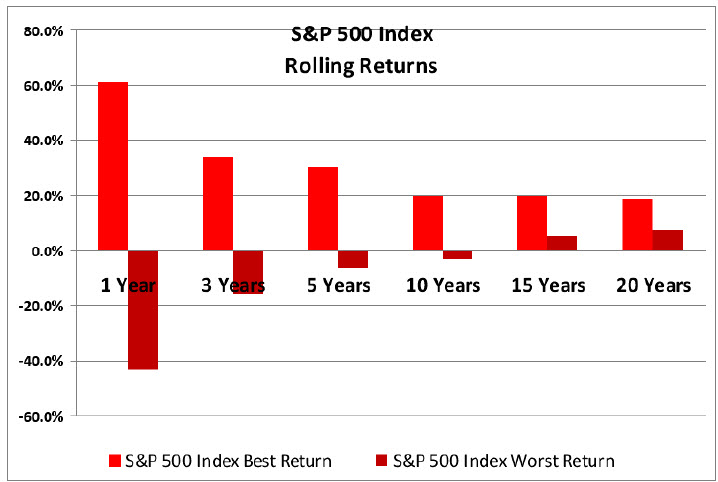
Based purely on U.S. data, the professional advisors seem to be getting the better of the debate, as you can see in the below chart, which shows rolling returns from 1973 through mid-2009.

dd342ee2-d38b-40ef-b622-583f11f0b02c

The outcomes in any one year have been frighteningly hard to predict, ranging anywhere from a 60% gain to a 40% loss. But if you hold that stock portfolio for three years, the best and worst are less dramatic than the best and worst returns over one year, and the returns are flattening out gradually over 10, 15 and 20 years. No 20-year time period in this study showed a negative annual rate of return.

But this is a fairly limited data set. What happens if you look at other countries and extend this research over longer time periods? This is exactly what David Blanchett at Morningstar, Michael Finke at Texas Tech University and Wade Pfau at the American College did in a new paper, as yet unpublished, which you can find here:
http://papers.ssrn.com/sol3/papers.cfm?abstract_id=2320828.

The authors examined real (inflation-adjusted) historical return patterns for stocks, bonds and cash in 20 industrialized countries, each over a 113-year time period. The sample size thus represents 2,260 return years, and the authors parsed the data by individual time periods and a variety of rolling time periods, which certainly expands the sample size beyond 87 years of U.S. market behavior.

What did they find? Looking at investors with different propensities for risk, they found that in general, people experienced less risk holding more stocks over longer time periods. The only exceptions were short periods of time for investors in Italy and Australia. The effect of time-dampened returns was particularly robust in the United Kingdom, Japan, Denmark, Austria, New Zealand, South Africa and the U.S.

Overall, the authors found that a timid investor with a long-term time horizon should increase his/her equity allocation by about 2.7% for each year of that time horizon, from whatever the optimal allocation would have been for one year. The adventurous investor with low risk aversion should raise equity allocation by 1.3% a year. If that sounds backwards, consider that the timid investor started out with a much lower stock allocation than the dare-devil investor–what the authors call the “intercept” of the Y axis where the slope begins.

Does that mean that returns in the future are guaranteed to follow this pattern? Of course not. But there seems to be some mechanism that brings security prices back to some kind of “normal” long-term return. It could be explained by the fact that investors tend to be more risk-averse when valuations (represented by the P/E ratios) are most attractive (when stocks, in other words, are on sale, but investors are smarting from recent market losses), and most tolerant of risk during the later stages of bull markets (when people are sitting on significant gains). In other words, market sentiment seems to view the future opportunity backwards.

Is it possible that stocks are not really fairly priced at all times, but instead are constantly fluctuating above and below some hard-to-discern “true” or “intrinsic” value, which is rising far more steadily below the waves? That underlying growth would represent the long-term geometric investment return, more or less–or, at least, it might have a relationship with it that is not well-explored. The old saw that stocks eventually return to their real values, that the market, long-term, is a weighing machine, might be valid after all.

If you have any questions about financial or investment planning and management, please don’t hesitate to contact us or visit our website at http://www.ydfs.com. We are a fee-only fiduciary financial planning firm that always puts your interests first.

Using Options To Enhance Portfolio Returns

When people think or hear about using options in their investment portfolios, they tend to think of them as risky instruments that lose their entire value, or worse, cause them to lose multiples of their value. But when used correctly, options can be a powerful tool to help enhance portfolio income, reduce overall portfolio risk, and make risk-defined bets on a stock, sector or fund.

What’s an Option

An option is a financial instrument, tied to or based on an individual stock or exchange traded fund, which gives the purchaser the right, but not the obligation, to buy or sell an underlying stock or fund. Options are unique in that they have a defined price to buy or sell the shares and a limited time to do so.  If you don’t “exercise” your right to buy or sell the shares within the time limit, whatever you pay for the option expires and is lost.

Options are sold as “contracts” for 100 shares each.  Remember, with options, you’re buying the right to buy or sell shares, not the shares themselves

There are two basic kinds of options: calls and puts. Let’s talk about each.

Calls and Puts

Think of calls as options to buy a stock or fund at a certain price. I liken a call to an option to buy a home at a certain price for a defined amount of time.

Let’s say that you’re interested in buying a home for $250,000 but aren’t sure that you can get the financing or whether the house is really worth the asking price. So you might offer the seller a sum of money to hold and sell you the house for $250,000 within 90 days. You might pay him a $2,500 “premium” for that option while you investigate financing or determine the true value of the home. During that time, the seller can’t offer to sell the home to anyone else.

If you can’t secure the financing, or you find out that the house is worth far less than $250,000, then you walk away having spent $2,500 for that right (but not the obligation) for 90 days to buy the home. If the true value of the home turns out to be $200,000, you just saved yourself $50,000 less the cost of the option (or $47,500).  If the value of the home instead turns out to be $300,000, then the seller is still obligated to sell you the house for $250,000. In that case, you would exercise your option and you just made an unrealized profit of $47,500 ($300,000 less $250,000 less the cost of the option or $2,500).

Think of puts as an option to sell a stock or fund at a certain price. In many ways, a put is akin to an insurance policy.

Let’s say that house that you just bought for $250,000 is insured for $250,000 and then burns down for a total loss. In that event, the insurance company would pay you for your loss as you “put” the (burned down) house to them. But in order to do that, you had to pay the insurance company an annual insurance premium of say $2,000. If nothing happens to the home, that premium paid is lost forever.

A Stock Example

Let’s turn the discussion to call options on stocks.

Say that you own 100 shares of Apple common stock currently trading for $500, which you bought for $400 per share and you want to generate additional income on those shares (besides the corporate dividend). To do so, you can sell a call option giving someone the right to “call away” your shares for a per share price of $550 within 45 days. For that sale, someone might pay you $1,000 (you don’t ever know who that someone is, but there’s always a willing buyer at the option exchanges for the right price). Note that there are many prices (called strike prices) that you can choose from to decide where you want to part with your Apple shares.

In this example, if Apple shares move down or never exceed $550 per share by the time the option expires, the buyer of that option will walk away without buying the shares and will be out $1,000, but you’ll be $1,000 richer. In that case, you keep your Apple shares and then repeat the process at a new appropriate sales price. Remember, if the buyer of the option can buy shares on the open market for less than $550, she has no reason to exercise that option.

If, on the other hand, Apple shares are at $575 by expiration, you’ll have to part with your shares for a price of $550 (plus the $1,000 that you pocketed for selling the option). The buyer of the option the exercises her option and then owns the shares and any appreciation over $550. You just made $150 per share profit plus the $1,000 option premium. You can then choose to buy new shares of Apple and repeat the process at a higher option price.  Note that the option buyer can call away the shares any time before they expire, but won’t do so unless the price of the shares is higher than $550.

Of course, with any option, you’re free to be the buyer of the calls to speculate on the price of any stock or fund. In the Apple example above, you could have been the buyer of the call option instead of being the seller and thereby speculate on the price of Apple appreciating.

So what about put options on a stock?

Lets continue the Apple example above. At $500 market value per share, you currently have $100 of unrealized profit per share. Now suppose you’ve become worried about a short-term decline in the overall market or in the price of Apple shares, but you don’t want to sell them yet.  Just in case, you might want a short-term insurance policy in the event that Apple shares tumble. In this case, you might buy a $500 put option for $1,000 to give you the right to “put” those shares to someone else for no less than $500 each.

So if Apple shares drop to $450, you’ll still get $500 for your shares when you exercise your put and the seller of the put will be out $4,000 ($500 minus $450 times 100 shares less $1,000 premium received). However, if the shares of Apple are trading for more than $500 by the expiration of the put option, then the put expires worthless and you’re out $1,000 and the seller pockets $1,000.

Safe Ways To Use Options

By now you may have realized that selling options is a nice way to make some extra income. When you consider that most options expire worthless, it is indeed better to be the “house” selling the options rather than the “bettor” buying the options.

The above examples are greatly simplified to help you with the understanding of options. We’ve left out all the mechanics and nuances of option trading to aid in understanding.

The reason that options get such a bad rap is because most people are buyers of options rather than sellers, and they usually buy far too many of them. Since each option contract is good for 100 shares, you shouldn’t buy or sell more contracts than you would buy or sell an equivalent number of shares of stock. Some people even sell calls on stocks that they don’t own (this is allowed), not realizing that stocks can sometimes go much higher than they can imagine. So if you sell an option “naked”, to a certain extent, you’re taking nearly unlimited risk.

In our client portfolios, we may generate income by selling calls against shares we own, so we only have the risk of the stock being called away. We may also hedge our portfolios with options to take advantage of short-term volatility. We may do so by trading puts, but do so in a risk defined way to minimize our premium outlay or maximize our premium generation. In other words, we don’t take unnecessary unlimited risk bets with options and use them only in the safest ways possible.

Hopefully this post helps you to better understand how we (and you could) use options in your own investment portfolios. Of course, if you want to dabble in options, I highly recommend that you get yourself a good book on options and study it carefully before trying them out. Option investing is where a little bit of knowledge is helpful, but can also be dangerous if you’re not sure what you’re doing.

If you’d like to know more about what we do to enhance and hedge investment portfolios, please don’t hesitate to contact us or just ask any questions.

Market Correction?

Last Monday, the U.S. markets dropped roughly 1% of their value (as measured by the S&P 500 index), and Europe and Asia were down by similar amounts the following day. The market then fell 2.1% on Friday in a sickening lurch. Today the S&P 500 fell another 0.5%. This combination was enough to cause pundits and investors to ask whether we are now in the early stages of a bear market or, indeed, if the past almost-five years should be considered an interim market rally inside of a longer-term bear market.

The answer, of course, is that nobody knows–not the brainiac Fed economists, not the fund managers and certainly not the pundits. A Wall Street Journal article noted that most of the sellers on Friday were short-term investors who were involved in program trading, selling baskets of stocks to protect themselves from short-term losses. Roughly translated, that means that a bunch of professional traders panicked when they learned that Chinese economic growth is slowing down on top of worries that the Fed is buying bonds at a somewhat less furious rate ($75 billion a month vs. $85 billion) than it was last year.

What we DO know is that it is often a mistake to panic sell into market downturns, which happen more frequently than most of us realize. A lot of people might be surprised to know that in the Summer of 2011, the markets had pulled back by almost 20%–twice the traditional definition of a market correction–only to come roaring back and reward patient investors. There were corrections in the Spring of 2010 (16%) and the Spring of 2012 (10%), but almost nobody remembers these sizable bumps on the way to new market highs. Indeed, most of us look back fondly at the time since March of 2009 as one long largely-uninterrupted bull market.

Bigger picture, since 1945, the market has experienced 27 corrections of 10% or more, and 12 bear markets where U.S. equities lost at least 20% of their value. The average decline was 13.3% over the course of 71 trading days. Perhaps the only statistic that really matters is that after every one of these pullbacks, the markets returned to record new highs. The turnarounds were always an unexpected surprise to most investors.

We may get a full 10% correction or even a full bearish period out of these negative trading days, and then again we may not. But history suggests an important lesson: if we DO get a correction or a bear market, we may not remember it a few years later if the markets recover as they always have in the past. The people who lose money in the long term are not those who endure a painful market downturn, but those who panic and sell when the market turns down. The facts are that the market is overdue for a reasonable correction after the torrid and virtually uninterrupted run up we’ve had since late 2012.

Instead of panic selling into the market downturn, you may choose to lighten up your equity weighting or re-balance some of your equity weight into other asset classes. After a long winning run, it never hurts to take some profits off the table, trim back your winners and leave the proceeds in cash to invest when the downturn ends. There are various inverse funds and other options available to partially hedge your portfolio if the uncertainty keeps you up at night. After a few days of selling, there’s usually a rally around the corner to counterbalance the weight of the selling and that’s a more opportune time to lighten up. None of this is a recommendation–they’re just some ideas to consider.

For our clients, we have raised and maintained a healthy level of cash and have used hedging to reduce our overall portfolio risk. If the correction becomes prolonged, we’ll do more of the same and await the next opportunities to re-invest. No one says that you have to stay 100% invested at all times.

If you have any questions or would like to speak to us about your portfolio needs or any financial planning matters, we’re here to help. We are a fee-only financial planning firm that always puts your interests first.
Your Returns Versus the Market

One of the most misleading statistics in the financial world is the return data we are routinely given by the financial media, telling us how much investors made in the markets and in individual stocks or mutual funds over some time period.  In fact, your returns are almost guaranteed to be different from whatever the markets and the funds you’ve invested in have gotten.

How is this possible?  Start with cash flows.  We are told that the S&P 500 has delivered a compounded return of about 7.8% from 1992 through 2011, which sounds pretty positive until you realize that this return would only be available to somebody who invested all his or her money at the beginning of 1992 and didn’t move that money around at all for the next twenty years.  If you invested systematically, the same amount every month, as most of us do, then you would have earned a 3.2% compounded return.  Why?  A lot of your money would have been exposed to the 2008 downturn, and not much of it would have enjoyed the dramatic run-up in stocks from 1992 to 2000.

In addition, there is the difference–only now getting attention from analysts–between investor returns and investment returns.  Human nature drives investors to sell their stocks and move to the sidelines after their portfolios have been hammered–which is often the worst possible time to sell.  And it drives people to start increasing their equity allocations toward the peak of bull markets when they perceive that everybody else is getting rich.  That means less of their money tends to be exposed to stocks when the market turns from bearish to bullish, and more is exposed when markets switch from bullish to bearish.

Understand also that owning a diversified portfolio means that only a portion of your investments are exposed to stocks. Assets such as cash, bonds, real estate, commodities and other non-stock investments all have returns that are inherently different than stocks, making overall portfolio return comparisons an “apples to oranges” one.

This would be bad enough, but people also switch their mutual fund and stock holdings.  When a great fund hits a rough patch, there’s a tendency to sell that dog and buy a fund that whose recent returns have been scorching hot.  Many times the underperforming fund will reverse course, while the hot fund will cool off.  The Morningstar organization now calculates, for every fund it follows, the difference between the returns of the mutual fund and the average returns of the investors in fund, and the differences can be astonishing.  Overall, according to Morningstar statistics and an annual report compiled by the Dalbar organization, investor returns have historically been about half of what the markets and funds are reporting.

And then there’s the tax bite.  Some mutual funds invest more tax-efficiently than others, and generate less ordinary income.  Beyond that, if a fund is sitting on significant losses when you invest, you get to ride out its gains without having the tax impact distributed to your 1040.  If the fund is sitting on large gains when you buy in, you could find yourself paying taxes on gains even if the fund loses money.

Sources:

http://www.forbes.com/sites/financialfinesse/2012/06/20/why-your-investment-returns-could-be-lower-than-you-think/

http://www.thesunsfinancialdiary.com/investing/understanding-ms-total-return-and-investor-return/

http://corporate.morningstar.com/cf/documents/MethodologyDocuments/FactSheets/InvestorReturns.pdf

My thanks to Inside Information publisher Bob Veres for his contribution to this post.

The Rollercoaster Effect

There are two kinds of investor in this world.  One type pays close attention to the daily (and sometimes hourly) flood of information, looking for a reason (any reason) to jump in or out of the markets.  The other kind of investor is in for the long haul, and recognizes that the markets are going to experience dips and turns.  If these people are particularly wise, they know that the dips and turns are the best friend of the steady, long-term investor, because as you put money into the markets, as you re-balance your portfolio, you gain a little extra return from the occasional opportunities to buy at bargain prices.

Last week, the investment markets made an unusually sharp turn on the roller coaster, and showed us once again the sometimes-comical fallacy of quick trading.  See if you can follow the logic of the events that led to last week’s selloff.  Federal Reserve Board Chairman Ben Bernanke and the Federal Open Market Committee issued a statement saying that the U.S. economy is improving faster than the Fed’s economists expected.  Therefore (the statement went on to say) if there was continued improvement, the Fed would scale back its QE3 (quantitative easing) program of buying Treasury and mortgage-backed securities on the open market, and ease back on stimulating the economy and keeping interest rates low.

Everybody knows that the Fed will eventually have to phase out its QE3 market interventions, and that this would be based on the strength of the economy, so this announcement should not have stunned the investing public.  Nothing in the statement suggested that the Fed had any immediate plans to stop buying altogether; only ease it back as it became less necessary.  The statement said that this hypothetical easing might possibly take place as early as this Fall, and only if the unemployment rate falls faster than expected.  At the same time, the Fed’s economists issued an economic forecast that was more optimistic than the previous one.

The result?  There was panic in the streets–or, at least, on Wall Street, where this bullish economic report seems to have caused the S&P 500 to lose 1.4% of its valueon Wednesday and another 2.5% on Thursday.

In addition–and here’s where it gets a little weird–stocks also fell sharply in Shanghai and across Europe, and oil futures fell dramatically.  How, exactly, are these investments impacted by QE3?

The only explanation for last week’s panic selloff is that thousands of media junkie investors must have listened to “we plan to ease back on QE3 when we believe the economy is back on its feet again,” and heard: “the Fed is about to end its QE3 stimulus!”

It’s possible that the investors who sold everything they owned on Wednesday  throughFriday will pile back in this week, but it’s just as likely that the panic will feed on itself for a while until sanity is restored.  If stocks were valued daily based on pure logic, on the real underlying value of the enterprises they represent, then the trajectory of the markets would be a long smooth upward slope for decades, as businesses, in aggregate, expanded, moved into new markets, and slowly, over time, boosted sales and profits.  The roller-coaster effect that we actually experience is created by the emotions of the market participants, who value their stocks at one price on Wednesday, and very different prices on Thursday and Friday.

The long-term investor has to ask: did any individual company in my investment portfolio become suddenly less valuable in two days?  Did ALL of their enterprise values in aggregate become less valuable within 48 hours–and at the same time, did Chinese and European stocks and oil also suddenly become less valuable?  Phrased this way, the only possible answer is: no.  And if that’s your answer, then you have to assume that eventually, people will eventually be willing to pay the real underlying value of the stocks in the market, and the last couple of days will be just one more exciting example of meaningless white noise.

With all that said, it’s prudent to be cautious about going “all in” on this pullback in the market and to perhaps take some hard-earned partial profits on positions you’ve been holding. In our clients’ portfolios, we’ve upped our hedges and taken partial profits on short-term positions, but are still holding the majority of our equities and bonds.

With the action in the markets last week, we officially have the beginnings of a downtrend, but that can be very short-lived in this QE environment, so we remain on our toes. Be sure to consult with your advisor if you’re uncomfortable with your holdings or have trouble sleeping at night because of your positions. Nothing in this message should be construed as investment advice or suggestions to buy or sell any security.

If you have any questions or comments, please don’t hesitate to contact us or post them here. We are a fee-only fiduciary financial planning and investment advisory firm that always puts your interests first.

Have a great week!

Sam

Sam H. Fawaz CFP™, CPA
Registered Investment Adivsor Representative
NAPFA Registered Fee-only Advisor
Financial Planning Asssociation Member
(734) 447-5305
(615) 395-2010
http://www.ydfs.com

TheMoneyGeek thanks Bob Veres, publisher of Inside Information for his help with writing this guest post.