Work Longer, Live Longer

There’s finally an answer to an age-old question: How can you live a longer, more satisfying life?

The answer: work past the traditional retirement age of 65.

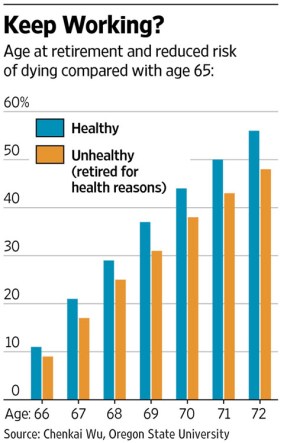
A new study published in the Journal of Epidemiology & Community Health looked at the risk of dying for different age groups of Americans, and compared it to their retirement age.  The researchers found that the likelihood of dying in any given year was 11% lower among people who delayed retirement for just one single year—from age 65 to age 66.  By age 70, people who continued working experienced a 38% lower risk of dying than people of the same age who had retired at age 65.  By age 72, the risk was 44% lower.  These results seemed not to be affected by other variables, like gender, lifestyle, education, income and even occupation.

CA - 2016-5-6 - Work longer, live longer

Why is working longer good for your health?  The article suggested that when you continue working, even part-time, your normal age-related decline in physical and mental functioning happens more slowly.  You’re having to stay engaged in the complicated work-world, which keeps you sharp—and, apparently, alive.

If you would like to discuss your retirement age or any other financial planning matters, please don’t hesitate to contact us or visit our website at http://www.ydfs.com. We are a fee-only fiduciary financial planning firm that always puts your interests first.  If you are not a client yet, an initial consultation is complimentary and there is never any pressure or hidden sales pitch.

Sources:
http://www.wsj.com/articles/retiring-after-65-may-help-people-live-longer-1462202016

The MoneyGeek thanks Bob Veres for his contribution to this post.

Last Call for Social Security Benefits File-And-Suspend – April 29 2016

Last fall, the Bipartisan Budget Act of 2015 changed the rules to eliminate two popular Social Security claiming strategies for married couples: File-and-Suspend, and Restricted Application.

Who should be considering this?

Anyone who has at least met the full retirement age of 66, and is not yet age 70, should be considering whether to submit a file-and-suspend request by April 29.  If you or someone you know is within this age range, please share this article and be aware that you/they have a very short window to meet the deadline. Anyone who wants to be “grandfathered” under the old (current, and more favorable) rules has only one week left to complete their Social Security application and suspension request by the April 29 deadline!

What is File-and-Suspend?

On the surface, it seems too good to be true.  Let’s say you have a married couple, where (let’s say) the husband has earned higher yearly income than his wife.  That means he has contributed more to Social Security over his working life.  The husband files for Social Security benefits at full retirement age (currently age 66) and then immediately files to suspend those benefits.

As a result of this simple maneuver, the wife is now entitled to immediately receive Social Security spousal benefits equal to half of the husband’s full retirement benefits that were just suspended.  She would do this if 50% of the husband’s benefit is higher than she would have received if she had simply claimed her own Social Security payments.

Because he suspended his benefits, the husband can continue working, and wait until age 70 to start receiving Social Security checks in his own name.  Why would he do that?  Because each year of deferral allows him to accumulate more credits—effectively raising his monthly benefits 8% a year, which is considerably higher than the inflation rate.  At that time, the wife would stop claiming the husband’s benefits and start receiving her own Social Security checks.  If she was working at the time, she might have raised the amount she could claim under her own name.

Presto!  More money now, more money later.

The original rationale behind the file and suspend strategy was to encourage more seniors to continue working.  The rationale behind ending it is that it was becoming a drain on the Social Security system.  Moreover, Congress was looking for money to offset a huge increase in Medicare Part B premiums for individuals not yet receiving Social Security payments.

Notably, the tactic is a moot point for anyone who has already claimed benefits, or who doesn’t plan to delay benefits going forward. Nor is file-and-suspend relevant for widows (who don’t need file-and-suspend to coordinate between retirement and survivor benefits), nor for divorcees (who rely on the Restricted Application strategy instead, which remains available after April 29 for anyone who was born in 1953 or prior).

Nonetheless, for married couples (and some parents with children) who are in the age 66-70 window and have not yet claimed their benefits, but where one person could activate a spousal or dependent child benefit for someone else while delaying their own benefit, only a small time window remains to submit a File-and-Suspend request before the rules are changed forever! And arguably, anyone who is single and doesn’t care about spousal benefits, but simply wants to preserve the right to “undo” and reinstate their delay decision in the next few years, may want to consider submitting a request to File-and-Suspend by April 29 as well!

If you or someone you know wishes to inquire or apply for this benefit, you should visit www.ssa.gov or call your local social security office.

If you would like to discuss your social security benefits situation or any other financial planning matters, please don’t hesitate to contact us or visit our website at http://www.ydfs.com. We are a fee-only fiduciary financial planning firm that always puts your interests first.  If you are not a client yet, an initial consultation is complimentary and there is never any pressure or hidden sales pitch.

An Estate Plan for your Digital Assets

In recent years, a new category of assets has appeared on the scene, which can be more complicated to pass on at someone’s death than stocks, bonds and cash.  The list includes such valuable property as digital domain names, social media accounts, websites and blogs that you manage, and pretty much anything stored in the digital “cloud.”  In addition, if you were to die tomorrow, would your heirs know the pass-codes to access your iPad or smartphone?  Or, for that matter, your e-mail account or the Amazon.com or iTunes shopping accounts you’ve set up?  Would they know how to shut down your Facebook account, or would it live on after your death?

A service called Everplans has created a listing of these and other digital assets that you might consider in your estate plan, and recommends that you share your logins and passwords with a digital executor or heirs.  If the account or asset has value (airline miles or hotel rewards programs, domain names) these should be transferred to specific heirs—and you can include these bequests in your will.  Other assets should probably be shut down or discontinued, which means your digital executor should probably be a detail-oriented person with some technical familiarity.

The site also provides a guide to how to shut down accounts; click on “F,” select “Facebook,” and you’re taken to a site (https://www.everplans.com/articles/how-to-close-a-facebook-account-when-someone-dies) which tells you how to deactivate or delete the account.  Note that each option requires the digital executor to be able to log into the site first; otherwise that person would have to submit your birth and death certificates and proof of authority under local law that he/she is your lawful representative.  (The executor can also “memorialize” your account, which means freezing it from outside participation.)

The point here is that even if you know who would get your house and retirement assets if you were hit by a bus tomorrow, you could still be leaving a mess to your heirs unless you clean up your digital assets as well.

If you would like to review your current investment portfolio or discuss any other financial planning matters, please don’t hesitate to contact us or visit our website at http://www.ydfs.com. We are a fee-only fiduciary financial planning firm that always puts your interests first.  If you are not a client yet, an initial consultation is complimentary and there is never any pressure or hidden sales pitch.

Sources:

https://www.everplans.com/articles/a-helpful-overview-of-all-your-digital-property-and-digital-assets

The MoneyGeek thanks guest writer Bob Veres for his contribution to this post

Could You Stomach the Perfect Investment?

Suppose a mutual fund knew for sure which 10% of the largest U.S. companies would earn the highest returns over the next five years, over each upcoming five-year period. You’d invest in that fund and hang tight, right?

A research company called Alpha Architect, recently posed this as an interesting thought experiment. It divided all of the 500 largest U.S. stocks into deciles, and imagined that a hypothetical fund was investing in only the upper 10% returning stocks in the first five-year period, starting on January 1, 1927, and every five years it would switch the portfolio to the future top 10% of all stocks. (Hindsight makes it a lot easier to model what would happen if we were blessed with perfect foresight.)

Okay, so now you’re invested, and if you could have bought and held this magical fund, then at the end of the year 2009, you’d have earned just under 29% a year. What could be easier?

But, not knowing that this fund had a workable crystal ball, would you have held on while it was experiencing a 75.96% downturn during a particularly bad bear market starting in 1929? Or might you have been tempted to bail to safer bonds at some point during that catastrophe? This perfect fund fell more than 44% during a one-year period starting at the end of March, 1937, and overall it experienced drops of 20% or more nine times during your holding period—plus an additional 19% draw down that took it within a whisker of bear market territory.

Some of the times when you might have been sorely tempted to jump ship: the 2000-2001 downturn, when your marvelous fund lost 34% while the S&P 500 was only down 21%. Or a precipitous 22.11% downturn starting at the end of 1974, when the S&P 500 was gaining 19.94%. Or the 19.91% drop from the end of September through the end of November 2002, at a time when the S&P 500 was sailing along with a 15.28% positive return. The long-term returns were terrific, but it took a lot of stomach to hold on for the full ride.

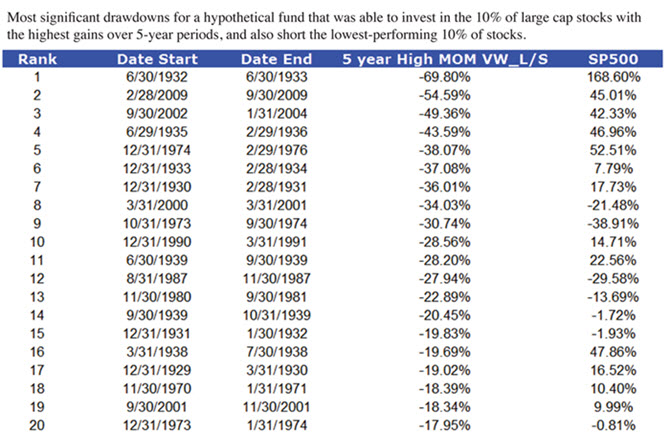
The authors also looked at an even more marvelous manager, who not only bought only the 10% of stocks that would go up the most in the subsequent five years, but also shorted the 10% of stocks that would experience the worst 5-year performance (shorting means that you borrow and sell a stock first, hoping it goes down, then buy it back when it’s cheaper). The mechanics of this fund are a little more complicated, but the results were even more dramatic: the fund experienced enormous losses at times when the S&P 500 was experiencing gains—as you can see from the accompanying chart, which shows this perfect fund’s biggest losses compared with S&P 500 returns during the same period. You really had to be intrepid to hold on and claim the fund’s remarkable 39.74% annualized returns.

CA - 2016-2-5 - Perfect investment

The point? The authors say that even if God (who presumably has perfect foresight) were running a mutual fund, He would have lost a lot of investors who lost faith in his management skill during those times when the markets experienced rough patches. It’s fundamentally a lesson in humility and patience; great long-term track records are not immune from pullbacks, and our all-too-human tendency is to lose faith in the face of adversity.

What does this tell us? It indicates that investing is hard, because our psychological make-up tends to push us to do the wrong thing at the wrong time when it comes to our money. At the risk of sounding self-serving, having an advisor manage your assets can help put a barrier between your natural instincts and the markets. And who can’t use a little coaching and seasoned expertise …?

If you would like to review your current investment portfolio or discuss any other financial planning matters, please don’t hesitate to contact us or visit our website at http://www.ydfs.com. We are a fee-only fiduciary financial planning firm that always puts your interests first.  If you are not a client yet, an initial consultation is complimentary and there is never any pressure or hidden sales pitch.

Source:

http://blog.alphaarchitect.com/2016/02/02/even-god-would-get-fired-as-an-active-investor/#.VrD5akrsaMY.twitter

The MoneyGeek thanks guest writer Bob Veres for his contribution to this post


Recovery—For How Long?

On Tuesday of this week, the U.S. stock markets (S&P 500 index) went up 2.39%, the highest one-day return in a month. Analysts attributed the rise to a variety of economic news that suggested that the American economy is not, after all, plunging into recession. The buoyant mood among investors may not last, but for many, it’s a welcome sign that things may not be as gloomy as they seemed just a month ago.

In fact, the S&P 500 only dropped about 12%, from 2078.36 at the end of December 2015 to the bottom of 1829.08 on February 11—despite widespread predictions of a 20% bear market. Since then, it has risen on shaky legs back to more than 1999, just 79 points from breaking even on the year. One more day like Tuesday would erase nearly all of the damage in 2016.

The good economic news involved construction spending, which reached its highest level since 2007. Oil prices were also gaining ground, although it’s hard to see why the average American would find reason to cheer about that. In addition, new orders and inventories stabilized in the manufacturing sector, after experiencing downturns in the last quarter of 2015.  On Friday, The February jobs report showed that the economy created 242,000 jobs and unemployment remains at a low 4.9%.  Other factors include the possibility that U.S. stock investors may finally have decided that declines in the Chinese markets are not going to directly affect the value of American-based businesses.

None of this means that we know what will happen next. Neither we nor any of the pundits you see on the financial news have any idea whether that long-awaited 20% decline will materialize, or the markets will continue to recover and we’ll all look back on February 11 prices as a great time to buy. But it’s worth reflecting on how unexpected this latest rally has been at a time when it seemed that all the news pointed to more pain and decline. Anybody who believed the pundits and fully retreated to the sidelines after the January selloff is now sitting on losses and wondering whether to jump in now and hope the gains continue, or wait and hope for another downturn, and risk losing even more ground if this turns out to be a long-term rally. This is not to say that hedging or taking some bull market profits off the table is still not a good idea. All-or-nothing investing is almost never a good idea.

We can never see the next turn in the market roller coaster, but long-term, the markets seem to operate under the opposite of the pull of gravity. You and I know with some degree of certainty in which direction the next 100% market move will be, even if we can’t pinpoint when or where.

If you would like to review your current investment portfolio or discuss any other financial planning matters, please don’t hesitate to contact us or visit our website at http://www.ydfs.com. We are a fee-only fiduciary financial planning firm that always puts your interests first.  If you are not a client yet, an initial consultation is complimentary and there is never any pressure or hidden sales pitch.

Sources:

http://www.businessinsider.com/the-stock-market-is-over-china-2016-2

http://www.bloomberg.com/news/articles/2016-02-29/japan-futures-down-on-strong-yen-as-china-stimulus-buoys-aussie

http://finance.yahoo.com/news/wall-st-open-higher-oil-143344528.html

The MoneyGeek thanks guest writer Bob Veres for his contribution to this post

What’s Going on in the Markets January 18 2016

Wow! There’s no diplomatic way to say this: the global stock markets are in panic mode right now. In two weeks of trading, the U.S. S&P 500 index is down 8% on the year, which brings us close to correction territory (a 10% decline), and has some predicting a bear market (a 20% decline).

On top of that, we’ve been hearing a widely-publicized, rather alarming prediction from Royal Bank of Scotland analyst Andrew Roberts, saying that the global markets “look similar to 2008.” Mr. Roberts is also predicting that technology and automation are set to wipe out half of all jobs in the developed world. If you listen closely out the window, you can almost hear traders shouting “Sell! Head for the exits! We’re all gonna’ die!!!”

When you’re in the middle of so much panic, when people are stampeding in all directions, it’s hard to realize that there is no actual fire in the theater. Yes, oil prices are down around $30 a barrel, and could go lower, which is not exactly terrific news for oil companies and oil services concerns—particularly those who have invested in fracking production. But cheaper energy IS good news for manufacturers and consumers, which is sometimes forgotten in the gloomy forecasts. Chinese stocks and the Chinese economy are showing more signs of weakness, and there are legitimate concerns about the status of junk bonds—that is, high-yield bonds issued by riskier companies with high debt levels, and many developing nations. These bonds have stabilized in the past few weeks, but another Federal Reserve interest rate hike could destabilize them all over again, leading to forced selling and investors taking losses in the dicier corners of the bond market.

If you can think above the shouting and jostling toward the exists, you might take a moment to wonder about some of these panic triggers. Are oil prices going to continue going down forever, or are they near a logical bottom? Is this a time to be selling stocks, or, with prices this low, a better time to be buying? Are China’s recent struggles relevant to the health of your portfolio and the value of the stocks you own?

And what about the RBS analyst who is yelling “Fire!” in the crowded theater? A closer look at Mr. Roberts’ track record shows that he has been predicting disaster, with some regularity, for the past six years—rather incorrectly, as it turns out. In June 2010, when the markets were about to embark on a remarkable five year boom, he wrote that “We cannot stress enough how strongly we believe that a cliff-edge may be around the corner, for the global banking system (particularly in Europe) and for the global economy. Think the unthinkable,” he added, ominously.   (“The unthinkable,” whatever that meant, never happened.)

Again, in July 2012, his analyst report read, in part: “People talk about recovery, but to me we are in a much worse shape than the Great Depression.” Wow! Wasn’t it scary to have lived through, well, a 3.2% economic growth rate in the U.S. the following year? What Great Depression was he talking about?  Taking his advice in the past would have put you on the sidelines for some of the nicest gains in recent stock market history. And it’s interesting to note that one thing Mr. Roberts did NOT predict was the 2008 market meltdown.

Since 1950, the U.S. markets have experienced a decline of between 5% and 10% (the territory we’re in already) in 35.5% of all calendar years—which is another way of saying that this recent draw down is entirely normal. In fact, our markets spend about 55% of the time in this range (pulling back).  One in five years (22.6%) have experienced draw downs of 10-15%, and 17.7% of our last 56 stock market years have seen downturns, at some point in the year, above 20%.

Stocks periodically go on sale because people panic and sell them at just about any price they can get in their rush to the exits, and we are clearly experiencing one of those periods now. Whether this will be one of those 5-10% years or a 20% year, only time will tell. But it’s worth noting that, in the past, every one of those draw downs eventually ended with an even greater upturn and markets testing new record highs.

Many investors apparently believe this is going to be the first time in market history where that isn’t going to happen. The rest of us can stay in our seats and decline to join the panic.

Without a doubt the market picture looks dour, and it’s hard to see red on our screens and declines on our monthly statements. A disciplined approach that takes into account your goals, risk tolerance and time horizon remains the best way to approach when and how you’ll sell. There’s always a better day to sell since strength always returns to markets after a panic. Your patience is always rewarded in the markets, though I acknowledge that it’s easier said than done. If investing in the stock markets was easy, then returns would not be anywhere near as rewarding as they are.

In our client portfolios, we continue to look for opportunities to add to positions in good funds and companies at the appropriate time. We continue to maintain a healthy cash position, and have increased our hedges. While we may see additional selling to start the week (which starts on Tuesday due to the Martin Luther King, Jr. holiday), I suspect that the selling is somewhat exhausted in the short term, so I’m expecting a robust bounce as early as this week (I saw signs of selling exhaustion on Friday January 15). The quality and duration of that bounce will tell us more about what’s to come, and whether more defensive measures are warranted.

Nothing in this note should be construed as investment advice or a recommendation to buy or sell any security. If you would like to review your current investment portfolio or discuss any other financial planning matters, please don’t hesitate to contact us or visit our website at http://www.ydfs.com. We are a fee-only fiduciary financial planning firm that always puts your interests first.  If you are not a client yet, an initial consultation is complimentary and there is never any pressure or hidden sales pitch.

Sources:

http://finance.yahoo.com/news/why-the-heck-are-the-markets-tanking-165146322.html

http://www.telegraph.co.uk/finance/comment/ambroseevans_pritchard/7857595/RBS-tells-clients-to-prepare-for-monster-money-printing-by-the-Federal-Reserve.html

http://www.publicfinanceinternational.org/news/2012/07/economic-crisis-%E2%80%98worse-great-depression%E2%80%99

http://blogs.spectator.co.uk/2016/01/the-author-of-the-rbs-sell-everything-note-has-been-predicting-disaster-for-the-last-five-years/

http://www.marquetteassociates.com/Research/Chart-of-the-Week-Posts/Chart-of-the-Week/ArticleID/140/Frequency-and-Magnitude-of-Stock-Market-Corrections

The MoneyGeek thanks guest writer Bob Veres for his contribution to this post

New Benefits for 529 Plans

On December 18, 2015, Congress approved the “Protecting Americans from Tax Hikes (PATH) Act of 2015”, which includes provisions that impact 529 plans. President Barack Obama signed the bill into law the same day.

Computers

Previously, 529 rules treated computers as a Qualified Higher Education Expense only if the beneficiary’s college required them as a condition of enrollment or attendance. Under the new law, computer equipment and related hardware qualify even if they are not specifically required by the university, college, or technical school the beneficiary attends, although they must be used primarily by the beneficiary while enrolled in school. The new law defines desktop computers, laptops, and other related technology as a Qualified Higher Education Expense. The costs for Internet access and computer software related to a beneficiary’s studies also qualify.

The new law is retroactive to expenses incurred since January 1, 2015. So if your beneficiary purchased a computer or related technology any time in 2015 to use while in college, funds from a 529 account can be used to cover the cost if the withdrawal was made by Thursday, December 31.

Refund Re-contribution

The PATH Act also gives 529 account owners a 60-day window to re-contribute refunds from Eligible Educational Institutions into their accounts. The law is retroactive for withdrawals made during 2015.

Under the new law, account owners have 60 days from the date of the refund to redeposit a refund of Qualified Higher Education Expenses into the same 529 account from which the money was withdrawn. For example, if a beneficiary receives a refund from an Eligible Educational Institution because he or she withdrew from school due to an illness or other unforeseen circumstance, the refund may be returned to the beneficiary’s 529 account and would not be deemed a non-qualified withdrawal or be subject to any taxes or tax penalties.

The re-contribution cannot exceed the amount of the refund.

The law is retroactive to January 1, 2015.

  • Account owners who received a refund of Qualified Higher Education Expenses between January 1, 2015, and December 18, 2015, the date the law was enacted, have until February 16, 2016 — 60 days from the enactment date for the PATH Act of 2015 — to redeposit the money.
  • Account owners who receive a refund of Qualified Higher Education Expenses on any date after December 18, 2015, have 60 days from the date of the refund to redeposit the money.

It is recommended that account owners keep a receipt of refunds in order to have documentation of the amount of the refund and the date it was issued.

If you would like to review your current investment portfolio or discuss any other financial planning matters, please don’t hesitate to contact us or visit our website at http://www.ydfs.com. We are a fee-only fiduciary financial planning firm that always puts your interests first.  If you are not a client yet, an initial consultation is complimentary and there is never any pressure or hidden sales pitch.


What’s Going on in the Markets January 7 2016

Have your long-term financial goals changed in the last four days?

Are American companies becoming less valuable because investors in China are panicking?

Is there any reason to think that because Chinese investors are panicking, that Chinese companies are less valuable today than they were a few days ago?

These are the kinds of questions to ponder as you watch the U.S. stock market catch a cold after China sneezed.  In each of the first four trading days of the year, China closed its markets due to a rapid fall in share prices—a move which may have made the panic worse, since it made investors fear being trapped in stocks that are seen as dropping in value.  It’s unclear exactly how or why, but the panic spread to global markets, with U.S. stocks falling 4.9% to mark the worst first-of-the-year drop in history.

For long-term investors, the result is much the same as if you went to the grocery store and discovered that the prices had fallen roughly 5% across the board.  At first, you might think this is a great bargain. But then you might wonder whether the prices will be even lower tomorrow or next week.  One thing you probably WOULDN’T worry about is whether prices will eventually go back up; you know they always have in the past after these sale events expire.

Will they?  The truth is, nobody knows—and if you see pundits on TV say with certainty that they know where the markets are going, your first impulse should be to laugh, and your second should be to check their track record for predicting the future.  Without a working crystal ball, it’s hard to know whether the markets are entering a correction phase which will make stocks even cheaper to buy, or whether people will wake up and realize that they don’t have to share the panic of Chinese investors on this side of the ocean.  The good news is there appears to be no major economic disruption like the Wall Street derivatives mess that triggered the 2008 downturn.  The best, sanest investors will once again watch the markets for entertainment purposes—or just turn the channel.

I overwhelmingly hear pundits predicting a bear market in 2016 (a bear market is defined as a 20% or more decline from the last market peak). “The bull market has gone on way too long, economic data is deteriorating, the Federal Reserve is raising interest rates, geopolitical events spell doom, we’re heading for a recession, oil is going to $1 per barrel” are all reasons our markets are headed for a tumble. Remind yourself that no one knows for sure what might happen, and while a bear market might assert itself in 2016, no one can reliably predict when it will come. All we know for certain is that it sets up opportunities

So what should you do? If you’ve enjoyed nice gains in your portfolio from this bull market, then you should consider cashing in some of those gains. It never hurts to take some money “off the table” and have some cash reserves to take advantage of better prices. Don’t panic sell–wait for the inevitable bounce that always comes after a multi-day selloff. You’ll be glad you did.

If you’d rather not tax the tax hit on your gains, there are ways to hedge your portfolio so you can at least sleep better at night. Speaking of that, if you’re up at night worrying about your portfolio, then you need to figure out whether you’ve taken on too much risk for your temperament and investing time horizon. You should first discuss all of this with your financial advisor/planner. Don’t have one? We’re glad to help.

As for our clients, we’ve been raising cash and doing some hedging ourselves over the past year. While there are some concerning recent economic trends and technical market anomalies, we don’t see signs of an impending recession on the horizon. We look for indications of a recession, because recessions usually lead to bear markets.

Nothing in this note should be construed as investment advice or a recommendation to buy or sell any security. If you would like to review your current investment portfolio or discuss any other financial planning matters, please don’t hesitate to contact us or visit our website at http://www.ydfs.com. We are a fee-only fiduciary financial planning firm that always puts your interests first.  If you are not a client yet, an initial consultation is complimentary and there is never any pressure or hidden sales pitch.

Sources:

http://www.ft.com/intl/cms/s/0/f248931e-b4e5-11e5-8358-9a82b43f6b2f.html#axzz3wc533ghn

http://www.ft.com/cms/s/0/bc8c0d60-b54d-11e5-b147-e5e5bba42e51.html?ftcamp=published_links%2Frss%2Fhome_us%2Ffeed%2F%2Fproduct#axzz3wc533ghn

The MoneyGeek thanks guest writer Bob Veres for his contribution to this post

The Association Factor

What’s the best way to be happy and successful? What do most happy and successful people have in common?

If you answered “money,” or anything to do with meditation or networking skills, you’re off the mark, according to Jason Butler, a former financial planner who is currently working as a motivational speaker. He says that after reading biographies of political, business, scientific and charity leaders, and hearing the personal stories of several hundred financial planning clients, one factor tends to be present in the happiest, most successful individuals, and it’s entirely in your control: who you surround yourself with. Call it your “association factor.”

There are several dimensions to this. If you’re an athlete who wants to improve your fitness or skill level, hanging out with (competing with) superior athletes will do more to help you ‘up your game’ than if you were associating with people you can beat without breaking a sweat. If you employ or work alongside people who have a diligent and service-oriented attitude, you can delegate work, avoid micromanaging, and feel confident that the workload will be shared fairly. If your social circle is full of people who are pessimistic, negative, defeatist or cynical, then it will pull you into pessimism or defeatism. We all know people who suck the life out of anybody they’re around. Why let it happen to you?

Butler says that cultivating meaningful personal relationships with the right types of people should be an essential priority for anyone who wants to live a meaningful, fulfilling, successful and happy life—which basically means all of us. You should consciously try to surround yourself with people who are optimistic, positive, capable and excited about the future.

The interesting thing about this advice is how few people seem to be intentional about their friendships. Most of us make friends by happenstance, because we shared an experience together or have something in common. Consciously creating a circle of friends, and constantly looking for business relationships that will be productive and supportive, is not often a priority.

But it can be, and the results could be dramatic.

If you would like to review your current investment portfolio or discuss any other financial planning matters, please don’t hesitate to contact us or visit our website at http://www.ydfs.com. We are a fee-only fiduciary financial planning firm that always puts your interests first.  If you are not a client yet, an initial consultation is complimentary and there is never any pressure or hidden sales pitch.

I wish everyone a happy 2016 with many successful associations!

Sam

Source:

https://www.linkedin.com/pulse/one-thing-all-happy-successful-people-do-jason-butler?trk=prof-post&utm_content=bufferf8382&utm_medium=social&utm_source=twitter.com&utm_campaign=buffer

The MoneyGeek thanks guest writer Bob Veres for his contribution to this post

Three Year-end Tax Reduction Tips

Even though April 15 now seems a distant deadline for filing your 2015 tax returns, in order to take advantage of some of the biggest tax reduction strategies, you have to act before the end of this year. Without further ado, here are three “go-to” maneuvers that you may want to execute by December 31.

1. Maximize Contributions to Tax-Advantaged Accounts

Contributing to your employer’s retirement plan is one of the smartest tax moves you can make. For 2015 (and 2016) you can save up to $18,000, or $24,000 if you are age 50 or older. Because contributions are typically made on a pretax basis, qualified plans such as 401(k)s and 403(b)s help to lower your current taxable income. Plus, the money in the account is allowed to grow tax deferred until you begin taking withdrawals, usually in retirement.1

If you are interested in supplementing your contributions to your employer’s plan, you may be eligible to fund a traditional IRA with a deductible or non-deductible contribution. You can contribute up to $5,500 in 2015 and 2016, adding $1,000 to that total if you are 50 or older and catching up on your retirement savings. Like 401(k)s, IRAs offer a “one-two punch” in tax savings: tax deferral on your investment until you start withdrawing money, along with a potential tax deduction on all or part of your annual contribution if you meet the IRS’s eligibility rules.

You could also direct your savings to a Roth IRA or a Roth 401(k), if offered by your employer. Although contributions to Roth retirement vehicles are made with after-tax dollars, withdrawals are tax free provided certain conditions are met. Keep in mind that the annual contributions limits for 2015 — $18,000 per individual or $24,000 for those age 50 or older — apply cumulatively to all employer-sponsored plans, Roth or traditional.

Even though you have until tax day — April 15, 2016 — to fund an IRA for 2015, why wait? Funding it by year-end potentially gives it all the more time to grow in a tax-deferred shelter.

If you’re self-employed or own a small business, you may have just enough time to set up a small business retirement plan before year-end. In some cases, you can wait until next year to fund it, but the plan must be established in 2015 to get the deduction this year.

2. Consider Tax-Loss Harvesting

Simply stated, tax-loss harvesting is the process of balancing portfolio losses against gains to help minimize your exposure to capital gains tax. In a year like 2015, in which the stock market experienced a significant late-summer swoon, such a strategy may be particularly attractive.

Generally, the IRS allows you to offset capital gains with capital losses to the extent of your total gains — and above that, you may be allowed to deduct up to $3,000 against ordinary income each year, thus potentially lowering your tax liability. Losses in excess of that limit can be carried over to the next year.

Yet as simple as this strategy may sound, it is fraught with caveats. For starters, before selling, consider the length of time you have held a security. Securities sold within a year of their purchase can generate short-term capital gains, which are taxed at the investor’s ordinary income tax rate — up to a maximum rate of 39.6% for the highest earning individuals.

Gains from the sale of securities held for more than one year are considered long-term gains and are taxed at a maximum rate of 15% for most Americans, but that rises to 20% for those with taxable incomes of over $400,000 ($450,000 for joint filers). In addition, the Medicare surtax on net investment income, which includes capital gains, results in an overall top long-term capital gains tax rate of 23.8% for high-income taxpayers.

Also keep in mind that the IRS prohibits you from claiming a loss on the sale of a security in a “wash sale.” The rule defines a wash sale as one in which an individual sells or trades securities at a loss and then goes on to buy additional shares in the same or substantially identical security within the 30 days before or after the date of sale.

The bottom line on tax-loss harvesting? If you are considering employing this strategy, evaluate carefully the investments you may select for sale, then discuss your plan with a trusted financial advisor. You certainly don’t want to wag the investment “dog” with the tax “tail”.

3. Timing Is Everything

Another popular year-end tax management strategy — particularly if you expect your taxable income to be higher than normal for the 2015 tax year — is to accelerate tax deductions and, where possible, to defer income. For instance, you could increase your charitable deductions or make advance payments for state and local taxes, insurance premiums, interest payments, medical procedures, or other deductible expenses for which you may be able to control the timing. Similarly, you may be able to delay some forms of discretionary income or hold on to stocks that have performed exceptionally well at least until early 2016, being mindful of what you expect your tax/income situation to be next year. Before prepaying any state income or local property taxes, be sure that the alternative minimum tax does not apply to you.

These are just some of the many steps you can take to help keep your taxes in check. Work with your financial and tax advisor(s) to make tax planning an integral part of your overall financial plan.

This communication is not intended to be tax advice and should not be treated as such. Each individual’s tax situation is different. If you would like to review your current tax situation or discuss any other financial planning matters, please don’t hesitate to contact us or visit our website at http://www.ydfs.com. We are a fee-only fiduciary financial planning firm that always puts your interests first.  If you are not a client yet, an initial consultation is complimentary and there is never any pressure or hidden sales pitch.

Disclaimer:

1Withdrawals from traditional IRAs are taxed at then-current income tax rates. Withdrawals prior to age 59½ may be subject to an additional federal tax.