Three Year-end Tax Reduction Tips

Even though April 15 now seems a distant deadline for filing your 2015 tax returns, in order to take advantage of some of the biggest tax reduction strategies, you have to act before the end of this year. Without further ado, here are three “go-to” maneuvers that you may want to execute by December 31.

1. Maximize Contributions to Tax-Advantaged Accounts

Contributing to your employer’s retirement plan is one of the smartest tax moves you can make. For 2015 (and 2016) you can save up to $18,000, or $24,000 if you are age 50 or older. Because contributions are typically made on a pretax basis, qualified plans such as 401(k)s and 403(b)s help to lower your current taxable income. Plus, the money in the account is allowed to grow tax deferred until you begin taking withdrawals, usually in retirement.1

If you are interested in supplementing your contributions to your employer’s plan, you may be eligible to fund a traditional IRA with a deductible or non-deductible contribution. You can contribute up to $5,500 in 2015 and 2016, adding $1,000 to that total if you are 50 or older and catching up on your retirement savings. Like 401(k)s, IRAs offer a “one-two punch” in tax savings: tax deferral on your investment until you start withdrawing money, along with a potential tax deduction on all or part of your annual contribution if you meet the IRS’s eligibility rules.

You could also direct your savings to a Roth IRA or a Roth 401(k), if offered by your employer. Although contributions to Roth retirement vehicles are made with after-tax dollars, withdrawals are tax free provided certain conditions are met. Keep in mind that the annual contributions limits for 2015 — $18,000 per individual or $24,000 for those age 50 or older — apply cumulatively to all employer-sponsored plans, Roth or traditional.

Even though you have until tax day — April 15, 2016 — to fund an IRA for 2015, why wait? Funding it by year-end potentially gives it all the more time to grow in a tax-deferred shelter.

If you’re self-employed or own a small business, you may have just enough time to set up a small business retirement plan before year-end. In some cases, you can wait until next year to fund it, but the plan must be established in 2015 to get the deduction this year.

2. Consider Tax-Loss Harvesting

Simply stated, tax-loss harvesting is the process of balancing portfolio losses against gains to help minimize your exposure to capital gains tax. In a year like 2015, in which the stock market experienced a significant late-summer swoon, such a strategy may be particularly attractive.

Generally, the IRS allows you to offset capital gains with capital losses to the extent of your total gains — and above that, you may be allowed to deduct up to $3,000 against ordinary income each year, thus potentially lowering your tax liability. Losses in excess of that limit can be carried over to the next year.

Yet as simple as this strategy may sound, it is fraught with caveats. For starters, before selling, consider the length of time you have held a security. Securities sold within a year of their purchase can generate short-term capital gains, which are taxed at the investor’s ordinary income tax rate — up to a maximum rate of 39.6% for the highest earning individuals.

Gains from the sale of securities held for more than one year are considered long-term gains and are taxed at a maximum rate of 15% for most Americans, but that rises to 20% for those with taxable incomes of over $400,000 ($450,000 for joint filers). In addition, the Medicare surtax on net investment income, which includes capital gains, results in an overall top long-term capital gains tax rate of 23.8% for high-income taxpayers.

Also keep in mind that the IRS prohibits you from claiming a loss on the sale of a security in a “wash sale.” The rule defines a wash sale as one in which an individual sells or trades securities at a loss and then goes on to buy additional shares in the same or substantially identical security within the 30 days before or after the date of sale.

The bottom line on tax-loss harvesting? If you are considering employing this strategy, evaluate carefully the investments you may select for sale, then discuss your plan with a trusted financial advisor. You certainly don’t want to wag the investment “dog” with the tax “tail”.

3. Timing Is Everything

Another popular year-end tax management strategy — particularly if you expect your taxable income to be higher than normal for the 2015 tax year — is to accelerate tax deductions and, where possible, to defer income. For instance, you could increase your charitable deductions or make advance payments for state and local taxes, insurance premiums, interest payments, medical procedures, or other deductible expenses for which you may be able to control the timing. Similarly, you may be able to delay some forms of discretionary income or hold on to stocks that have performed exceptionally well at least until early 2016, being mindful of what you expect your tax/income situation to be next year. Before prepaying any state income or local property taxes, be sure that the alternative minimum tax does not apply to you.

These are just some of the many steps you can take to help keep your taxes in check. Work with your financial and tax advisor(s) to make tax planning an integral part of your overall financial plan.

This communication is not intended to be tax advice and should not be treated as such. Each individual’s tax situation is different. If you would like to review your current tax situation or discuss any other financial planning matters, please don’t hesitate to contact us or visit our website at http://www.ydfs.com. We are a fee-only fiduciary financial planning firm that always puts your interests first.  If you are not a client yet, an initial consultation is complimentary and there is never any pressure or hidden sales pitch.

Disclaimer:

1Withdrawals from traditional IRAs are taxed at then-current income tax rates. Withdrawals prior to age 59½ may be subject to an additional federal tax.

Rate Hike Hype

While I’m still a tad skeptical, we will almost surely see the U.S. Federal Reserve Board (Fed) start the long process of ending its intrusion into the interest rate markets, by allowing short-term rates to rise starting on Wednesday. It will be the first time the Fed has raised rates since 2006, and for some it will mark the beginning of the final chapter of the Great Recession.

Since 2008, as most of us know, returns on short-term bonds have been at or near zero percent, which is a consequence of the Fed keeping the Federal Funds rate—the rate at which it will lend banks virtually unlimited amounts of money, short-term—at 0.125%. The average Fed Funds rate has historically been 3.5% to 4.0%, so this is a considerable amount of stimulus.

At the same time, the Fed has purchased more than $3.5 trillion worth of Treasury securities and home mortgage pools as part of its quantitative easing (QE) programs, bidding aggressively against much smaller buyers, which is another way of saying: forcing the rates on these bonds down closer to zero.

Pulling back out of these interventions is going to be tricky, in part because shifts in interest rates have a direct impact on a still-fragile U.S. economy (higher rates mean higher borrowing costs, potentially less corporate investment and lower profits), and even trickier because we don’t know how investors will react. In the past, the markets have panicked at the mere mention of a cutback in Fed involvement, and (more recently) have also risen on the same news, presumably because people drew encouragement from the confidence the Fed was showing in the strength and resilience of the U.S. economy.

There are also some tricky mechanical problems. The central bank will try to control the extent that short-term rates rise and fall by raising the interest it pays to banks for the reserves held at the Fed, and also cautiously raising the amount it pays money market funds for short-term trades known as “reverse repurchase agreements.” The mechanics are highly technical and complicated—and still unproven, although there are reports that the Fed has been conducting tests for the past two years.

As the markets react, either upwards or downwards, there are a few things to keep in mind. First, despite the headlines soon to be blaring from every financial section of every newspaper in the country, the rate is expected to move very modestly from .125% to .375%—clearly a small first step in a long journey toward the long-term average. After each step—prominently including this one—the Fed will evaluate the consequences before deciding to make future changes. If the economy slows, or if there are signs that inflation is falling below the Fed’s 2% annual target, it could delay the next move by months or even years. That caution greatly reduces the danger of any kind of serious economic pullback.

It’s also worth noting that the Fed has announced no plans to sell the nearly $4.2 trillion worth of various bonds—including the aforementioned Treasuries and mortgages—that it owns. At the moment, the bank is simply rolling over the portfolio, meaning it reinvests $21 billion a month as bonds mature. Eventually, most observers expect the reinvestment to stop and the Fed to allow the huge bond holdings to mature and fall off of its balance sheet. The fact that this is not being done currently reflects the exquisite degree of caution among Fed policymakers, who don’t want to rock the boat too fast or too hard.

Finally, some have wondered about the future of mortgage interest rates as the Fed begins a cautious exit from the bond markets. Interestingly, recent history shows that mortgages haven’t been especially influenced by changes in the benchmark rate. The last time we saw extremely low interest rates, after the tech bubble burst in the early 2000’s, the Fed brought its Fed funds rate down to 1%. It began raising rates by 0.25% a quarter starting in the summer of 2004, but over the next four months, the 30-year fixed-rate mortgage actually fell from 6.3% to 5.58%. By the time of the last increase in the summer of 2006, mortgage rates were running at 6.68%, just a half-percent higher than they had been at the previous Fed funds rate low.

Nobody knows exactly what to expect when the announcement comes on Wednesday, but you can look for the investment markets to bounce around a bit more than usual, and economists—including the teams employed by the Fed—to examine every scrap of data about the impact on the economy over the next quarter. At that time, Fed policymakers will face another decision, and there is no reason to expect them to be less cautious than they have been recently. For many of us, the rate rise should be reason for celebration, a sign that the long recession and period of economic uncertainty is finally starting—carefully—to be put in our rear view mirror.

If you would like to review your current investment portfolio or discuss any other financial planning matters, please don’t hesitate to contact us or visit our website at http://www.ydfs.com. We are a fee-only fiduciary financial planning firm that always puts your interests first.  If you are not a client yet, an initial consultation is complimentary and there is never any pressure or hidden sales pitch.

Sources:

https://www.washingtonpost.com/news/where-we-live/wp/2015/12/14/what-a-fed-rate-hike-could-mean-to-mortgage-borrowers/

https://www.washingtonpost.com/news/wonk/wp/2015/12/14/the-federal-reserve-will-likely-raise-interest-rates-this-week-this-is-what-happens-next/

http://www.usatoday.com/story/money/2015/12/14/this-week-december-13/77155714/

The MoneyGeek thanks guest writer Bob Veres for his contribution to this post

A Better Stock-ing Stuffer

What’s a better gift for a young person than a savings bond or a gift card?

When you talk with people who have made a lifelong habit of saving and investing, often you’ll hear them say that somebody—often a grandparent—gave them a few shares of stock at a young age. Following the stock, learning about the company and seeing the dividends reinvested got them interested in a whole new mysterious economic realm that many people never learn about.

The problem, of course, is that it’s not always easy, in this day and age, to give a few shares of stock. Instead of printed shares, we have electronic ownership, which is why websites like giveashare.com and uniquestockgift.com can charge twice as much for a stock and a printed certificate as you would pay for the same share if you went online through a discount brokerage firm. Buying a share directly means creating a new custodial account for the young child, and then executing a brokerage transfer or creating an UGMA account.

Recently, the idea of giving a share or two of stock has gotten a lot easier, with a website called SparkGift. You click on the site, and over the next two minutes, you select a recipient, provide an email address and Social Security number, select an investment—it could be Disney, Tesla, a Vanguard index fund or any ETF, anything that is publicly traded—and a dollar amount. The person on the other end of the email opens the message and creates the account. At that point, your payment executes the trade, and the securities end up in an account in the child’s name. You can use a credit card to make the purchase.

According to the site, the average gift size is $75 to $100, and the giver will be charged $2.95 plus 3% of the gift size, equivalent to the transaction costs at a discount brokerage firm. Some children have gone so far as to establish their own gift registry, specifying the stocks they’re interested in—like Disney, Mattel, Apple or Electronic Arts—which encourages them to research the companies behind the brands they like.

Rather than a gift card that will be spent immediately, the stocks will demonstrate investment appreciation over time—and might even help your kids or grandkids with retirement planning someday.

If you would like to review your current investment portfolio or discuss any other financial planning matters, please don’t hesitate to contact us or visit our website at ydfs.com. We are a fee-only fiduciary financial planning firm that always puts your interests first.  If you are not a client yet, an initial consultation is complimentary and there is never any pressure or hidden sales pitch.

Sources:

http://time.com/money/4067454/giving-shares-stock-sparkgift/?xid=tcoshare

https://www.sparkgift.com/#

http://thereformedbroker.com/2015/10/12/the-greatest-gift-you-can-give-a-young-person/

The MoneyGeek thanks guest writer Bob Veres for his contribution to this post


The Paris Attacks

Most of us watched news coverage of the multiple terrorist acts against the city of Paris, France, with a mixture of horror and dread. The horror was our usual response to terrorism, the feeling that arises when we ask ourselves: how can people think this way? And when we realize that, somehow, there ARE people who think that way, which is so far from our own reality, that the realization triggers deep emotions somewhere far on the opposite end of the spectrum from inspirational.

The dread, of course, comes from the realization that these attacks could have, and might still, happen here—that is, wherever we happen to be sitting, whatever concert venue or restaurant we might be planning to visit.

Hard on these emotions comes outrage, and that helps illustrate something that is seldom realized about terrorism. In a recently published book entitled The Better Angels of Our Nature, author Steven Pinker points out that terrorism is far from a new phenomenon. After the Roman conquest, resistance fighters in Judea—who called themselves zealots—would stab unguarded Roman officials whenever the opportunity arose. In the 11th century, Shia muslims launched furtive assassinations on officials who practiced a different version of their belief system. For 200 years, a cult in India strangled tens of thousands of people traveling through their country. The assassination of President William McKinley was executed by a particularly ugly breed of terrorist known at the time as anarchists. Most of us remember days when London and Belfast were routinely rocked by Irish Republican Army terror strikes, and in the U.S., the Weather Underground of the 1960s had a terrible habit of setting off explosives in public places.

The book lists many other instances of terrorist organizations, but all of them prove a point: eventually, each of these groups will go too far, provoke the consciousness of the general public in the wrong way, and turn sympathy to their cause into outrage. Pinker cites statistics that show that virtually zero terrorist organizations ever accomplish their aims, and they tend to die out after their most visible credibility-destroying “success.” One has only to think of the fate of Al Qaeda after 9/11 as an example of a terrorist organization whose relevance declined to near zero in the messy aftermath.

No doubt, the ISIS leaders who planned the attacks on Paris believed that this bloodletting would cause all Western nations to recoil in fear, and back off of their military efforts to contain the new caliphate so it wouldn’t strike again. You and I know that this is pure nonsense. The inevitable outcome will be a new resolve, a hardening, a coming-together of the Western nations in a display of solidarity with France. Countries that were inclined not to get involved in the Middle Eastern messiness are now motivated to sign on for an international military campaign that will contain and perhaps completely destroy ISIS. Leaders who feared that their citizens would revolt at the thought of military intervention can now count on the support of their outraged voters. The next year or two will almost certainly reveal the ISIS attacks on Paris to have been a fatal mistake for those who dream of an Islamic, Sharia-governed caliphate in Syria and Iraq.

Today, you will see the world’s investment markets open lower, and probably close lower, as the horror of the events in Paris are translated into uncertainty about the world we live in—and, therefore, the safety of our assets, reflected in our stocks. The markets always respond reflexively and negatively to threats to our safety.

But as the year proceeds through its last few weeks, the smart money always tells us that these downturns are temporary. Fears that global enterprises are somehow worth less because blood was spilled overseas will prove to be overblown. More importantly, after the events in Paris, the object of our horror and fear—the terrorist organization known as ISIS—is about to confront an opponent more powerful than its leaders have the ability to imagine: the resolve of the Western nations. At the same time, it will have to endure the disgust and repudiation of moderate members of the muslim faith, in the Middle East and elsewhere.

The world changed over the weekend, but not in a way that affects the value of your investments. The change will be felt most powerfully in the failed dreams of a caliphate whose leaders have made a grave and awful miscalculation, who are destined to pay dearly for their malicious stupidity.

TheMoneyGeek thanks guest writer Bob Veres for writing this post

2015 Third Quarter Review

Many investors will be glad to finally see the end of the third quarter of 2015, and most of them will feel like their portfolios are worse off than they actually are. That whooshing sound you hear is not just air being let out of the markets; it’s also an end to that optimistic feeling that many people had been cautiously building during the long 6-year bull market that followed the Great Recession.

The past three months turned yearly gains into yearly losses almost completely across the board of the investment opportunity set. The Wilshire 5000–the broadest measure of U.S. stocks—fell 6.91% in the third quarter of 2015, posting a total return of -5.79% in the first half of the year. The comparable Russell 3000 index is down 5.45% so far this year.

The Wilshire U.S. Large Cap index dropped 6.44% of its value for the quarter, and is now down 5.15% for 2015. The Russell 1000 large-cap index is down 5.24% so far this year, while the widely-quoted S&P 500 index of large company stocks posted a loss of 6.94% in the third quarter, and is now down 6.75% for the year.

The Wilshire U.S. Mid-Cap index lost 8.96% for the quarter, and is now off 4.86% as we head into the fourth quarter. The Russell Midcap Index has lost 8.58% so far this year.

Small company stocks, as measured by the Wilshire U.S. Small-Cap index, gave investors a 10.88% loss during the latest three months, which takes the index down 7.29% so far in 2015. The comparable Russell 2000 Small-Cap Index is down 7.73% in the first three-quarters of the year, while the technology-heavy Nasdaq Composite Index lost 7.35% for the quarter, and stands at a 2.45% loss for the first three quarters of the year.

Meanwhile, in the global markets, the broad-based EAFE index of companies in developed foreign economies lost 10.75% in dollar terms in the third quarter of the year, for a negative 7.35% return so far this year. In aggregate, European stocks lost 9.07%, and are down 7.33% for the year. Emerging markets stocks of less developed countries, as represented by the EAFE EM index, were down a whopping 18.53% for the quarter, and are down 17.18% for the year.

Looking over the other investment categories, real estate investments, as measured by the Wilshire U.S. REIT index, gained 2.88% for the third quarter, but is still standing at a 3.01% loss for the year. Commodities, as measured by the S&P GSCI index, lost 19.3% in the third quarter, largely due to a fall in oil prices that may be nearing its end. They are down 19.46% this year.

There were many contributors to the loss of confidence in the stock market, and they appear to have been mainly psychological. Analysts blame the Federal Reserve Board for not having raised rates as the so-called “smart money” seems to have expected in September. Why are low rates a bad thing? Because Fed economists seem to believe that the economy has not recovered sufficiently to warrant stopping the central bank’s long-running stimulus program. Who are we investors to argue with the Fed economists?

Except… The explanation for not raising rates had little to do with actual economic activity, which is finally moving ahead, as of the second quarter, at an annualized 3.9% growth rate for U.S. GDP. This is higher than the 3.7% estimate from the Bureau of Economic Analysis, and much higher than the 2% rate that the U.S. economy has experienced since 2009. At the same time, consumer income, wages and salaries, and spending are all increasing modestly, existing home sales are growing at a 6.2% rate over last year, and the unemployment rate, once higher than 10%, has finally dropped down to the 5% range.

The Fed explained that it was delaying its rate rise because the core inflation rate—currently 1.83%, is below the 2% target rate the Fed set back in June 2012. Some people believe low inflation is a GOOD thing, and speculate that’s the real reason.

And another reason why many investors are nervous about the markets—could be the slower growth of the Chinese economy, coupled with the recent unnerving drop in its stock market. Unfortunately, the Chinese government controls the economic statistics that come out of the world’s second largest economy, which makes it hard to know exactly how fast China is or isn’t growing. But it’s worth noting that Chinese stock prices, even after the drop, are still up 31.6% from where they were a year ago.

For the time being, investors will have to continue to accept interest rates at historically low levels. The Bloomberg U.S. Corporate Bond Index now has an effective yield of 3.42%. 30-year Treasuries are yielding 2.87%, down from 3.13% a quarter ago, and 10-year Treasuries currently yield 2.06%, down from 2.36% in June.

At the low end, the yield on 3-month U.S. T-bills remains at 0.01%. 6-month bills are only slightly more generous, at 0.08%. Long-term (30-year) municipal bonds are yielding 3.16%, more than comparable Treasuries, and you get the federal tax-exemption thrown in for good measure.

When you look at the decline year-to-date, you see relatively small losses. But many investors are remembering that they were 10-15% wealthier just a couple of months ago, measuring their pain from the high point of the various indices. It’s tough to watch your portfolio go down, but it’s also worth remembering that people have been predicting a significant downturn—erroneously—for the better part of six years. Now that the downturn has finally arrived, it hasn’t been terribly painful, mostly giving back gains that were posted in the first two quarters.

The third quarter could be a temporary drawdown that sets the market up for a push back into positive territory by the end of the year, which would give us a record seven years of positive market performance. Or we could see the year end in negative territory, perhaps even giving us the first true bear market (defined as a drop of 20% from the peak) since the Great Recession. We don’t know how the psychology of millions of investors will turn in the next few months, and neither do the smart money analysts who thought that interest rates would be nudged upward by our central bank last month.

We do, however, have confidence that the next bear market will be followed by yet another bullish period that will eventually take us back into record territory, and we’re pretty sure that the markets will punish anyone who tries to outguess their unpredictable behavior in the short term. If you know what the next quarter will bring, please tell us now. Meanwhile, perhaps we should celebrate the fact that we can buy many kinds of investments at cheaper prices than we could just three short months ago. It’s not much, but it’s something to feel good about.

In our client portfolios, our returns this quarter were buffered by a larger than normal cash position, investments in inverse funds, a focus on defensive sectors, and by selling call options against some of our positions. If the market chooses to launch a 4th quarter rally, we’ll be ready for it. It may even have already started. But if the market instead chooses to go the bear route, we’ll increase our defensiveness further.

If you would like to review your current investment portfolio or discuss any other financial planning matters, please don’t hesitate to contact us or visit our website at http://www.ydfs.com. We are a fee-only fiduciary financial planning firm that always puts your interests first.  If you are not a client yet, an initial consultation is complimentary and there is never any pressure or hidden sales pitch.

Sources:

Wilshire index data: http://www.wilshire.com/Indexes/calculator/

Russell index data: http://www.russell.com/indexes/data/daily_total_returns_us.asp

S&P index data: http://www.standardandpoors.com/indices/sp-500/en/us/?indexId=spusa-500-usduf–p-us-l–

http://www.tradingeconomics.com/united-states/unemployment-rate

Nasdaq index data: http://quicktake.morningstar.com/Index/IndexCharts.aspx?Symbol=COMP

International indices: http://www.mscibarra.com/products/indices/international_equity_indices/performance.html

Commodities index data: http://us.spindices.com/index-family/commodities/sp-gsci

Treasury market rates: http://www.bloomberg.com/markets/rates-bonds/government-bonds/us/

Aggregate corporate bond rates: https://indices.barcap.com/show?url=Benchmark_Indices/Aggregate/Bond_Indices

Aggregate corporate bond rates: http://www.bloomberg.com/markets/rates-bonds/corporate-bonds/

Muni rates: https://indices.barcap.com/show?url=Benchmark_Indices/Aggregate/Bond_Indices

http://www.bloomberg.com/news/articles/2015-07-01/global-equity-axis-tilts-east-even-as-china-takes-gloss-off-gain

http://money.cnn.com/2015/06/29/investing/china-stocks-bear-market/index.html

http://www.reuters.com/article/2015/10/01/us-usa-economy-idUSKCN0RV4I120151001

http://www.theguardian.com/business/2015/sep/28/us-stock-markets-fall-concerns-china-economy

http://www.usnews.com/news/business/articles/2015/10/01/asia-stocks-higher-china-manufacturing-index-ticks-higher

http://www.usnews.com/news/articles/2015/09/29/will-russias-move-ruin-erdogans-plan-for-syria?int=af8409

http://www.usnews.com/news/articles/2015/10/01/federal-reserve-stands-pat-on-interest-rates-as-an-anxious-world-waits?int=a6f909

The MoneyGeek thanks guest writer Bob Veres for his contribution to this post.

The Brink of Grexit

Well, the Greek voters were asked, once again, whether they would accept additional austerity measures that were demanded by their creditors, including the European Central Bank, the International Monetary Fund and the European Commission. And once again they voted—this time overwhelmingly (61.31% to 38.69%)—to hunker down and move the country to the brink of a Grexit from the euro currency.

Their choice may not have been hard to make. Virtually all of the $264 billion that has been loaned to the Greek government have actually been paid to the European banks who unwisely loaded up on Greek debt before 2009—and the loans and extensions, to them through Greece, has kept the European banking system solvent during the crisis. Virtually none of that money has gone back into the ailing Greek economy.

Over the past three years, the Greek government, following many of the demanded austerity measures, has actually reached the point of budget surplus, aside, of course, from the debt repayments. The cost: a skyrocketing unemployment rate that has reached 25.6%, including 60% of the nation’s young workers, and a steep recession which economists seem to agree would only get steeper if the country accepts the austerity demands. The Greek economy has shrunk by 25% over the last five years.

But the hardship continues. Anticipating a currency shift from euros to drachma, Greek citizens have staged the mother of all bank runs, trying to get as many euros out of the system as they could before they are potentially exchanged for lesser-value drachmas. The government limited the amount of their own money that citizens could withdraw to approximately $67 a day, and has now shut down the Greek banking system at least through end of the week.   Re-opening the banks could be problematic, since they don’t hold nearly as many euros as depositors have put into them.

Some are betting that the European Central Bank will provide guarantees and financial support to keep the banks from collapsing and taking the Greek economy down with them. But you can expect Germany to push back hard on this idea.

Will Greece leave the Eurozone? Nobody knows, but the vote suggests that the citizens of Greece have had enough of European (read: German) control over their economy and political decisions; indeed, some observers saw the extremely hard line at the negotiating table as a ploy to destroy Greek’s ruling Syriza party by forcing Greek voters to abandon it. There are sizable numbers of people in other European countries who feel the same way about losing control over their own affairs, who are closely watching how the European Union responds.

The discussions will be tricky. If the European Union offers further concessions, then you can expect Spain (unemployment rate: 23.1%) to ask for less stringent austerity and some space to get its own economy moving again. Portugal could be next.

And, of course, if Greece leaves, and begins to experience economic growth again, then those citizens in other countries could demand that their leaders also cast off the layer of oversight and control coming from Brussels.

What should you watch for? Greece is already technically in default as of last Tuesday, on $1.7 billion in payments. At the end of July, it will owe the next payment, in the amount of just under $4 billion. One compromise possibility is that the European Union, led by Germany, will reluctantly allow Greece to extend its payments, and also put together some kind of an aid package for the Greek economy that would help it become more able to make payments in the future.

How does this affect you? Once again, you’re going to see turmoil in the markets, and a temporary decline in the value of the euro on international markets. You’ll hear pundits and economists speculate about the “fate of the Eurozone,” and eventually, one way or another, everything will settle down again without affecting in any way the underlying value of the stocks you own. We’ve all seen this crisis a few times before, and each time the predictions of some form of doom haven’t come true. This “crisis” is very real to the Greek people, but the world will go on no matter how it’s resolved.

Now the current severe correction in the Chinese stock markets is a matter for another article, and that could prove much more important than the whole Grexit, if officials don’t wrest control of their markets.

If you would like to review your current investment portfolio or discuss any other financial planning matters, please don’t hesitate to contact us or visit our website at http://www.ydfs.com. We are a fee-only fiduciary financial planning firm that always puts your interests first.  If you are not a client yet, an initial consultation is complimentary and there is never any pressure or hidden sales pitch.

Sources:

http://finance.yahoo.com/news/greece-says-oxi-heres-happens-180726938.html

http://www.nytimes.com/interactive/2015/business/international/greece-debt-crisis-euro.html?_r=0

http://www.nytimes.com/2015/07/06/business/international/eurozone-central-bank-now-controls-destiny-of-greeces-battered-banks.html?rref=business/international&module=Ribbon&version=context&region=Header&action=click&contentCollection=International%20Business&pgtype=Multimedia

http://www.nytimes.com/2015/07/06/business/international/eurozone-central-bank-now-controls-destiny-of-greeces-battered-banks.html?rref=business/international&module=Ribbon&version=context&region=Header&action=click&contentCollection=International%20Business&pgtype=Multimedia

The MoneyGeek thanks guest writer Bob Veres for his contribution to this post

“Grexit” Vote Coming

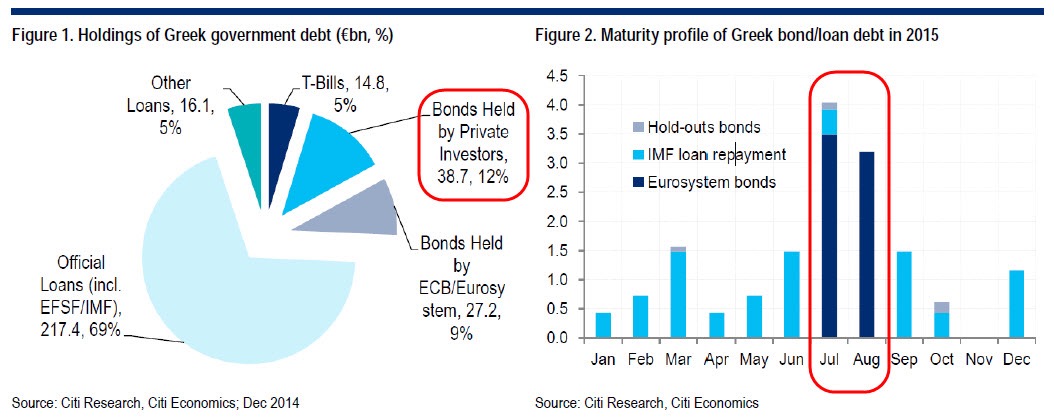
Any way you look at it, the standoff between the nation of Greece and the leaders of the European Union is a mess. But it may not be quite the problem that the press is making it out to be. In case you haven’t been following the story, the gist of it is that the Greek government, over a period of years that included the time it hosted the Summer Olympics, issued more bonds than, in retrospect, it could possibly pay back. The total debt outstanding peaked at somewhere around $340 billion, which is actually more than the $242 billion in goods and services that the entire Greek economy produces in a year.  You’ve no doubt heard about a series of bailouts organized by the European Union, the International Monetary Fund and other groups which have collectively extended loans and extensions amounting to $217 billion to date. As you can see from Figure 2, on the right-hand side, roughly $4 billion in payments are due in July and more than $3 billion in August, after which time the payment schedule becomes somewhat more forgiving through 2022. Grexit 2015-06-29 There are three problems with this picture. First, it has become apparent that Greece doesn’t have the money to make the July and August payments. Second, in return for additional debt relief, the various creditors are asking that the Greek government do more than just balance its budget (which it has). Their demands seem a bit harsh and somewhat picky when they’re organized in a list: Greece would have to reduce pension payments to current and retired workers by 40%, raise the retirement age to 67 in 2022 rather than 2025, phase out supplemental bonuses for poorer retirees in 2017 rather than 2018, and cut back on early retirement immediately. (The proposals also include additional taxes on consumers but not businesses.)   And third: the newly-elected Greek government, led by Alexis Tsipras of the Syriza party, ran on a platform of rejecting any further budget concessions and compromises. This turned out to be an extremely successful political strategy: the party won 149 out of the 300 seats in the Greek Parliament in what is regarded as a rousing popular mandate. Negotiations predictably broke down, and now the Syriza leaders are asking the Greek citizens to vote on whether they will accept the or reject the austerity measures that the EU creditors are demanding. Polls suggest that the voters would like to keep their country in the Eurozone but that they oppose any additional budget reductions. In other words, nobody knows how the referendum will end. If the citizens of Greece reject austerity, it will present the European Union with a difficult choice: back down and continue to help Greece ease out of the crisis (which would be politically difficult to sell, especially to German voters), or deny the concessions that Greece needs, and effectively force Greece out of the Eurozone. If the latter happens, then the future becomes a bit murky. Greek banks have been shut down in advance of the July 5 vote, strongly suggesting that Greek leaders, holding a “no” vote, would no longer use the euro as its currency. They would print drachmas, which, in those frozen bank accounts, would replace euros at par. The drachmas would immediately lose value on the international markets, which would allow Greece to undercut its competitors in the export markets. Meanwhile, Greece could default on all or portions of its debt, and offer to pay drachmas instead. Who loses in this scenario? Everybody. The European banks holding Greek debt and private investors, are the obvious losers. But closer to home, any Greek citizen who didn’t get his/her money out of the bank before the freeze, will have to accept a haircut on the deposits, as drachmas will inevitably be worth less than euros. At the same time, many Greek banks are holding massive amounts of Greek government debt, which they need as collateral for European Central Bank loans that are keeping THEM (the banks) afloat. Alternatively, Greece could offer everyone 50-70 cents on the dollar in debt repayments, and would probably get mostly takers from creditors who would like to put this whole saga behind them. Do YOU lose in any of these scenarios? If either side blinks, then the situation goes back to business as usual. If Greek voters agree to give the EU what it wants, then some economists believe that the Greek economy will go into a steep recession, but your personal exposure to Greek companies is almost certainly minimal, and the problem will be temporary. If Greek voters vote “no”, the EU negotiators remain intractable and Greece leaves the Eurozone, then you can expect breathless and sometimes scary headlines and short-term turmoil in European stocks, with some investors panicking and others uncertain. But the smart money says that the Eurozone is strong enough to sustain the loss of one of its smallest economies, and Greece, too, will survive. The irony, which nobody seems to have noticed, is that after accepting many of the earlier austerity measures, the Greek government is actually running a budget surplus without the debt payments—something U.S. citizens can only dream of. If the additional austerity measures do, eventually, get put in place, the subsequent recession would reduce tax receipts and push Greece back into deficits again. If you’re a Greek citizen who hit the ATM after they had run out of money, then this is a pretty big crisis for your long-term financial situation. Otherwise, like most so-called “crises,” the possibility of a “Grexit” and the upcoming special election in Greece is more about entertainment than about making or losing money in your long-term portfolio.  There may even be opportunities to buy some good solid companies or funds from those panicking out of their positions. So the Grexit is a non-issue for anyone not living and working in Greece. Our financial system had five years to manage, hedge, and otherwise reduce exposure to a Greek default. Most Greek debt is now held by European governments who can weather these losses. For them it isn’t a big deal because they didn’t enter into these positions expecting a profit, or even their money back. All they were doing is buying stability and time. And given that they delayed the inevitable Greek default by five years, they did a pretty good job. While a few politicians might lose their jobs and damage their legacy over this, the financial system will survive without Greece because of the time they bought us. If you would like to review your current investment portfolio or discuss any other financial planning matters, please don’t hesitate to contact us or visit our website at http://www.ydfs.com. We are a fee-only fiduciary financial planning firm that always puts your interests first. If you are not a client yet, an initial consultation is complimentary and there is never any pressure or hidden sales pitch. Sources: https://en.wikipedia.org/wiki/Economy_of_Greece http://confluenceinvestment.com/assets/docs/2015/daily_Jun_29_2015.pdf http://www.zerohedge.com/news/2015-02-03/who-owns-greek-debt-and-when-it-due http://www.washingtonpost.com/blogs/wonkblog/wp/2015/06/25/europe-strikes-back-it-seems-to-be-trying-to-push-greece-out-of-the-euro/ TheMoneyGeek thanks guest writer Bob Veres for his help writing this post

Planning for Known — and Unknown — Health Care Costs in Retirement

The issue of health care costs in retirement — and planning for them well in advance of retirement — is becoming a centerpiece of any retirement planning discussion.

A recent study by Employee Benefit Research Institute (EBRI) projected that in 2014, men and women who wanted a 90% chance of having enough money to cover out-of-pocket health care expenses in retirement would need to have saved $116,000 and $131,000 respectively by age 65.1 This is a sobering goal when you consider that just 42% of workers in their 50s and 60s report total savings and investments in excess of $100,000.2

Part of the problem with putting a price tag on retiree health care expenses is that every situation will vary depending on an individual’s health, the type of health care coverage they carry, and when they hope to retire. That said, EBRI has identified some “recurring expenses,” or standard elements of cost that can be estimated and planned for in advance as well as “non-recurring” expenses that are less predictable but tend to increase with age.

Recurring vs. Non-Recurring Expenses

Using data gleaned from the Health and Retirement Study (HRS) — a longstanding, highly respected study of representative U.S. households with individuals over age 50 — EBRI was able to categorize utilization patterns and expenses for two separate types of health care services:

  • Recurring services — include doctor visits, prescription drug usage, and dentist services. Since these services tend to remain stable throughout retirement, it is possible to calculate an average out-of-pocket expense among individuals age 65 and older of $1,885 annually.3 Projecting forward, and factoring in the following assumptions: a 2% inflation rate, a 3% rate of return on investments, and a life expectancy of 90 years, EBRI estimates that one would need $40,798 at age 65 to cover the average out-of-pocket expenses for recurring health care needs throughout retirement. It should be noted that this calculation does not include expenses for any insurance premiums or over-the-counter medications.
  • Non-recurring expenses — include overnight hospital stays, overnight nursing home stays, home health care, outpatient surgery, and special facilities. Unlike recurring expenses, the cost of most non-recurring services increases with age. For example, average annual out-of-pocket expenses for nursing home stays are estimated at $8,902 for those in the 65 to 74 age group, $16,948 for those aged 75 to 84, and $24,185 for individuals aged 85 and up.3

Yet because the likelihood of utilizing these services and the degree to which they will be needed is largely unknown, projecting the savings needed to cover these costs throughout retirement is an elusive exercise. However, by thinking about the total out-of-pocket savings goals of $116,000 for men and $131,000 for women cited earlier in terms of recurring and non-recurring costs may help retirees and those nearing retirement in their planning efforts.

Bigger Picture Planning

As financial planners, we often recommend taking a holistic approach to calculating income needs in retirement, factoring in such costs as taxes and debt payments along with other typical expenses including health care. In addition to the out-of-pocket health care calculations discussed above, consider what you think you might have to pay in annual premiums if you were to apply for health insurance today. Lastly, and perhaps most important, add in an allowance for inflation — both general and health care inflation.

Your financial planner can help get the retirement income planning discussion started and — as part of that exercise — can work with you to put some numbers around your health care planning needs.

This article offers only an outline; it is not a definitive guide to all possible consequences and implications of any specific saving or investment strategy. If you would like to review your retirement plan, investment strategy or discuss any other financial planning matters, please don’t hesitate to contact us or visit our website at http://www.ydfs.com. We are a fee-only fiduciary financial planning firm that always puts your interests first.  If you are not a client yet, an initial consultation is complimentary and there is never any pressure or hidden sales pitch.

Sources:

1Employee Benefit Research Institute, news release, “Needed Savings for Health Care in Retirement Continue to Fall,” October 28, 2014.

2Employee Benefit Research Institute, 2014 Retirement Confidence Survey, March 2014. (Not including the value of a primary residence or defined benefit plans.)

3Employee Benefit Research Institute, “Utilization Patterns and Out-of-Pocket Expenses for Different Health Care Services Among American Retirees,” February 2015.

How Do I Know If My IRA Contributions Are Tax Deductible?

Contributions to a traditional IRA are tax deductible if you don’t already participate in an employer-sponsored retirement plan. For 2015, the maximum you can contribute to an IRA is $5,500. If you are age 50 or over, you can make an additional “catch-up contribution” of $1,000.

If you do participate in an employer-sponsored plan, your contributions still can be fully or partially deductible, up to certain income thresholds. For 2015, those limits are between $61,000 and $71,000 for single filers and $98,000 and $118,000 for married couples filing joint returns.

If you are ineligible to make deductible contributions to a traditional IRA, you may want to investigate a Roth IRA. Contributions to a Roth IRA are made with after-tax dollars and are not tax deductible, but distributions are tax free. Be aware that there are income thresholds to contribute to a Roth. For 2015, those limits are between $116,000 and $131,000 for single filers and $183,000 and $193,000 for married couples filing joint returns.

You can find more information on the IRS website.

If you have questions about your current IRA’s or if you would like to discuss any other financial planning matters, please don’t hesitate to contact us or visit our website at http://www.ydfs.com. We are a fee-only fiduciary financial planning firm that always puts your interests first.  If you are not a client yet, an initial consultation is complimentary and there is never any pressure or hidden sales pitch.

Return on College

Let’s say you’re giving your niece or grandson some advice on which major to select in college. Do you tell them to get an art degree, or take courses in social sciences? Or should they focus on business and finance?

The decision should not ignore their natural abilities and interests, of course. But if they’re looking for the best return on their tuition dollars, then they might consider spending their time in the computer sciences and math buildings.

This information comes from a report published by PayScale.com, which helps people manage their careers and figure out what they’re worth on the job market. PayScale’s research team tracked the median salary for people who completed its salary survey online. They then compared the 20-year earnings of people following different careers with what was earned, on average, by competing workers with a high school diploma but no college degree. Then they subtracted the cost of 4 years of college tuition, to arrive at a return on investment figure—the additional money the degree provided. Advanced degrees like law and medicine were excluded; the survey focused on bachelors degrees.

The results were striking. Business and finance majors came away with a respectable $331,345 average return on investment (ROI) over 20 years, but they actually finished a distant third on the list, just ahead of sales, marketing and public relations ($318,212). The highest ranking majors, by this metric, were computer and math, whose degree-holders saw a net return on their tuition investment of $584,339 over the 20 years after graduation. These nerdy individuals nosed out the architecture and engineering graduates, whose average ROI came to $561,475.

Life, physical and social sciences majors fared somewhat less well, earning almost exactly $250,000 more than their high school diploma competition. Graduates with an arts, design, entertainment and related degree came in last in the survey; they are expected to make a little over $125,000 as a result of their college training.

Interestingly, the PayScale website also tracks the average return on tuition investment for different colleges. Graduates of Harvey Mudd College in Claremont, CA can expect to earn nearly $1 million over the 20 years after graduation, with a typical starting salary north of $75,000—with a 4-year college investment of $237,700. Numbers 2-10 on the rankings include the California Institute of Technology ($901,400 earnings, $221,600 cost); The Stevens Institute of Technology in Hoboken, NJ ($841,000; $232,000), the Colorado School of Mines in Golden, CO ($831,000; $112,000); Babson College in Wellesley, MA ($812,800; $230,200); Stanford University ($809,000; $233,300); the Massachusetts Institute of Technology ($798,500; $224,500); Georgia Institute of Technology ($796,300; $86,700); Princeton University ($795,700; $217,300); and the Virginia Military Institute ($767,300; $95,700).

You can look up your own alma mater here: http://www.payscale.com/college-roi/

If you would like to talk about college planning or discuss any other financial planning matters, please don’t hesitate to contact us or visit our website at http://www.ydfs.com. We are a fee-only fiduciary financial planning firm that always puts your interests first.  If you are not a client yet, an initial consultation is complimentary and there is never any pressure or hidden sales pitch.

Sources:

http://www.payscale.com/college-roi/

http://www.bloomberg.com/news/articles/2015-03-05/the-career-with-the-biggest-financial-payoff?hootPostID=293b20e2f9470947cb0facdcea7f70ea

TheMoneyGeek thanks guest writer Bob Veres for writing this post