2015 Third Quarter Review

Many investors will be glad to finally see the end of the third quarter of 2015, and most of them will feel like their portfolios are worse off than they actually are. That whooshing sound you hear is not just air being let out of the markets; it’s also an end to that optimistic feeling that many people had been cautiously building during the long 6-year bull market that followed the Great Recession.

The past three months turned yearly gains into yearly losses almost completely across the board of the investment opportunity set. The Wilshire 5000–the broadest measure of U.S. stocks—fell 6.91% in the third quarter of 2015, posting a total return of -5.79% in the first half of the year. The comparable Russell 3000 index is down 5.45% so far this year.

The Wilshire U.S. Large Cap index dropped 6.44% of its value for the quarter, and is now down 5.15% for 2015. The Russell 1000 large-cap index is down 5.24% so far this year, while the widely-quoted S&P 500 index of large company stocks posted a loss of 6.94% in the third quarter, and is now down 6.75% for the year.

The Wilshire U.S. Mid-Cap index lost 8.96% for the quarter, and is now off 4.86% as we head into the fourth quarter. The Russell Midcap Index has lost 8.58% so far this year.

Small company stocks, as measured by the Wilshire U.S. Small-Cap index, gave investors a 10.88% loss during the latest three months, which takes the index down 7.29% so far in 2015. The comparable Russell 2000 Small-Cap Index is down 7.73% in the first three-quarters of the year, while the technology-heavy Nasdaq Composite Index lost 7.35% for the quarter, and stands at a 2.45% loss for the first three quarters of the year.

Meanwhile, in the global markets, the broad-based EAFE index of companies in developed foreign economies lost 10.75% in dollar terms in the third quarter of the year, for a negative 7.35% return so far this year. In aggregate, European stocks lost 9.07%, and are down 7.33% for the year. Emerging markets stocks of less developed countries, as represented by the EAFE EM index, were down a whopping 18.53% for the quarter, and are down 17.18% for the year.

Looking over the other investment categories, real estate investments, as measured by the Wilshire U.S. REIT index, gained 2.88% for the third quarter, but is still standing at a 3.01% loss for the year. Commodities, as measured by the S&P GSCI index, lost 19.3% in the third quarter, largely due to a fall in oil prices that may be nearing its end. They are down 19.46% this year.

There were many contributors to the loss of confidence in the stock market, and they appear to have been mainly psychological. Analysts blame the Federal Reserve Board for not having raised rates as the so-called “smart money” seems to have expected in September. Why are low rates a bad thing? Because Fed economists seem to believe that the economy has not recovered sufficiently to warrant stopping the central bank’s long-running stimulus program. Who are we investors to argue with the Fed economists?

Except… The explanation for not raising rates had little to do with actual economic activity, which is finally moving ahead, as of the second quarter, at an annualized 3.9% growth rate for U.S. GDP. This is higher than the 3.7% estimate from the Bureau of Economic Analysis, and much higher than the 2% rate that the U.S. economy has experienced since 2009. At the same time, consumer income, wages and salaries, and spending are all increasing modestly, existing home sales are growing at a 6.2% rate over last year, and the unemployment rate, once higher than 10%, has finally dropped down to the 5% range.

The Fed explained that it was delaying its rate rise because the core inflation rate—currently 1.83%, is below the 2% target rate the Fed set back in June 2012. Some people believe low inflation is a GOOD thing, and speculate that’s the real reason.

And another reason why many investors are nervous about the markets—could be the slower growth of the Chinese economy, coupled with the recent unnerving drop in its stock market. Unfortunately, the Chinese government controls the economic statistics that come out of the world’s second largest economy, which makes it hard to know exactly how fast China is or isn’t growing. But it’s worth noting that Chinese stock prices, even after the drop, are still up 31.6% from where they were a year ago.

For the time being, investors will have to continue to accept interest rates at historically low levels. The Bloomberg U.S. Corporate Bond Index now has an effective yield of 3.42%. 30-year Treasuries are yielding 2.87%, down from 3.13% a quarter ago, and 10-year Treasuries currently yield 2.06%, down from 2.36% in June.

At the low end, the yield on 3-month U.S. T-bills remains at 0.01%. 6-month bills are only slightly more generous, at 0.08%. Long-term (30-year) municipal bonds are yielding 3.16%, more than comparable Treasuries, and you get the federal tax-exemption thrown in for good measure.

When you look at the decline year-to-date, you see relatively small losses. But many investors are remembering that they were 10-15% wealthier just a couple of months ago, measuring their pain from the high point of the various indices. It’s tough to watch your portfolio go down, but it’s also worth remembering that people have been predicting a significant downturn—erroneously—for the better part of six years. Now that the downturn has finally arrived, it hasn’t been terribly painful, mostly giving back gains that were posted in the first two quarters.

The third quarter could be a temporary drawdown that sets the market up for a push back into positive territory by the end of the year, which would give us a record seven years of positive market performance. Or we could see the year end in negative territory, perhaps even giving us the first true bear market (defined as a drop of 20% from the peak) since the Great Recession. We don’t know how the psychology of millions of investors will turn in the next few months, and neither do the smart money analysts who thought that interest rates would be nudged upward by our central bank last month.

We do, however, have confidence that the next bear market will be followed by yet another bullish period that will eventually take us back into record territory, and we’re pretty sure that the markets will punish anyone who tries to outguess their unpredictable behavior in the short term. If you know what the next quarter will bring, please tell us now. Meanwhile, perhaps we should celebrate the fact that we can buy many kinds of investments at cheaper prices than we could just three short months ago. It’s not much, but it’s something to feel good about.

In our client portfolios, our returns this quarter were buffered by a larger than normal cash position, investments in inverse funds, a focus on defensive sectors, and by selling call options against some of our positions. If the market chooses to launch a 4th quarter rally, we’ll be ready for it. It may even have already started. But if the market instead chooses to go the bear route, we’ll increase our defensiveness further.

If you would like to review your current investment portfolio or discuss any other financial planning matters, please don’t hesitate to contact us or visit our website at http://www.ydfs.com. We are a fee-only fiduciary financial planning firm that always puts your interests first.  If you are not a client yet, an initial consultation is complimentary and there is never any pressure or hidden sales pitch.

Sources:

Wilshire index data: http://www.wilshire.com/Indexes/calculator/

Russell index data: http://www.russell.com/indexes/data/daily_total_returns_us.asp

S&P index data: http://www.standardandpoors.com/indices/sp-500/en/us/?indexId=spusa-500-usduf–p-us-l–

http://www.tradingeconomics.com/united-states/unemployment-rate

Nasdaq index data: http://quicktake.morningstar.com/Index/IndexCharts.aspx?Symbol=COMP

International indices: http://www.mscibarra.com/products/indices/international_equity_indices/performance.html

Commodities index data: http://us.spindices.com/index-family/commodities/sp-gsci

Treasury market rates: http://www.bloomberg.com/markets/rates-bonds/government-bonds/us/

Aggregate corporate bond rates: https://indices.barcap.com/show?url=Benchmark_Indices/Aggregate/Bond_Indices

Aggregate corporate bond rates: http://www.bloomberg.com/markets/rates-bonds/corporate-bonds/

Muni rates: https://indices.barcap.com/show?url=Benchmark_Indices/Aggregate/Bond_Indices

http://www.bloomberg.com/news/articles/2015-07-01/global-equity-axis-tilts-east-even-as-china-takes-gloss-off-gain

http://money.cnn.com/2015/06/29/investing/china-stocks-bear-market/index.html

http://www.reuters.com/article/2015/10/01/us-usa-economy-idUSKCN0RV4I120151001

http://www.theguardian.com/business/2015/sep/28/us-stock-markets-fall-concerns-china-economy

http://www.usnews.com/news/business/articles/2015/10/01/asia-stocks-higher-china-manufacturing-index-ticks-higher

http://www.usnews.com/news/articles/2015/09/29/will-russias-move-ruin-erdogans-plan-for-syria?int=af8409

http://www.usnews.com/news/articles/2015/10/01/federal-reserve-stands-pat-on-interest-rates-as-an-anxious-world-waits?int=a6f909

The MoneyGeek thanks guest writer Bob Veres for his contribution to this post.
The Brink of Grexit

Well, the Greek voters were asked, once again, whether they would accept additional austerity measures that were demanded by their creditors, including the European Central Bank, the International Monetary Fund and the European Commission. And once again they voted—this time overwhelmingly (61.31% to 38.69%)—to hunker down and move the country to the brink of a Grexit from the euro currency.

Their choice may not have been hard to make. Virtually all of the $264 billion that has been loaned to the Greek government have actually been paid to the European banks who unwisely loaded up on Greek debt before 2009—and the loans and extensions, to them through Greece, has kept the European banking system solvent during the crisis. Virtually none of that money has gone back into the ailing Greek economy.

Over the past three years, the Greek government, following many of the demanded austerity measures, has actually reached the point of budget surplus, aside, of course, from the debt repayments. The cost: a skyrocketing unemployment rate that has reached 25.6%, including 60% of the nation’s young workers, and a steep recession which economists seem to agree would only get steeper if the country accepts the austerity demands. The Greek economy has shrunk by 25% over the last five years.

But the hardship continues. Anticipating a currency shift from euros to drachma, Greek citizens have staged the mother of all bank runs, trying to get as many euros out of the system as they could before they are potentially exchanged for lesser-value drachmas. The government limited the amount of their own money that citizens could withdraw to approximately $67 a day, and has now shut down the Greek banking system at least through end of the week.   Re-opening the banks could be problematic, since they don’t hold nearly as many euros as depositors have put into them.

Some are betting that the European Central Bank will provide guarantees and financial support to keep the banks from collapsing and taking the Greek economy down with them. But you can expect Germany to push back hard on this idea.

Will Greece leave the Eurozone? Nobody knows, but the vote suggests that the citizens of Greece have had enough of European (read: German) control over their economy and political decisions; indeed, some observers saw the extremely hard line at the negotiating table as a ploy to destroy Greek’s ruling Syriza party by forcing Greek voters to abandon it. There are sizable numbers of people in other European countries who feel the same way about losing control over their own affairs, who are closely watching how the European Union responds.

The discussions will be tricky. If the European Union offers further concessions, then you can expect Spain (unemployment rate: 23.1%) to ask for less stringent austerity and some space to get its own economy moving again. Portugal could be next.

And, of course, if Greece leaves, and begins to experience economic growth again, then those citizens in other countries could demand that their leaders also cast off the layer of oversight and control coming from Brussels.

What should you watch for? Greece is already technically in default as of last Tuesday, on $1.7 billion in payments. At the end of July, it will owe the next payment, in the amount of just under $4 billion. One compromise possibility is that the European Union, led by Germany, will reluctantly allow Greece to extend its payments, and also put together some kind of an aid package for the Greek economy that would help it become more able to make payments in the future.

How does this affect you? Once again, you’re going to see turmoil in the markets, and a temporary decline in the value of the euro on international markets. You’ll hear pundits and economists speculate about the “fate of the Eurozone,” and eventually, one way or another, everything will settle down again without affecting in any way the underlying value of the stocks you own. We’ve all seen this crisis a few times before, and each time the predictions of some form of doom haven’t come true. This “crisis” is very real to the Greek people, but the world will go on no matter how it’s resolved.

Now the current severe correction in the Chinese stock markets is a matter for another article, and that could prove much more important than the whole Grexit, if officials don’t wrest control of their markets.

If you would like to review your current investment portfolio or discuss any other financial planning matters, please don’t hesitate to contact us or visit our website at http://www.ydfs.com. We are a fee-only fiduciary financial planning firm that always puts your interests first.  If you are not a client yet, an initial consultation is complimentary and there is never any pressure or hidden sales pitch.

Sources:

http://finance.yahoo.com/news/greece-says-oxi-heres-happens-180726938.html

http://www.nytimes.com/interactive/2015/business/international/greece-debt-crisis-euro.html?_r=0

http://www.nytimes.com/2015/07/06/business/international/eurozone-central-bank-now-controls-destiny-of-greeces-battered-banks.html?rref=business/international&module=Ribbon&version=context&region=Header&action=click&contentCollection=International%20Business&pgtype=Multimedia

http://www.nytimes.com/2015/07/06/business/international/eurozone-central-bank-now-controls-destiny-of-greeces-battered-banks.html?rref=business/international&module=Ribbon&version=context&region=Header&action=click&contentCollection=International%20Business&pgtype=Multimedia

The MoneyGeek thanks guest writer Bob Veres for his contribution to this post

“Grexit” Vote Coming

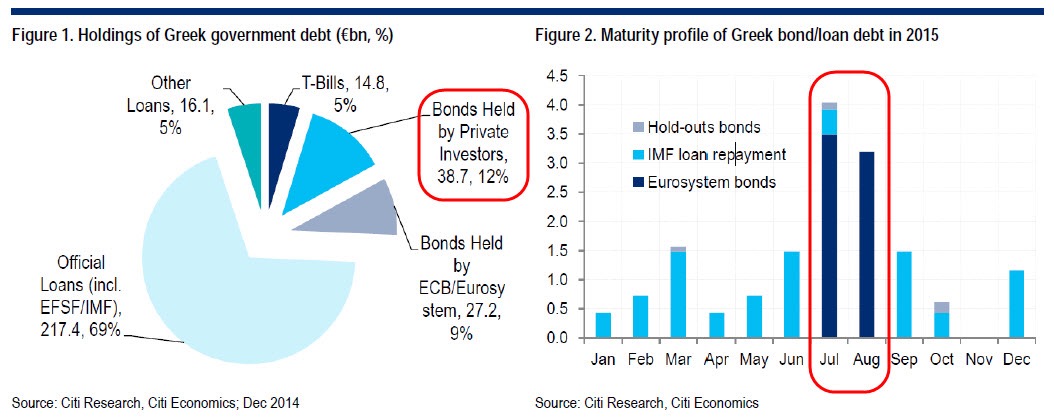
Any way you look at it, the standoff between the nation of Greece and the leaders of the European Union is a mess. But it may not be quite the problem that the press is making it out to be. In case you haven’t been following the story, the gist of it is that the Greek government, over a period of years that included the time it hosted the Summer Olympics, issued more bonds than, in retrospect, it could possibly pay back. The total debt outstanding peaked at somewhere around $340 billion, which is actually more than the $242 billion in goods and services that the entire Greek economy produces in a year.  You’ve no doubt heard about a series of bailouts organized by the European Union, the International Monetary Fund and other groups which have collectively extended loans and extensions amounting to $217 billion to date. As you can see from Figure 2, on the right-hand side, roughly $4 billion in payments are due in July and more than $3 billion in August, after which time the payment schedule becomes somewhat more forgiving through 2022. Grexit 2015-06-29 There are three problems with this picture. First, it has become apparent that Greece doesn’t have the money to make the July and August payments. Second, in return for additional debt relief, the various creditors are asking that the Greek government do more than just balance its budget (which it has). Their demands seem a bit harsh and somewhat picky when they’re organized in a list: Greece would have to reduce pension payments to current and retired workers by 40%, raise the retirement age to 67 in 2022 rather than 2025, phase out supplemental bonuses for poorer retirees in 2017 rather than 2018, and cut back on early retirement immediately. (The proposals also include additional taxes on consumers but not businesses.)   And third: the newly-elected Greek government, led by Alexis Tsipras of the Syriza party, ran on a platform of rejecting any further budget concessions and compromises. This turned out to be an extremely successful political strategy: the party won 149 out of the 300 seats in the Greek Parliament in what is regarded as a rousing popular mandate. Negotiations predictably broke down, and now the Syriza leaders are asking the Greek citizens to vote on whether they will accept the or reject the austerity measures that the EU creditors are demanding. Polls suggest that the voters would like to keep their country in the Eurozone but that they oppose any additional budget reductions. In other words, nobody knows how the referendum will end. If the citizens of Greece reject austerity, it will present the European Union with a difficult choice: back down and continue to help Greece ease out of the crisis (which would be politically difficult to sell, especially to German voters), or deny the concessions that Greece needs, and effectively force Greece out of the Eurozone. If the latter happens, then the future becomes a bit murky. Greek banks have been shut down in advance of the July 5 vote, strongly suggesting that Greek leaders, holding a “no” vote, would no longer use the euro as its currency. They would print drachmas, which, in those frozen bank accounts, would replace euros at par. The drachmas would immediately lose value on the international markets, which would allow Greece to undercut its competitors in the export markets. Meanwhile, Greece could default on all or portions of its debt, and offer to pay drachmas instead. Who loses in this scenario? Everybody. The European banks holding Greek debt and private investors, are the obvious losers. But closer to home, any Greek citizen who didn’t get his/her money out of the bank before the freeze, will have to accept a haircut on the deposits, as drachmas will inevitably be worth less than euros. At the same time, many Greek banks are holding massive amounts of Greek government debt, which they need as collateral for European Central Bank loans that are keeping THEM (the banks) afloat. Alternatively, Greece could offer everyone 50-70 cents on the dollar in debt repayments, and would probably get mostly takers from creditors who would like to put this whole saga behind them. Do YOU lose in any of these scenarios? If either side blinks, then the situation goes back to business as usual. If Greek voters agree to give the EU what it wants, then some economists believe that the Greek economy will go into a steep recession, but your personal exposure to Greek companies is almost certainly minimal, and the problem will be temporary. If Greek voters vote “no”, the EU negotiators remain intractable and Greece leaves the Eurozone, then you can expect breathless and sometimes scary headlines and short-term turmoil in European stocks, with some investors panicking and others uncertain. But the smart money says that the Eurozone is strong enough to sustain the loss of one of its smallest economies, and Greece, too, will survive. The irony, which nobody seems to have noticed, is that after accepting many of the earlier austerity measures, the Greek government is actually running a budget surplus without the debt payments—something U.S. citizens can only dream of. If the additional austerity measures do, eventually, get put in place, the subsequent recession would reduce tax receipts and push Greece back into deficits again. If you’re a Greek citizen who hit the ATM after they had run out of money, then this is a pretty big crisis for your long-term financial situation. Otherwise, like most so-called “crises,” the possibility of a “Grexit” and the upcoming special election in Greece is more about entertainment than about making or losing money in your long-term portfolio.  There may even be opportunities to buy some good solid companies or funds from those panicking out of their positions. So the Grexit is a non-issue for anyone not living and working in Greece. Our financial system had five years to manage, hedge, and otherwise reduce exposure to a Greek default. Most Greek debt is now held by European governments who can weather these losses. For them it isn’t a big deal because they didn’t enter into these positions expecting a profit, or even their money back. All they were doing is buying stability and time. And given that they delayed the inevitable Greek default by five years, they did a pretty good job. While a few politicians might lose their jobs and damage their legacy over this, the financial system will survive without Greece because of the time they bought us. If you would like to review your current investment portfolio or discuss any other financial planning matters, please don’t hesitate to contact us or visit our website at http://www.ydfs.com. We are a fee-only fiduciary financial planning firm that always puts your interests first. If you are not a client yet, an initial consultation is complimentary and there is never any pressure or hidden sales pitch. Sources: https://en.wikipedia.org/wiki/Economy_of_Greece http://confluenceinvestment.com/assets/docs/2015/daily_Jun_29_2015.pdf http://www.zerohedge.com/news/2015-02-03/who-owns-greek-debt-and-when-it-due http://www.washingtonpost.com/blogs/wonkblog/wp/2015/06/25/europe-strikes-back-it-seems-to-be-trying-to-push-greece-out-of-the-euro/ TheMoneyGeek thanks guest writer Bob Veres for his help writing this post

Planning for Known — and Unknown — Health Care Costs in Retirement

The issue of health care costs in retirement — and planning for them well in advance of retirement — is becoming a centerpiece of any retirement planning discussion.

A recent study by Employee Benefit Research Institute (EBRI) projected that in 2014, men and women who wanted a 90% chance of having enough money to cover out-of-pocket health care expenses in retirement would need to have saved $116,000 and $131,000 respectively by age 65.1 This is a sobering goal when you consider that just 42% of workers in their 50s and 60s report total savings and investments in excess of $100,000.2

Part of the problem with putting a price tag on retiree health care expenses is that every situation will vary depending on an individual’s health, the type of health care coverage they carry, and when they hope to retire. That said, EBRI has identified some “recurring expenses,” or standard elements of cost that can be estimated and planned for in advance as well as “non-recurring” expenses that are less predictable but tend to increase with age.

Recurring vs. Non-Recurring Expenses

Using data gleaned from the Health and Retirement Study (HRS) — a longstanding, highly respected study of representative U.S. households with individuals over age 50 — EBRI was able to categorize utilization patterns and expenses for two separate types of health care services:

  • Recurring services — include doctor visits, prescription drug usage, and dentist services. Since these services tend to remain stable throughout retirement, it is possible to calculate an average out-of-pocket expense among individuals age 65 and older of $1,885 annually.3 Projecting forward, and factoring in the following assumptions: a 2% inflation rate, a 3% rate of return on investments, and a life expectancy of 90 years, EBRI estimates that one would need $40,798 at age 65 to cover the average out-of-pocket expenses for recurring health care needs throughout retirement. It should be noted that this calculation does not include expenses for any insurance premiums or over-the-counter medications.
  • Non-recurring expenses — include overnight hospital stays, overnight nursing home stays, home health care, outpatient surgery, and special facilities. Unlike recurring expenses, the cost of most non-recurring services increases with age. For example, average annual out-of-pocket expenses for nursing home stays are estimated at $8,902 for those in the 65 to 74 age group, $16,948 for those aged 75 to 84, and $24,185 for individuals aged 85 and up.3

Yet because the likelihood of utilizing these services and the degree to which they will be needed is largely unknown, projecting the savings needed to cover these costs throughout retirement is an elusive exercise. However, by thinking about the total out-of-pocket savings goals of $116,000 for men and $131,000 for women cited earlier in terms of recurring and non-recurring costs may help retirees and those nearing retirement in their planning efforts.

Bigger Picture Planning

As financial planners, we often recommend taking a holistic approach to calculating income needs in retirement, factoring in such costs as taxes and debt payments along with other typical expenses including health care. In addition to the out-of-pocket health care calculations discussed above, consider what you think you might have to pay in annual premiums if you were to apply for health insurance today. Lastly, and perhaps most important, add in an allowance for inflation — both general and health care inflation.

Your financial planner can help get the retirement income planning discussion started and — as part of that exercise — can work with you to put some numbers around your health care planning needs.

This article offers only an outline; it is not a definitive guide to all possible consequences and implications of any specific saving or investment strategy. If you would like to review your retirement plan, investment strategy or discuss any other financial planning matters, please don’t hesitate to contact us or visit our website at http://www.ydfs.com. We are a fee-only fiduciary financial planning firm that always puts your interests first.  If you are not a client yet, an initial consultation is complimentary and there is never any pressure or hidden sales pitch.

Sources:

1Employee Benefit Research Institute, news release, “Needed Savings for Health Care in Retirement Continue to Fall,” October 28, 2014.

2Employee Benefit Research Institute, 2014 Retirement Confidence Survey, March 2014. (Not including the value of a primary residence or defined benefit plans.)

3Employee Benefit Research Institute, “Utilization Patterns and Out-of-Pocket Expenses for Different Health Care Services Among American Retirees,” February 2015.

How Do I Know If My IRA Contributions Are Tax Deductible?

Contributions to a traditional IRA are tax deductible if you don’t already participate in an employer-sponsored retirement plan. For 2015, the maximum you can contribute to an IRA is $5,500. If you are age 50 or over, you can make an additional “catch-up contribution” of $1,000.

If you do participate in an employer-sponsored plan, your contributions still can be fully or partially deductible, up to certain income thresholds. For 2015, those limits are between $61,000 and $71,000 for single filers and $98,000 and $118,000 for married couples filing joint returns.

If you are ineligible to make deductible contributions to a traditional IRA, you may want to investigate a Roth IRA. Contributions to a Roth IRA are made with after-tax dollars and are not tax deductible, but distributions are tax free. Be aware that there are income thresholds to contribute to a Roth. For 2015, those limits are between $116,000 and $131,000 for single filers and $183,000 and $193,000 for married couples filing joint returns.

You can find more information on the IRS website.

If you have questions about your current IRA’s or if you would like to discuss any other financial planning matters, please don’t hesitate to contact us or visit our website at http://www.ydfs.com. We are a fee-only fiduciary financial planning firm that always puts your interests first.  If you are not a client yet, an initial consultation is complimentary and there is never any pressure or hidden sales pitch.

Return on College

Let’s say you’re giving your niece or grandson some advice on which major to select in college. Do you tell them to get an art degree, or take courses in social sciences? Or should they focus on business and finance?

The decision should not ignore their natural abilities and interests, of course. But if they’re looking for the best return on their tuition dollars, then they might consider spending their time in the computer sciences and math buildings.

This information comes from a report published by PayScale.com, which helps people manage their careers and figure out what they’re worth on the job market. PayScale’s research team tracked the median salary for people who completed its salary survey online. They then compared the 20-year earnings of people following different careers with what was earned, on average, by competing workers with a high school diploma but no college degree. Then they subtracted the cost of 4 years of college tuition, to arrive at a return on investment figure—the additional money the degree provided. Advanced degrees like law and medicine were excluded; the survey focused on bachelors degrees.

The results were striking. Business and finance majors came away with a respectable $331,345 average return on investment (ROI) over 20 years, but they actually finished a distant third on the list, just ahead of sales, marketing and public relations ($318,212). The highest ranking majors, by this metric, were computer and math, whose degree-holders saw a net return on their tuition investment of $584,339 over the 20 years after graduation. These nerdy individuals nosed out the architecture and engineering graduates, whose average ROI came to $561,475.

Life, physical and social sciences majors fared somewhat less well, earning almost exactly $250,000 more than their high school diploma competition. Graduates with an arts, design, entertainment and related degree came in last in the survey; they are expected to make a little over $125,000 as a result of their college training.

Interestingly, the PayScale website also tracks the average return on tuition investment for different colleges. Graduates of Harvey Mudd College in Claremont, CA can expect to earn nearly $1 million over the 20 years after graduation, with a typical starting salary north of $75,000—with a 4-year college investment of $237,700. Numbers 2-10 on the rankings include the California Institute of Technology ($901,400 earnings, $221,600 cost); The Stevens Institute of Technology in Hoboken, NJ ($841,000; $232,000), the Colorado School of Mines in Golden, CO ($831,000; $112,000); Babson College in Wellesley, MA ($812,800; $230,200); Stanford University ($809,000; $233,300); the Massachusetts Institute of Technology ($798,500; $224,500); Georgia Institute of Technology ($796,300; $86,700); Princeton University ($795,700; $217,300); and the Virginia Military Institute ($767,300; $95,700).

You can look up your own alma mater here: http://www.payscale.com/college-roi/

If you would like to talk about college planning or discuss any other financial planning matters, please don’t hesitate to contact us or visit our website at http://www.ydfs.com. We are a fee-only fiduciary financial planning firm that always puts your interests first.  If you are not a client yet, an initial consultation is complimentary and there is never any pressure or hidden sales pitch.

Sources:

http://www.payscale.com/college-roi/

http://www.bloomberg.com/news/articles/2015-03-05/the-career-with-the-biggest-financial-payoff?hootPostID=293b20e2f9470947cb0facdcea7f70ea

TheMoneyGeek thanks guest writer Bob Veres for writing this post

Is America in Decline?

In 1945, the U.S. made up more than half of the world’s total gross domestic product (GDP), which basically means that half the world’s economy took place inside U.S. borders. Today that figure is just under 22%.

Does that mean America is in decline?

There seems to be a bull market in doomsayers these past few years, as we’re all reading arguments that the U.S. is slowly losing its grip on global preeminence. The rhetoric today sounds a lot like the hand-wringing back in the 1980s when Japan was allegedly taking over the global economy, and before that, when the Soviet Union had more missiles and a Sputnik circling over our heads.

There’s no easy way to define the overall quality of an economy, but probably the most thorough assessment comes out each year via the World Economic Forum’s Global Competitiveness Rankings. The most recent report ranked 144 countries around the world, including Qatar (16), Moldavia (82), Namibia (88), Lesotho (107) and the unhappy states of Chad (143) and Guinea (144), whose citizens eke out their lives on per capita incomes of $1,218 and $564 a year, respectively.

The survey looks at 12 “pillars” of economic competitiveness, including labor market efficiency, the quality of primary education and higher education, infrastructure, the strength of institutions, innovation, business sophistication, technological readiness and the sophistication of the financial markets. Each of these categories are broken down into dozens of subcategories, which are separately evaluated. For instance, when looking at the strength of each country’s public institutions, the World Economic Forum researchers consider whether people in a given country have strong property rights and intellectual property protection, whether there is corruption and the routine payment of bribes, whether the citizens enjoy judicial independence and a solid legal framework, and how well investors enjoy shareholder protection.

In the most recent survey, the U.S. ranked third overall, with an overall rating of 5.5 on a scale of 1-6. Ahead of it were Switzerland (5.7) and Singapore (5.6). China, the country that you most often hear cited as the all-powerful up-and-coming economy, ranked 28th, two rungs below Saudi Arabia, one rung above Estonia. Brazil and India, which are sometimes mentioned as powerful competitors to U.S. economic hegemony, are ranked 57th and 71st, respectively.

The point of the rankings is to show which countries have created the healthiest (or, in the cases of Chad and Guinea, the least-healthy) economic climate for future growth. But of course there are other ways of measuring competitiveness, including the bottom line (as mentioned at the top of the article) of percentage of the world GDP, and whether you’re moving up or down.

US and Global GDP through 2014

By that standard, the U.S. is indeed moving down. If you look at Figure 1 above, which shows the size of the overall global and U.S. economies since 1991, you see that the U.S. has enjoyed steady economic growth, while the world at large has essentially taken off like a rocket. The years following the collapse of the Soviet Union, when several billion people were suddenly allowed to become capitalists, have been good for world growth. When China shifted from a communist to a capitalist economic posture, this added fuel to the rocket. The democratization of computer technology and the global Internet has empowered value creators everywhere.

The U.S., Europe and Japan, in other words, no longer have a monopoly on capitalism. And that’s a good thing.

Is there a better way of evaluating how the U.S. economy is holding up in an increasingly competitive world? Figure 2 below looks at the first chart from a slightly different angle. Since 1991, what percentage of all the world’s business has been happening in the U.S., vs. Europe, Japan, China, India, Russia and Brazil?   How much of the total global economy did each nation claim in each year, and how has that balance changed over time?

US GDP Market Share through 2014

What you see there is that the U.S. is still in the lead by a pretty wide margin, and in recent years has actually stabilized its percentage of total global GDP. The decline has come mostly because a lot of smaller emerging markets, plus China and, to a certain extent, Brazil, India and Russia, have all been growing. At the same time, America’s traditional competitors—Europe and Japan—have been sinking. If you want to point a finger at decline, perhaps that’s a better direction than the U.S.

Does the U.S. face economic challenges? Of course. Is our political system a mess? Sure. Could things be better? Certainly. But if you sift through a lot of variables with a fine-toothed comb, you discover that the U.S. has created a better environment to grow and prosper than almost anywhere else, and it has held its own with the roaring growth of the emerging markets while the other developed nations are losing ground. More than a fifth of all economic activity still happens in the U.S., and the long, slow decline in that figure is not due to stagnation at home, but abundant growth all around the world. That’s not something to worry about; it’s something we should be celebrating.

If you would like to review your current investment portfolio or discuss any other financial planning matters, please don’t hesitate to contact us or visit our website at http://www.ydfs.com. We are a fee-only fiduciary financial planning firm that always puts your interests first.  If you are not a client yet, an initial consultation is complimentary and there is never any pressure or hidden sales pitch.

Sources:

http://reports.weforum.org/global-competitiveness-report-2014-2015/rankings/

http://www.economywatch.com/economic-statistics/year/1990/

http://theamericanscene.com/2008/05/07/a-post-american-world

TheMoneyGeek thanks guest writer Bob Veres for writing this post.

Getting Ready for a Fresh Start

Despite the potential long-term benefits of reviewing personal finances on an annual basis, it seems that many Americans still don’t make it a priority to do so.

Have you already taken steps to give yourself a fresh financial start next year? It’s still not too late to begin.

Aim Higher for Retirement

Today, workers are eligible to contribute more money than ever to their employer-sponsored retirement plans. For most workers, the maximum annual pre-tax contribution is $18,000 in 2015. If you’re at least 50 years old, you may also make additional contributions — known as catch-up contributions — of up to $6,000. That amounts to a $24,000 overall contribution limit this year.

Search for Savings

Even if you can’t contribute the maximum, a reality for many given life’s various financial challenges, seek out opportunities to set aside more money for retirement whenever possible.

Consider creating a comprehensive household budget that allows you to plan and track spending on an ongoing basis and includes among your listed expenses a commitment to “pay yourself” in the form of retirement savings. More than likely you’ll find some “fat” in your budget, even just a little, that can be trimmed to free up savings dollars.

Defeat Debt

The U.S. savings rate recently hit its lowest level in almost half a century, due in part to higher rates of borrowing and credit card debt. If debt is getting in the way of your long-term goals, consider strategies for chipping away at it:

  • Transferring high-interest debt to a credit card with a lower rate.
  • Trying to pay at least twice the minimum required payment.
  • Using a tax-refund to pay off outstanding loans.

For more ideas on how to get a fresh start or to discuss any other financial planning matters, please don’t hesitate to contact us or visit our website at http://www.ydfs.com. We are a fee-only fiduciary financial planning firm that always puts your interests first.  If you are not a client yet, an initial consultation is complimentary and there is never any pressure or hidden sales pitch.

Understanding Bond Investing: It’s a Matter of Balance

It’s a common misconception to think of bonds as “plain vanilla” investments that are appropriate only for certain types of people, such as financially conservative retirees. But in reality, bond investments may have the potential to add stability to a portfolio and help reduce overall investment risk — regardless of your age or financial outlook.

What Is a Bond?

Bonds are investment securities issued by corporations or governments to raise money for a particular purpose. Basically, bonds are the “IOUs” of the business world. There are different types of bond funds, each with varying levels of risk and return potential. Generally speaking, the higher the risk, the better the return potential. For example:

  • Government bond funds invest in bonds issued by the U.S. Treasury. Historically, they have been among the strongest types of bond investments. However, they typically offer lower returns than other bonds.
  • Corporate bond funds invest in bonds issued by private companies. They can range from “investment grade” (safer, lower return potential) to “below investment grade” (riskier, higher return potential).

Know the Risks

Bond funds are subject to several types of investment risk, including:

  • Market risk — Like stock prices, bond prices move up and down. However, such fluctuations tend to be less severe in the bond market.
  • Interest rate risk — When interest rates rise, bond prices may fall, and vice versa.
  • Inflation risk — If the return on a bond fund does not outpace the rising cost of living, the purchasing power of your investment could decline over time.

Managing Risk

Despite these risks, investors of all ages may potentially benefit from putting some money in bond funds. Because bond funds tend to respond to market influences differently than stock funds, they may help balance out the risks associated with stock investing.

In addition, lower-risk bond funds, such as government and investment-grade corporate bond funds, may help protect some of your money from losses during turbulent times.

If you would like to review bond investments in your current portfolio or discuss any other financial planning matters, please don’t hesitate to contact us or visit our website at http://www.ydfs.com. We are a fee-only fiduciary financial planning firm that always puts your interests first.  If you are not a client yet, an initial consultation is complimentary and there is never any pressure or hidden sales pitch.

About that Social Security Insolvency

Social Security’s future solvency has become one of the most commonly-discussed issues in retirement planning—and for good reason.  Gallup polls show that an estimated 57% of retirees rely on Social Security as a major source of retirement income—a number that has held steady since the early 2000s.  But when Generation X and Y individuals plan for their future retirement, they’ll often ask their advisor to assume that Social Security won’t be there for them 20 or 30 years down the road.

However, if you look closely at the numbers, you see a very different story.  Up until 2011, the Social Security system actually collected more revenues from workers’ FICA payments than it paid out in benefits—and that has been generally true since the 1940’s.  Most of the Social Security benefits that people receive today are simply a transfer; that is, the money is collected from worker paychecks (and, of course, employer matches), spends a few days at the U.S. Treasury and then is paid out to recipients.  The surplus has been used to pay government operating expenses, and for seven decades, the government issued “special issue federal securities” (essentially fancy IOUs that pay interest) to the Social Security trust fund.

In 2011, the program crossed that threshold where benefit payments slightly exceeded the amount collected.  Why?  Because the number of beneficiaries, compared to the number of workers, has steadily increased.  In 1955, there were more than eight workers paying into Social Security for every beneficiary.  Today, that number is closer to three workers for every beneficiary, and by 2031, if current estimates are correct, that ratio will fall to just over two workers supporting every retired beneficiary.

When Social Security Administration actuaries crunch the numbers, they have to take into account the shifting demographics, and then make estimates of fertility and immigration rates, longevity, labor force participation rates, the growth of real wages and growth of the economy every year between now and 2078.  After adding in the value of the government IOUs, they estimate that if nothing is done to fix the system, the trust fund IOUs will run out in the year 2033.  At that time, only the FICA money collected from workers would be available to pay Social Security beneficiaries.  In real terms, that means the beneficiaries would, in 2034, see their payments drop to 77% of what they were promised.

In other words, the money being transferred from current workers to beneficiaries through the FICA payroll program, assuming no course corrections between now and 2033, will be enough to pay retirees 77% of the benefits they were otherwise expecting.

The government actuaries say that if nothing is done to fix the problem over the next 63 years, this percentage will gradually decline to 72% by the year 2078.

So the first takeaway from these analyses is that today’s workers are looking at a worst-case scenario of only receiving about 75% of the benefits that they would otherwise have expected to receive.  This is far different from the zero figure that they’re asking their advisors to use in retirement projections.

How likely is it that there will be no course corrections?  There are two possible ways that this 75% figure could go up.  One lies in the assumptions themselves.  The Social Security Administration actuaries have tended to err on the side of conservatism, presumably because they would rather be pleasantly surprised than discover that they were too optimistic.  But what if the future doesn’t look as gloomy as their assumptions make it out to be?

To take just one of the variables, the actuaries are projecting that labor force participation rates for men will fall from 75.5% of the population in 1997 to 74% by 2075, while the growth in female workers will stop their long climb and peter out around 60%.  If male labor force participation rates don’t fall, and if female rates continue to rise, some of the funding gap will be eliminated.

Similarly, the projections assume that the U.S. economy’s productivity gains (which drive wage increases) will grow 1.3% a year, well below long-term U.S. averages and certainly below the assumptions of economists who believe that biotech and information age revolutions will spur unprecedented growth.  If real wages were to grow at something closer to the post-Great Recession rate of 2% a year, then more than half of the funding gap would be eliminated.  If the current slump in immigration (due to tighter immigration policies) is reversed, and the economy grows faster than the anemic 2% rates the Social Security Administration is projecting (compared to 2.5% recently), then the “bankrupt” system begins to look surprisingly solvent.

A second possibility is that Congress will tweak the numbers and bring Social Security’s long-term finances back in balance, as it has done 21 times since the program originated in 1937.  The financial press often cites the fact that the total future Social Security funding shortfall amounts to $13.6 trillion, but they seldom add that this represents just 3.5% of future taxable payrolls through 2081.  Small tweaks—like extending the age to collect full retirement benefits from 67 to 68, raising the FICA tax rate by 3.5 percentage points or making the current 12.4% rate (employee plus employer match) apply to all taxable income rather than the $118,500 current limit—would restore solvency far enough into the future that today’s workers would be comfortable adding back 100% of their anticipated benefits into their retirement projections.

How likely is it that Congress will take these measures, in light of recent partisan budget battles?  It’s helpful to remember that older Americans tend to vote with more consistency than younger citizens.  The more you’ve paid into the system, the more you expect to at least get back the money you were promised.

The bottom line here is that if you’re skeptical about Social Security’s future solvency, then you should pencil in 75% of the benefits you would otherwise expect—rather than $0.  Meanwhile, as you approach the age when you’re eligible for benefits, watch for signs that immigration restrictions are loosening, the economy is growing faster than the SSA actuaries’ gloomy projections, more people are working during traditional retirement years or yet another round of tweaks from our elected representatives.

If you would like to review your social security payment options or projections, analyze your current investment portfolio or discuss any other financial planning matters, please don’t hesitate to contact us or visit our website at http://www.ydfs.com. We are a fee-only fiduciary financial planning firm that always puts your interests first.  If you are not a client yet, an initial consultation is complimentary and there is never any pressure or hidden sales pitch.

Sources:

http://economix.blogs.nytimes.com/2014/03/05/another-way-to-do-the-math-for-social-security-reform/?_r=0

http://www.treasury.gov/resource-center/economic-policy/ss-medicare/Documents/ssissuebriefno.%205%20no%20cover.pdf

http://www.treasury.gov/resource-center/economic-policy/ss-medicare/Documents/post.pdf

http://www.wsj.com/articles/how-social-security-benefits-are-calculated-when-you-wait-to-start-taking-them-1421726460

http://www.usatoday.com/story/money/personalfinance/2013/11/25/nine-surprising-social-security-statistics/3698005/

http://www.huffingtonpost.com/2013/02/18/change-social-security_n_2708000.html

http://www.therubins.com/socsec/solvency.htm

http://www.encyclopedia.com/topic/social_security.aspx

http://fdlaction.firedoglake.com/2012/04/30/growing-number-of-americans-expect-to-rely-mostly-on-social-security/

TheMoneyGeek wishes to thank guest writer Bob Veres for this post.