Market & Economic Summary for the Week Ended January 3, 2025

In another volatile holiday-shortened week, the S&P 500 index closed 0.5% lower as the euphoric end-of-year rally lost all momentum. The NASDAQ index closed down 0.75%, while the small capitalization stocks finally showed some strength and closed up 0.9%. The traditional year-end Santa Claus rally was MIA as more signs of institutional distribution (selling) emerged.

The Institute for Supply Management’s (ISM) Purchasing Managers (PMI) Index (1) for Manufacturing came in at 49.3%, just 0.9 percentage points higher than November’s reading but still in contraction. While manufacturing is still in contraction overall, it is moving slower. Additionally, the New Orders Index improved in December.

However, the report also showed that the Employment Index decreased and fell deeper into contraction while the Prices Index rose and grew faster. If manufacturing employment continues to decline while prices climb and overall contraction persists, even an increase in new orders may not keep the manufacturing sector afloat.

Pending Home Sales (2) from the National Association of Realtors increased by 2.2%, suggesting buyers may no longer be willing to wait for lower mortgage rates. The 30-year fixed rate is still increasing and nearing 7%.

The 20-City Adjusted Case-Shiller Home Price Index for October was up 0.3% versus September (4.2% year over year), slightly higher than expected.

Monitoring additional housing metrics in the coming weeks will be essential to gauge the housing market’s health in 2025.

Weekly jobless claims came in at 211,000, lower than expectations for 225,000, showing continued stability. This data tends to be volatile around the holidays.

The U.S. Bureau of Labor Statistics will release its monthly jobs report for December on Friday, January 10.

YDream Financial Services is an investment advisory and financial planning firm serving the entire United States. If you would like to review your current investment portfolio or discuss any other financial planning matters, please don’t hesitate to contact us or visit our website at http://www.ydfs.com. We are a fee-only fiduciary financial planning firm that always puts your interests first. If you are not a client, an initial consultation is complimentary, and there is never any pressure or hidden sales pitch. We start with a specific assessment of your personal situation. There is no rush and no cookie-cutter approach. Each client and your financial plan and investment objectives are different.

(1) The Institute for Supply Management (ISM) Manufacturing Purchasing Managers’ Index (PMI), released on the first business day of each month for the previous month, surveys purchasing and supply executives around the country on new orders, production, employment, and much more. Manufacturing supply executives are polled on their view of the current economic climate concerning their respective businesses. The ISM Manufacturing PMI is a diffusion index – “they have properties of leading indicators and are convenient summary measures showing the prevailing direction of change and the scope of change.” A reading above 50 percent indicates that the manufacturing economy is generally expanding, while a reading below 50 percent indicates that it is typically declining. The ISM Manufacturing PMI is considered a highly reliable gauge of current business conditions for the manufacturing sector.

(2) The Pending Home Sales Index from the National Association of Realtors (NAR) is a leading indicator for the housing sector based on pending sales of existing homes. A sale is pending if a contract has been signed but has not yet closed. Typically, these sales close within two months of a contract signing.

Source: InvesTech Research

What Persistent Inflation Could Mean for the U.S. Economy

Economic reports of late seem to point to a weakening economy and stubborn inflation.

On April 30, the Employment Cost Index for the first calendar quarter of 2024 showed a 1.2% increase (4.2% year-over-year); that was 25% higher than the consensus estimate of 0.9%.

The FHFA House Price Index for February 2024 was much hotter than expected, coming in at 1.2% versus 0.1% expected (7.0% year-over-year.) Similarly, the February Case-Shiller 20-City Home Price Index came in at 0.6% versus 0.1% expected (7.3% year-over-year.)

At the same time, two more economic reports were released on April 30.

The Chicago Purchasing Managers’ Index (PMI) was 37.9 (versus 45 expected).

The Conference Board’s Consumer Confidence Index also came in far below expectations (97 versus 104 expected).

The stock markets were understandably confused: Normally, lower economic activity means lower inflation. Instead, what we got was higher inflation and lower economic activity.

In the stock markets, confusion equals selling now and asking questions later. That’s what we are seeing now.

Persistent Inflation

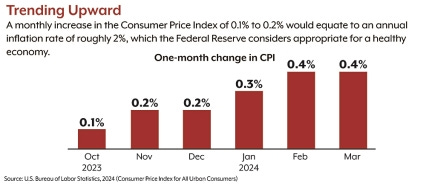
On April 10, 2024, the U.S. Bureau of Labor Statistics released the Consumer Price Index (CPI) for March, and the increase in CPI — the most commonly cited measure of inflation — was higher than expected. The rate for all items (headline inflation) was 3.5% over the previous year, while the “core CPI” rate, which strips out volatile food and energy prices, was even higher at 3.8%. The month-over-month change was also higher than anticipated at 0.4%. (1)

The stock market then dropped sharply on this news and continued to slide over the following days, while economists engaged in public handwringing over why their projections had been wrong and what the higher numbers might mean for the future path of interest rates. Most projections were off by just 0.1% — core CPI was expected to increase by 3.7% instead of 3.8% — which hardly seems earth-shattering to the casual observer. But this small difference suggested that inflation was proving more resistant to the Federal Reserve’s high interest-rate regimen (raising interest rates is one of the most common ways to curb spending and corporate investing to reduce inflationary pressures.) (2)

It’s important to remember that the most dangerous battle against inflation seems to have been won. CPI inflation peaked at 9.1% in June 2022, and there were fears of runaway inflation similar to the 1980s. That did not happen; inflation declined steadily through the end of 2023. The issue now is that there has been upward movement during the first three months of 2024.(3) This is best seen by looking at the monthly rates, which capture the current situation better than the 12-month rates. March 2024 was the third increase month that points to higher inflation (see chart).

High for longer

While price increases hit consumers directly in the pocketbook, the stock market reacted primarily to what stubborn inflation might mean for the benchmark federal funds rate and U.S. businesses. From March 2022 to July 2023, the Federal Open Market Committee (FOMC or AKA the Fed) raised the funds rate from near-zero to the current range of 5.25%–5.5% to slow the economy and hold back inflation.

At the end of 2023, with inflation moving firmly toward the Fed’s target of 2%, the FOMC projected three quarter-percentage point decreases in 2024, and some observers expected the first decrease might be this spring. Now it’s clear that the Fed will have to wait to reduce rates. (4)(5)

Higher interest rates make it more expensive for businesses and consumers to borrow. For businesses, this can hold back expansion and cut into profits when revenue is used to service debt. This is especially difficult for smaller companies, which often depend on debt to grow and sustain operations. Tech companies and banks are also sensitive to high rates. (6)

As mentioned above, in theory, high interest rates should hold back consumer spending and help reduce prices by suppressing demand. So far, however, consumer spending has remained strong. In March 2024, personal consumption expenditures — the standard measure of consumer spending — rose at an unusually strong monthly rate of 0.8% in current dollars or 0.5% when adjusted for inflation. (7)

The job market has also stayed strong, with unemployment below 4% for 26 consecutive months and wages rising steadily. (8)

The fear of keeping interest rates too high for too long is that it could slow the economy, but that is not the case, making it difficult for the Fed to justify rate cuts.

What’s driving inflation?

The Consumer Price Index measures price changes in a fixed market basket of goods and services, and some inputs are weighted more heavily than others.

The cost of shelter is the largest single category, accounting for about 36% of the index and almost 38% of the March increase in CPI. (9) The good news is that measurements of shelter costs — primarily actual rent and estimated rent that homeowners might receive if they rented their homes — tend to lag current price changes, and other measures suggest that rents are leveling or going down. (10)

Two lesser components contributed well above their weight. Gas prices, which are always volatile, comprised only 3.3% of the index but accounted for 15% of the overall increase in CPI. Motor vehicle insurance prices comprised just 2.5% of the index but accounted for more than 18% of the increase. Together, shelter, gasoline, and motor vehicle insurance drove 70% of March CPI inflation. On the positive side, food prices comprised 13.5% of the index and rose by only 0.1%, effectively reducing inflation. (11)

While the Fed pays close attention to the CPI, its preferred inflation measure is the personal consumption expenditures (PCE) price index, which places less emphasis on shelter costs, includes a broader range of inputs, and accounts for changes in consumer behavior. Due to these factors, PCE inflation tends to run lower than CPI. The annual increase in March was 2.7% for all items and 2.8% for core PCE, excluding food and energy. The monthly increase was 0.3% for both measures. (12)

Although these figures are closer to the Fed’s 2% target, they are not low enough, given strong employment and consumer spending, to suggest that the Fed will reduce interest rates anytime soon. It’s also unlikely that the Fed will raise rates.

The Fed seems poised to give current interest rates more time to push inflation to a healthy level, ideally without slowing economic activity. (13)

And since higher interest rates mean more competition for investment dollars and lower corporate earnings, stock markets don’t tend to react favorably, especially when 3-4 interest rate cuts were expected earlier this year.

The Fed issues its next interest rate decision on Wednesday afternoon, May 1, 2024. No change in interest rates is all but a given. However, what Federal Reserve Chairman Jerome Powell says about the recent economic data and the Fed’s stance on when future rate cuts are coming will no doubt be parsed word for word for clues when the press conference is convened.

Please pass the popcorn.

If you would like to review your current investment portfolio or discuss any other retirement, tax, or financial planning matters, please don’t hesitate to contact us at 734-447-5305 or visit our website at http://www.ydfs.com. We are a fee-only fiduciary financial planning firm that always puts your interests first. If you are not a client, an initial consultation is complimentary, and there is never any pressure or hidden sales pitch. We start with a specific assessment of your personal situation. There is no rush and no cookie-cutter approach. Each client and your financial plan and investment objectives are different.

Footnotes:

1, 3, 8–9, 11) U.S. Bureau of Labor Statistics, 2024

2)The New York Times, April 10, 2024

4) Federal Reserve, 2023

5) Forbes, December 5, 2023

6) The Wall Street Journal, April 15, 2024

7, 12) U.S. Bureau of Economic Analysis, 2024

10) NPR, April 18, 2024

13) Bloomberg, April 19, 2024

Are Interest Rates Signaling a Recession?

According to Investopedia, the yield curve shows the relationship between bond yields (the interest rates on the vertical axis) and bond maturity (the time on the horizontal axis).

Long-term bonds generally provide higher yields than short-term bonds because investors demand higher returns to compensate for the risk of lending money over an extended period. Occasionally, however, this relationship flips, and investors are willing to accept lower yields in return for the relative safety of longer-term bonds. This is called a yield curve inversion because a graph showing bond yields in relation to maturity is essentially turned upside down.

Imagine going to the bank and being told that a 1-year certificate of deposit yields 4.0%, but the 5-year CD only yields 3.0%. Few people would lock up their money for five times as long and earn a lower rate. This is an example of a yield inversion.

A yield curve could also apply to any bonds that carry similar risk, but the most studied curve is for U.S. Treasury securities, and the most common focal point is the relationship between the two-year and 10-year Treasury notes. Although Treasuries are often referred to as bonds, maturities up to one year are called bills, while maturities of two to 10 years are called notes. Only 20- and 30-year Treasuries are officially called bonds.

The two-year yield has been higher than the 10-year yield since July 2022, and beginning in late November, the difference has been at levels not seen since 1981. The biggest separation in 2022 came on December 7, when the two-year was 4.26%, and the 10-year was 3.42%, a difference of 0.84%. Other short-term Treasuries have also offered higher yields;  the highest yields in early 2023 were for the six-month and one-year Treasury bills. (1) 

Predicting Recessions

An inversion of the two-year and ten-year Treasury notes has preceded each recession over the past 50 years, reliably predicting a recession within the next one to two years. (2)  A 2018 Federal Reserve study suggested that an inversion of the three-month and ten-year Treasuries may be an even more reliable indicator, predicting a recession within about 12 months. (3) The three-month and ten-year Treasuries have been inverted since late October 2022, and in December 2022 and early January 2023, the difference was often greater than the inversion of the two- and 10-year notes. (4)

Weakness or Inflation Control?

Yield curve inversions do not cause a recession; rather they indicate a shift in investor sentiment that may reflect underlying economic weakness. A normal yield curve suggests investors believe the economy will continue to grow and interest rates will likely rise with the growth. In this scenario, an investor typically would want a premium to tie up capital in long-term bonds and potentially miss out on other opportunities in the future.

Conversely, an inversion suggests that investors see economic challenges that are likely to push interest rates down and typically would instead invest and lock in longer-term bonds at today’s yields. This increases demand for long-term bonds, driving prices up and yields down.

Note that bond prices and yields move in opposite directions; the more you pay for a bond that pays a given coupon interest rate, the lower the yield will be, and vice-versa.

The current situation is not so simple. The Federal Reserve has rapidly raised the benchmark federal funds rate (short-term) to combat inflation, increasing it from near 0% in March 2022 to 4.50%–4.75% today. The fed funds rate is the rate charged for overnight loans within the Federal Reserve System.  The funds rate directly affects other short-term rates, which is why yields on short-term Treasuries have increased rapidly. The fact that 10-year Treasuries have lagged the increase in the federal funds rate may mean that investors believe a recession is coming. But it could also reflect the confidence that the Fed is winning the battle against inflation and will lower rates over the next few years. This is in line with the Federal Reserve’s (The Fed) projections, which see the funds rate peaking at 5.0%–5.25% by the end of 2023 and then dropping to 4.0%–4.25% in 2024 and 3.0%–3.25% in 2025. (5)

Inflation has been slowing somewhat in October-December, but there is a long way to go to reach the Fed’s target of 2% inflation for a healthy economy. (6)  The fundamental question remains the same as it has been since the Fed launched its aggressive rate increases: Will it require a recession to control inflation, or can it be controlled without shifting the economy into reverse?

Other Indicators and Forecasts

The yield curve is one of many indicators that economists consider when making economic projections. Among the most closely watched are the ten leading economic indicators published by the Conference Board, with data on employment, interest rates, manufacturing, stock prices, housing, and consumer sentiment. The Leading Economic Index, which includes all ten indicators, fell for nine consecutive months through November 2022. Conference Board economists predict a recession beginning around the end of 2022 and lasting until mid-2023. (7) Recessions are not officially declared by the National Bureau of Economic Research until they are underway. The Conference Board view would suggest the United States may already be in a recession.

In The Wall Street Journal’s October 2022 Economic Forecasting Survey, most economists believed the United States would enter a recession within the next 12 months, with an average expectation of a relatively mild 8-month downturn. (8) More recent surveys of economists for the Securities Industry and Financial Markets Association and Wolters Kluwer Blue Chip Economic Indicators also found a consensus for a mild recession in 2023. (9)

For now, the economy appears strong despite high inflation, with a low December 2022 unemployment rate of 3.5% and an estimated 2.9% 4th quarter growth rate for real gross domestic product (GDP). Nonetheless, the indicators and surveys discussed above suggest an economic downturn in the next year or so. This would likely cause some job losses and other temporary financial hardship, but a brief recession may be the necessary price to tame inflation and put the U.S. economy on a more stable track for future growth.

If you would like to review your current investment portfolio or discuss any other financial planning matters, please don’t hesitate to contact us or visit our website at http://www.ydfs.com. We are a fee-only fiduciary financial planning firm that always puts your interests first.  If you are not a client yet, an initial consultation is complimentary and there is never any pressure or hidden sales pitch. We start with a specific assessment of your personal situation. There is no rush and no cookie-cutter approach. Each client is different, and so are your financial plan and investment objectives.

(1), (4) U.S. Treasury, 2023

(2)  Financial Times, December 7, 2022

(3) Federal Reserve Bank of San Francisco, August 27, 2018

(5) Federal Reserve, 2022

(6) U.S. Bureau of Labor Statistics, 2022

(7)  The Conference Board, December 22, 2022

(8) The Wall Street Journal, October 16, 2022

(9) SIFMA, December 2022