Market & Economic Week-January 31, 2025

The S&P 500 index closed down 1% in a volatile week. Monday’s markets opened on a down note due to bad news for artificial intelligence stocks, mostly recovered during the week, then dipped back down on Friday due to news on tariffs going into effect over the weekend. The NASDAQ 100 index lost 1.4%, while the small-capitalization stocks (small caps) lost 1.5%

For January, the S&P 500 index gained 2.7%, the NASDAQ 100 was up 2.2%, and the small caps bounced back 2.0%, a solidly positive start to the year.

Consumer Confidence from the Conference Board fell 5.4 points in January. The Present Situation Index fell sharply by nearly ten points while the Future Expectations Index fell 2.6 points to 83.9, hovering above the Conference Board’s “80” threshold for “recession ahead.” Overall, consumer confidence remains within the same range as it has bounced in for the last two years.

The Commerce Department reported that U.S. manufactured durable goods orders plunged by 2.2% in December (amid a nosedive in orders for transportation equipment) after tumbling by a revised 2.0% in November. Economists expected an increase of 0.8% in December, which was a big expectations miss.

December New Home Sales from the Census Bureau rose 3.6%. However, unsold inventory continues to increase and now represents a supply of 8.5 months at the current sales rate, which is historically elevated and is among some of its highest levels since the popping of the last housing bubble.

Pending Home Sales from the National Association of Realtors (NAR) tumbled 5.5% in December, with decreased transactions in all four regions of the country. The report further highlights the fragile housing market, a key area to watch. Pending sales have bounced around a small range over the last couple of years and remain near record lows. This marks a significant downturn in contract signings, evidence of prolonged buyer hesitation due to decades-high mortgage rates.

The 30-year fixed mortgage rate remains near 7%, contributing to affordability issues and keeping potential buyers from purchasing. Despite the Federal Reserve’s 1% rate cut since September, mortgage rates have risen over the same period.

December’s headline Personal Consumption Expenditure (PCE) Index was 2.6%, up from 2.4% the previous month, while Core PCE, the Fed’s preferred measure of inflation, remained stubbornly unchanged at 2.8%. While inflation has moderated since its highs following the pandemic, it remains elevated and could pose issues for the Federal Reserve.

Sam H. Fawaz is the President of YDream Financial Services, Inc., a fee-only investment advisory and financial planning firm serving the entire United States. If you would like to review your current investment portfolio or discuss any other tax or financial planning matters, please don’t hesitate to contact us or visit our website at http://www.ydfs.com. We are a fiduciary financial planning firm that always puts your interests first, with no products to sell. If you are not a client, an initial consultation is complimentary, and there is never any pressure or hidden sales pitch. We start with a specific assessment of your personal situation. There is no rush and no cookie-cutter approach. Each client and their financial plan and investment objectives are different.

Source: InvesTech Research

Market & Economic Summary for the Week Ended January 24, 2025

The shortened holiday trading week saw markets react positively to the presidential inauguration and a slew of policy decisions, lifting the S&P 500 Index by 1.7% to a new all-time closing high. The NASDAQ index closed up almost 1.6%, and the small-capitalization Russell 2000 index followed suit and closed up almost 1.4%.

While market technical data failed to make significant positive headway going into this coming week’s Federal Open Market Committee meeting, institutional selling (distribution) eased for the first time in several weeks.

Economic data was somewhat light this week.

Existing Home Sales from the National Association of Realtors for December rose 2.2% month over month and 9.3% year over year. Despite these seeming improvements, total sales for 2024 settled at the lowest level in almost 30 years. Existing Home Sales have bounced around a historically low range since late 2022 and continue to expose significant fissures in the housing market. Housing sector stocks remained buoyant for the week.

The Consumer Sentiment final reading for January surprised to the downside, dropping 4% from December’s reading. All components saw declines except for consumers’ assessments of personal finances. This broad-based pullback reflects concerns surrounding the current and future economy and inflation. Year-ahead inflation expectations soared to 3.3% this month, which does not bode well for the Fed’s battle to their 2% target.

The Conference Board’s Leading Economic Index (LEI) fell back in December. Despite strong contributions from financial inputs, the LEI failed to gain positive traction, as half of the ten components, including new orders and consumer expectations, were negative for the month. Thus, the leading economic data indicates that the path forward remains somewhat uncertain.

Sam H. Fawaz is the President of YDream Financial Services, Inc., a fee-only investment advisory and financial planning firm serving the entire United States. If you would like to review your current investment portfolio or discuss any other tax or financial planning matters, please don’t hesitate to contact us or visit our website at http://www.ydfs.com. We are a fiduciary financial planning firm that always puts your interests first, with no products to sell. If you are not a client, an initial consultation is complimentary, and there is never any pressure or hidden sales pitch. We start with a specific assessment of your personal situation. There is no rush and no cookie-cutter approach. Each client and their financial plan and investment objectives are different.

Source: InvesTech Research

Market & Economic Summary for the Week Ended January 17, 2025

Compared to the prior week, all seemed to be forgiven in the markets, as the S&P 500 index leaped 2.9% thanks to better-than-feared inflation data. The NASDAQ also sprinted up 2.9%, while the Small-Capitalization stocks led the way, vaulting almost 4.0%. January continues to live up to its reputation for increasing chop and volatility, while some signs of institutional selling continued.

The Consumer Price Index (CPI) for December came in at 2.9%, up from 2.7% in November. Core CPI (which excludes the more volatile categories of food and energy) was down from 3.3% to 3.2%, signaling that the rate of inflation is stubbornly stable and consumers are still feeling the pinch. Wall Street cheered this better than expected news as it continues to expect (hope?) at least two rate cuts in 2025.

The Producer Price Index (PPI), which tracks prices paid by businesses, was also up 3.3% year over year in December but lower than forecast. The vast majority of producer price increases resulted from energy costs.

The National Federation of Independent Businesses (NFIB) released its Small Business Optimism Index for December, which increased to its highest reading since July 2019. Small business owners are feeling more hopeful about the future, anticipating that potential favorable regulatory changes from the incoming administration will help Main Street.

Builder Confidence from the National Association of Home Builders (NAHB) edged up in December, as did Traffic of Prospective Buyers. However, sales expectations in the next six months fell six points. Price cuts and sales incentives continue to be offered as the cost of construction and high mortgage rates rise.

Housing Starts were up a surprising 15.8% in December, much of this due to an almost 60% increase in multi-family unit starts. This is an extremely volatile monthly number, and it’s worth noting that Housing Starts were still down 4.4% year-over-year. Additionally, Building Permits, which are generally more forward-looking and feed into future housing starts, were down 0.7% from November and down 3.1% compared to 2023.

YDream Financial Services is an investment advisory and financial planning firm serving the entire United States. If you would like to review your current investment portfolio or discuss any other financial planning matters, please don’t hesitate to contact us or visit our website at http://www.ydfs.com. We are a fee-only fiduciary financial planning firm that always puts your interests first. If you are not a client, an initial consultation is complimentary, and there is never any pressure or hidden sales pitch. We start with a specific assessment of your personal situation. There is no rush and no cookie-cutter approach. Each client and your financial plan and investment objectives are different.

Source: InvesTech Research

Market & Economic Summary for the Week Ended January 10, 2025

The S&P 500 index closed almost two percent lower after a fairly volatile, shortened trading week as investors grapple with uncertainty regarding future monetary policy and economic conditions. The NASDAQ index shed 2.2% while the small capitalization stocks slid 3.4% on the week, giving up their prior week‘s strength.

The post-election market “bump” we saw has all but been dissipated as institutional distribution (selling) continued this week, raising concerns of a more extended market correction.

Friday’s Employment Situation Summary (AKA the monthly jobs report) from the Bureau of Labor Statistics (BLS) for December surprised forecasts, coming in with 256K new jobs while the unemployment rate ticked down to 4.1%. Employment increases were seen in health care, retail, government, and social assistance. While a positive development, all but retail are non-cyclical sectors that are less sensitive to economic fluctuations. Stocks sold off and interest rates ticked up in response as the report reduces the possibility of additional rate cuts in 2025.

Job Openings from the BLS for November reported an increase to its highest level since May. Despite this, both the hiring and quits rate ticked down, suggesting that employers are hiring cautiously and that workers may feel less confident about finding new job opportunities.

The Institute for Supply Management’s (ISM) Services Sector rose in December, signaling continued expansion. However, a dramatic increase in the Prices Paid subcomponent is concerning, indicating that inflation pressures are becoming more pervasive. Despite improvements in most components, bond yields jumped higher and stocks sold off, proving that good economic news can sometimes elicit a bad market reaction.

A deeper look beneath the surface reveals why the situation may not be as encouraging as it seems. Many survey respondents cited end-of-year seasonal factors that boosted demand (perhaps to front-run potential tariffs.) Indeed, the main focus was tied to concerns about potential tariffs. This implies that the services sector could be weaker in the coming months if new policies are introduced.

Since September, the Federal Reserve has implemented several short-term interest rate cuts in an attempt to support economic growth. However, despite these efforts, longer-term bond yields have actually continued to climb (pressuring bond prices.) This suggests that some investors may be rejecting the idea that inflation has been tamed, which would likely limit the Fed’s ability to reduce rates further in the near term.

Friday’s preliminary January reading of Consumer Sentiment from the University of Michigan saw a fractional decrease from last month. However, the Current Conditions component improved while the Consumer Expectations component fell, reflecting concerns over future economic growth. Inflation uncertainty has climbed considerably over the past twelve months and year-ahead expectations soared in January, its highest reading since May 2024.

Sam H. Fawaz is the President of YDream Financial Services, Inc., a fee-only investment advisory and financial planning firm serving the entire United States. If you would like to review your current investment portfolio or discuss any other tax or financial planning matters, please don’t hesitate to contact us or visit our website at http://www.ydfs.com. We are a fee-only fiduciary financial planning firm that always puts your interests first with no products to sell. If you are not a client, an initial consultation is complimentary, and there is never any pressure or hidden sales pitch. We start with a specific assessment of your personal situation. There is no rush and no cookie-cutter approach. Each client and their financial plan and investment objectives are different.

Source: InvesTech Research

Market & Economic Summary for the Week Ended January 3, 2025

In another volatile holiday-shortened week, the S&P 500 index closed 0.5% lower as the euphoric end-of-year rally lost all momentum. The NASDAQ index closed down 0.75%, while the small capitalization stocks finally showed some strength and closed up 0.9%. The traditional year-end Santa Claus rally was MIA as more signs of institutional distribution (selling) emerged.

The Institute for Supply Management’s (ISM) Purchasing Managers (PMI) Index (1) for Manufacturing came in at 49.3%, just 0.9 percentage points higher than November’s reading but still in contraction. While manufacturing is still in contraction overall, it is moving slower. Additionally, the New Orders Index improved in December.

However, the report also showed that the Employment Index decreased and fell deeper into contraction while the Prices Index rose and grew faster. If manufacturing employment continues to decline while prices climb and overall contraction persists, even an increase in new orders may not keep the manufacturing sector afloat.

Pending Home Sales (2) from the National Association of Realtors increased by 2.2%, suggesting buyers may no longer be willing to wait for lower mortgage rates. The 30-year fixed rate is still increasing and nearing 7%.

The 20-City Adjusted Case-Shiller Home Price Index for October was up 0.3% versus September (4.2% year over year), slightly higher than expected.

Monitoring additional housing metrics in the coming weeks will be essential to gauge the housing market’s health in 2025.

Weekly jobless claims came in at 211,000, lower than expectations for 225,000, showing continued stability. This data tends to be volatile around the holidays.

The U.S. Bureau of Labor Statistics will release its monthly jobs report for December on Friday, January 10.

YDream Financial Services is an investment advisory and financial planning firm serving the entire United States. If you would like to review your current investment portfolio or discuss any other financial planning matters, please don’t hesitate to contact us or visit our website at http://www.ydfs.com. We are a fee-only fiduciary financial planning firm that always puts your interests first. If you are not a client, an initial consultation is complimentary, and there is never any pressure or hidden sales pitch. We start with a specific assessment of your personal situation. There is no rush and no cookie-cutter approach. Each client and your financial plan and investment objectives are different.

(1) The Institute for Supply Management (ISM) Manufacturing Purchasing Managers’ Index (PMI), released on the first business day of each month for the previous month, surveys purchasing and supply executives around the country on new orders, production, employment, and much more. Manufacturing supply executives are polled on their view of the current economic climate concerning their respective businesses. The ISM Manufacturing PMI is a diffusion index – “they have properties of leading indicators and are convenient summary measures showing the prevailing direction of change and the scope of change.” A reading above 50 percent indicates that the manufacturing economy is generally expanding, while a reading below 50 percent indicates that it is typically declining. The ISM Manufacturing PMI is considered a highly reliable gauge of current business conditions for the manufacturing sector.

(2) The Pending Home Sales Index from the National Association of Realtors (NAR) is a leading indicator for the housing sector based on pending sales of existing homes. A sale is pending if a contract has been signed but has not yet closed. Typically, these sales close within two months of a contract signing.

Source: InvesTech Research

Markets & Macroeconomic Summary for the Week Ended December 27, 2024

The S&P 500 index closed 0.65% higher in a volatile, shortened holiday trading week. The NASDAQ index gained 0.75%, while the small caps were slightly positive, up 0.21%. The Microcap index outperformed for the week, bouncing up 1.3%. Additional signs of bearish distribution appeared this week.

Another holiday-shortened trading week is ahead, with the stock markets closed on New Year’s Day. Whether Santa can right his sleigh and deliver further gains in his traditional year-end rally remains to be seen.

Durable Goods, a volatile data series, was better than expected. It showed that new orders for key U.S.-manufactured capital goods surged in November, up 0.7%, amid strong demand for machinery. However, new orders were down 1.1% month-over-month, missing expectations.

The Conference Board’s consumer confidence reading was down from last month’s reading and notably lower than forecast. The Present Situation and Expectations Indexes fell, with the Expectations Index just slightly above the Conference Board’s 80.0 “recession threshold.” This was surprising given the renewed post-election euphoria and optimism expected to continue.

While only a single monthly data point, it is surprising that the post-election rebound in Consumer Confidence was not sustained. If consumer attitudes continue to sour and spending slows dramatically, it can significantly impact the stock market and economy in 2025.

New Home Sales from the Census Bureau were up 5.9% in November. Sales rose despite decades-high mortgage rates, mainly due to a drop in the median sales price, which saw its lowest price tag since February 2022. New home inventory was down slightly and represents a supply of 8.9 months at current prices.

Key housing-related stocks have continued to suffer due to rising interest rates. The 30-year mortgage rate from Freddie Mac rose to 6.9% this week, notably higher than its interim low of 6.1% in late September. Continued housing weakness could also indicate impending economic and stock market weakness.

Source: InvesTech Research

What’s Going on in the Markets August 6, 2024

With the lazy, hazy days of summer come the doldrums in the stock markets—or so everyone thought.

July went out with a bang as the market rally broadened significantly to include small-caps and mid-caps, while the red-hot technology stocks took a breather. Sure, the S&P 500 index was only up 1%, but the small caps were up 11%, the mid-caps were up 7%, and even the bonds were up 3%.

But since then, if July was the lion, August has been the bear. The S&P 500 index is down 5% in just three August trading days, the small caps have given back almost 10%, and the tech-heavy NASDAQ 100 has slid 7.5%. In the digital age, markets move fast.

Now, mind you, the S&P 500 is still up about 15% over the last 12 months (and up 9.5% year-to-date), but every 10-12 months, we should expect a 5%- 9% pullback in the markets. We had a 5.3% pullback in April, but the last time we saw a pullback of this size ended last October. The markets have been remarkably calm over the past year, and we went 356 trading days without a 2% daily pullback in the S&P 500 index. That may be why this pullback feels so jarring.

Pundits and the media will posit several reasons for the pullback, such as:

·       The Federal Reserve is on the cusp of making a policy mistake by keeping interest rates higher for longer and is pushing the country into a recession.

·       The July monthly jobs report, which was out on Friday, spooked traders and investors as it came in much lighter than expected, and the unemployment rate ticked up. This fanned the fears that a recession was on the way (there’s always a recession on the way; the trick is knowing when we’re in one.)

·       Over the weekend, news broke that legendary investor Warren Buffet sold half of his stake in Apple during the past quarter and is stockpiling cash.

·       The possibility of a bigger, more freely spending government—regardless of party—is giving traders fits. The markets crave certainty, and summertime offers little of it in election years.

·       Escalating tensions in the Middle East.

·       The unwinding of a long-running Japanese Yen carry trade, in which traders sold the Yen and invested it in higher-paying countries and other opportunities for months if not years. Now, that trade is unwinding and directly affects the world’s stock markets.

You can cite any of the above reasons for the selloff, but the selling will stop when the fear that’s getting the better of so many traders and investors goes away. But certainty about the election is about three months away. Absent a market crash, any possibility of a short-term interest rate cut is about 45 days away. So, buckle up, meanwhile.

In our client portfolios, we’ve been getting defensive by taking some money off the table for weeks now. We are hedged with money market cash earning 5%, Treasury Bills, bonds, inverse funds, and options sold against our positions. We’re prepared to get more defensive if things get worse, but this is a time to look for quality stocks and funds that were too expensive about a week ago. We did some shopping for some clients last week.

We’ve had a fantastic start to the year, and historically, an election year tends to be volatile from the summer into September/October. Once the overhang from the election uncertainty is gone, the market should resume its uptrend by the end of the year.

In short, as I’ve repeated before, the secret to success in accumulating wealth is not to get scared out of your positions. It’s never about completely avoiding risk in the markets but reducing risk. If you’re losing sleep over your investments, consider reducing your exposure or contact us to help determine if you’re overly invested.

Meanwhile, try and stay cool!

If you would like to review your current investment portfolio or discuss any other retirement, tax, or financial planning matters, please don’t hesitate to contact us at 734-447-5305 or visit our website at http://www.ydfs.com. We are a fee-only fiduciary financial planning firm that always puts your interests first. If you are not a client, an initial consultation is complimentary, and there is never any pressure or hidden sales pitch. We start with a specific assessment of your personal situation. There is no rush and no cookie-cutter approach. Each client and your financial plan and investment objectives are different.

The Impact of Higher Interest Rates on Real Estate

At the beginning of March 2022, the U.S. 10-year Treasury Bill interest rate hovered around 1.8%. By January 2024, that same 10-year rate hovered around 4%, more than doubling in less than two years.

As a result, U.S. commercial real estate prices fell more than 11% between March 2022, when the Federal Reserve started hiking interest rates, and January 2024. The potential for steeper losses has chilled the market and still poses potentially significant risks to some property owners and lenders. (1)

On the residential side of the real estate market, the national median price of an existing home rose 5.7% over the year that ended in April 2024 to reach $407,600, a record high for April. (2) Despite sky-high borrowing costs, buyer demand (driven by younger generations forming new households) has exceeded the supply of homes for sale.

Here are some factors affecting these distinct markets and the broader economy.

Slow-motion Commercial Meltdown

The expansion of remote work and e-commerce (two byproducts of the pandemic) drastically reduced demand for office and retail space, especially in major metro areas. An estimated $1.2 trillion in commercial loans are maturing in 2024 and 2025, but depressed property values, high financing costs, and vacancy rates could make it difficult for owners to keep up with their debt. (3) In April 2024, an estimated $38 billion of office buildings were threatened by default, foreclosure, or distress, the highest amount since 2012. (4)

In a televised interview on CBS’ 60 Minutes in February, Federal Reserve Chairman Jerome Powell said the mounting losses in commercial real estate are a “sizable problem” that could take years to resolve, but the risks to the financial system appear to be manageable. (5)

Locked-up Housing Market

The average rate for a 30-year fixed interest rate mortgage climbed from around 3.2% in the beginning of 2022 to a 23-year high of nearly 8% in October 2023. Mortgage rates have dropped since then, but not as much as many hoped. In May 2024, the average rate hovered around 7%. (6)

The inventory of homes for sale has been extremely low since the pandemic, but a nationwide housing shortage has been in the works for decades. The 2005-2007 housing crash devastated the construction industry, and labor shortages, limited land, higher material costs, and local building restrictions have all been blamed for a long-term decline in new single-family home construction.  The Federal Home Loan Mortgage Corporation, better known as Freddie Mac, estimated the housing shortfall was 3.8 million units in 2021 (most recent data). (7)

Many homeowners have mortgages with ultra-low rates, making them reluctant to sell because they would have to finance their next homes at much higher rates. This “lock-in effect” has worsened the inventory shortage and cut deep into existing home sales. At the same time, the combination of higher mortgage rates and home prices has taken a serious toll on affordability and locked many aspiring first-time buyers out of homeownership.

In April 2024, home inventories were up 16% over the previous year, but there was still just a 3.5-month supply at the current sales pace (a market with a six-month supply is viewed as balanced between buyers and sellers, but see the Latest Housing Data below.) The supply of homes priced at more than $1 million was up 34% over the previous year, which may help affluent buyers but won’t do much to improve the affordability of entry-level homes. (8)

New Construction Kicking In

Newly built homes accounted for 33.4% of homes for sale in the first quarter of 2024, down from a peak of 34.5% in 2022 but still about double the pre-pandemic share. The growth in market share for new homes was mostly due to the lack of existing homes for sale. (9)

April 2024 was the second-highest month for total housing completions in 15 years, with 1.62 million units (measured annually), including single-family and multi-family homes. (10) This may cause apartment vacancies to trend higher, help slow rent growth, and allow more families to purchase brand-new homes in the next few months.

Renters are seeing some relief thanks to a glut of multi-family apartment projects that were started in 2021 and 2022 — back when interest rates were low — and are gradually becoming available. In the 1st quarter of 2024, the average apartment rent fell to $1,731, 1.8% below the peak in the summer of 2023. (11)

We don’t want to see a dramatic decline in new multi-family housing projects just as rents are starting to ease. Reducing housing inflation is essential to paving a path toward lower interest rates, but rents could rise again if the new supply drops significantly.

Effects Weave Through the Economy

By one estimate, the construction and management of commercial buildings contributed $2.5 trillion to U.S. gross domestic product (GDP), generated $881.4 billion in personal earnings, and supported 15 million jobs in 2023. (12) According to the National Association of Realtors, residential real estate contributed an estimated $4.9 trillion (or 18%) to U.S. GDP in 2023, with each median-priced home sale generating about $125,000. When a home is purchased (new or existing), it tends to increase housing-related expenditures such as appliances, furniture, home improvement, and landscaping. (13)

Both real estate industries employ many types of professionals, and developing new homes and buildings stimulates local economies by creating well-paying construction jobs and boosting property tax receipts. The development benefits other businesses (locally and nationally) by increasing production and employment in industries that provide raw materials like lumber or that manufacture or sell building tools, equipment, and components.

Shifts in real estate values, up or down, can influence consumer and business finances, confidence, and spending. And when buying a home seems unattainable, some younger consumers might give up on that goal and spend their money on other things.

If interest rates stay high for too long, they could accelerate commercial loan defaults, losses, and bank failures, continue to constrain home sales, or eventually push down home values—and any of these outcomes could potentially cut into economic growth. When the Federal Reserve finally begins to cut interest rates, borrowing costs should follow, but that’s not likely to happen until inflation is no longer viewed as the larger threat.

Latest Housing Data

The latest housing data shows we may have seen a cyclical high for the housing market.

For April, the S&P Case-Shiller 20-City House Price Index was up again, increasing by 0.4% on a seasonally adjusted basis, but below forecasts. While the Index is rising to new highs, home price growth is slowing.

May New Home Sales fell 11.3% from the previous month, and prices are now 9% below their October 2022 peak. The number of months’ supply of new homes for sale jumped, rising to 9.3 months, reflecting inventory levels only seen in some of the worst housing recessions of the last 50 years.

The housing market is starting to come back to earth. It is a major unknown how long it will take to normalize or how swift its fall. If new home sales data worsens and existing home supply increases further, prices will inevitably come down. We don’t want to see mounting evidence of a housing market plunge, which would majorly affect the broader economy.

If you would like to review your current investment portfolio or discuss any other retirement, tax, or financial planning matters, please don’t hesitate to contact us at 734-447-5305 or visit our website at http://www.ydfs.com. We are a fee-only fiduciary financial planning firm that always puts your interests first. If you are not a client, an initial consultation is complimentary, and there is never any pressure or hidden sales pitch. We start with a specific assessment of your personal situation. There is no rush and no cookie-cutter approach. Each client and your financial plan and investment objectives are different.

1, 3) International Monetary Fund, January 18, 2024

2, 8, 10, 13) National Association of Realtors, 2024

4) The Wall Street Journal, April 30, 2024

5) CBS News, February 4, 2024

6–7) Freddie Mac, 2022–2024

9) Redfin, May 20, 2024

11) Moody’s, April 1, 2024

12) NAIOP Commercial Real Estate Development Association, 2024

What Persistent Inflation Could Mean for the U.S. Economy

Economic reports of late seem to point to a weakening economy and stubborn inflation.

On April 30, the Employment Cost Index for the first calendar quarter of 2024 showed a 1.2% increase (4.2% year-over-year); that was 25% higher than the consensus estimate of 0.9%.

The FHFA House Price Index for February 2024 was much hotter than expected, coming in at 1.2% versus 0.1% expected (7.0% year-over-year.) Similarly, the February Case-Shiller 20-City Home Price Index came in at 0.6% versus 0.1% expected (7.3% year-over-year.)

At the same time, two more economic reports were released on April 30.

The Chicago Purchasing Managers’ Index (PMI) was 37.9 (versus 45 expected).

The Conference Board’s Consumer Confidence Index also came in far below expectations (97 versus 104 expected).

The stock markets were understandably confused: Normally, lower economic activity means lower inflation. Instead, what we got was higher inflation and lower economic activity.

In the stock markets, confusion equals selling now and asking questions later. That’s what we are seeing now.

Persistent Inflation

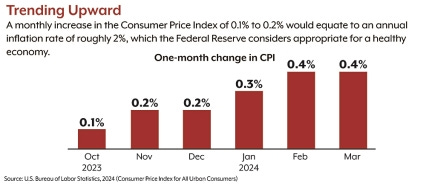
On April 10, 2024, the U.S. Bureau of Labor Statistics released the Consumer Price Index (CPI) for March, and the increase in CPI — the most commonly cited measure of inflation — was higher than expected. The rate for all items (headline inflation) was 3.5% over the previous year, while the “core CPI” rate, which strips out volatile food and energy prices, was even higher at 3.8%. The month-over-month change was also higher than anticipated at 0.4%. (1)

The stock market then dropped sharply on this news and continued to slide over the following days, while economists engaged in public handwringing over why their projections had been wrong and what the higher numbers might mean for the future path of interest rates. Most projections were off by just 0.1% — core CPI was expected to increase by 3.7% instead of 3.8% — which hardly seems earth-shattering to the casual observer. But this small difference suggested that inflation was proving more resistant to the Federal Reserve’s high interest-rate regimen (raising interest rates is one of the most common ways to curb spending and corporate investing to reduce inflationary pressures.) (2)

It’s important to remember that the most dangerous battle against inflation seems to have been won. CPI inflation peaked at 9.1% in June 2022, and there were fears of runaway inflation similar to the 1980s. That did not happen; inflation declined steadily through the end of 2023. The issue now is that there has been upward movement during the first three months of 2024.(3) This is best seen by looking at the monthly rates, which capture the current situation better than the 12-month rates. March 2024 was the third increase month that points to higher inflation (see chart).

High for longer

While price increases hit consumers directly in the pocketbook, the stock market reacted primarily to what stubborn inflation might mean for the benchmark federal funds rate and U.S. businesses. From March 2022 to July 2023, the Federal Open Market Committee (FOMC or AKA the Fed) raised the funds rate from near-zero to the current range of 5.25%–5.5% to slow the economy and hold back inflation.

At the end of 2023, with inflation moving firmly toward the Fed’s target of 2%, the FOMC projected three quarter-percentage point decreases in 2024, and some observers expected the first decrease might be this spring. Now it’s clear that the Fed will have to wait to reduce rates. (4)(5)

Higher interest rates make it more expensive for businesses and consumers to borrow. For businesses, this can hold back expansion and cut into profits when revenue is used to service debt. This is especially difficult for smaller companies, which often depend on debt to grow and sustain operations. Tech companies and banks are also sensitive to high rates. (6)

As mentioned above, in theory, high interest rates should hold back consumer spending and help reduce prices by suppressing demand. So far, however, consumer spending has remained strong. In March 2024, personal consumption expenditures — the standard measure of consumer spending — rose at an unusually strong monthly rate of 0.8% in current dollars or 0.5% when adjusted for inflation. (7)

The job market has also stayed strong, with unemployment below 4% for 26 consecutive months and wages rising steadily. (8)

The fear of keeping interest rates too high for too long is that it could slow the economy, but that is not the case, making it difficult for the Fed to justify rate cuts.

What’s driving inflation?

The Consumer Price Index measures price changes in a fixed market basket of goods and services, and some inputs are weighted more heavily than others.

The cost of shelter is the largest single category, accounting for about 36% of the index and almost 38% of the March increase in CPI. (9) The good news is that measurements of shelter costs — primarily actual rent and estimated rent that homeowners might receive if they rented their homes — tend to lag current price changes, and other measures suggest that rents are leveling or going down. (10)

Two lesser components contributed well above their weight. Gas prices, which are always volatile, comprised only 3.3% of the index but accounted for 15% of the overall increase in CPI. Motor vehicle insurance prices comprised just 2.5% of the index but accounted for more than 18% of the increase. Together, shelter, gasoline, and motor vehicle insurance drove 70% of March CPI inflation. On the positive side, food prices comprised 13.5% of the index and rose by only 0.1%, effectively reducing inflation. (11)

While the Fed pays close attention to the CPI, its preferred inflation measure is the personal consumption expenditures (PCE) price index, which places less emphasis on shelter costs, includes a broader range of inputs, and accounts for changes in consumer behavior. Due to these factors, PCE inflation tends to run lower than CPI. The annual increase in March was 2.7% for all items and 2.8% for core PCE, excluding food and energy. The monthly increase was 0.3% for both measures. (12)

Although these figures are closer to the Fed’s 2% target, they are not low enough, given strong employment and consumer spending, to suggest that the Fed will reduce interest rates anytime soon. It’s also unlikely that the Fed will raise rates.

The Fed seems poised to give current interest rates more time to push inflation to a healthy level, ideally without slowing economic activity. (13)

And since higher interest rates mean more competition for investment dollars and lower corporate earnings, stock markets don’t tend to react favorably, especially when 3-4 interest rate cuts were expected earlier this year.

The Fed issues its next interest rate decision on Wednesday afternoon, May 1, 2024. No change in interest rates is all but a given. However, what Federal Reserve Chairman Jerome Powell says about the recent economic data and the Fed’s stance on when future rate cuts are coming will no doubt be parsed word for word for clues when the press conference is convened.

Please pass the popcorn.

If you would like to review your current investment portfolio or discuss any other retirement, tax, or financial planning matters, please don’t hesitate to contact us at 734-447-5305 or visit our website at http://www.ydfs.com. We are a fee-only fiduciary financial planning firm that always puts your interests first. If you are not a client, an initial consultation is complimentary, and there is never any pressure or hidden sales pitch. We start with a specific assessment of your personal situation. There is no rush and no cookie-cutter approach. Each client and your financial plan and investment objectives are different.

Footnotes:

1, 3, 8–9, 11) U.S. Bureau of Labor Statistics, 2024

2)The New York Times, April 10, 2024

4) Federal Reserve, 2023

5) Forbes, December 5, 2023

6) The Wall Street Journal, April 15, 2024

7, 12) U.S. Bureau of Economic Analysis, 2024

10) NPR, April 18, 2024

13) Bloomberg, April 19, 2024

What’s Going on in the Markets November 29, 2023

Who ya’ gonna believe? The headlines or the market?

The latest economic headlines read:

“Credit Card Defaults are on the rise”
“Household savings rates are at historic lows”
“Banking Credit Contracts to Levels Not Seen Since the Global Financial Crisis”
“Home Builder Confidence from the National Association of Homebuilders takes another sharp drop”
“Trucking Employment is Contracting at a rate not seen since the 2000 and 2008 Crises.”
“The Conference Board of Leading Economic Indicators Declined for the 19th consecutive month”
“Yield Curves are Steepening after being extensively inverted, a sign of recession”
“Overdue commercial property loans hit 10-year high at US banks”
“No End in Sight for the Ukraine-Russia War”
“Could The War in the Middle East be the start of World War 3?”
“World Panics as supply of Twinkies Shrinks” (OK I made that one up to see if you’re paying attention)

With headlines like these, you’d think the stock markets were crashing, and we’re already in a deep recession.

Instead, the markets are having one of their best Novembers in history (after an awful October), which has led to headlines like these:

“The stock market is following a rare pattern that could signal double-digit gains next year”
“Extreme investor bearishness suggests stock market gains of 16% are coming in the next 12 months”
“The S&P 500 could soar more than 20% in the next year after an ultra-rare buy signal just flashed”
“This stock market signal points to the S&P 500 surging 25% within the next year”
“The Dow just flashed a bullish ‘golden cross’ Two days after the bearish ‘death cross’ signal”

High inflation and interest rates, two prominent wars, and unprecedented dichotomies continue to mount throughout the market and the economy, which can only mean that Wall Street’s roller-coaster ride is far from over. Let’s take a closer look at some of the headlines driving the markets.

Leading Economic Indicators

The Conference Board’s Leading Economic Indicator (LEI) has warned of trouble all year. It has declined for 19 consecutive months, its third-longest streak on record. When viewed as a ratio with the Conference Board’s Coincident Economic Indicator (CEI), declines from peaks have typically led to recessions. When decreasing, this ratio provides evidence that coincident indicators are holding up, but leading indicators are deteriorating. The Leading-to-Coincident Ratio has steeply declined since its peak in December 2021. Never has this ratio fallen this far and at such a rapid rate without a corresponding recession.

Treasury Yields

Another warning sign still flashing red and has a near-perfect track record for predicting recessions is the yield spread between 10-year and 2-year Treasurys.

Typically, one would expect to receive a higher interest rate on longer-duration bonds, CDs, debt, etc. After all, the more time a debt is outstanding, the more risk the lender takes (e.g., default risk, interest rate risk, bankruptcy, death, etc.). 10-year Treasurys should normally pay a higher interest rate than 2-year Treasurys to compensate lenders (the public) for this added risk.

An inversion means shorter-duration Treasurys command a higher interest rate than longer-duration Treasurys. Historically, inversions are unusual and indicate the economy is vulnerable. After all, if you’re concerned about the economy, it means you’re concerned about corporations being able to pay back their debt. Hence, you’re more likely to buy shorter-term debt. That pushes shorter-term interest rates into inversion. Simply put, if you had concerns about your brother-in-law paying back a personal loan, you’re more likely to keep the term shorter rather than longer, right?

The most recent inversion of the 10-year treasury bill and the 2-year treasury bill interest rates began in July of 2022 and quickly became its deepest (widest) since the early 1980s. The initial inversion is an early warning sign of a potential oncoming recession, but when this yield spread moves back above 0.0 (or it un-inverts), historically, there are four months on average before the onset of a recession. So, this is another definite recession warning sign.

Institute for Supply Management (ISM) Economic Indicators

A few macroeconomic indicators bounced back from dire levels or improved earlier this year, spurring hopes of a soft landing. However, unfortunately, many of these improvements have recently reversed course.

The ISM manufacturing index, also known as the purchasing managers’ index (PMI), is a monthly indicator of U.S. economic activity based on a survey of purchasing managers at more than 300 manufacturing firms. It is a key indicator of the state of the U.S. economy. The PMI measures the change in production levels across the U.S. economy from month to month. The PMI report is released on the first business day of each month.

The 50 level in the PMI (both manufacturing and services) is the demarcation between economic expansion and contraction. Above 50, it’s expanding; below 50, it’s contracting.

Late last year, the ISM Manufacturing PMI index fell into contraction territory (<50.0) and has yet to move back into expansion. It has contracted for 12 consecutive months, showing some improvement mid-year before dropping once again in October.

The ISM Non-Manufacturing (or services) Index is an economic index based on surveys of more than 400 non-manufacturing (or services) firms’ purchasing and supply executives. The ISM Services PMI comes out in the first week of each month and provides a detailed view of the U.S. economy from a non-manufacturing standpoint.

The ISM Services Index has been resilient this year, dropping below 50.0 just once since the pandemic. After initially improving in early 2023, it has declined for the past two months and is now at a five-month low. Because more than 70% of the economy is services-based, any contraction would not benefit the whole economy.

Housing and Real Estate

Housing, another major economic sector, accounts for 15-18% of U.S. GDP and is also on somewhat of a roller coaster ride of its own. Despite its improvement earlier this year, home sales have retracted and are at their lowest levels since 2010.

Existing home sales, which comprise most of the housing market, decreased 4.1% in October 2023 from the level in September to a seasonally adjusted annual rate of 3.79 million, the lowest rate since August 2010, according to the National Association of Realtors. October sales fell 14.6% from a year earlier.

New home sales for October came in lower than expected at 679,000, lower than September’s surprise of 759,000 but slightly higher than August’s 675,000. Despite being below expectations, these numbers are pretty robust (not surprising, given that existing homeowners with low mortgage rates are not selling).

Today’s housing market is still one of the most unaffordable in U.S. history. Home prices have exceeded the extremes of the 2005 housing bubble peak. With today’s high mortgage rates, high home prices, and ever-increasing ownership costs, housing activity seems to be at a standstill overall. Continued declines in home sales would hint at a bursting housing bubble.

On November 8, the Financial Times reported that overdue commercial property loans hit a 10-year high at U.S. banks. The Federal Reserve’s hiking campaign to curb inflation has caused borrowing costs of all types to surge this year, including in commercial real estate. Combined with empty building space from the pandemic work-from-home trend, commercial real estate is in a tight spot. The Green Street Commercial Property Price Index is now down nearly 20% from its 2022 peak and back to a level not seen since the short COVID-induced recession in 2020.

Inflation

While commercial property prices have fallen, price pressures elsewhere have reaccelerated in recent months, prompting consumers to expect inflation to remain elevated in the months ahead. After all, how many items at the grocery or department store have you seen come down in price (besides perhaps eggs and gasoline?)

For October, while headline and Core Consumer Price Indexes (CPI) improved slightly (inflation down), the recent acceleration in consumer inflation expectations indicates that this improvement could be temporary.

In consumer sentiment surveys, the first half of this year saw consumers growing more optimistic about the economy as inflation slowed; however, expectations of future inflation have surged since then, and consumers are becoming discouraged again. Discouraged consumers turn into non-confident consumers who tend to put away their wallets and walk away from discretionary purchases.

Since September, consumer expectations of higher inflation in 12 months have increased significantly to 4.4%. Meanwhile, inflation expectations in five years reached 3.2% as of October’s interim report, their highest level in over a decade. Despite the recent easing in the CPI data, this inflationary expectation pressures the Federal Reserve to keep interest rates elevated.

Inflation expectations notwithstanding, consumers have enthusiastically supported the economy this year despite inflationary challenges. However, the upward trend in credit card delinquency rates indicates an increasingly stressed consumer. Figures from the Federal Reserve show that credit card delinquencies have risen to 2011 levels, and delinquent auto loans are at their highest since 2010. Though not at the extreme levels seen during the Great Financial Crisis (2007-2009), these delinquencies are not slowing and could quickly surge higher if stronger parts of the economy begin to falter.

Jobs

Employment continues to be the last bastion of strength in today’s economy and is important to watch. Jobs remain plentiful, and employees increasingly view employment as transactional (as opposed to long-term). While the unemployment rate remains at historic lows, it has trended upward recently, which could become worrisome.

The unemployment rate in October clocked in at 3.9%, quite low by historical standards but 0.5 percentage points higher than the low rate we saw earlier this year (3.4%).  Increases in the unemployment rate of at least 0.6 percentage points from a cyclical low have confirmed the onset of nearly every recession of the past 50 years, with only one false signal in 1959. Accordingly, the unemployment rate is now just 0.1 percentage points away from reaching this threshold, which would confirm the onset of a recession. The November monthly jobs report and the unemployment rate are scheduled to be released on Friday, December 8.

The Stock Markets: What? Me Worry?

Since the start of November, the S&P 500 Index has been up about 8.5%. The tech-heavy NASDAQ index is up about 10.8%.

Rocket-boosted by the Magnificent Seven tech stocks (Amazon, Apple, Google, Meta, Microsoft, Nvidia, and Tesla), the indexes would not be anywhere nearly as strong without them. While the combined seven stocks are up about 80% year-to-date, the other 493 stocks in the S&P 500 Index are flat. While historically, a handful of stocks “carry” the indexes, we usually see better performance from the rest, and we’re largely not seeing that. Lately, the rally is showing signs of slowly broadening out, which is a good sign going into year’s end.

If you look at the S&P 500 Index on an equal-weight basis (where each stock has an equal “vote,” as opposed to a weighted approach based on company size), the index would be up only 3.8% year-to-date. The Mid-cap 400 index is also up 3.8% year-to-date, and the Small Cap 600 is up 3.3%.

Since we’re in the 4th quarter of a pre-election year, the markets have two reasons to be seasonally positive. True to form, November has reclaimed most of the losses from August to October and looks poised to take out the July high in December. As long as the S&P 500 Index holds the 4400 level, things look good. Daily new high prices among stocks that outnumber new low prices are also encouraging and add to the rally’s strength.

My main concern is with the valuation of the Magnificent Seven Stocks. Compared with the Nifty Fifty Stocks in 1972 and the Tech bubble in 2000, these seven stocks are just as overvalued. Momentum trading combined with valuations this extreme can turn great companies into terrible investments, so buyers at these levels should beware. Should the drive to buy anything related to AI (Artificial Intelligence) cool off in 2024, these seven stocks will have a disproportionate effect on the indexes, driving down the markets quickly, especially since so many portfolio managers have piled into them as “safe havens.” I’m not saying to sell them now, but if you’re overexposed to them and have enjoyed the ride, it would be prudent to trim them at their current levels (this is not a recommendation to buy or sell.)

Recession Watch

A strong consumer, robust labor market, the housing wealth effect, and the lasting effects of a zero interest rate policy held in place too long have made 2023 recession callers look foolish (including me).

Underestimating the U.S. Consumer has always been a bad bet, especially when locked down for months, saving their stimulus checks and unspent wages and ultimately coming out of the gates splurging. While their savings are nearly depleted, I would not completely count them out just yet, and a recession in 2024 is definitely not a sure thing, although I still believe we will have one next year.

As discussed above, there are signs that the post-pandemic fiscal and monetary drugs are starting to wear off for the world’s economies, and a hangover might be on the horizon. Whether and when that hangover turns gross domestic product in a negative direction and, therefore, an economic recession, is anyone’s guess. I like what Bloomberg Points of Return writer John Authers wrote this week on that topic:

“…Having got this far, there’s now a pretty good chance the US can get through the next two years without a recession. But the odds still point more to a downturn. That explains the negativity in opinion polls and surveys of consumers, even if it completely fails to explain the enthusiasm among consumers when they go shopping. And then there’s the issue of stock market sentiment, which is utterly baffling.”

It would be understandable to read this post and think that things look grim and that it’s time to batten down the hatches and sell everything. It’s not. When it comes to discounting the future, the markets usually have it right (looking out 6-9 months), and we may just be experiencing some economic indigestion that will resolve itself, and the stock markets will challenge and exceed the all-time highs in 2024.

Election years are positive for a reason: the incumbents want to be re-elected, so you can’t underestimate the levers they can pull to keep the economy firing on all cylinders and postpone any recession until a later year. Never underestimate what determined politicians can do.

I would like to take this opportunity to wish your family and you a very happy holiday season.

If you would like to review your current investment portfolio or discuss any other financial planning matters, please don’t hesitate to contact us or visit our website at http://www.ydfs.com. We are a fee-only fiduciary financial planning firm that always puts your interests first.  If you are not a client, an initial consultation is complimentary, and there is never any pressure or hidden sales pitch. We start with a specific assessment of your personal situation. There is no rush and no cookie-cutter approach. Each client is different, and so are your financial plan and investment objectives.

Source: InvesTech Research