Delaying Retirement May Provide the Financial Boost You Need

Americans are living longer, healthier lives, and this trend is affecting how they think about and plan for retirement. For instance, according to the Employee Benefit Research Institute, the age at which workers expect to retire has been rising slowly over the past couple of decades. In 1991, just 11% of workers expected to retire after age 65. Fast forward to 2014, and that percentage tripled to 33% — and 10% don’t plan to retire at all.1

Working later in life can offer a number of advantages. Many people welcome the opportunity to extend an enjoyable career, maintain professional contacts, and continue to learn new skills.

A Financial Boost

In addition to personal rewards, the financial benefits can go a long way toward helping you live in comfort during your later years. For starters, staying on the job provides the opportunity to continue contributing to your employer-sponsored retirement plan. And if your employer allows you to make catch-up contributions, just a few extra years of saving through your workplace plan could give your retirement nest egg a considerable boost, as the table below indicates.

A Few Extra Years Could Add Up

Year Maximum Annual Contribution Catch-Up Contribution for Workers Age 50 and Older Total Annual
Contributions
2015 $18,000 $6,000 $24,000
2016-2020 Indexed to inflation Indexed to inflation $??,???

Delaying Distributions

In addition to enabling you to continue making contributions to your employer’s plan, delaying retirement may allow you to put off taking distributions until you do hang up your hat. Typically, required minimum distributions (RMDs) are mandated when you reach age 70½, but your employer may permit you to delay withdrawals if you work past that age.

Keep in mind that if you have a traditional IRA, you are required to begin RMDs by age 70½, while a Roth IRA has no distribution requirements during the account holder’s lifetime — a feature that can prove very attractive to individuals who want to keep their IRA intact for a few added years of tax-deferred investment growth or for those who intend to pass the Roth IRA on to beneficiaries.

A Look at Social Security

Your retirement age also has a significant bearing on your Social Security benefit. Although most individuals are eligible for Social Security at age 62, taking benefits at this age permanently reduces your payout by 20% to 30% or more. Waiting until your full retirement age — between 66 and 67 — would allow you to claim your full unreduced benefit. And for each year past your full retirement age you wait to claim benefits, you earn a delayed retirement credit worth 8% annually up until age 70.2 Consider researching your options to continue working past the traditional retirement age. By remaining on the job, your later years may be more secure financially and more rewarding personally.

If you would like to discuss your retirement options/investments, or any other financial planning matters, please don’t hesitate to contact us or visit our website at http://www.ydfs.com. We are a fee-only fiduciary financial planning firm that always puts your interests first.  If you are not a client yet, an initial consultation is complimentary and there is never any pressure or hidden sales pitch.

Source:

1Employee Benefit Research Institute, 2014 Retirement Confidence Survey, March 18, 2014.

2Social Security Administration. The benefit increase no longer applies when you reach age 70, even if you continue to delay taking benefits.

Interest Rates: What’s the Connection to Your Portfolio?

When it comes to interest rates, one thing’s for certain: What goes down will eventually come up.

The federal funds rate — the rate on which short-term interest rates are based — has varied significantly over time. It’s a cycle of ups and downs that can affect your personal finances — your credit card rates, for example. But what about less familiar effects, like those that interest rate changes can have on your investments? Understanding the relationship between bonds, stocks, and interest rates could help you better cope with inevitable changes in our economy and your portfolio.

Bond Market Mechanics

Interest rates often fall in a weak economy and rise as it strengthens. As the economy gathers steam, companies experience higher costs (wages and materials) and they usually borrow money to grow. That’s where bond yields and prices enter the equation.

What is yield? It’s a measure of a bond’s return based on the price the investor paid for it and the interest the bond will pay. Falling interest rates usually result in declining yields. As rates spiral downward, businesses and governments “call” or redeem the existing bonds they’ve issued that carry higher interest rates, replacing them with new, lower-yielding bonds. Why? To save money. (A homeowner refinances his or her home at a lower mortgage rate for the same reason.)

Interest rate changes affect bond prices in the opposite way. Declining interest rates usually result in rising bond prices and vice versa — think of it as a seesaw relationship. What causes this change? When interest rates rise, investors flock to new bonds because of their higher yields. Therefore, owners of existing bonds reduce prices in an attempt to attract buyers.

Investors who hold on to bonds until maturity aren’t concerned with this seesaw relationship. But bond fund investors may see its effects over time.

Evaluating Equities

Interest rate changes can also affect stocks. For instance, in the short term, the stock market often declines in the midst of rising interest rates because companies must pay more to borrow money for expansion and capital improvements. Increasing rates often impact small companies more than large, well-established firms. That’s because they usually have less cash, shorter track records, and other limited resources that put them at higher risk. On the other hand, a drop in interest rates may result in higher stock prices if corporate profits increase.

So why do some stocks increase in value even as interest rates rise, or vice versa? Because industry or company-specific factors — such as the development of a new product — can impact stock prices more than rate changes.

Taking Action

Is there anything an investor can do when faced with interest rate uncertainty? You bet. Although you can’t change interest rates, you can assemble a portfolio that can potentially ride out the inevitable ups and downs. Risk reduction begins with diversifying your investments in as many ways as possible.

Let’s start with equities. Consider investing across different sectors, because no one knows which of today’s industries will fuel the next expansion. Also be aware that some sectors — such as energy — are more economically sensitive than others, which can lead to increased volatility. Additionally, consider stocks or stock mutual funds that invest in different market caps (sizes) and have different investing styles, such as both value and growth investing.

On to fixed-income investments: Do your bond funds hold bonds of different maturities — short, medium and long-term — and types, such as government and corporate? Different types of bonds react in their own way to interest rate changes. Long-term bonds, for instance, are more sensitive to rate changes than short-term bonds.

Interest rates will always fluctuate in response to economic conditions. Rather than trying to guess the Federal Reserve’s next move, why not concentrate on creating a portfolio that will serve your needs well — no matter which way rates go?

If you would like to review your current investment portfolio or discuss any other financial planning matters, please don’t hesitate to contact us or visit our website at http://www.ydfs.com. We are a fee-only fiduciary financial planning firm that always puts your interests first.  If you are not a client yet, an initial consultation is complimentary and there is never any pressure or hidden sales pitch.

What Is a Stretch IRA?

A stretch IRA is a traditional IRA that passes from the account owner to a younger beneficiary at the time of the account owner’s death. Since the younger beneficiary has a longer life expectancy than the original IRA owner, he or she will be able to “stretch” the life of the IRA by receiving smaller required minimum distributions (RMDs) each year over his or her life span. More money can then remain in the IRA with the potential for continued tax-deferred growth.

Creating a stretch IRA has no effect on the account owner’s RMD requirements, which continue to be based on his or her life expectancy. Once the account owner dies, however, beneficiaries begin taking RMDs based on their own life expectancies. Whereas the owner of a stretch IRA must begin receiving RMDs after reaching age 70 1/2, beneficiaries of a stretch IRA begin receiving RMDs after the account owner’s death. In either scenario, distributions are taxable to the payee at then-current income tax rates.

It’s worth noting that beneficiaries also have the right to receive the full value of their inherited IRA assets by the end of the fifth year following the year of the account owner’s death. However, by opting to take only the required minimum amount instead, a beneficiary can theoretically stretch the IRA and tax-deferred growth throughout his or her lifetime.

If you do not currently have any IRA beneficiaries, employing the stretch technique by naming a (human) beneficiary could provide significant long-term benefits. Special rules apply to naming a trust or estate as IRA beneficiaries, so it’s best to consult a tax or financial planner to discuss the consequences and pitfalls.

Added Perspectives

Your enhanced ability to stretch IRA assets is a direct result of an IRS decision to simplify the rules regarding RMDs from IRAs. The new rules allow beneficiaries to be named after the account owner’s RMDs have begun, and beneficiary designations can be changed after the account owner’s death (although no new beneficiaries can be named at that point). Also, the amount of a beneficiary’s RMD is based on his or her own life expectancy, even if the original account owner’s RMDs had already begun.

Note that the rules presented in this article apply to traditional IRAs bequeathed to a non-spousal beneficiary. Special rules apply to spousal beneficiaries.

So if you’re unlikely to deplete your IRA assets during your lifetime, consider creating a multi-generational stretch IRA. By doing so, you could build long-term financial security for a loved one while minimizing estate taxes.

If you would like to review your current beneficiary designations or discuss any other financial planning matters, please don’t hesitate to contact us or visit our website at http://www.ydfs.com. We are a fee-only fiduciary financial planning firm that always puts your interests first.  If you are not a client yet, an initial consultation is complimentary and there is never any pressure or hidden sales pitch.

2015 First Quarter Report: Stop Awaiting the Fed

The first quarter of the new year has brought us small positive returns in many of the U.S. and global indices, and more than the usual amount of anxiety along with them.

The Wilshire 5000–the broadest measure of U.S. stocks and bonds—was up 1.61% for the first three months of 2015, which is remarkable considering that the index lost .75% on the last day of the quarter. The comparable Russell 3000 index has gained 1.80% so far this year.

The Wilshire U.S. Large Cap index gained 1.27% in the first three months of 2015. The Russell 1000 large-cap index was up 1.59%, while the widely-quoted S&P 500 index of large company stocks posted a gain of 0.44% in the first quarter of the year.

The Wilshire U.S. Mid-Cap index gained 5.77% for the quarter. The Russell Midcap Index was up 3.95%.

Small company stocks, as measured by the Wilshire U.S. Small-Cap index, gave investors a 4.51% return during three months of the year. The comparable Russell 2000 Small-Cap Index was up 4.32%, while the technology-heavy NASDAQ Composite Index gained 3.48% for the quarter.

Meanwhile, global markets are showing signs of life, which means returns comparable to the U.S. stock market. The broad-based EAFE index of companies in developed foreign economies gained 4.19% in dollar terms in the first quarter of the year, in part because Far Eastern stocks were up 8.27%. In aggregate, European stocks gained 5.15%, although they are still down more than 8% over the past 12 months. Emerging markets stocks of less developed countries, as represented by the EAFE EM index, fared less well, gaining 1.91% for the quarter. Many emerging markets are highly dependent on strong crude prices and stronger currencies, two factors working against them during this quarter.

Looking over the other investment categories, real estate investments, as measured by the Wilshire U.S. REIT index, was up 4.67% for the first quarter, despite falling 0.87% on the final day. Commodities, as measured by the S&P GSCI index, continued their losing ways, dropping 8.22% of their value in the first quarter, largely because of continuing drops in oil prices.

If you were watching the markets day-to-day, you experienced a mild roller coaster, what trading professionals refer to as a sideways market. One day it was up, the next down, each day (or week) seeming to erase the gains or losses of the previous ones. The best explanation for this phenomenon is that investors are still looking over their shoulders at interest rates, waiting for bond yields to jump higher, making bonds more competitive with stocks and triggering an outflow from the stock market that could (so the reasoning goes) cause a bear market in U.S. equities.

However, investors have been waiting for this shoe to drop for the better part of three years, and meanwhile, interest rates have drifted decidedly lower in the first quarter. The Bloomberg U.S. Corporate Bond Index now has an effective yield of 2.93%. 30-year Treasuries are yielding 2.48%, roughly 0.3% lower than in December, and 10-year Treasuries currently yield 1.87%, down from 2.17% at the beginning of the year. At the low end, you need a microscope to see the yield on 3-month T-bills, at 0.02%; 6-month bills are only slightly more generous, at 0.10%.

This interest rate watch has created a peculiar dynamic where up is down and down is up in terms of how traders and stock market gamblers look at the future. The generally positive economic news is greeted with dismay (The Fed will notice and start raising rates sooner rather than later! Boo!) and any bad news sends the stock market back up again into mild euphoria (The Fed might hold off another quarter! Yay!).

There are several obvious problems with this. First, probably least important, the Fed’s future actions are inscrutable. You will hear knowledgeable Fed-watchers say that the Fed will take action as early as June or as late as next year, and none of them really know.

Second, small incremental rises in interest rates are not closely associated with bear markets, as everybody seems to assume. Figure 1 may be a little hard to interpret, but each blue square shows the price/earnings ratio for the U.S. stock market as a whole after interest rates have risen to particular levels, almost all of them higher than today. What you see is that when rates have gone up in the past, the price people will pay for stocks has also gone up. Why? For exactly the reason you think: rising rates are a sign of a healthy economy, which is precisely why the Federal Reserve Board would decide that stimulus is no longer necessary. Companies—and their stocks—tend to thrive in healthy economies.

CA - 2015-4-1 - Figure 1

The chart also shows that rates can get too high for the health of stocks—the cutoff point seems to be up around 5.5% to 6%. But incremental quarter-point rises are not going to take the U.S. economy into that territory for a long time. History has shown that markets and interest rates can go up together for several quarters, after the market gets over the initial “shock” of the first interest rate hike. So far, the fed has given every indication that they will remain accommodative and patient.

Finally, we should all welcome the Fed pullback, not fear it. A lot of the uncertainty among traders and even long-term investors is coming from anxiety over how this experiment is going to end. The U.S. Central bank has directly intervened in the markets and in the economy, and is still doing so. When that ends, normal market forces will take over, and we’ll all have a better handle on what “normal” means in this economic era. Is there great demand for credit to fuel growth? What would rational investors pay for Treasury and corporate bonds if they weren’t bidding against an 800-pound gorilla? Would retirees prefer an absolutely certain 4.5% return on 30-year Treasury bonds or the less certain (but historically higher) returns they can get from the stock market? These are questions that all of us would like to know the answer to, and we won’t until all the quantitative easing and interventions have ended.

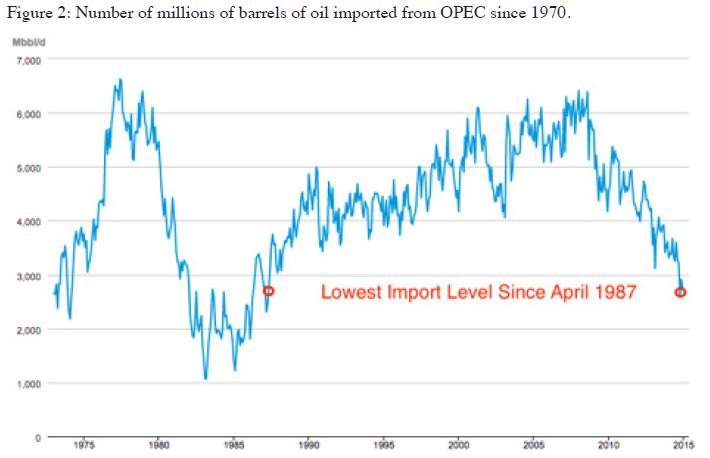
What DO we know? Figure 2 shows that the U.S. economy is less dependent on foreign oil than at any time since 1987, and the trend is moving toward complete independence. Oil—and energy generally—is cheaper now than it has been in several decades, which makes our lives, and the production of goods and services, less expensive.

CA - 2015-4-1 - Figure 2

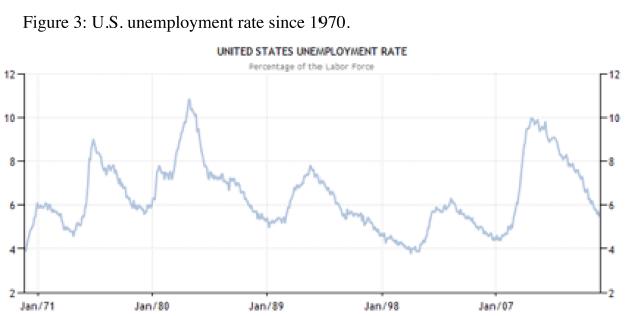
Meanwhile, more Americans are working. Figure 3 shows that the U.S. unemployment rate—at 5.5%—is trending dramatically lower, and is now reaching levels that are actually below the long-term norms. Unemployment today is lower than the rate for much of the booming ‘90s, and is approaching the lows of the early 1970s.

CA - 2015-4-1 - Figure 3

And real GDP—the broadest measure of economic activity in the United States—increased 2.4% last year, after rising 2.2% the previous year.   America is growing. Not rapidly, but slow growth might not be so terrible. Rapid economic growth has, in the past, often preceded economic recessions, where excesses had to be corrected. Slow, steady growth may be boring, but it’s certainly not bad news for the economy or the markets. For fun, look at Figure 4, which shows, in a creative way, the size of the U.S. economy compared with the rest of the world. Each U.S. state is labeled with an entire country whose total economic output is roughly equal to that state’s. The point: the U.S. is still a colossus that stands across the global economy.

CA - 2015-4-1 - Figure 4

It has been said that people lose far more money in opportunity costs by trying to avoid future market downturns while the markets are still going up, than by holding their ground during actual downturns. And, in fact, in every case so far, the U.S. market has eventually made up the ground it lost in every bear market we’ve experienced.  The last trading day of the 1st quarter looked quite bearish, as have many other gloomy trading days during this seven-year bull market. It seems like every week, somebody else has predicted an imminent decline that has not happened. People who listened to the alarmists lost out on solid returns. You filter out the good news at your peril.

For our client portfolios we continue to take a somewhat defensive stance as this aging bull market carries on.  Despite softening economic data during the past few months, we see little evidence or warning signs of an impending recession or severe bear market over the next 6-9 months, although that could change anytime. Nonetheless, we await opportunities to re-deploy some cash, but the market has been recalcitrant to give much of a pullback from its recent highs.  Bull markets rarely die of old age; they often die of over-exuberance.  So far, we’re not seeing much of a rush to equities; rather, we see the market still climbing the proverbial wall of worry.

If you would like to review your current investment portfolio or discuss any other financial planning matters, please don’t hesitate to contact us or visit our website at http://www.ydfs.com. We are a fee-only fiduciary financial planning firm that always puts your interests first.  If you are not a client yet, an initial consultation is complimentary and there is never any pressure or hidden sales pitch.

Happy Easter!

Sources:

Wilshire index data: http://www.wilshire.com/Indexes/calculator/

Russell index data: http://www.russell.com/indexes/data/daily_total_returns_us.asp

S&P index data: http://www.standardandpoors.com/indices/sp-500/en/us/?indexId=spusa-500-usduf–p-us-l–

http://www.tradingeconomics.com/united-states/unemployment-rate

Nasdaq index data: http://quicktake.morningstar.com/Index/IndexCharts.aspx?Symbol=COMP

International indices: http://www.mscibarra.com/products/indices/international_equity_indices/performance.html

Commodities index data: http://us.spindices.com/index-family/commodities/sp-gsci

Treasury market rates: http://www.bloomberg.com/markets/rates-bonds/government-bonds/us/

TheMoneyGeek thanks guest writer Bob Veres for co-writing this post.

Lower Oil, Less Looking For It

You already know that oil prices are lower than they have been in a long time, in part because U.S. oil production is higher than it has ever been, and still climbing steeply. But you have to wonder how long these conditions will last, since lower oil prices make it less economical for oilfield services companies to drill.

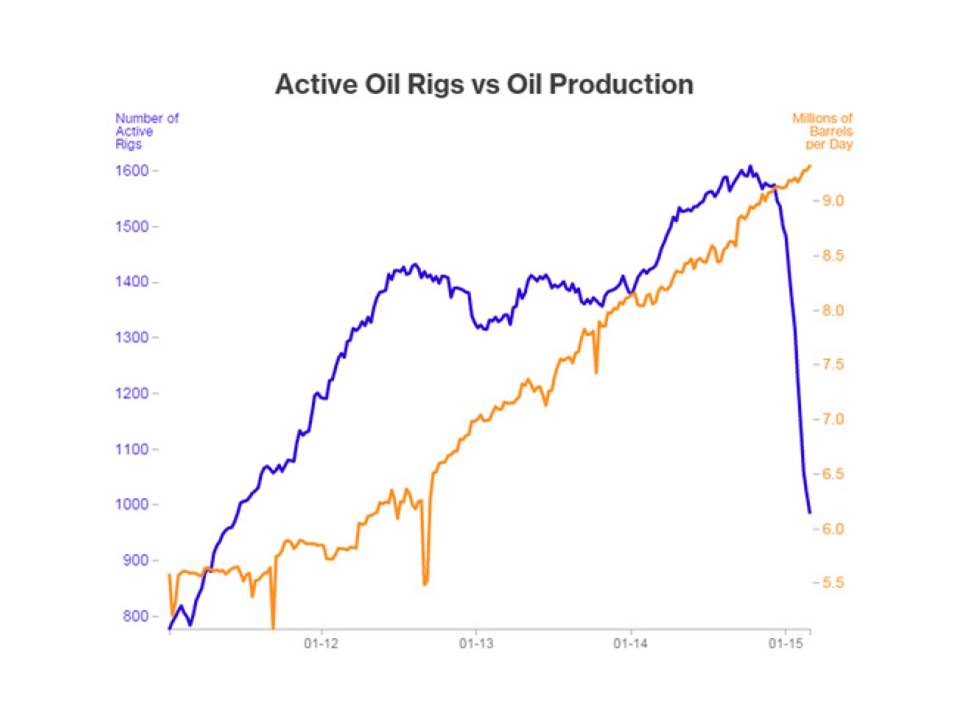
The below chart, courtesy of the oilfield services company Baker Hughes, may be the most dramatic illustration of economic reality you will see this month. It shows how the U.S. has increased the millions of barrels of oil per day that we’re pumping out of U.S. soil in the past four years. Looking at the orange line rising ever-more-steeply, you wonder whether oil prices will ever go back up to previous levels.

CA - 2014-3-10 Oil Rigs Chart

But then you see the purple line, which tracks the number of active oil rigs that are out there looking for new sources of oil. The last quarter of 2014 and the first few months of this year have created a dramatic bear market for drilling rigs in action. In just two fiscal quarters, the number of rigs in the field has dropped almost by half, and there is no sign that the trend is slowing down.

What does that mean? Nothing in the short term, since the orange line represents existing production. But longer-term, you have to expect that fewer active rigs will mean fewer wells and, at the very least, a leveling out of that orange line. Oil prices may be down today, but that doesn’t mean supplies will outrun demand forever. Enjoy the low gas prices while you can.

If you would like to review your current investment management portfolio or discuss any other financial planning matters, please don’t hesitate to contact us or visit our website at http://www.ydfs.com. We are a fee-only fiduciary financial planning firm that always puts your interests first.  If you are not a client yet, an initial consultation is complimentary and there is never any pressure or hidden sales pitch.

Source:

http://www.bloomberg.com/news/articles/2015-03-06/oil-rigs-get-slammed-for-the-13th-week

TheMoneyGeek thanks guest writer Bob Veres for writing this post.

More Proof that Higher Contributions Are Most Important to Retirement Plan Success

A study by the Putnam Institute, “Defined Contribution Plans: Missing the forest for the trees?” contends that while a number of variables, such as fund selection, asset allocation, portfolio re-balancing, and deferral (contribution) rates all contribute to a defined contribution plan’s effectiveness — or lack thereof — it is deferral rates that should be placed near the top of the hierarchy when considering ways to boost retirement saving success.1

As part of its analysis, the research team created a hypothetical scenario in which an individual’s contribution rate increased from 3% of income to 4%, 6%, and 8%. After 29 years, the final balance jumped from $138,000, to $181,000, $272,000, and $334,000, respectively.

Even with a just a 1% increase — to a 4% deferral rate — the participant’s final accumulation would have been 30% greater than it would have been using a fund selection strategy defined as the “Crystal Ball” strategy, in which the plan sponsor uses a predefined formula to predict which funds may potentially perform well for the next three-year period. Further, the 1% boost in income deferral would have had a wealth accumulation effect nearly 100% larger than a growth asset allocation strategy, and 2,000% greater than rebalancing. Of course these results are hypothetical and past performance does not guarantee future results.

One key takeaway of the study was for plan sponsors to find ways to communicate the benefits of higher deferral rates to employees, and to help them find ways to do so.

Retirement Savings Tips

The Employee Benefit Research Institute reported in 2014 that 44% of American workers have tried to figure out how much money they will need to accumulate for retirement, and one-third admit they are not doing a good job in their financial planning for retirement.2 Are you? If so, these strategies may help you to better identify and pursue your retirement savings goals:

Double-check your assumptions. When do you plan to retire? How much money will you need each year? Where and when do you plan to get your retirement income? Are your investment expectations in line with the performance potential of the investments you own?

Use a proper “calculator.” The best way to calculate your goal is by using one of the many interactive worksheets now available free of charge online and in print. Each type features questions about your financial situation as well as blank spaces for you to provide answers. But remember, your ultimate goal is to save as much money as possible for retirement regardless of what any calculator might suggest.

Contribute more. At the very least, try to contribute enough to receive the full amount of any employer’s matching contribution. It’s also a good idea to increase contributions annually, such as after a pay raise.

Retirement will likely be one of the biggest expenses in your life, so it’s important to maintain an accurate cost estimate and financial plan. Make it a priority to calculate your savings goal at least once a year.

If you would like to review your current deferral rate(s) or discuss any other financial planning matters, please don’t hesitate to contact us or visit our website at http://www.ydfs.com. We are a fee-only fiduciary financial planning firm that always puts your interests first.  If you are not a client yet, an initial consultation is complimentary and there is never any pressure or hidden sales pitch.

Sources:

1Putnam Institute, Defined Contribution Plans: Missing the forest for the trees?, May 2014.

2Ruth Helman, Nevin Adams, Craig Copeland, and Jack VanDerhei. “The 2014 Retirement Confidence Survey: Confidence Rebounds–for Those With Retirement Plans,” EBRI Issue Brief, no. 397, March 2014.

Is America in Decline?

In 1945, the U.S. made up more than half of the world’s total gross domestic product (GDP), which basically means that half the world’s economy took place inside U.S. borders. Today that figure is just under 22%.

Does that mean America is in decline?

There seems to be a bull market in doomsayers these past few years, as we’re all reading arguments that the U.S. is slowly losing its grip on global preeminence. The rhetoric today sounds a lot like the hand-wringing back in the 1980s when Japan was allegedly taking over the global economy, and before that, when the Soviet Union had more missiles and a Sputnik circling over our heads.

There’s no easy way to define the overall quality of an economy, but probably the most thorough assessment comes out each year via the World Economic Forum’s Global Competitiveness Rankings. The most recent report ranked 144 countries around the world, including Qatar (16), Moldavia (82), Namibia (88), Lesotho (107) and the unhappy states of Chad (143) and Guinea (144), whose citizens eke out their lives on per capita incomes of $1,218 and $564 a year, respectively.

The survey looks at 12 “pillars” of economic competitiveness, including labor market efficiency, the quality of primary education and higher education, infrastructure, the strength of institutions, innovation, business sophistication, technological readiness and the sophistication of the financial markets. Each of these categories are broken down into dozens of subcategories, which are separately evaluated. For instance, when looking at the strength of each country’s public institutions, the World Economic Forum researchers consider whether people in a given country have strong property rights and intellectual property protection, whether there is corruption and the routine payment of bribes, whether the citizens enjoy judicial independence and a solid legal framework, and how well investors enjoy shareholder protection.

In the most recent survey, the U.S. ranked third overall, with an overall rating of 5.5 on a scale of 1-6. Ahead of it were Switzerland (5.7) and Singapore (5.6). China, the country that you most often hear cited as the all-powerful up-and-coming economy, ranked 28th, two rungs below Saudi Arabia, one rung above Estonia. Brazil and India, which are sometimes mentioned as powerful competitors to U.S. economic hegemony, are ranked 57th and 71st, respectively.

The point of the rankings is to show which countries have created the healthiest (or, in the cases of Chad and Guinea, the least-healthy) economic climate for future growth. But of course there are other ways of measuring competitiveness, including the bottom line (as mentioned at the top of the article) of percentage of the world GDP, and whether you’re moving up or down.

US and Global GDP through 2014

By that standard, the U.S. is indeed moving down. If you look at Figure 1 above, which shows the size of the overall global and U.S. economies since 1991, you see that the U.S. has enjoyed steady economic growth, while the world at large has essentially taken off like a rocket. The years following the collapse of the Soviet Union, when several billion people were suddenly allowed to become capitalists, have been good for world growth. When China shifted from a communist to a capitalist economic posture, this added fuel to the rocket. The democratization of computer technology and the global Internet has empowered value creators everywhere.

The U.S., Europe and Japan, in other words, no longer have a monopoly on capitalism. And that’s a good thing.

Is there a better way of evaluating how the U.S. economy is holding up in an increasingly competitive world? Figure 2 below looks at the first chart from a slightly different angle. Since 1991, what percentage of all the world’s business has been happening in the U.S., vs. Europe, Japan, China, India, Russia and Brazil?   How much of the total global economy did each nation claim in each year, and how has that balance changed over time?

US GDP Market Share through 2014

What you see there is that the U.S. is still in the lead by a pretty wide margin, and in recent years has actually stabilized its percentage of total global GDP. The decline has come mostly because a lot of smaller emerging markets, plus China and, to a certain extent, Brazil, India and Russia, have all been growing. At the same time, America’s traditional competitors—Europe and Japan—have been sinking. If you want to point a finger at decline, perhaps that’s a better direction than the U.S.

Does the U.S. face economic challenges? Of course. Is our political system a mess? Sure. Could things be better? Certainly. But if you sift through a lot of variables with a fine-toothed comb, you discover that the U.S. has created a better environment to grow and prosper than almost anywhere else, and it has held its own with the roaring growth of the emerging markets while the other developed nations are losing ground. More than a fifth of all economic activity still happens in the U.S., and the long, slow decline in that figure is not due to stagnation at home, but abundant growth all around the world. That’s not something to worry about; it’s something we should be celebrating.

If you would like to review your current investment portfolio or discuss any other financial planning matters, please don’t hesitate to contact us or visit our website at http://www.ydfs.com. We are a fee-only fiduciary financial planning firm that always puts your interests first.  If you are not a client yet, an initial consultation is complimentary and there is never any pressure or hidden sales pitch.

Sources:

http://reports.weforum.org/global-competitiveness-report-2014-2015/rankings/

http://www.economywatch.com/economic-statistics/year/1990/

http://theamericanscene.com/2008/05/07/a-post-american-world

TheMoneyGeek thanks guest writer Bob Veres for writing this post.

Getting Ready for a Fresh Start

Despite the potential long-term benefits of reviewing personal finances on an annual basis, it seems that many Americans still don’t make it a priority to do so.

Have you already taken steps to give yourself a fresh financial start next year? It’s still not too late to begin.

Aim Higher for Retirement

Today, workers are eligible to contribute more money than ever to their employer-sponsored retirement plans. For most workers, the maximum annual pre-tax contribution is $18,000 in 2015. If you’re at least 50 years old, you may also make additional contributions — known as catch-up contributions — of up to $6,000. That amounts to a $24,000 overall contribution limit this year.

Search for Savings

Even if you can’t contribute the maximum, a reality for many given life’s various financial challenges, seek out opportunities to set aside more money for retirement whenever possible.

Consider creating a comprehensive household budget that allows you to plan and track spending on an ongoing basis and includes among your listed expenses a commitment to “pay yourself” in the form of retirement savings. More than likely you’ll find some “fat” in your budget, even just a little, that can be trimmed to free up savings dollars.

Defeat Debt

The U.S. savings rate recently hit its lowest level in almost half a century, due in part to higher rates of borrowing and credit card debt. If debt is getting in the way of your long-term goals, consider strategies for chipping away at it:

  • Transferring high-interest debt to a credit card with a lower rate.
  • Trying to pay at least twice the minimum required payment.
  • Using a tax-refund to pay off outstanding loans.

For more ideas on how to get a fresh start or to discuss any other financial planning matters, please don’t hesitate to contact us or visit our website at http://www.ydfs.com. We are a fee-only fiduciary financial planning firm that always puts your interests first.  If you are not a client yet, an initial consultation is complimentary and there is never any pressure or hidden sales pitch.

Understanding Bond Investing: It’s a Matter of Balance

It’s a common misconception to think of bonds as “plain vanilla” investments that are appropriate only for certain types of people, such as financially conservative retirees. But in reality, bond investments may have the potential to add stability to a portfolio and help reduce overall investment risk — regardless of your age or financial outlook.

What Is a Bond?

Bonds are investment securities issued by corporations or governments to raise money for a particular purpose. Basically, bonds are the “IOUs” of the business world. There are different types of bond funds, each with varying levels of risk and return potential. Generally speaking, the higher the risk, the better the return potential. For example:

  • Government bond funds invest in bonds issued by the U.S. Treasury. Historically, they have been among the strongest types of bond investments. However, they typically offer lower returns than other bonds.
  • Corporate bond funds invest in bonds issued by private companies. They can range from “investment grade” (safer, lower return potential) to “below investment grade” (riskier, higher return potential).

Know the Risks

Bond funds are subject to several types of investment risk, including:

  • Market risk — Like stock prices, bond prices move up and down. However, such fluctuations tend to be less severe in the bond market.
  • Interest rate risk — When interest rates rise, bond prices may fall, and vice versa.
  • Inflation risk — If the return on a bond fund does not outpace the rising cost of living, the purchasing power of your investment could decline over time.

Managing Risk

Despite these risks, investors of all ages may potentially benefit from putting some money in bond funds. Because bond funds tend to respond to market influences differently than stock funds, they may help balance out the risks associated with stock investing.

In addition, lower-risk bond funds, such as government and investment-grade corporate bond funds, may help protect some of your money from losses during turbulent times.

If you would like to review bond investments in your current portfolio or discuss any other financial planning matters, please don’t hesitate to contact us or visit our website at http://www.ydfs.com. We are a fee-only fiduciary financial planning firm that always puts your interests first.  If you are not a client yet, an initial consultation is complimentary and there is never any pressure or hidden sales pitch.

Put Time on Your Side With the Power of Compounding

Sometimes people put off saving for retirement because so many other things seem to get in the way. Do you find yourself among them? If so, try to overcome the urge to procrastinate and start saving as soon as possible. When it comes to investing for long-term goals, time can be a powerful ally.

Time and Investment Returns

The reason time can work for you is because of a concept called compounding. The idea behind compounding is simple — when your investment earns money, this amount is reinvested in your account and potentially generates more earnings. Over time, this process can increase the growth potential of your original investment. If your earnings are reinvested for a long enough period, compounding can reduce some of the pressure on you to invest greater amounts as you approach retirement.

The power of reinvested earnings partly explains why some people who start investing early in their careers often end up with more money than people who start later, even if their total contributions are less.

Compounding With Every Paycheck

Your employer-sponsored plan may be one of the most convenient ways to make compounding work for you. Every paycheck, you have a new opportunity to add to your retirement savings. For 2015, you may be able to contribute a maximum of $18,000 (check with your employer, because some organizations may impose lower limits). If you are age 50 or older, you may also have the opportunity to save up to $6,000 more. Even if you cannot afford to invest the maximum amount, try to do as much as you can.

Of course, you can’t benefit from compounding if you don’t stay invested. Withdrawing money during your working years could wipe out or reduce the savings you have accumulated, which would reduce some of the benefit of compounding.

So don’t procrastinate. Start saving as soon as possible and take advantage of what compounding can potentially do for you.

If you would like to review your current investment portfolio or discuss any other financial planning matters, please don’t hesitate to contact us or visit our website at http://www.ydfs.com. We are a fee-only fiduciary financial planning firm that always puts your interests first.  If you are not a client yet, an initial consultation is complimentary and there is never any pressure or hidden sales pitch.