Understanding Invesco’s Aggressive QQQ Proxy Push

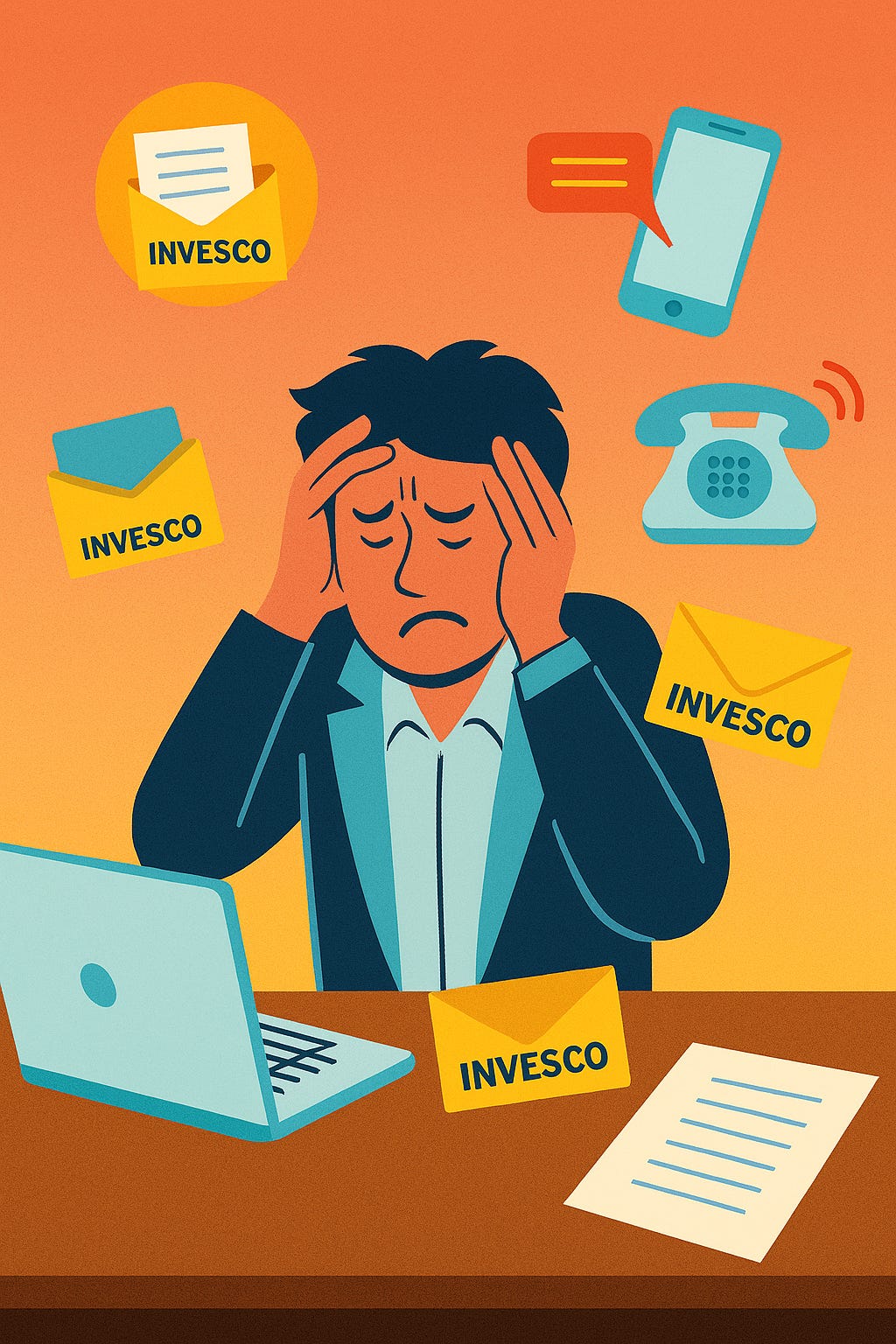
Several clients have written to me inquiring about the barrage of calls, emails, and messages from Invesco regarding the ETF QQQ’s push to gather proxy votes. Here’s an excerpt of one client’s question and my response (greatly expanded for this article):

“…not the most consequential message you’ll receive this year, but my curiosity has been piqued … by the campaign from Invesco QQQ to cast a proxy vote. I’ve never seen anything like it – the mailings, the calls, and so on – for a process that, in my experience, has always been ultra-routine and pretty meaningless for someone like me. Can you explain, and do you have any advice?”

Thanks for reading Uncommon Cents! Subscribe for free to receive new posts and support my work.

Here’s how I responded

Regarding the campaign, you’re not alone. Many clients have noticed the unusually intense campaign from Invesco regarding the proxy vote for Invesco QQQ, and you’re right that it stands out from what’s usually a routine process for most fund shareholders.

Early on, my business partner suggested that I write and send an email to clients about this. Not realizing the intensity of Invesco’s push, I decided we didn’t need to, which turned out to be a mistake. In all my years in the business, I’ve never seen or heard of any company launching such an intense and aggressive proxy gathering campaign.
Here’s what’s really going on

Invesco is proposing to convert the ETF QQQ from its current structure (a unit investment trust, which dates back to the earliest ETFs) into a modern, open-ended exchange-traded fund. The primary rationale is to enhance flexibility, oversight, and reduce costs. Specifically, if shareholders approve, the QQQ expense ratio would decrease by 10% (from 0.20% to 0.18%), resulting in tens of millions of dollars in yearly savings across the fund. Importantly, this change won’t impact QQQ’s strategy, holdings, or tax characteristics, nor will it change the fund’s manager or its index-tracking approach.

The reason you’ve gotten multiple mailings and calls? Invesco requires a high level of shareholder participation: by law, converting QQQ’s trust structure requires more than half of all shares to be actively voted “yes.” Unlike typical votes where non-responses are ignored, in this case, non-votes count as “no” votes—which is why the fund is spending so much to encourage participation and obtain a quorum. With so many retail investors holding QQQ, this is a true logistical challenge.

Details of the push

  • Three separate proposals must all pass: shareholders are voting on three linked items: conversion from a unit investment trust to an open-ended ETF, associated changes to the management/advisory structure, and the creation of a board of directors. If any proposal fails, none of the changes will be implemented.​
  • Non-votes count as “No” votes: Unlike routine proxy votes, shareholders who do not respond are counted against the proposals, making high participation essential.​
  • Shareholder benefits include:
    • Lower expense ratio (from 0.20% to 0.18%, estimated savings ~$70 million/year).​
    • Enhanced governance via a new board overseeing the fund for the first time; greater reporting and transparency, including summary prospectuses and semi-annual reports.​
  • No change to investment objective, index, or tax treatment: The fund will continue to track the Nasdaq-100® Index. The conversion is a tax-free event for shareholders.​
  • Huge outreach effort: Invesco is spending an estimated $40 million on proxy solicitation to ensure quorum, highlighting the unusual scale and importance of this campaign.​
  • Record date: August 15, 2025. Only shareholders of record as of this date are eligible to vote.​
  • If approved, conversion is likely to happen by year-end or early 2026.

Potential downsides of shareholder approval

  • Increased Operational Flexibility Means More Managerial Discretion: The move to an open-ended fund structure allows Invesco and its new board greater latitude in making changes, such as fee adjustments or introducing derivatives, that previously required more restrictive oversight under the unit investment trust (UIT) format. This future flexibility depends on the intentions and discipline of the board and managers, and could shift if there’s turnover in leadership.​
  • Invesco Begins Collecting Direct Management Fees: The new format allows Invesco to collect a “unitary management fee” that the trust structure previously didn’t permit. This creates an incentive to grow profits and, potentially, alter expenses down the line, despite the initial fee reduction.​
  • Board Compensation and Governance Costs: A nine-member board will be introduced, which adds an additional cost layer (director compensation and overhead) that could offset some savings or shift incentives compared to a strictly trustee-based approach.​
  • Liquidity Risk in Market Downturns: Open-ended funds may be forced to sell portfolio assets at unfavorable prices if a large number of investors redeem shares during periods of stress, potentially impacting performance. The UIT structure allows shares to trade among investors without requiring the sale of underlying assets, a mechanism that some investors value for stability during volatile times.​
  • Shareholder Risk in Securities Lending: Invesco may expand its securities lending activities under the new structure, and any resulting risks or losses would be borne directly by shareholders, not by Invesco.​
  • No Guarantee Future Fees Will Remain Lower: While initial projections indicate a 10% reduction in the expense ratio, future changes to fee schedules are possible under the new open-ended structure, subject to board approval.​

While many see these risks as manageable, they should be evaluated alongside the promised benefits. It’s important for shareholders to understand both sides before casting a vote.

What major institutional holders think

Major institutions that hold QQQ have generally leaned in support of the conversion vote, viewing the restructuring as beneficial for both operational efficiency and cost reduction. However, the fund has an unusually large retail investor base, making institutional votes influential but insufficient to guarantee passage, which is why Invesco has mounted such an aggressive campaign.​

  • Institutional Sentiment: Proxy advisory firms and ETF strategists have publicly supported the move, highlighting reduced expense ratios, improved governance via a new board, and enhanced transparency as positives for shareholders. Major institutional holders—including major brokerage platforms, asset managers, and pension funds—are widely expected to vote in favor due to these clear-cut advantages, as their own portfolios will directly benefit from fee savings.​
  • Voting Weight: Institutions typically vote their shares, but approximately 40–50% of QQQ ownership is held by retail investors, and a majority of the outstanding shares must vote “yes” for the conversion to occur.​
  • No Institutional Opposition Spotted: As of now, there is no reported campaign of institutional opposition to the change; the proposal is seen industry-wide as a modernization step that aligns QQQ with other large ETFs.

What I think

This change appears to be designed to benefit shareholders by offering lower costs and greater transparency. Despite the potential downsides, it is unlikely to introduce major surprises or large additional risks.

If you agree, I’d suggest voting in favor; however, you won’t be at any disadvantage if you simply ignore the campaign—the fund will continue regardless. Invesco’s push is simply a matter of meeting the voting threshold they need.

Timing of the vote postponed

The original QQQ conversion proxy vote was scheduled for October 24, 2025. After failing to reach a quorum at the original meeting, the vote was postponed to December 5, 2025.

It sounds like the phone calls, emails, snail mail, and text messages will continue for a few more weeks. Or as they say, “the beatings will continue until morale improves.” Maybe casting your vote will stop all the messages. In any case, it’s worth a try.

Sam H. Fawaz CFP®, CPA, PFS is the President of YDream Financial Services, Inc., a fee-only investment advisory and financial planning firm serving the entire United States. If you would like to review your current investment portfolio or discuss any other retirement, college, tax, or financial planning matters, please don’t hesitate to contact us or visit our website at http://www.ydfs.com. We are a fiduciary financial planning firm that always puts your interests first, with no products to sell. If you are not a client, an initial consultation is complimentary, and there is never any pressure or hidden sales pitch. We begin with a thorough assessment of your unique personal situation. There is no rush and no cookie-cutter approach. Each client’s financial plan and investment objectives are unique.

The High Ground: Why AI Will Never Replace Human Financial Planners

Introductory Note: I was inspired to write this based on a recent rant by one of the fathers of the financial planning profession and author of “Inside Information”, Bob Veres. I’ve used his rant (with his express written permission) to expand on this topic.

Every few months, the same headline resurfaces—“Artificial intelligence (AI) won’t replace human financial planners.” It’s meant to reassure, but perhaps we should also ask: why does this declaration keep needing to be made?

These forecasts of inevitable obsolescence have circulated through our profession for decades. We heard them when the first planning programs rolled out in the early 1980s. We heard them again in the 2010s, when “robo‑advisors” promised efficient algorithms would do the same work for a fraction of the cost. Today, with artificial intelligence reshaping industries from law to logistics, we’re told—yet again—that technology will soon do it all… but “not yet.”

My position is simpler: not ever.

Am I being naive or perhaps ignorant of where AI is headed? Perhaps.

Many don’t know this, but the roots of the “geek” in my financial planning moniker, “themoneygeek,” stem from my strong interest and decades-long professional background and expertise working in technology as a software product manager, technology consultant, and educator.

I got my start in the financial planning profession by first consulting with other financial planners on their technology architecture needs to get that proverbial foot in the door. So, as a self-declared technogeek since the 1980s, I have some credibility when making this statement.

What Technology Really Does Best

Let’s be clear—technology is not the enemy of good advice. It’s an amplifier. AI‑driven tools can already integrate real‑time market data, automate rebalancing, flag tax‑loss harvesting opportunities, model cash flow across multiple scenarios, and surface insights about spending or risk that would take hours to identify manually.​

A fee‑only fiduciary who embraces these tools can deliver faster answers, cleaner reporting, and deeper analytics. In that sense, technology actually gives human advisors more leverage to serve their clients—just as earlier innovations like portfolio management and financial planning software once did.​

But algorithms can’t build trust, navigate life events, or calm a shaken client during a market shock. A spreadsheet doesn’t hear the fear in someone’s voice. A chatbot doesn’t see a spouse’s expression at the thought of retiring early or funding a child’s education.

The True Frontier of Advice

The maturation of our profession has always followed an upward path—from product sales, to planning, to personalized professional advice. The next step is coaching: helping clients clarify what they truly want from this one precious life they’ve been given.

That process involves conversations about purpose, family, trade‑offs, and meaning—topics that no predictive model can quantify. Many clients, given the tools, still won’t set priorities or pursue their deeper goals without a trusted nudge from a human advisor. They’ll plan for others before they plan for themselves. And that’s where the real value of our work lies: helping people live their money, not just manage it.​

Where the “High Ground” Lies

The safest territory from automation is not in number‑crunching but in connection—the human partnership that turns goals into action.

Technology can see patterns. Only people can see you.

Artificial intelligence will make planners faster, smarter, and more efficient—but never replace the relationship that gives planning its meaning.

So rather than defending our values against technology, let’s stand firmly on higher ground:

Empathy. Context. Coaching. Accountability.

Those are the edges no algorithm can reach.

Sam H. Fawaz CFP®, CPA, PFS is the President of YDream Financial Services, Inc., a fee-only investment advisory and financial planning firm serving the entire United States. If you would like to review your current investment portfolio or discuss any other retirement, college, tax, or financial planning matters, please don’t hesitate to contact us or visit our website at http://www.ydfs.com. We are a fiduciary financial planning firm that always puts your interests first, with no products to sell. If you are not a client, an initial consultation is complimentary, and there is never any pressure or hidden sales pitch. We begin with a thorough assessment of your unique personal situation. There is no rush and no cookie-cutter approach. Each client’s financial plan and investment objectives are unique.

U.S. Government Shutdown 2025: What It Means and How Long It Could Last

The federal government officially shut down many of its operations at 12:01 a.m. on October 1, 2025. (1) This is the 15th government shutdown since 1980. Most were short, lasting one to three days. The longest lasted 34 full days, from December 2018 to January 2019. (2)

It’s impossible to predict how long the current shutdown might last, but it may be helpful to know more about why it happened and what you can expect if it continues.

Zero out of 12 appropriations bills

The federal fiscal year begins on October 1, and under normal procedures, twelve appropriations bills for various government sectors are expected to be passed by that date to fund activities ranging from federal employee salaries to national park operations and food safety inspections.

These appropriations are considered discretionary spending, meaning that Congress has the flexibility to set the amounts. Obviously, it would be helpful for federal agencies to know their operating budgets in advance of the fiscal year, but all 12 appropriations bills have not been passed before October 1 (or any time during the year) since FY 1997. (3)

In 2018–19, five of the twelve appropriations bills had passed prior to the shutdown, which helped limit the damage. (4) This year, no appropriations bills have been passed. However, some agencies — primarily in the Department of Defense and Department of Homeland Security — received new funding from the One Big Beautiful Bill Act passed this summer, which may allow certain programs and functions to continue. (5)

Continuing resolutions and omnibus spending bills

To buy time for further negotiations, Congress typically passes a continuing resolution, which extends federal spending to a specific date, generally at or based on the level of the previous year. These bills are essentially placeholders that keep the government open until full-year spending legislation is enacted.

Even with the extensions provided by continuing resolutions, Congress seldom passes individual appropriations bills. Instead, they are often combined into massive omnibus spending bills that may include other provisions unrelated to funding.

The current situation

The U.S. Constitution gives the House of Representatives sole power to initiate revenue bills, so the House typically passes funding legislation and sends it to the Senate. Whereas the House can pass legislation with a simple majority, the Senate generally requires 60 votes to pass legislation due to the filibuster rule. This, in turn, typically requires cooperation from both political parties.

The House approved a continuing resolution that would extend funding for seven weeks at current levels of spending. Senate Republicans, with one exception, voted for the bill late on the night of September 30, joined by three Democrats for a total of 55 votes, five votes short of the 60 votes needed to pass. Earlier in the evening, a Democrat-sponsored continuing resolution also failed to pass. (6)

Although a larger group of Senate Democrats provided support for a similar continuing resolution in March, they have refused to support this resolution unless it includes an extension of Affordable Care Act (ACA) health insurance subsidies that are scheduled to expire on December 31, 2025.

Allowing the ACA subsidies to lapse could significantly raise health insurance premiums for many Americans, and Republican leadership has expressed a willingness to consider extending them, but not as part of the continuing resolution. Democrats also seek to reverse spending cuts to Medicaid. (7)

Effects of the shutdown

According to the law, the U.S. Treasury cannot spend money that has not been approved by Congress. Therefore, agencies that rely on discretionary spending cannot pay their employees or maintain essential services.

Each agency has its own shutdown plan. Certain “essential services” — primarily related to public safety — will continue and be funded retroactively after funding has been authorized. Here are the potential effects on some key services. (8–12)

· Mail will continue to be delivered because the U.S. Postal Service is self-funded.

· Social Security, Medicare, and Medicaid will continue to make payments because the funds for these programs do not require annual appropriations. However, other services, such as benefit verifications and application processing, may cease.

· Interest on Treasury securities will continue to be paid.

· Federal workers will not be paid. Workers considered “essential” will be required to work without pay, while others would typically be furloughed. However, the Trump administration has issued instructions that agencies should use the shutdown as an opportunity to reduce their workforces, an action that has not occurred during previous shutdowns. Lost wages for essential and furloughed employees will be reimbursed after funding is approved.

· Unlike federal employees, private contractors who often work side-by-side with federal employees are not guaranteed to be paid.

· Air travel could be affected. In 2019, high absenteeism among Transportation Security Administration (TSA) workers, who were required to work without pay, resulted in long lines, delays, and gate closures at some airports.

· Environmental and food inspections could stop.

· “Accessible areas” of national parks, such as roads, trails, and open-air memorials, will remain open, as will locations and services supported directly by visitor fees. Other areas may be closed, and visitor services may be unavailable.

· The Internal Revenue Service has special funding that will allow it to maintain operations for the first five business days of the shutdown. It’s unclear what would happen after that, but if a large number of workers are furloughed, the IRS would be unable to perform verifications for income and Social Security numbers, which could delay mortgage and other loan applications. Tax refunds could also be delayed.

· Key economic reports, like the monthly jobs report, may be delayed, making it more difficult for the Federal Reserve to gauge economic activity when making decisions.

· The National Flood Insurance Program will stop issuing policies or renewals.

· Federal student loan disbursements and grants to local school districts should continue, along with processing the Free Application for Federal Student Aid (FAFSA). However, an extended shutdown could cause delays in processing and support activities, and schools located on federal land, such as Indian reservations or military bases, could temporarily lose funding.

· The Supplemental Nutrition Assistance Program (SNAP or food stamps) and the Special Supplemental Nutrition Program for Women, Infants, and Children (WIC) will continue for now, but it is unclear how long they can be sustained.

While any shutdown causes hardship for federal workers and the citizens they serve, a brief shutdown typically has a minimal effect on the broader U.S. economy, because lost payments are generally made up after spending is authorized. However, an extended shutdown can be costly.

The Congressional Budget Office estimated that the 2018–19 shutdown reduced gross domestic product (GDP) by $11 billion, including $3 billion that was never recovered. Even so, this was a tiny fraction of GDP. (13)

Previous shutdowns have generally not significantly impacted global markets, except for some moderate short-term volatility. However, a prolonged shutdown could have a greater temporary impact. (14)

If the shutdown continues, be sure to check the status of federal agencies and services that may directly affect you.

Shutdown effects on markets and the debt ceiling

The current shutdown has sparked little more than a yawn among investors. On the first two days of the shutdown, the S&P 500 index closed higher, suggesting that many people are barely aware of what is happening or the potential ramifications.

Although the current debate is not directly related to the debt ceiling, we will likely confront that issue again in January.

The debt ceiling was temporarily suspended in August 2023 through December 31, 2024. However, once the suspension expired, the debt ceiling was reinstated to approximately $36.1 trillion to account for obligations incurred during the suspension period.

Congress raised the statutory debt ceiling by $5 trillion in July 2025, increasing the limit from $36.1 trillion to $41.1 trillion. Interestingly, the national debt is projected to surpass $39.4 trillion by January 1, 2026.

While it appears that markets are largely ignoring this current shutdown, if it drags on, it could become a bigger problem than most expect. The longer this issue continues, the closer we come to facing the same situation with the debt ceiling at the start of 2026.

Note: Projections are based on current conditions, are subject to change, and may not materialize as expected.

Sam H. Fawaz CFP®, CPA, PFS is the President of YDream Financial Services, Inc., a fee-only investment advisory and financial planning firm serving the entire United States. If you would like to review your current investment portfolio or discuss any other retirement, college, tax, or financial planning matters, please don’t hesitate to contact us or visit our website at http://www.ydfs.com. We are a fiduciary financial planning firm that always puts your interests first, with no products to sell. If you are not a client, an initial consultation is complimentary, and there is never any pressure or hidden sales pitch. We begin with a thorough assessment of your unique personal situation. There is no rush and no cookie-cutter approach. Each client’s financial plan and investment objectives are unique.

Footnotes: 1) The Hill, October 1, 2025; 2, 5, 13) CBS News, September 29, 2025; 3) The New York Times, September 29, 2025; 4, 10) Committee for a Responsible Federal Budget, September 16, 2025; 6) The New York Times, September 30, 2025; 7) Associated Press, September 29, 2025, and October 1, 2025; 8) The Wall Street Journal, October 1, 2025; 9, 14) CNBC, October 1, 2025; 11) The New York Times, October 1, 2025; 12) ABC News, October 1, 2025

Google Securities Class Action Settlement

If you received a notice via U.S. mail last month regarding a securities class action settlement for Alphabet/GOOGL, it is because you are or were an Alphabet (GOOGL) Shareholder and purchaser of shares between April 23, 2018, and April 30, 2019.

As an affected shareholder, you can file a claim to recover (a yet undetermined but estimated) amount from the fund.

If you’re interested in doing so, for your convenience, I have compiled the below instructions describing background information and steps you need to take to file your claim.

I reviewed the GOOGL securities class action settlement, and depending on the number of shares you bought during the above period, you may conclude that the effort required to collect your portion of the claim not be worth the payoff. You should make this decision for yourself.

The settlement entitles “Persons that purchased or otherwise acquired Alphabet Class A and/or Class C stock from April 23, 2018, through April 30, 2019, inclusive” a portion of the settlement. 

“Members of the class here will recover an average distribution per common share, under the Plan of Allocation, approximately $6.41 per Class A share and $5.90 per Class C share.”

The above distribution plan relates to the number of pre-split shares of GOOGL. In July 2022, GOOGL shares underwent a 20 for 1 split, so based on the above distribution plan, you would receive approximately $0.32 per current Class A share and $0.295 per Class A share post-split.

Given the time it takes to complete the online claim and the documentation you must attach/upload (trade confirmations and statements proving ownership), this may or may not be worth your time.

However, if you’d like to file a claim, you can do so online at Alphabet Securities Settlement.

Shareholders have until July 25, 2024 to file a claim. Claim processing will likely take several months, so I would not expect reimbursement until early to mid-2025.