2015 First Quarter Report: Stop Awaiting the Fed

The first quarter of the new year has brought us small positive returns in many of the U.S. and global indices, and more than the usual amount of anxiety along with them.

The Wilshire 5000–the broadest measure of U.S. stocks and bonds—was up 1.61% for the first three months of 2015, which is remarkable considering that the index lost .75% on the last day of the quarter. The comparable Russell 3000 index has gained 1.80% so far this year.

The Wilshire U.S. Large Cap index gained 1.27% in the first three months of 2015. The Russell 1000 large-cap index was up 1.59%, while the widely-quoted S&P 500 index of large company stocks posted a gain of 0.44% in the first quarter of the year.

The Wilshire U.S. Mid-Cap index gained 5.77% for the quarter. The Russell Midcap Index was up 3.95%.

Small company stocks, as measured by the Wilshire U.S. Small-Cap index, gave investors a 4.51% return during three months of the year. The comparable Russell 2000 Small-Cap Index was up 4.32%, while the technology-heavy NASDAQ Composite Index gained 3.48% for the quarter.

Meanwhile, global markets are showing signs of life, which means returns comparable to the U.S. stock market. The broad-based EAFE index of companies in developed foreign economies gained 4.19% in dollar terms in the first quarter of the year, in part because Far Eastern stocks were up 8.27%. In aggregate, European stocks gained 5.15%, although they are still down more than 8% over the past 12 months. Emerging markets stocks of less developed countries, as represented by the EAFE EM index, fared less well, gaining 1.91% for the quarter. Many emerging markets are highly dependent on strong crude prices and stronger currencies, two factors working against them during this quarter.

Looking over the other investment categories, real estate investments, as measured by the Wilshire U.S. REIT index, was up 4.67% for the first quarter, despite falling 0.87% on the final day. Commodities, as measured by the S&P GSCI index, continued their losing ways, dropping 8.22% of their value in the first quarter, largely because of continuing drops in oil prices.

If you were watching the markets day-to-day, you experienced a mild roller coaster, what trading professionals refer to as a sideways market. One day it was up, the next down, each day (or week) seeming to erase the gains or losses of the previous ones. The best explanation for this phenomenon is that investors are still looking over their shoulders at interest rates, waiting for bond yields to jump higher, making bonds more competitive with stocks and triggering an outflow from the stock market that could (so the reasoning goes) cause a bear market in U.S. equities.

However, investors have been waiting for this shoe to drop for the better part of three years, and meanwhile, interest rates have drifted decidedly lower in the first quarter. The Bloomberg U.S. Corporate Bond Index now has an effective yield of 2.93%. 30-year Treasuries are yielding 2.48%, roughly 0.3% lower than in December, and 10-year Treasuries currently yield 1.87%, down from 2.17% at the beginning of the year. At the low end, you need a microscope to see the yield on 3-month T-bills, at 0.02%; 6-month bills are only slightly more generous, at 0.10%.

This interest rate watch has created a peculiar dynamic where up is down and down is up in terms of how traders and stock market gamblers look at the future. The generally positive economic news is greeted with dismay (The Fed will notice and start raising rates sooner rather than later! Boo!) and any bad news sends the stock market back up again into mild euphoria (The Fed might hold off another quarter! Yay!).

There are several obvious problems with this. First, probably least important, the Fed’s future actions are inscrutable. You will hear knowledgeable Fed-watchers say that the Fed will take action as early as June or as late as next year, and none of them really know.

Second, small incremental rises in interest rates are not closely associated with bear markets, as everybody seems to assume. Figure 1 may be a little hard to interpret, but each blue square shows the price/earnings ratio for the U.S. stock market as a whole after interest rates have risen to particular levels, almost all of them higher than today. What you see is that when rates have gone up in the past, the price people will pay for stocks has also gone up. Why? For exactly the reason you think: rising rates are a sign of a healthy economy, which is precisely why the Federal Reserve Board would decide that stimulus is no longer necessary. Companies—and their stocks—tend to thrive in healthy economies.
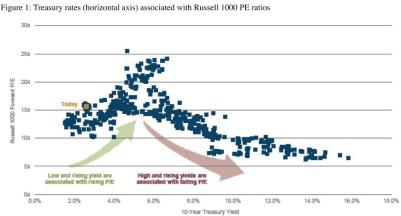
CA - 2015-4-1 - Figure 1

The chart also shows that rates can get too high for the health of stocks—the cutoff point seems to be up around 5.5% to 6%. But incremental quarter-point rises are not going to take the U.S. economy into that territory for a long time. History has shown that markets and interest rates can go up together for several quarters, after the market gets over the initial “shock” of the first interest rate hike. So far, the fed has given every indication that they will remain accommodative and patient.

Finally, we should all welcome the Fed pullback, not fear it. A lot of the uncertainty among traders and even long-term investors is coming from anxiety over how this experiment is going to end. The U.S. Central bank has directly intervened in the markets and in the economy, and is still doing so. When that ends, normal market forces will take over, and we’ll all have a better handle on what “normal” means in this economic era. Is there great demand for credit to fuel growth? What would rational investors pay for Treasury and corporate bonds if they weren’t bidding against an 800-pound gorilla? Would retirees prefer an absolutely certain 4.5% return on 30-year Treasury bonds or the less certain (but historically higher) returns they can get from the stock market? These are questions that all of us would like to know the answer to, and we won’t until all the quantitative easing and interventions have ended.

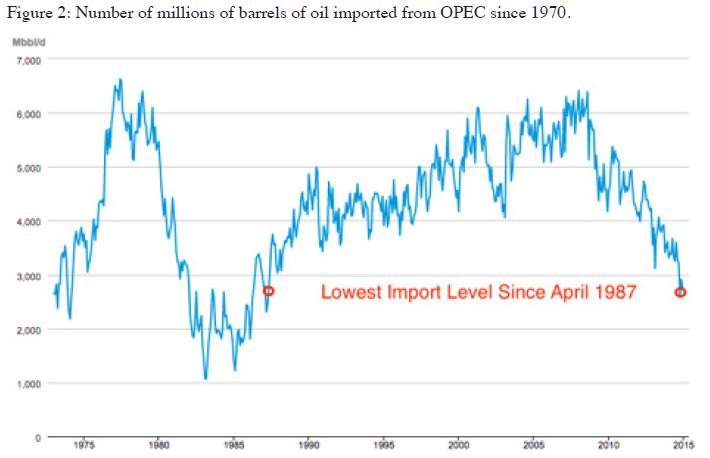
What DO we know? Figure 2 shows that the U.S. economy is less dependent on foreign oil than at any time since 1987, and the trend is moving toward complete independence. Oil—and energy generally—is cheaper now than it has been in several decades, which makes our lives, and the production of goods and services, less expensive.

CA - 2015-4-1 - Figure 2

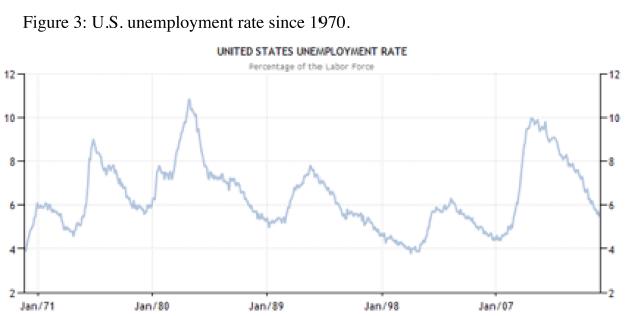
Meanwhile, more Americans are working. Figure 3 shows that the U.S. unemployment rate—at 5.5%—is trending dramatically lower, and is now reaching levels that are actually below the long-term norms. Unemployment today is lower than the rate for much of the booming ‘90s, and is approaching the lows of the early 1970s.

CA - 2015-4-1 - Figure 3

And real GDP—the broadest measure of economic activity in the United States—increased 2.4% last year, after rising 2.2% the previous year.   America is growing. Not rapidly, but slow growth might not be so terrible. Rapid economic growth has, in the past, often preceded economic recessions, where excesses had to be corrected. Slow, steady growth may be boring, but it’s certainly not bad news for the economy or the markets. For fun, look at Figure 4, which shows, in a creative way, the size of the U.S. economy compared with the rest of the world. Each U.S. state is labeled with an entire country whose total economic output is roughly equal to that state’s. The point: the U.S. is still a colossus that stands across the global economy.
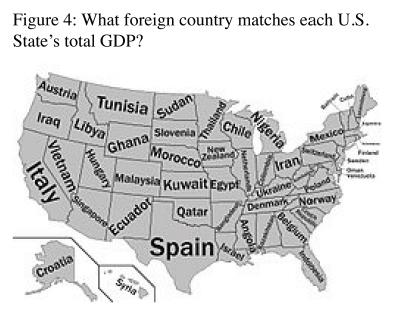
CA - 2015-4-1 - Figure 4

It has been said that people lose far more money in opportunity costs by trying to avoid future market downturns while the markets are still going up, than by holding their ground during actual downturns. And, in fact, in every case so far, the U.S. market has eventually made up the ground it lost in every bear market we’ve experienced.  The last trading day of the 1st quarter looked quite bearish, as have many other gloomy trading days during this seven-year bull market. It seems like every week, somebody else has predicted an imminent decline that has not happened. People who listened to the alarmists lost out on solid returns. You filter out the good news at your peril.

For our client portfolios we continue to take a somewhat defensive stance as this aging bull market carries on.  Despite softening economic data during the past few months, we see little evidence or warning signs of an impending recession or severe bear market over the next 6-9 months, although that could change anytime. Nonetheless, we await opportunities to re-deploy some cash, but the market has been recalcitrant to give much of a pullback from its recent highs.  Bull markets rarely die of old age; they often die of over-exuberance.  So far, we’re not seeing much of a rush to equities; rather, we see the market still climbing the proverbial wall of worry.

If you would like to review your current investment portfolio or discuss any other financial planning matters, please don’t hesitate to contact us or visit our website at http://www.ydfs.com. We are a fee-only fiduciary financial planning firm that always puts your interests first.  If you are not a client yet, an initial consultation is complimentary and there is never any pressure or hidden sales pitch.

Happy Easter!

Sources:

Wilshire index data: http://www.wilshire.com/Indexes/calculator/

Russell index data: http://www.russell.com/indexes/data/daily_total_returns_us.asp

S&P index data: http://www.standardandpoors.com/indices/sp-500/en/us/?indexId=spusa-500-usduf–p-us-l–

http://www.tradingeconomics.com/united-states/unemployment-rate

Nasdaq index data: http://quicktake.morningstar.com/Index/IndexCharts.aspx?Symbol=COMP

International indices: http://www.mscibarra.com/products/indices/international_equity_indices/performance.html

Commodities index data: http://us.spindices.com/index-family/commodities/sp-gsci

Treasury market rates: http://www.bloomberg.com/markets/rates-bonds/government-bonds/us/

TheMoneyGeek thanks guest writer Bob Veres for co-writing this post.

Lower Oil, Less Looking For It

You already know that oil prices are lower than they have been in a long time, in part because U.S. oil production is higher than it has ever been, and still climbing steeply. But you have to wonder how long these conditions will last, since lower oil prices make it less economical for oilfield services companies to drill.

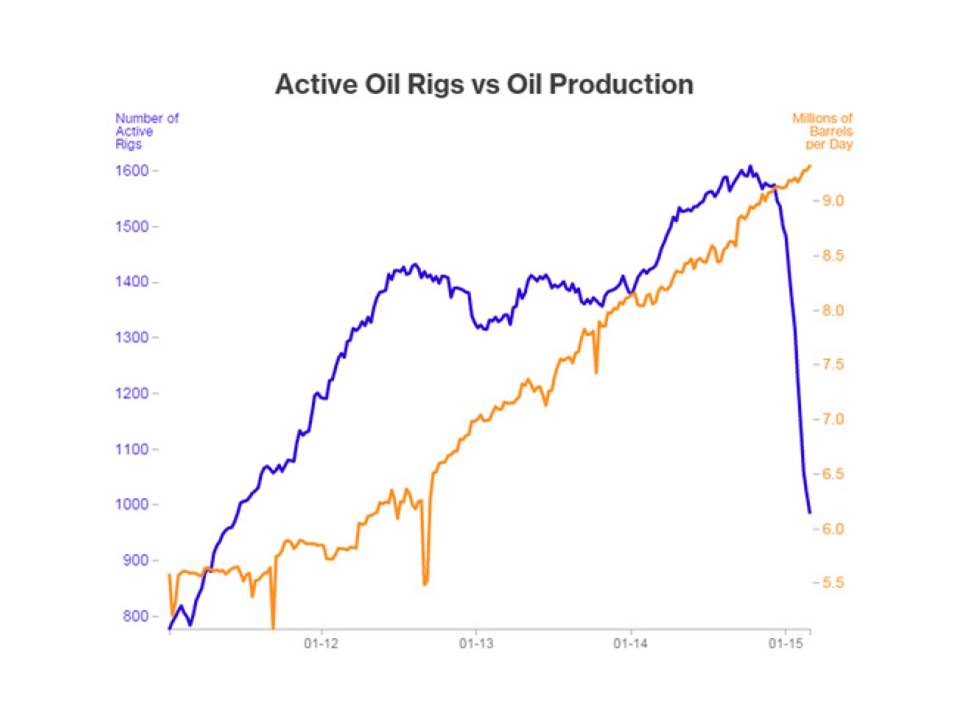
The below chart, courtesy of the oilfield services company Baker Hughes, may be the most dramatic illustration of economic reality you will see this month. It shows how the U.S. has increased the millions of barrels of oil per day that we’re pumping out of U.S. soil in the past four years. Looking at the orange line rising ever-more-steeply, you wonder whether oil prices will ever go back up to previous levels.

CA - 2014-3-10 Oil Rigs Chart

But then you see the purple line, which tracks the number of active oil rigs that are out there looking for new sources of oil. The last quarter of 2014 and the first few months of this year have created a dramatic bear market for drilling rigs in action. In just two fiscal quarters, the number of rigs in the field has dropped almost by half, and there is no sign that the trend is slowing down.

What does that mean? Nothing in the short term, since the orange line represents existing production. But longer-term, you have to expect that fewer active rigs will mean fewer wells and, at the very least, a leveling out of that orange line. Oil prices may be down today, but that doesn’t mean supplies will outrun demand forever. Enjoy the low gas prices while you can.

If you would like to review your current investment management portfolio or discuss any other financial planning matters, please don’t hesitate to contact us or visit our website at http://www.ydfs.com. We are a fee-only fiduciary financial planning firm that always puts your interests first.  If you are not a client yet, an initial consultation is complimentary and there is never any pressure or hidden sales pitch.

Source:

http://www.bloomberg.com/news/articles/2015-03-06/oil-rigs-get-slammed-for-the-13th-week

TheMoneyGeek thanks guest writer Bob Veres for writing this post.

More Proof that Higher Contributions Are Most Important to Retirement Plan Success

A study by the Putnam Institute, “Defined Contribution Plans: Missing the forest for the trees?” contends that while a number of variables, such as fund selection, asset allocation, portfolio re-balancing, and deferral (contribution) rates all contribute to a defined contribution plan’s effectiveness — or lack thereof — it is deferral rates that should be placed near the top of the hierarchy when considering ways to boost retirement saving success.1

As part of its analysis, the research team created a hypothetical scenario in which an individual’s contribution rate increased from 3% of income to 4%, 6%, and 8%. After 29 years, the final balance jumped from $138,000, to $181,000, $272,000, and $334,000, respectively.

Even with a just a 1% increase — to a 4% deferral rate — the participant’s final accumulation would have been 30% greater than it would have been using a fund selection strategy defined as the “Crystal Ball” strategy, in which the plan sponsor uses a predefined formula to predict which funds may potentially perform well for the next three-year period. Further, the 1% boost in income deferral would have had a wealth accumulation effect nearly 100% larger than a growth asset allocation strategy, and 2,000% greater than rebalancing. Of course these results are hypothetical and past performance does not guarantee future results.

One key takeaway of the study was for plan sponsors to find ways to communicate the benefits of higher deferral rates to employees, and to help them find ways to do so.

Retirement Savings Tips

The Employee Benefit Research Institute reported in 2014 that 44% of American workers have tried to figure out how much money they will need to accumulate for retirement, and one-third admit they are not doing a good job in their financial planning for retirement.2 Are you? If so, these strategies may help you to better identify and pursue your retirement savings goals:

Double-check your assumptions. When do you plan to retire? How much money will you need each year? Where and when do you plan to get your retirement income? Are your investment expectations in line with the performance potential of the investments you own?

Use a proper “calculator.” The best way to calculate your goal is by using one of the many interactive worksheets now available free of charge online and in print. Each type features questions about your financial situation as well as blank spaces for you to provide answers. But remember, your ultimate goal is to save as much money as possible for retirement regardless of what any calculator might suggest.

Contribute more. At the very least, try to contribute enough to receive the full amount of any employer’s matching contribution. It’s also a good idea to increase contributions annually, such as after a pay raise.

Retirement will likely be one of the biggest expenses in your life, so it’s important to maintain an accurate cost estimate and financial plan. Make it a priority to calculate your savings goal at least once a year.

If you would like to review your current deferral rate(s) or discuss any other financial planning matters, please don’t hesitate to contact us or visit our website at http://www.ydfs.com. We are a fee-only fiduciary financial planning firm that always puts your interests first.  If you are not a client yet, an initial consultation is complimentary and there is never any pressure or hidden sales pitch.

Sources:

1Putnam Institute, Defined Contribution Plans: Missing the forest for the trees?, May 2014.

2Ruth Helman, Nevin Adams, Craig Copeland, and Jack VanDerhei. “The 2014 Retirement Confidence Survey: Confidence Rebounds–for Those With Retirement Plans,” EBRI Issue Brief, no. 397, March 2014.

Return on College

Let’s say you’re giving your niece or grandson some advice on which major to select in college. Do you tell them to get an art degree, or take courses in social sciences? Or should they focus on business and finance?

The decision should not ignore their natural abilities and interests, of course. But if they’re looking for the best return on their tuition dollars, then they might consider spending their time in the computer sciences and math buildings.

This information comes from a report published by PayScale.com, which helps people manage their careers and figure out what they’re worth on the job market. PayScale’s research team tracked the median salary for people who completed its salary survey online. They then compared the 20-year earnings of people following different careers with what was earned, on average, by competing workers with a high school diploma but no college degree. Then they subtracted the cost of 4 years of college tuition, to arrive at a return on investment figure—the additional money the degree provided. Advanced degrees like law and medicine were excluded; the survey focused on bachelors degrees.

The results were striking. Business and finance majors came away with a respectable $331,345 average return on investment (ROI) over 20 years, but they actually finished a distant third on the list, just ahead of sales, marketing and public relations ($318,212). The highest ranking majors, by this metric, were computer and math, whose degree-holders saw a net return on their tuition investment of $584,339 over the 20 years after graduation. These nerdy individuals nosed out the architecture and engineering graduates, whose average ROI came to $561,475.

Life, physical and social sciences majors fared somewhat less well, earning almost exactly $250,000 more than their high school diploma competition. Graduates with an arts, design, entertainment and related degree came in last in the survey; they are expected to make a little over $125,000 as a result of their college training.

Interestingly, the PayScale website also tracks the average return on tuition investment for different colleges. Graduates of Harvey Mudd College in Claremont, CA can expect to earn nearly $1 million over the 20 years after graduation, with a typical starting salary north of $75,000—with a 4-year college investment of $237,700. Numbers 2-10 on the rankings include the California Institute of Technology ($901,400 earnings, $221,600 cost); The Stevens Institute of Technology in Hoboken, NJ ($841,000; $232,000), the Colorado School of Mines in Golden, CO ($831,000; $112,000); Babson College in Wellesley, MA ($812,800; $230,200); Stanford University ($809,000; $233,300); the Massachusetts Institute of Technology ($798,500; $224,500); Georgia Institute of Technology ($796,300; $86,700); Princeton University ($795,700; $217,300); and the Virginia Military Institute ($767,300; $95,700).

You can look up your own alma mater here: http://www.payscale.com/college-roi/

If you would like to talk about college planning or discuss any other financial planning matters, please don’t hesitate to contact us or visit our website at http://www.ydfs.com. We are a fee-only fiduciary financial planning firm that always puts your interests first.  If you are not a client yet, an initial consultation is complimentary and there is never any pressure or hidden sales pitch.

Sources:

http://www.payscale.com/college-roi/

http://www.bloomberg.com/news/articles/2015-03-05/the-career-with-the-biggest-financial-payoff?hootPostID=293b20e2f9470947cb0facdcea7f70ea

TheMoneyGeek thanks guest writer Bob Veres for writing this post

Is America in Decline?

In 1945, the U.S. made up more than half of the world’s total gross domestic product (GDP), which basically means that half the world’s economy took place inside U.S. borders. Today that figure is just under 22%.

Does that mean America is in decline?

There seems to be a bull market in doomsayers these past few years, as we’re all reading arguments that the U.S. is slowly losing its grip on global preeminence. The rhetoric today sounds a lot like the hand-wringing back in the 1980s when Japan was allegedly taking over the global economy, and before that, when the Soviet Union had more missiles and a Sputnik circling over our heads.

There’s no easy way to define the overall quality of an economy, but probably the most thorough assessment comes out each year via the World Economic Forum’s Global Competitiveness Rankings. The most recent report ranked 144 countries around the world, including Qatar (16), Moldavia (82), Namibia (88), Lesotho (107) and the unhappy states of Chad (143) and Guinea (144), whose citizens eke out their lives on per capita incomes of $1,218 and $564 a year, respectively.

The survey looks at 12 “pillars” of economic competitiveness, including labor market efficiency, the quality of primary education and higher education, infrastructure, the strength of institutions, innovation, business sophistication, technological readiness and the sophistication of the financial markets. Each of these categories are broken down into dozens of subcategories, which are separately evaluated. For instance, when looking at the strength of each country’s public institutions, the World Economic Forum researchers consider whether people in a given country have strong property rights and intellectual property protection, whether there is corruption and the routine payment of bribes, whether the citizens enjoy judicial independence and a solid legal framework, and how well investors enjoy shareholder protection.

In the most recent survey, the U.S. ranked third overall, with an overall rating of 5.5 on a scale of 1-6. Ahead of it were Switzerland (5.7) and Singapore (5.6). China, the country that you most often hear cited as the all-powerful up-and-coming economy, ranked 28th, two rungs below Saudi Arabia, one rung above Estonia. Brazil and India, which are sometimes mentioned as powerful competitors to U.S. economic hegemony, are ranked 57th and 71st, respectively.

The point of the rankings is to show which countries have created the healthiest (or, in the cases of Chad and Guinea, the least-healthy) economic climate for future growth. But of course there are other ways of measuring competitiveness, including the bottom line (as mentioned at the top of the article) of percentage of the world GDP, and whether you’re moving up or down.

US and Global GDP through 2014

By that standard, the U.S. is indeed moving down. If you look at Figure 1 above, which shows the size of the overall global and U.S. economies since 1991, you see that the U.S. has enjoyed steady economic growth, while the world at large has essentially taken off like a rocket. The years following the collapse of the Soviet Union, when several billion people were suddenly allowed to become capitalists, have been good for world growth. When China shifted from a communist to a capitalist economic posture, this added fuel to the rocket. The democratization of computer technology and the global Internet has empowered value creators everywhere.

The U.S., Europe and Japan, in other words, no longer have a monopoly on capitalism. And that’s a good thing.

Is there a better way of evaluating how the U.S. economy is holding up in an increasingly competitive world? Figure 2 below looks at the first chart from a slightly different angle. Since 1991, what percentage of all the world’s business has been happening in the U.S., vs. Europe, Japan, China, India, Russia and Brazil?   How much of the total global economy did each nation claim in each year, and how has that balance changed over time?

US GDP Market Share through 2014

What you see there is that the U.S. is still in the lead by a pretty wide margin, and in recent years has actually stabilized its percentage of total global GDP. The decline has come mostly because a lot of smaller emerging markets, plus China and, to a certain extent, Brazil, India and Russia, have all been growing. At the same time, America’s traditional competitors—Europe and Japan—have been sinking. If you want to point a finger at decline, perhaps that’s a better direction than the U.S.

Does the U.S. face economic challenges? Of course. Is our political system a mess? Sure. Could things be better? Certainly. But if you sift through a lot of variables with a fine-toothed comb, you discover that the U.S. has created a better environment to grow and prosper than almost anywhere else, and it has held its own with the roaring growth of the emerging markets while the other developed nations are losing ground. More than a fifth of all economic activity still happens in the U.S., and the long, slow decline in that figure is not due to stagnation at home, but abundant growth all around the world. That’s not something to worry about; it’s something we should be celebrating.

If you would like to review your current investment portfolio or discuss any other financial planning matters, please don’t hesitate to contact us or visit our website at http://www.ydfs.com. We are a fee-only fiduciary financial planning firm that always puts your interests first.  If you are not a client yet, an initial consultation is complimentary and there is never any pressure or hidden sales pitch.

Sources:

http://reports.weforum.org/global-competitiveness-report-2014-2015/rankings/

http://www.economywatch.com/economic-statistics/year/1990/

http://theamericanscene.com/2008/05/07/a-post-american-world

TheMoneyGeek thanks guest writer Bob Veres for writing this post.

Getting Ready for a Fresh Start

Despite the potential long-term benefits of reviewing personal finances on an annual basis, it seems that many Americans still don’t make it a priority to do so.

Have you already taken steps to give yourself a fresh financial start next year? It’s still not too late to begin.

Aim Higher for Retirement

Today, workers are eligible to contribute more money than ever to their employer-sponsored retirement plans. For most workers, the maximum annual pre-tax contribution is $18,000 in 2015. If you’re at least 50 years old, you may also make additional contributions — known as catch-up contributions — of up to $6,000. That amounts to a $24,000 overall contribution limit this year.

Search for Savings

Even if you can’t contribute the maximum, a reality for many given life’s various financial challenges, seek out opportunities to set aside more money for retirement whenever possible.

Consider creating a comprehensive household budget that allows you to plan and track spending on an ongoing basis and includes among your listed expenses a commitment to “pay yourself” in the form of retirement savings. More than likely you’ll find some “fat” in your budget, even just a little, that can be trimmed to free up savings dollars.

Defeat Debt

The U.S. savings rate recently hit its lowest level in almost half a century, due in part to higher rates of borrowing and credit card debt. If debt is getting in the way of your long-term goals, consider strategies for chipping away at it:

  • Transferring high-interest debt to a credit card with a lower rate.
  • Trying to pay at least twice the minimum required payment.
  • Using a tax-refund to pay off outstanding loans.

For more ideas on how to get a fresh start or to discuss any other financial planning matters, please don’t hesitate to contact us or visit our website at http://www.ydfs.com. We are a fee-only fiduciary financial planning firm that always puts your interests first.  If you are not a client yet, an initial consultation is complimentary and there is never any pressure or hidden sales pitch.

Understanding Bond Investing: It’s a Matter of Balance

It’s a common misconception to think of bonds as “plain vanilla” investments that are appropriate only for certain types of people, such as financially conservative retirees. But in reality, bond investments may have the potential to add stability to a portfolio and help reduce overall investment risk — regardless of your age or financial outlook.

What Is a Bond?

Bonds are investment securities issued by corporations or governments to raise money for a particular purpose. Basically, bonds are the “IOUs” of the business world. There are different types of bond funds, each with varying levels of risk and return potential. Generally speaking, the higher the risk, the better the return potential. For example:

  • Government bond funds invest in bonds issued by the U.S. Treasury. Historically, they have been among the strongest types of bond investments. However, they typically offer lower returns than other bonds.
  • Corporate bond funds invest in bonds issued by private companies. They can range from “investment grade” (safer, lower return potential) to “below investment grade” (riskier, higher return potential).

Know the Risks

Bond funds are subject to several types of investment risk, including:

  • Market risk — Like stock prices, bond prices move up and down. However, such fluctuations tend to be less severe in the bond market.
  • Interest rate risk — When interest rates rise, bond prices may fall, and vice versa.
  • Inflation risk — If the return on a bond fund does not outpace the rising cost of living, the purchasing power of your investment could decline over time.

Managing Risk

Despite these risks, investors of all ages may potentially benefit from putting some money in bond funds. Because bond funds tend to respond to market influences differently than stock funds, they may help balance out the risks associated with stock investing.

In addition, lower-risk bond funds, such as government and investment-grade corporate bond funds, may help protect some of your money from losses during turbulent times.

If you would like to review bond investments in your current portfolio or discuss any other financial planning matters, please don’t hesitate to contact us or visit our website at http://www.ydfs.com. We are a fee-only fiduciary financial planning firm that always puts your interests first.  If you are not a client yet, an initial consultation is complimentary and there is never any pressure or hidden sales pitch.

About that Social Security Insolvency

Social Security’s future solvency has become one of the most commonly-discussed issues in retirement planning—and for good reason.  Gallup polls show that an estimated 57% of retirees rely on Social Security as a major source of retirement income—a number that has held steady since the early 2000s.  But when Generation X and Y individuals plan for their future retirement, they’ll often ask their advisor to assume that Social Security won’t be there for them 20 or 30 years down the road.

However, if you look closely at the numbers, you see a very different story.  Up until 2011, the Social Security system actually collected more revenues from workers’ FICA payments than it paid out in benefits—and that has been generally true since the 1940’s.  Most of the Social Security benefits that people receive today are simply a transfer; that is, the money is collected from worker paychecks (and, of course, employer matches), spends a few days at the U.S. Treasury and then is paid out to recipients.  The surplus has been used to pay government operating expenses, and for seven decades, the government issued “special issue federal securities” (essentially fancy IOUs that pay interest) to the Social Security trust fund.

In 2011, the program crossed that threshold where benefit payments slightly exceeded the amount collected.  Why?  Because the number of beneficiaries, compared to the number of workers, has steadily increased.  In 1955, there were more than eight workers paying into Social Security for every beneficiary.  Today, that number is closer to three workers for every beneficiary, and by 2031, if current estimates are correct, that ratio will fall to just over two workers supporting every retired beneficiary.

When Social Security Administration actuaries crunch the numbers, they have to take into account the shifting demographics, and then make estimates of fertility and immigration rates, longevity, labor force participation rates, the growth of real wages and growth of the economy every year between now and 2078.  After adding in the value of the government IOUs, they estimate that if nothing is done to fix the system, the trust fund IOUs will run out in the year 2033.  At that time, only the FICA money collected from workers would be available to pay Social Security beneficiaries.  In real terms, that means the beneficiaries would, in 2034, see their payments drop to 77% of what they were promised.

In other words, the money being transferred from current workers to beneficiaries through the FICA payroll program, assuming no course corrections between now and 2033, will be enough to pay retirees 77% of the benefits they were otherwise expecting.

The government actuaries say that if nothing is done to fix the problem over the next 63 years, this percentage will gradually decline to 72% by the year 2078.

So the first takeaway from these analyses is that today’s workers are looking at a worst-case scenario of only receiving about 75% of the benefits that they would otherwise have expected to receive.  This is far different from the zero figure that they’re asking their advisors to use in retirement projections.

How likely is it that there will be no course corrections?  There are two possible ways that this 75% figure could go up.  One lies in the assumptions themselves.  The Social Security Administration actuaries have tended to err on the side of conservatism, presumably because they would rather be pleasantly surprised than discover that they were too optimistic.  But what if the future doesn’t look as gloomy as their assumptions make it out to be?

To take just one of the variables, the actuaries are projecting that labor force participation rates for men will fall from 75.5% of the population in 1997 to 74% by 2075, while the growth in female workers will stop their long climb and peter out around 60%.  If male labor force participation rates don’t fall, and if female rates continue to rise, some of the funding gap will be eliminated.

Similarly, the projections assume that the U.S. economy’s productivity gains (which drive wage increases) will grow 1.3% a year, well below long-term U.S. averages and certainly below the assumptions of economists who believe that biotech and information age revolutions will spur unprecedented growth.  If real wages were to grow at something closer to the post-Great Recession rate of 2% a year, then more than half of the funding gap would be eliminated.  If the current slump in immigration (due to tighter immigration policies) is reversed, and the economy grows faster than the anemic 2% rates the Social Security Administration is projecting (compared to 2.5% recently), then the “bankrupt” system begins to look surprisingly solvent.

A second possibility is that Congress will tweak the numbers and bring Social Security’s long-term finances back in balance, as it has done 21 times since the program originated in 1937.  The financial press often cites the fact that the total future Social Security funding shortfall amounts to $13.6 trillion, but they seldom add that this represents just 3.5% of future taxable payrolls through 2081.  Small tweaks—like extending the age to collect full retirement benefits from 67 to 68, raising the FICA tax rate by 3.5 percentage points or making the current 12.4% rate (employee plus employer match) apply to all taxable income rather than the $118,500 current limit—would restore solvency far enough into the future that today’s workers would be comfortable adding back 100% of their anticipated benefits into their retirement projections.

How likely is it that Congress will take these measures, in light of recent partisan budget battles?  It’s helpful to remember that older Americans tend to vote with more consistency than younger citizens.  The more you’ve paid into the system, the more you expect to at least get back the money you were promised.

The bottom line here is that if you’re skeptical about Social Security’s future solvency, then you should pencil in 75% of the benefits you would otherwise expect—rather than $0.  Meanwhile, as you approach the age when you’re eligible for benefits, watch for signs that immigration restrictions are loosening, the economy is growing faster than the SSA actuaries’ gloomy projections, more people are working during traditional retirement years or yet another round of tweaks from our elected representatives.

If you would like to review your social security payment options or projections, analyze your current investment portfolio or discuss any other financial planning matters, please don’t hesitate to contact us or visit our website at http://www.ydfs.com. We are a fee-only fiduciary financial planning firm that always puts your interests first.  If you are not a client yet, an initial consultation is complimentary and there is never any pressure or hidden sales pitch.

Sources:

http://economix.blogs.nytimes.com/2014/03/05/another-way-to-do-the-math-for-social-security-reform/?_r=0

http://www.treasury.gov/resource-center/economic-policy/ss-medicare/Documents/ssissuebriefno.%205%20no%20cover.pdf

http://www.treasury.gov/resource-center/economic-policy/ss-medicare/Documents/post.pdf

http://www.wsj.com/articles/how-social-security-benefits-are-calculated-when-you-wait-to-start-taking-them-1421726460

http://www.usatoday.com/story/money/personalfinance/2013/11/25/nine-surprising-social-security-statistics/3698005/

http://www.huffingtonpost.com/2013/02/18/change-social-security_n_2708000.html

http://www.therubins.com/socsec/solvency.htm

http://www.encyclopedia.com/topic/social_security.aspx

http://fdlaction.firedoglake.com/2012/04/30/growing-number-of-americans-expect-to-rely-mostly-on-social-security/

TheMoneyGeek wishes to thank guest writer Bob Veres for this post.

The Psychology of Investing: How We Cope With Risk

Researchers have found that investors have a tendency to psychologically exaggerate declines in the performance of an investment and to minimize gains. It’s a phenomenon with a complex sounding name — “myopic loss aversion” — but also one that makes a simple point: Psychology plays a role in our investment decisions. Understanding that role, the subject of this second installment of a three-part series on investment risk, may help you stay on course toward your long-term financial objectives.

Word Play

Individuals subconsciously “frame” expectations based upon how the information is presented to them. For instance, would you prefer to invest in a security that has a 40% chance of yielding negative returns or one that has a 60% chance of yielding positive returns? Many people would choose the latter, even though the same investment opportunity was offered in both cases.

Running With the Pack

It’s human nature to want to choose investments that have performed well. On the other hand, many of us are naturally risk-averse. Sometimes these inclinations combine to make us less effective investors. For instance, do you know people who wait to invest until they hear of a security that consistently produces above-average returns? Then, sensing a “safe bet,” they purchase this investment — often when it’s at peak value. If the investment drops in value, they move their money to what they perceive as a less risky security or even pull out of the market altogether — even if such a move clashes with their long-term goals.

This sort of short-term thinking creates risk, too. When investors move in and out of the market, they’re practicing an investment tactic known as market timing. The risk is that they’ll mistime the market and lose out on potential gains. Even professional portfolio managers admit that it can be difficult to predict market moves.

Personal Experiences and Our Portfolios

Research has shown that individuals who grew up during the Great Depression are more likely to invest conservatively, while those who entered the market during the mid-1990s expect high returns and tend to invest more aggressively. Being aware of how past experience may influence your perceptions, can help you avoid financial strategies that may work against you.

So What Can You Do?

Several strategies may help you minimize the role that emotions and psychological tendencies play in your investment decisions. Stay focused on your long-term goals and not the market’s short-term moves. And rather than reviewing your investments’ performance every week, consider scheduling quarterly or semi annual portfolio reviews with a qualified financial professional.

Finally, develop — and stick to — a well thought out plan that’s based on your goals and your personal tolerance for risk. Look for more on these and other strategies that may help you cope with risk in the final installment of this series.

If you would like to review your current investment portfolio or discuss any other financial planning matters, please don’t hesitate to contact us or visit our website at http://www.ydfs.com. We are a fee-only fiduciary financial planning firm that always puts your interests first.  If you are not a client yet, an initial consultation is complimentary and there is never any pressure or hidden sales pitch.

Put Time on Your Side With the Power of Compounding

Sometimes people put off saving for retirement because so many other things seem to get in the way. Do you find yourself among them? If so, try to overcome the urge to procrastinate and start saving as soon as possible. When it comes to investing for long-term goals, time can be a powerful ally.

Time and Investment Returns

The reason time can work for you is because of a concept called compounding. The idea behind compounding is simple — when your investment earns money, this amount is reinvested in your account and potentially generates more earnings. Over time, this process can increase the growth potential of your original investment. If your earnings are reinvested for a long enough period, compounding can reduce some of the pressure on you to invest greater amounts as you approach retirement.

The power of reinvested earnings partly explains why some people who start investing early in their careers often end up with more money than people who start later, even if their total contributions are less.

Compounding With Every Paycheck

Your employer-sponsored plan may be one of the most convenient ways to make compounding work for you. Every paycheck, you have a new opportunity to add to your retirement savings. For 2015, you may be able to contribute a maximum of $18,000 (check with your employer, because some organizations may impose lower limits). If you are age 50 or older, you may also have the opportunity to save up to $6,000 more. Even if you cannot afford to invest the maximum amount, try to do as much as you can.

Of course, you can’t benefit from compounding if you don’t stay invested. Withdrawing money during your working years could wipe out or reduce the savings you have accumulated, which would reduce some of the benefit of compounding.

So don’t procrastinate. Start saving as soon as possible and take advantage of what compounding can potentially do for you.

If you would like to review your current investment portfolio or discuss any other financial planning matters, please don’t hesitate to contact us or visit our website at http://www.ydfs.com. We are a fee-only fiduciary financial planning firm that always puts your interests first.  If you are not a client yet, an initial consultation is complimentary and there is never any pressure or hidden sales pitch.