2016 YDFS Investment Review

So President-elect Trump didn’t crash the market; the world didn’t fall apart after the Brexit vote; and the worst start to the year in history didn’t derail what ended up being a pretty good year in the stock markets. “Who da thunk it?”

You know you’re deep into a longstanding bull market when you see things like average pedestrians keeping one eye on the market tickers outside of brokerage houses to see when the Dow Jones Industrial Average has finally breached the 20,000 mark.  Who would have imagined record market highs at this point last year, when the indices ended the year in slightly negative territory?  Or when the new year 2016 got off to such a rocky start, tumbling 10% in the first two weeks—the worst start to a year since 1930?

The markets eventually bottomed in mid-February and began a long, slow recovery, turning positive by the end of March, suffering a setback when the U.K. decided to leave the Eurozone, and endured another hard bump right after the elections.  In the end, we were disappointed; the Dow finished at 19,762.60 for the year—but the bull market has continued for another year.

This was the second year in a row that the final quarter provided investors with solid gains. The Wilshire 5000–the broadest measure of U.S. stocks—was up 4.54% in the fourth quarter of 2016, ending the year up 13.37%.  The comparable Russell 3000 index gained 4.21% in the final quarter, to finish up 12.74% for the year.

Large cap stocks were up as well.  The Wilshire U.S. Large Cap index gained 4.14% in the fourth quarter, and finished the year up 12.49%.  The Russell 1000 large-cap index closed with a 3.83% fourth quarter performance, and finished the year up 12.05%, while the widely-quoted S&P 500 index of large company stocks was up 3.25% in the fourth quarter, finishing up 9.54% for calendar 2016.

The Wilshire U.S. Mid-Cap index gained 5.31% in the final quarter, finishing the year with a gain of 17.22%.  The Russell Midcap Index gained 3.21% in the fourth quarter, and was up 13.80% in calendar 2016.

This was a year to remember for investors in small company stocks.  As measured by the Wilshire U.S. Small-Cap index, investors posted an 8.30% gain over the last three months of the year, for a total return of 22.41% over the entire 12 months.  The comparable Russell 2000 Small-Cap Index finished the year up 21.31%, while the technology-heavy Nasdaq Composite Index rose 1.34% in the fourth quarter, to finish the year up 7.50%.

International investments contributed a slight decline to overall portfolio returns.   The broad-based EAFE index of companies in developed foreign economies lost 1.04% in the fourth quarter of the year, finishing the year down 1.88% in dollar terms (I expect these stocks to carry the winning torch any day now).  In aggregate, European stocks lost 3.39% for the year, while EAFE’s Far East Index gained just 0.14%.  Emerging markets stocks of less developed countries, as represented by the EAFE EM index, gained 8.58% for the year.

Looking over the other investment categories, real estate investments, as measured by the Wilshire U.S. REIT index, lost 2.28% during the year’s final quarter, but managed to finish up 7.24% for calendar 2016.

Last year, investors were wondering why they owned commodities in their portfolios, when their statements showed that the index delivered a whopping 32.86% loss.  This year, they may be wondering why they weren’t more committed to the asset class, as the S&P GSCI index gained 27.77%, fueled in part by a 45.03% rise in the S&P crude oil index.  Gold prices shot up 8.63% for the year and silver gained 15.84%.

In the bond markets, it’s possible that the decades-long bull market—which basically means declining interest rates—has ended, and the fixed-income world is experiencing rate rises.  But despite the nudge by the Federal Reserve Board, the moves have not exactly been dramatic.  Over the past year, rates on 10-year Treasury bonds have risen from 2.25% to 2.44%, while 30-year government bond yields have risen from 3.00% to 3.07%.  According to Barclay’s Bank indices, U.S. liquid corporate bonds with a 1-5 year maturity have seen yields rise incrementally from 2.4% to 2.8% on average. Despite the many cries and declarations that the 30 year bull market in bonds is over, rest assured that bonds won’t go down without a fight (winning streaks that last so long never die that quickly).

As always, there were many unpredictable anomalies in the investment world.  In the international markets, anyone lucky enough to have speculated on the Brazilian Bovespa index—comparable to the U.S. S&P 500—would have reaped a gain of 68.9% this year, despite all the headline drama around the Zika virus and political uncertainties that were reported on during the Olympic games.  Russian stocks were up 51% for the year, despite the recent sanctions from the U.S. government and the lingering international sanctions related to the invasion of the Crimean peninsula.

As is my obligation as a financial planner, I have to point out that while you may not have realized anywhere near the kinds of returns outlined above for the year, having a diversified and perhaps hedged portfolio means that you never have enough of the stuff that went up and too much of the stuff that came down or underperformed. Risk management of any kind during this bull market (read: diversification) tends to blunt returns during the good times, but is a welcome friend when the markets turn against us. Since no one knows when this is, you have to stick to your investment approach through thick and thin (you do have an investment approach, don’t you? We’re available to help you craft an investment approach if you need us).

What’s going to happen in 2017?  Short-term market traders seem to be expecting a robust economic stimulus combined with lower taxes and deregulatory policies that would boost the short-term profits of American corporations.  But it is helpful to remember that we are entering the ninth year of economic expansion, making this the fourth longest since 1900.  In addition, growth has not exactly been robust; the U.S. GDP has averaged just 2.1% yearly increases since the Great Recession, making this the most sluggish of all post-World War II expansions.

Slow but steady has not been a terrible formula for workers or stock investors.  The unemployment rate has slowly ticked down from a post-recession peak of 10% to less than 5% currently.  U.S. stock indices are posting record highs with double-digit gains, and that Dow 20,000 level, while essentially meaningless, is still catching a lot of attention.

It’s clear that the new President-elect wants to accelerate America’s economic growth, but the policy prescription has not always been clear.  Will we rip up longstanding trade agreements, cut back on immigration quotas and deport millions of workers who crossed the border without a visa?  Will there be a wall built between the U.S. and Mexico?  Will the government pay for huge infrastructure projects, at the same time reducing taxes and thus raising the national debt?  Will Congress raise the debt ceiling without protest if that happens?  Will the Fed raise rates more aggressively in the coming year, or cooperate with the President-elect in his efforts to drive the economy into a faster lane?

At the same time, there are many unknowns around the globe.  China’s economic growth has stalled for the second consecutive year, and you will soon be reading about a banking crisis in Italy that could force the country to leave the Eurozone—potentially a much bigger blow to European economic unity than Brexit or a still-possible Greek exit.  Russian hackers may have ushered in an era of unfettered global intrusions into our Internet infrastructure, and there will surely be a continuation of ISIS-sponsored terrorism in Europe and elsewhere.

Every year of this longstanding bull market, we have to look over our shoulders and wonder when and how it will end.  With the January downturn and so much uncertainty at this time last year, nobody could have predicted double-digit returns on U.S. stocks at year-end.  This year could bring more of the same, or it could fulfill the dire predictions many have made during the election cycle, including both Democrats and Republicans who believe the country is in worse shape than the numbers would indicate. Just remember that bull markets rarely die of old age; instead, they die from excessive enthusiasm and ebullience. This bull market is anything but ebullient.

What we have learned over the past few years is that the markets have a way of surprising us, and that trying to time the market, and get out in anticipation of a downturn, is a loser’s game.  At the county fair or amusement park, when we get on the roller coaster, we don’t bail out and jump over the side at some scary point on the track; we hang on for the remainder of the ride.  The history of the markets has been a general upward trend that benefits long-term investors, and looking out over the long-term, that—and a few hard bumps along the way–is probably the best outcome to expect.

This is not to say that you should commit 100% of your capital to the market or stay all in at all times. It never hurts to take a few chips off the table when things are going well so that you have some dry powder to deploy when those hard bumps come along. Rebalancing into underperforming investment classes at least once or twice a year is always a good idea as well.

If you would like to review your current investment portfolio or discuss any other financial planning matters, please don’t hesitate to contact us or visit our website at http://www.ydfs.com. We are a fee-only fiduciary financial planning firm that always puts your interests first.  If you are not a client yet, an initial consultation is complimentary and there is never any pressure or hidden sales pitch. We start with a specific assessment of your personal situation. There is no rush and no cookie-cutter approach. Each client is different, and so is your financial plan and investment objectives.

You can interact with Sam TheMoneyGeek and read his latest musings on Twitter at http://twitter.com/themoneygeek

Sources:

Wilshire index data: http://www.wilshire.com/Indexes/calculator/

Russell index data: http://www.russell.com/indexes/data/daily_total_returns_us.asp

S&P index data: http://www.standardandpoors.com/indices/sp-500/en/us/?indexId=spusa-500-usduf–p-us-l–

Nasdaq index data: http://quotes.morningstar.com/indexquote/quote.html?t=COMP

http://www.nasdaq.com/markets/indices/nasdaq-total-returns.aspx

International indices: https://www.msci.com/end-of-day-data-search

Commodities index data: http://us.spindices.com/index-family/commodities/sp-gsci

Treasury market rates: http://www.bloomberg.com/markets/rates-bonds/government-bonds/us/

Aggregate corporate bond rates: https://index.barcap.com/Benchmark_Indices/Aggregate/Bond_Indices

Aggregate corporate bond rates: http://www.bloomberg.com/markets/rates-bonds/corporate-bonds/

 Muni rates:  https://indices.barcap.com/show?url=Benchmark_Indices/Aggregate/Bond_Indices

http://www.wsj.com/articles/chinas-stock-market-still-a-draw-after-tumultuous-year-1451303164

http://www.marketwatch.com/story/these-are-the-bestand-worstperforming-assets-of-2016-2016-12-30?link=sfmw_tw

http://www.theworldin.com/article/10632/unsettling-year-markets

http://www.forbes.com/sites/maggiemcgrath/2016/12/30/markets-end-last-trading-day-of-2016-in-red-but-post-gains-for-the-year/#7db846fd7c07

The MoneyGeek thanks guest writer Bob Veres for his contribution to this post


Higher Interest Rates: One and Done or More to Come?

We all know that we’re paying more for almost everything these days. Everything, of course, except money. Interest rates have been at historical lows for more than eight years, even though the economy has steadily improved over this period.

So anybody who was surprised that the Federal Reserve Board (A.K.A. The Fed) decided to raise its benchmark short-term interest rate last week probably wasn’t paying attention.  The U.S. economy is humming along, the stock market is booming and the unemployment rate has fallen faster than anybody expected.  The incoming administration has promised lower taxes and a stimulative $550 billion infrastructure investment.  The question on the minds of most observers is: what were they waiting for?

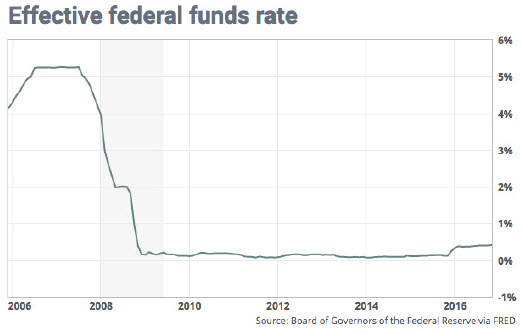
The rate rise is extremely conservative: up 0.25%, to a range from 0.50% to 0.75%—which, as you can see from the accompanying chart, is just a blip compared to where the Fed had its rates ten years ago.

federal-funds-rate-2016-12-16

The bigger news is the announced intention to raise rates three times next year, and move rates to a “normal” 3% by the end of 2019—which is faster than some anticipated, although still somewhat conservative.  Whether any of that will happen is unknown; after all, in December 2015, the Fed was telegraphing four rate adjustments in 2016 , before backing off until now with just this one. Personally, I believe that three interest rate increases in 2017 will prove inadequate, especially if current signs of inflation intensify next year.

The rise in rates is good news for those who believe that the Fed has intruded on normal market forces, suppressed interest rates much longer than could be considered prudent, and even better news for people who are bullish about the U.S. economy.  The Fed may have been the last remaining skeptic that the U.S. was out of the danger zone of falling back into recession; indeed, its announcement acknowledged the sustainable growth in economic activity and low unemployment as positive signs for the future.  However, bond investors might be less pleased, as higher bond rates mean that existing bonds lose value.  The recent rise in bond rates at least hints that the long bull market in fixed-rate securities—that is, declining yields on bonds—may finally be over.

For stocks, the impact is more nuanced.  Bonds and other interest-bearing securities compete with stocks in the sense that they offer stable—if historically lower—returns on your investment.  As interest rates rise, the see-saw between whether you prefer stability or future growth tips a bit, and some stock investors move some of their investments into bonds, reducing demand for stocks and potentially lowering future returns.  None of that, alas, can be predicted in advance, and the fact that the Fed has finally admitted that the economy is capable of surviving higher rates should be good news for people who are investing in the companies that make up the economy. That’s not to say that the prospect of more interest rate hikes won’t cause volatility in the stock markets.

So there may be a lump of coal on the list for over-exuberant investors in the year ahead. Although the current weight of evidence points to a continuation of this economic recovery, pressures that have been synonymous with trouble in past cycles have been developing. Wage and commodity (oil, raw materials) price increases may be rising faster than anticipated, and the Fed could easily fall behind in their efforts to keep inflation in check.

The bottom line here is that, for all the headlines you might read, there is no reason to change your investment plan as a result of a 0.25% change in a rate that the Fed charges banks when they borrow funds overnight.  There is always too much uncertainty about the future to make accurate predictions, and today, with the incoming administration, the tax proposals, the fiscal stimulation, and the real and proposed shifts in interest rates, the uncertainty level may be higher than usual.

If you would like to review your current investment portfolio or discuss any other financial planning matters, please don’t hesitate to contact us or visit our website at http://www.ydfs.com. We are a fee-only fiduciary financial planning firm that always puts your interests first.  If you are not a client yet, an initial consultation is complimentary and there is never any pressure or hidden sales pitch. We start with a specific assessment of your personal situation. There is no rush and no cookie-cutter approach. Each client is different, and so is your financial plan and investment objectives.

Sources:

http://www.businessinsider.com/fed-fomc-statement-interest-rates-december-2016-2016-12

http://www.marketwatch.com/story/fed-to-hike-interest-rates-next-week-while-ignoring-the-elephant-in-the-room-2016-12-09

http://www.reuters.com/article/us-usa-fed-idUSKBN1430G4

http://www.usatoday.com/story/money/personalfinance/2016/12/15/fed-rate-hike-7-questions-and-answers/95470676/?hootPostID=32175354f7440337d62a767b3db92c68

The MoneyGeek thanks guest writer Bob Veres for his contribution to this post

2017 Retirement Contribution Limits Unchanged

Retirement plan contributions are supposed to be indexed and adjusted annually in line with the change in the rate of inflation. But only in the governmental fantasy world of non-inflation are adjustments not necessary.

That is to say, in case you missed it, the contribution limits to your 401(k) plan, IRA and Roth IRA—set by the government each year based on the inflation rate—will not go up in 2017.  Just like this year, you will be able to defer up to $18,000 of your paycheck to your 401(k), and individuals over age 50 will still be able to make a “catch-up” contribution of an additional $6,000.  (The same limits apply to 403(b) plans and the federal government’s new Thrift Savings Plan.)  Your IRA and Roth IRA contributions will continue to max out at $5,500, plus a $1,000 “catch-up” contribution for persons 50 or older.

SEP IRA and Solo 401(k) contribution limits, meanwhile, will go up from $53,000 this year to $54,000 in 2017.

The government has made small changes to the income limits on who can make deductions to a Roth IRA and who can claim a deduction for their contribution to a traditional IRA.  The phaseout schedule (income range) for single filers for 2016 starts at $117,000 and contributions are entirely phased out at $132,000; for joint filers the current range is $186,000 to $196,000.  In 2017, the single phaseout will run $1,000 higher, from $118,000 to $133,000, and the joint phaseout threshold will rise $2,000, to $188,000 up to $198,000.  Single persons who have a retirement plan at work will see the income at which they can no longer deduct their IRA contributions go up $1,000 as well, with the phaseout starting at $62,000 and ending at $72,000.  Couples will see their phaseout schedule rise to $99,000 to $119,000.

If you would like to review your retirement plan options, current investment portfolio or discuss any other financial planning matters, please don’t hesitate to contact us or visit our website at http://www.ydfs.com. We are a fee-only fiduciary financial planning firm that always puts your interests first.  If you are not a client yet, an initial consultation is complimentary and there is never any pressure or hidden sales pitch. We start with a specific assessment of your personal situation. There is no rush and no cookie-cutter approach. Each client is different, and so is your financial plan and investment objectives.

Sources:

http://money.cnn.com/2016/10/27/retirement/401k-ira-contribution-2017/index.html?iid=Lead

http://www.investopedia.com/articles/retirement/111516/2017-cola-adjustments-overview.asp?partner=mediafed

The MoneyGeek thanks guest writer Bob Veres for his contribution to this post
Roth IRA Conversions after Age 70-1/2

A Roth IRA conversion allows you to move a sum of money from a traditional/rollover IRA into a Roth IRA, pay the taxes due, and thereby convert the future distributions into a tax-free stream out of the Roth IRA for yourself or your heirs.  You probably already know that the IRS requires you to start taking mandatory distributions from your traditional IRA when you turn 70 1/2, even if you don’t actually need the money.  A Roth IRA has no such annual minimum distribution requirement for the original owner and spouse. So the question is: can you do a Roth conversion at that late date, and thereby defer distributions forever?

The answer is that you CAN do a Roth conversion at any time, including after age 70 1/2.  But that might not be ideal tax planning.  Why?  Because at the time of the conversion, you would have to pay ordinary income taxes on the amount converted—basically, paying Uncle Sam up-front for what you would owe on all future distributions.  So, from a tax standpoint, you’re either paying taxes on yearly distributions or all at once.  (Or, if it’s a partial conversion, on the amount transferred over.)  If the goal was to avoid having to pay taxes on that money until you needed it, the conversion kind of defeats the purpose. Unless, of course, you have little other taxable income, and adding a Roth Conversion amount costs you little or nothing in taxes

The traditional reason people made Roth conversions was to pay taxes at a lower rate today than the rate they expect to have to pay on distributions in the future.  They might also want to convert in order to leave the Roth IRA dollars to heirs who might be in a higher tax bracket (keep in mind that a heir who is not your spouse is required to take a minimum, albeit non-taxable, distribution from a Roth IRA).  But with the new Republican Administration taking over, and Republicans controlling both houses of Congress, tax rates are odds-on favorites to go down, not up, in the near future.

If you still want to go ahead and make a conversion after the mandatory distribution date, the law says that you have to take your mandatory withdrawal from your IRA before you do your conversion. That means that you can’t make a 100% conversion of your traditional IRA if you are subject to minimum distribution requirements.  Regardless, you or your tax advisor should “run the numbers” to ensure that you understand the taxes and tax rates that apply before and after the Roth Conversion.

If you would like to review your current investment portfolio or discuss any other tax or financial planning matters, please don’t hesitate to contact us or visit our website at http://www.ydfs.com. We are a fee-only fiduciary financial planning firm that always puts your interests first.  If you are not a client yet, an initial consultation is complimentary and there is never any pressure or hidden sales pitch. We start with a specific assessment of your personal situation. There is no rush and no cookie-cutter approach. Each client is different, and so is your financial plan and investment objectives.

Source:
http://time.com/money/4568635/roth-ira-conversion-year-turn-70-%C2%BD/?xid=tcoshare

The MoneyGeek thanks guest writer Bob Veres for his contribution to this post

Celebrity Apprentice – Presidential Edition

Can lightning strike twice? Apparently it can as pundits, oddsmakers and major polls got it all wrong when forecasting our choice for our next president. Most had Clinton winning in a landslide. The first lightning instance was their wrong call on the Brexit vote earlier this year.

With President Elect Donald Trump, you may be well advised to prepare for a potentially wild ride in the investment markets over the next few weeks; indeed, the markets turned sharply negative in the overnight futures market Tuesday due to the uncertainties ahead. However, the day after the election (Wednesday), the markets closed decisively higher than election day in an opposite reaction to a market crash which some warned about if Trump was elected.

Questions Abound: Will the new President really build an expensive wall across our Southern border?  Will he introduce legislation that will nullify the Affordable Care Act and throw millions of Americans with pre-existing health conditions into health insurance limbo?  Do taxpaying non-citizens who have children born in America have reason to fear deportation?  Are our allies abroad really going to have to renegotiate their trade and security arrangements with the world’s superpower? Will he even the score with his government adversaries, invite them into his boardroom, and tell them “You’re fired”?

It is helpful to remember that market gyrations are almost always bad times to trade, and particularly to sell.  We have more than two months before the new president takes office.  Traders and analysts have plenty of time to settle down between now and the first 100 days of the Trump presidency, and evaluate whether America’s corporations are, indeed, worth much less than they were before election night (they’re not).  The safest bet you can make is that they  may be unusually jumpy for the next four years.  But in the end, the intrinsic value of stocks doesn’t change with the occupant of the White House.

One of the more interesting things to watch out for is a tax reform proposal sometime in early 2017.  Along the campaign trail, candidate Trump proposed simplifying our taxes down to three ordinary income tax brackets: 12% (up to $75,000 for joint filers), 25% ($75,000 to $225,000) and 33% (above $225,000).  The wish list includes a doubling of the standard deduction, with itemized deductions capped at $100,000 for single filers; $200,000 for joint filers.  Capital gains taxes would be capped at 20%, federal estate and gift taxes would be eliminated and the step-up in basis would be eliminated for estates over $10 million.

However, one should remember that these proposals were made before anyone imagined that Americans would elect an undivided government, with the Presidency, the House and Senate all under the control of one party.  The next four years—indeed, the first 100 days of the new Presidency—represent an opportunity for the Republican party to do something much more ambitious than simply tinker with our nation’s tax rules.  Influential Republican leaders—including House Speaker Paul Ryan—have reportedly been planning for some years to rewrite our nation’s tax code.

What, exactly, would tax reform look like?  At this point, we simply don’t know.  The goal would be tax simplification, but the bet here is that whatever form this takes will add thousands of pages to the current law and will likely look very different from Trump’s proposal.

Of course, everything is speculation at this point, which is the most important thing to keep in mind if the markets roil and the shock and awe of the unexpected election outcome begins to sink in and cooler heads prevail.  The very worst thing you could do, over the next few days and weeks, is make a temporary loss permanent by selling into the general panic. Better yet, take advantage of others’ panic and add to your investments at prices lower than they were during the past couple of years.

If you would like to review your current investment portfolio or discuss any other financial planning matters, please don’t hesitate to contact us or visit our website at http://www.ydfs.com. We are a fee-only fiduciary financial planning firm that always puts your interests first.  If you are not a client yet, an initial consultation is complimentary and there is never any pressure or hidden sales pitch. We start with a specific assessment of your personal situation. There is no rush and no cookie-cutter approach. Each client is different, and so is your financial plan and investment objectives.

The MoneyGeek thanks guest writer Bob Veres for his contribution to this post.

Growing Pains

We measure the economic growth of the country via the Gross Domestic Product. Gross domestic product (GDP) is the monetary value of all the finished goods and services produced within a country’s borders in a specific time period. Though GDP is usually calculated on an annual basis, it is calculated and reported on a quarterly basis in the United States. After one of the worst recessions this country has seen ended in 2009, you’d think that the country would ramp up growth, but it has been anything but a ramp.

So why has the American economy grown so slowly since the Great Recession?  This year, GDP growth will fall somewhere in the 1.5% to 1.8% range, below the 3% growth rate that is considered a sign of robust economic health.  Critics have blamed everything from China’s slowdown, to globally outsourced manufacturing, and to fiscal fights in Washington.  But new research from economists at the Federal Reserve Board points to a different—and much simpler—explanation.

The researchers started with a demographic prediction model.  The model recognizes that the economy was destined to grow rapidly when the workforce is heavily weighted toward young accumulators, as it was in the 1960’s and 1970’s when the Baby Boom generation entered the workforce.  The good times continued as the labor force matured and the Boomers reached a high consumption stage of their lives.

But then the Fed economists asked: what happens when the Baby Boomers start to retire, as they did starting in 2005, and in increasing numbers since?  The boomer generation had fewer children than their parents did, so the research shows that as the workforce aged and retired, there were fewer people left in the workforce.  Economic output inevitably declined, no matter what happened in China or the manufacturing sector.

Over the past decade, the research shows that what economists call “capital”—machines, factories, roads, buildings, etc.—has become abundant compared to labor, which has depressed the return that investors receive for investing in capital.  This doesn’t just mean slower economic growth; it also leads to a decline in interest rates (due to a slowing demand for capital).  This helps explain why interest rates rose in the 1960’s and 1970’s, and have gradually declined in the subsequent decades.

The conclusion?  The U.S.—alongside many other developed nations—is experiencing a decline in workers compared with retirees, which happens to coincide with the lingering effects of the financial crisis.  The power of demography is like the tide; don’t blame the government or the Fed for not intervening, because they don’t have the power to overcome the shortage of workers (just ask anyone in Japan, suffering from one of the worst economic declines over the past twenty years due to an aging population and tight immigration policies).  More babies, and maybe more immigrants, represent better solutions.

If you would like to review your current investment portfolio or discuss any other financial planning matters, please don’t hesitate to contact us or visit our website at http://www.ydfs.com. We are a fee-only fiduciary financial planning firm that always puts your interests first.  If you are not a client yet, an initial consultation is complimentary and there is never any pressure or hidden sales pitch. We start with a specific assessment of your personal situation. There is no rush and no cookie-cutter approach. Each client is different, and so is your financial plan and investment objectives.

Sources:

http://www.federalreserve.gov/econresdata/feds/2016/files/2016080pap.pdf

https://www.washingtonpost.com/news/wonk/wp/2016/10/07/theres-a-devastatingly-simple-explanation-for-americas-economic-mess/?tid=sm_tw

The MoneyGeek thanks guest writer Bob Veres for his contribution to this post


Buying an Inexpensive Credit Score

It’s a classic chicken or egg dilemma: your kids graduate from college and face an immediate problem: they have no credit history, which makes it harder for them to rent an apartment or get a credit card.  But how do they get a credit history without someone granting them credit?  Is there a way the parents can help them without risking their own credit score?

An article on the website Nerdwallet suggests a solution that will cost just $200.  You encourage your child to open a secured credit card, whose credit limit is equal to a deposit that can be as low as $200.  You make the deposit on his/her behalf, and presto!  The cardholder is now able to make small purchases, pay back into the account, and establish a credit score in about six months.  And the transactions weigh more heavily in credit scoring when the adult child is a primary user, rather than an authorized user on the parent’s credit card.  An added advantage: the child receives his/her own separate bill, and becomes accustomed to paying on time.

Credit experts recommend that the child hold spending to 30% or less of the credit limit—which basically means putting no more than $60 on the credit card, and then paying that amount back.  Parents can spring for a higher deposit if they think the adult child will be responsible for making higher payments.

Make sure the new credit card holder understands the interest rates, minimum payment and due date on the statements, and help adult children calculate how long it would take to pay off the balance making only minimum payments.  Better yet, teach them that paying off credit cards in full every month is the only responsible way to handle them. Interest rates tend to be very high, potentially making this inexpensive solution a more expensive one.

Eventually, once the adult child has learned good credit card habits by using a card with training wheels, he or she can transition to an unsecured credit card.  At that point, the secured card can be closed and your deposit returned. And voila! You’ve just helped your young adult move ahead on the road to a better financial future.

If you would like to review your current investment portfolio or discuss any other financial planning matters, please don’t hesitate to contact us or visit our website at http://www.ydfs.com. We are a fee-only fiduciary financial planning firm that always puts your interests first.  If you are not a client yet, an initial consultation is complimentary and there is never any pressure or hidden sales pitch. We start with a specific assessment of your personal situation. There is no rush and no cookie-cutter approach. Each client is different, and so is your financial plan and investment objectives.

Source:

https://www.nerdwallet.com/blog/finance/buy-your-kid-good-credit-score/

The MoneyGeek thanks guest writer Bob Veres for his contribution to this post

Third Quarter 2016 YDFS Market Review

Over seven years into this bull market and the fears of a market swoon or bear market have not materialized. In fact, 100 days after the Brexit scare, nine months after the most recent Fed rate hike, the markets once again confounded the instincts of nervous investors and went up instead of down.  Last week, Fed Chairperson Janet Yellen told the world that the U.S. economy is healthy enough to weather a rise in interest rates, but the Fed governors met in September and declined to serve up the first rate hike since last December 15.  That was reassuring news to the Wall Street traders, and investors generally, helping to provide yet another quarter of positive gains in U.S. stocks.

The Wilshire 5000 Total Market Index–the broadest measure of U.S. equities—gained 4.53% for the third quarter, and is now up 8.39% for the first three quarters of the year.  The comparable Russell 3000 index was up 4.40% for the quarter and is sitting on 8.18% gains so far this year.

Larger companies posted the lowest gains.  The Wilshire U.S. Large Cap index was up 3.92% in the third quarter of 2016, putting it at a positive 8.01% since the beginning of January.  The Russell 1000 large-cap index provided a 4.03% return over the past quarter, with a gain of 7.92% so far this year, while the widely-quoted S&P 500 index of large company stocks posted a gain of 3.31% in the third quarter, and is up 6.08% for the year so far.

Meanwhile, the Wilshire U.S. Mid-Cap index was up 4.35% for the quarter, and is sitting on a positive gain of 11.31% for the year.  The comparable Russell Midcap Index gained 4.52% for the quarter, and is up 10.26% for the year.

Small company stocks, as measured by the Wilshire U.S. Small-Cap index, gave investors a 7.67% return during the third quarter, up 13.03% so far this year.  The comparable Russell 2000 Small-Cap Index gained 9.05%, posting an 11.46% gain so far this year, while the technology-heavy Nasdaq Composite Index gained 9.67% for the quarter and is up 6.06% heading into the final quarter of 2016.

Looking abroad, the U.S. remains a haven of stability in a very messy global investment scene.  The broad-based EAFE index of companies in developed foreign economies gained 5.80% in dollar terms in the third quarter of the year, but is still down 0.85% for the first three-quarters of the year.  In aggregate, European stocks have lost 2.67% so far in 2016.  Far Eastern stocks are up just 1.73% for the year.  In contrast, a basket of emerging markets stocks domiciled less developed countries, as represented by the EAFE EM index, gained 8.32% for the quarter, and are sitting on gains of 13.77% for the year so far.

Looking over the other investment categories, real estate investments, as measured by the Wilshire U.S. REIT index, were down 1.21% for the third quarter, but still enjoy a gain of 9.75% for the year.  Commodities, as measured by the S&P GSCI index, lost 4.15% of their value in the third quarter, but are sitting on gains of 5.30% for the year so far.

On the bond side, the interest rate story is essentially unchanged: rates are still low, once again confounding all the experts who have been expecting significant rate rises for more than half a decade now.  10-year U.S. government bonds are currently yielding 1.59%.  Three-month notes were yielding 0.27% at the end of the quarter, while 12-month bonds were paying just 0.58%.  Go out to 30 years, and you can get a 2.32% annual coupon yield. Looking ahead to December, the experts might be proven right as the markets currently give nearly a 2 in 3 chance that the Federal Reserve will raise short-term interest rates by 0.25%.

While it’s interesting to compare your quarterly rates of return with the above indexes, you should expect that your returns will not match them. If you have a diversified or hedged portfolio of domestic stocks, foreign stocks, bonds, real estate, commodities, etc., your blended rate of return will likely be something less than any one of the above indexes. Diversification tends to blunt overall returns, but it’s the only way to weather the ups and downs of the market over the long term.  No one should be fully (100%) invested in risky assets.

What’s keeping stock prices high while sentiment appears to be—let’s call it “restrained?”  Nobody knows the answer, but a deeper look at the U.S. economy suggests that the economic picture isn’t nearly as gloomy as it is sometimes reported in the press.  Economic growth for the second quarter has been revised upwards from 1.1% to 1.4%, due to higher corporate spending in general and especially as a result of increasing corporate investments in research and development.  America’s trade deficit shrank in August.  Consumer spending—which makes up more than two-thirds of U.S. economic activity-, rose a robust 4.3% for the quarter, perhaps partly due to higher take-home wages this year.

Meanwhile, if someone had told you five years ago that today’s unemployment rate would be 4.9%, you would have thought they were highly optimistic.  But after the economy gained 151,000 more jobs in August, unemployment remained below 5% for the third consecutive month, and the trend is downward.  At the same time, average hourly earnings for American workers have risen 2.4% so far this year.

Based on their reading of the Treasury yield curve (the rates of interest paid plotted over short, medium and long term periods), economists at the Federal Reserve Bank of Cleveland have pegged the chances of a recession this time next year at a low 11.25%.  They predict GDP growth of 1.5% for this election year—which, while below targets, is comfortably ahead of the negative numbers that would signal an economic downturn.  (In general, a steep yield curve has been a predictor of strong economic growth, while an inverted one, where short-term rates are higher than longer-term yields, are associated with a looming recession.) Other indicators that we follow give a less than 10% chance of recession over the next year.

On top of everything else, as you can see from the accompanying chart, corporate profits have been on a long-term upswing, even if the rise has been choppy since 2008.  Will this long-term trend continue?  Who knows?

ca-2016-10-1-quarter-end-report

The U.S. returns have been so good for so long that many investors are wondering: why are we bothering with foreign stocks?  A recent Forbes column suggested the answer: historically, since 1970, foreign stocks have outperformed domestic stocks almost exactly 50% of the time, meaning the long trend we’ve become accustomed to could reverse itself at any time.

Nobody would dispute that the economic statistics are weak tea leaves for trying to predict the market’s next move, and it is certainly possible that the U.S. and global economy are weaker than they appear.  But the slow, steady growth we’ve experienced since 2008 is showing no visible signs of ending, and it’s hard to find the usual euphoria and reckless investing that normally accompanies a market top and subsequent collapse of share prices.  At the current pace, we might look back on 2016 as another pretty good year to be invested, which is really all we ask for.

If you would like to review your current investment portfolio or discuss any other financial planning matters, please don’t hesitate to contact us or visit our website at http://www.ydfs.com. We are a fee-only fiduciary financial planning firm that always puts your interests first.  If you are not a client yet, an initial consultation is complimentary and there is never any pressure or hidden sales pitch. We start with a specific assessment of your personal situation. There is no rush and no cookie-cutter approach. Each client is different, and so is your financial plan and investment objectives.

Sources:

Wilshire index data.  http://www.wilshire.com/Indexes/calculator/

Russell index data: http://indexcalculator.russell.com/

S&P index data: http://www.standardandpoors.com/indices/sp-500/en/us/?indexId=spusa-500-usduf–p-us-l–

Nasdaq index data: http://quicktake.morningstar.com/Index/IndexCharts.aspx?Symbol=COMP

International indices: http://www.mscibarra.com/products/indices/international_equity_indices/performance.html

Commodities index data: http://us.spindices.com/index-family/commodities/sp-gsci

Treasury market rates: http://www.bloomberg.com/markets/rates-bonds/government-bonds/us/

Aggregate corporate bond rates: https://indices.barcap.com/show?url=Benchmark_Indices/Aggregate/Bond_Indices

Aggregate corporate bond rates: http://www.bloomberg.com/markets/rates-bonds/corporate-bonds/

https://www.yahoo.com/news/yellen-defends-tougher-banking-regulations-141913276.html

http://www.bls.gov/news.release/pdf/empsit.pdf

https://www.yahoo.com/news/u-economy-less-sluggish-2nd-165152063.html

http://www.tradingeconomics.com/united-states/corporate-profits

https://www.clevelandfed.org/our-research/indicators-and-data/yield-curve-and-gdp-growth.aspx

http://www.forbes.com/sites/wadepfau/2016/09/29/us-markets-are-outperforming-global-markets-what-should-you-do/?utm_content=38955693&utm_medium=social&utm_source=twitter#476c0e8f3308

The MoneyGeek thanks guest writer Bob Veres for his contribution to this post

Regulators to the Rescue?

By now, some of you have received one or more notices from your broker or custodian about changes to your chosen money market fund. What do these changes mean to you?

The world of money market funds changed forever back in 2008, when an investment vehicle called the Reserve Primary Fund loaded up on loan obligations backed by Lehman Brothers.  Lehman famously went under, and the fund “broke the buck,” meaning that when Lehman was unable to pay back its loans, the value of a share of the Reserve Primary Fund dipped under $1.

This was the first time many investors realized that money market funds were not risk-free.  Many panicked, causing a run on other money market instruments, and overall the event added another unhappy twist to the financial crisis.

Fast forward to the near future: October 14, 2016, the date when new protective regulations implemented by the Securities and Exchange Commission, will go into effect.  Yes, the government wheels creak along that slowly.

What regulations?  To make sure that the funds are able to redeem at par ($1 per share), all money market instruments that invest in taxable corporate debt or municipal bonds, and have institutional investors, will have to keep at least 10% of their assets either in cash, U.S. Treasury securities or other securities that will convert to cash within one day (many money market funds make overnight loans to lending institutions in the U.S. and Europe.)

As further safeguards, at least 30% of a money market fund’s assets will have to be liquid within one week, and funds will be restricted from investing more than 3% of their assets in lower-quality second-tier securities.  No more than one-half of one percent of their assets can be invested in second-tier securities issued by any single issuer.  Finally, money market funds will not be allowed to buy second-tier securities that mature in more than 45 days.

What happens if all these safeguards don’t work, and a share of the money market fund still goes below $1?  In those (probably rare) instances, the fund’s board of directors are permitted to suspend your ability to redeem your investment for up to ten days, and under certain circumstances, they may impose a 1% or 2% fee on your redemptions. That’s pretty steep, considering that you’re probably currently receiving less than a 1% return on your money market funds.

The bottom line is that investors will still be able to put $1 into a money market fund and expect to get $1 back out again when they sell shares—with, perhaps, a tiny bit more confidence a few months from now. Just don’t expect these money market funds to keep up with the pace of inflation.

If you would like to review your current investment portfolio or discuss any other financial planning matters, please don’t hesitate to contact us or visit our website at http://www.ydfs.com. We are a fee-only fiduciary financial planning firm that always puts your interests first.  If you are not a client yet, an initial consultation is complimentary and there is never any pressure or hidden sales pitch. We start with a specific assessment of your personal situation. There is no rush and no cookie-cutter approach. Each client is different, and so is your financial plan and investment objectives.

Sources:
http://www.multnomahgroup.com/hubfs/PDF_Files/Webinar_Presentation_Slides/Money_Market_Mutual_Funds_Slides.pdf?t=1439394348032

http://www.bankrate.com/finance/investing/sec-new-rules-for-money-market-funds.aspx
http://dealbook.nytimes.com/2014/07/23/s-e-c-approves-rules-on-money-market-funds/?_r=0

http://www.thesimpledollar.com/best-money-market-account/

http://www.bankrate.com/funnel/money-market-mutual-funds/money-market-mutual-fund-results.aspx?Taxable=true

The MoneyGeek thanks guest writer Bob Veres for his contribution to this post

What’s Going on in the Markets September 9 2016

On Friday September 9 2016, the S&P 500 index fell 2.4%, while the Dow Jones Industrial Average fell 2.1%.  This was the first “greater than 1%” sell-off since June, its worst single-session loss in more than two months. The drop ended a relatively quiet summer for U.S. stocks, which had touched new highs in mid-August. But despite Friday’s jarring downdraft, market internals remain solid and equity markets are within stones throw of their recent peaks. Of course, the press reports are describing it as a full-blown market panic.

Even if the short-term pullback in stocks persists, we do not believe the longer-term bull market—which has been underway since 2009—is dead. U.S. economic data has generally shown signs of strength, and an improving economy should support the stock market over the long term.

So what’s going on?  Efforts to trace the reason why quick-twitch traders scattered for the hills on Friday turned up two suspects.  The first was Boston Federal Reserve President Eric Rosengren, who sits at the table of Fed policy makers who decide when (and how much) to raise the Federal Funds rate.  On Friday, he announced that there was a “reasonable case” for raising interest rates in the U.S. economy.  According to a number of observers, traders had previously believed there was a 12% chance of a September rate hike by the Fed; now, they think there’s a 24% chance that the rates will go up after the Fed’s September 21-22 meeting. Oh the horror of a less than 1 in 4 chance of a quarter-point (0.25%) rise in short-term interest rates–sell everything!

If the Fed decides the economy is healthy enough to sustain another rise in interest rates—from rates that are still at historic lows—why would that be bad for stocks?  Any rise in bond rates would make bond investments more attractive compared with stocks, and therefore might entice some investors to sell stocks and buy bonds.  However, with dividends from the S&P 500 stocks averaging 2.09%, compared with a 1.67% yield from 10-year Treasury bonds, this might not be a money-making trade.

If the possibility of a 0.25% rise in short-term interest rates doesn’t send you into a panic, maybe a pronouncement by bond guru Jeffrey Gundlach, of DoubleLine Capital Management, will make you quiver.  Gundlach’s exact words, which are said to have helped send Friday’s markets into a tailspin, were: “Interest rates have bottomed.  They may not rise in the near term as I’ve talked about for years.  But I think it’s the beginning of something, and you’re supposed to be defensive.” My thoughts on this: pundits have been declaring the end of the bull market in bonds for many years and have been proven wrong time and time again. Statements like this are pretty worthless in my opinion. Could he be right? Sure, there’s a 50/50 chance.

Short-term traders appear to have decided that Gundlach was telling them to retreat to the sidelines, and some have speculated that a small exodus caused automatic program trading—that is, money management algorithms that are programmed to sell stocks whenever they sense that there are others selling.  After the computers had taken the market down by 1%, human investors noticed and began selling as well.

Uncertainty about central bank policy outside the U.S. was another potential cause for Friday’s volatility. On Thursday, the European Central Bank opted for no new easing moves and Japanese bond yields have continued to rise. The two events have sent a message to markets that quantitative easing (bond buying and other monetary stimulus) may have lost some of its efficacy and will not continue indefinitely.

For seasoned investors, a 2% drop after a very long market calm simply means a return to normal volatility.  This is generally good news for investors, because volatility has historically provided more upside than downside, and because these occasional downdrafts provide a chance to add to your stock holdings at bargain prices. I’ve been telling clients all summer long to expect a volatile and rocky September and October. Does that make me smart? Nope, historically, periods of calm like we’ve seen are always followed by volatility. September and October tend to be more volatile than other months of the year.  Markets have been unusually calm this summer, and prolonged periods of low volatility can make markets susceptible to news and rumors. Given the emphasis the market is now placing on Fed policy—and the uncertainty surrounding it—we wouldn’t be surprised to see markets continue to experience volatile swings when news or economic data suggest the Fed may, or may not, raise interest rates.

That doesn’t, of course, mean that we know what will happen when the exchanges open back up on Monday, or whether the trend will be up or down next week or for the remainder of the month.  Nor do we know whether the Fed will raise rates in late September, or how THAT will affect the market.

As for bonds, while rising interest rates can translate into falling bond prices—bond yields typically move inversely to bond prices—it’s important to remember that yields generally don’t move in tandem all along the yield curve. The Fed influences short-term interest rates, but long-term interest rates are generally affected by other factors, such as economic growth and inflation expectations. And even if the Fed does raise short-term interest rates again this year, I would anticipate that future rate hikes would be gradual, as inflation remains low and the U.S. economy is only growing moderately.

That said, periods of market volatility are a good time to review your risk tolerance and make sure your portfolio is aligned with your time horizon and investing goals. A well-diversified portfolio, with a mix of stocks, bonds and cash allocated appropriately based on your goals and risk tolerance, can help you weather periods of market turbulence.

All we can say with certainty is that there have been quite a number of temporary panics during the bull market that started in March 2009, and selling out at any of them would have been a mistake.  You must resist overreacting to swings in the market. Stock market fluctuations are a normal part of investing; panicking and pulling money out of the market may mean missing out on a potential rebound.

The U.S. economy is showing no sign of collapse, job creation is stable and a rise in interest rates from near-negative levels would probably be good for long-term economic growth.  The Institute for Supply Management survey for the manufacturing sector recently showed an unexpected decline, and the service sector moved down by more than economists had expected, so I will be monitoring upcoming survey results closely to see if this develops into a trend. The employment situation remains firm; new job openings hit a record high in July and new claims for unemployment remain near recent lows.

While it may be prudent to trim some profits, panic is seldom a good recipe for making money in the markets, and our best guess is that Friday will prove to have been no exception. Market volatility is unnerving, but it’s a normal—and normally short-lived—part of investing. If you’ve built a solid financial plan and a well-diversified portfolio, it’s best to ignore the noise and focus on your long-term goals.

If you would like to review your current investment portfolio or discuss any other financial planning matters, please don’t hesitate to contact us or visit our website at http://www.ydfs.com. We are a fee-only fiduciary financial planning firm that always puts your interests first.  If you are not a client yet, an initial consultation is complimentary and there is never any pressure or hidden sales pitch. We start with a specific assessment of your personal situation. There is no rush and no cookie-cutter approach. Each client is different, and so is your financial plan and investment objectives.

Sources:

http://www.bloomberg.com/news/articles/2016-09-08/gundlach-says-it-s-time-to-get-defensive-as-rates-may-rise

http://www.forbes.com/sites/laurengensler/2016/09/09/stocks-fall-worst-day-since-brexit/#3a9ed7252961

http://www.bloomberg.com/news/articles/2016-09-09/split-among-fed-officials-leaves-september-rate-outlook-murky?utm_content=markets&utm

http://thereformedbroker.com/2016/09/09/dow-decline-signals-end-of-western-civilization/?utm

https://www.treasury.gov/resource-center/data-chart-center/interest-rates/Pages/TextView.aspx?data=yield

The MoneyGeek thanks guest writer Bob Veres for his contribution to this post