What is Uncle Sam doing with your tax money?

Now that your tax money is in the hands of Uncle Sam, what will he do with it?  How will the government allocate your contribution to the overall budget?
 
Your Social Security payments are easy; they go to pay Social Security benefits to current retirees, and for now (the future is another matter), they fully fund that obligation. Some of that money also goes to cover a portion of Medicare’s expenses; the remainder is covered by general federal revenue.
 
Your income taxes are divided among several broad budgetary categories.  A surprisingly large chunk is spent on the military (27%) and military-related veteran’s benefits (5.1%).  Another 22.7% goes to various forms of healthcare for U.S. residents, including the rest of the Medicare bill plus Medicaid.  13.9% of your tax money goes to pay interest on Uncle Sam’s debt–paid out to Treasury bill and bond holders every six months.  Unemployment benefits take up another 9.8%.
 
In the “Everything Else” category on the government spending pie chart, a surprisingly low 4.5% is spent on running the government, including various agencies such as the FBI and immigration services.  A total of 4% goes to housing programs, community development and block grants, while education gets a 2% slice of the pie–for programs like Head Start, and also the Pell Grants for college students.  Less than 2% is spent on scientific research, international affairs, transportation and energy.
 
If you’d like to get a receipt from the government for your taxes paid, which itemizes how that money is spent, well, good luck petitioning the IRS.  But you can get a fairly accurate receipt from the National Priorities Project here: http://nationalpriorities.org/interactive-data/taxday/. Just type in this year’s tax payment from your 1040, find your state, click a button and you’ll see what you paid for in terms of government services, interest and overhead.  Depending on how you feel about our government spending priorities, it may make your tax experience more or less painful.

If you have any questions about how to plan to pay less in taxes through tax and financial planning, please don’t hesitate to contact or visit us at www.ydfs.com.
 
 
Sources:
 
http://money.cnn.com/2014/04/11/pf/taxes/how-federal-income-taxes-are-spent/index.html
 
http://nationalpriorities.org/interactive-data/taxday/

Employers Ramping Up Retirement Plan Features

Employers are enhancing their retirement plans and increasing access to professional investment advice in an attempt to bolster employee retirement readiness.

A new study by Aon Hewitt, which polled more than 400 plan sponsors serving 10 million plan participants, revealed a number of initiatives being taken to strengthen employee ability to achieve greater financial security in retirement. Key actions include the following:

  • Boosting employer matching funds: The percentage of employers offering dollar-for-dollar matches on the first 6% of employee contributions, has nearly doubled in the past two years, from 10% in 2011 to 19% today. And virtually all employers now offer some level of matching contributions.
  • Offering immediate eligibility: Three out of four employers now allow employees to begin participating in a workplace retirement plan as of their hire date — a dramatic increase over the 45% of employers that offered immediate plan eligibility in 2001. In addition, more than half of employers also offer “day one” access to employer matching contributions.
  • Providing access to Roth-style plans: Giving plan participants the option of choosing between a standard defined contribution plan and a Roth-style plan has become a priority for more employers in the past several years. Now 50% of employers allow Roth contributions (up 11% since 2008), and of those who offer the Roth option, 27% currently allow in-plan Roth conversions. Another 16% will offer this feature within the year.
  • Offering access to a range of advisory services: One of the fastest-growing benefit trends is the availability of various types of professional guidance, which is now offered by three out of four plan sponsors. One-on-one financial counseling tops the list (with 59% of plans offering), followed by online guidance (55% of plans), and managed accounts (52% — a significant jump from just two years ago when only 29% of plans offered this feature). Target-date funds — another form of investment guidance — are well into the acceptance curve, with 86% of plan sponsors offering them.

If you have any questions about your employer retirement/benefit plans or any other fee-only fiduciary financial planning matters, please don’t hesitate to contact us or visit http://www.ydfs.com.

Source:  Aon Hewitt news release, October 30, 2013.

Taking Distributions from 529 College Savings Plans

Parents looking to take advantage of the many benefits of saving for college with a 529 plan will want to know the full details of which educational expenses qualify for tax-free distribution status — and which do not.1 In Publication 970, the IRS gives detailed guidance on qualified expenses. Here are a few important points:

What’s Covered

 Tuition and fees are covered in full.

  • Room and board, if the student is enrolled at least half time. But such expense must be not more than the greater of (1) the allowance for room and board, as determined by the school, that was included in the cost of attendance; or (2) the actual amount charged if the student is residing in housing owned or operated by the school.
  • Food. If you spend a certain amount for a meal plan, that entire amount can be deducted, even if used for coffee or ice cream and not a full meal. Weekend meals can also be included if the dining halls are not open.
  • Books and supplies. Any fees associated with purchasing school textbooks are considered qualified, as are required equipment or supplies such as notebooks and writing tools.
  • Computers/laptops, but only if required by the school. If required, Internet fees and PDAs or “smartphones” may also qualify. The Savings Enhancement for Education in College Act (H.R. 529) that is currently being considered by Congress would expand this definition to apply to all computer technology used by the student.
  • Special needs services required by special-needs students that are incurred in connection with enrollment or attendance at school.

 What’s Not Covered

 Student loans. Interest on or repayment of student loans is not considered a qualified expense by the IRS.

  • Insurance, sports or club activity fees, and many other types of fees that may be charged to students but are not required as a condition of enrollment.
  • Transportation to and from school.
  • Concert tickets or other entertainment costs, unless attendance is requisite to a course or curriculum.
  • Note that expenses must apply to a qualified college, university, or vocational school for post-secondary educational expenses. Also keep in mind that taxes and a possible 10% additional federal tax will apply to all distributions that are not considered qualified educational expenses by the IRS, so be sure to check first.

If you have any questions about saving and investing for college, please don’t hesitate to contact us or visit http://www.ydfs.com

1By investing in a 529 plan outside of the state in which you pay taxes, you may lose the tax benefits offered by that state’s plan. Withdrawals used for qualified expenses are federally tax free. Tax treatment at the state level may vary.

Would You Pay Less Taxes in Another Country?

Tax day has passed in the U.S., along with the usual complaints about the complexity and financial burden that federal and state taxes (and FICA) impose on our lives. But have you ever wondered how U.S. taxes compare with what citizens in other countries have to pay?

Recently, the accounting firm PricewaterhouseCoopers calculated the tax burden, for tax year 2013, for people living in 19 of the G20 nations (the 20th member is the European Union, which has a variety of tax regimes). The report looked first at people who are in the upper-income levels–a person with a salary equivalent of $400,000, with a home mortgage of $1.2 million. After all income tax rates and Social Security (or equivalent) contributions have been taken out, what percentage of his/her income would this person have left over?

The people we should have the most sympathy for on our annual tax day live in Italy, where this person would get to keep $202,360 of that $400,000 income–or 50.59%. A comparable person living in India would keep 54.9%, while someone living in the United Kingdom would keep 57.28%.

Here’s the full list. Notice that the U.S. is about in the middle of the pack:

19. Italy – 50.59%
18. India – 54.90%
17. United Kingdom – 57.28%
16. France – 58.10%
15. Canada – 58.13%
14. Japan – 58.68%
13. Australia – 59.30%
12. United States – 60.45%
11. Germany – 60.61%
10. South Africa – 61.78%
9. China – 62.05%
8. Argentina – 64.02%
7. Turkey – 64.64%
6. South Korea – 65.75%
5. Indonesia – 69.78%
4. Mexico – 70.60%
3. Brazil – 73.32%
2. Russia – 87%
1. Saudi Arabia – 96.86%

Before you conclude that the U.S. is below average on this list, you should know that PricewaterhouseCoopers applied New York state (13.3%) and New York city (maximum 3.9%) taxes on the American calculation. If it had used Texas or Florida state tax rates instead, the U.S. would easily have ranked somewhere in the top ten.

And this list is somewhat skewed because so many European countries are left off, because they are lumped into the EU. It also doesn’t include Canada, which imposes a 29% top federal tax rate on its citizens, and then tacks on a maximum 25.75% rate at the province level.

PricewaterhouseCoopers did include many of the EU countries when it calculated the tax burdens on people with average incomes, and here the list looks somewhat different. The accounting firm assumed that a hypothetical married couple, with two children, earned the average income in each nation, and then calculated the overall tax rate the family would have to pay.

Denmark – 34.8%
Austria – 31.9%
Belgium – 31.8%
Finland – 29.4%
Netherlands – 28.7%
Greece – 26.7%
United Kingdom – 24.9%
Germany – 21.3%
United States – 10.4%
South Korea – 10.2%
Slovak Republic – 10%
Mexico – 9.5%
Chile – 7%
Czech Republic – 5.6%
(China, Russia, South Korea, Indonesia and Brazil would assess 0% taxes on this hypothetical family)

Does this mean that the U.S. tax system is fair? Or equitable? It depends on your perspective. Tax rates in the U.S. have been as high as 94% on all income over $200,000 (1944-45), and as low as 28% (1988-1990), with the bulk of years coming in between 40% and 70%. Meanwhile, some countries assess more taxes from corporations than from their citizens, while some have it the other way around. And some nations are evolving. At the beginning of World War II, individuals and families paid 38% of the total federal tax burden, and corporations picked up the other 62%. Today, thanks to aggressive lobbying, corporations have turned that around and then some. Individuals and families pay 82% of today’s total federal income tax haul, and corporations pay 18%.

We should also remember that high taxes don’t necessarily correlate with economic misery or poverty. Consistently, Belgium, which had the highest tax burden on average wage-earners (and imposes a top 50% rate on upper-income citizens) also consistently scores as one of the happiest countries in the world.

Sources:

http://www.bbc.com/news/magazine-26327114

http://billmoyers.com/2013/10/03/the-us-has-low-taxes-so-why-do-people-feel-ripped-off/

Click to access nyc_tax_rate_schedule.pdf

http://www.ntu.org/tax-basics/history-of-federal-individual-1.html


20 Things to Know about the Russian Incursion into Ukraine

Image

Our hearts and prayers go out to the people of Ukraine, as they undergo both an internal political crisis and what appears to be military intervention from Russia.  For people of a certain age, the current events, with tanks rolling across the Russian border into a neighboring nation that wants to exercise its freedom, it feels a bit like the Cold War days all over again.

Whenever we see troop movements and fires raging in the streets of a capitol city the size of Chicago, our instinct is to assume the worst and move our money to the sidelines.  But is this really the best strategy?  Some commentators see any market downturn as a buying opportunity, since stocks are going on sale simply because of unfounded fear of economic aftershocks.

Here are some facts that you might not know about what has, hitherto, been a relatively quiet new member of the world economic community.

1) The word “Ukraine” means “borderland” in proto-Slavic.  It appears to have acquired this name simultaneously from Poland, Austria and Russia, referring to the territory that sits across the border of so many European nations and Russia.  In fact, the Polish referred to their troops stationed in this area as Ukranians–that is, borderlanders.  Since the country became independent from the Soviet Union, it is no longer referred to internationally as “The Ukraine.”

2) Ukraine’s currency is the hryvnia, adopted in 1996 after the country suffered the greatest one-year bout of hyperinflation in global economic history.  (Zimbabwe has since broken the record.)  Today, one dollar will buy 9.6 hryvnias.  A euro will buy 13.3 of them.

3) After Russia, Ukraine has the largest military presence in Europe.  Ukrainian troops have been deployed as part of international peacekeeping missions in Somalia, Kosovo, Lebanon and Sierra Leone, and has engaged in multinational military exercises with U.S. military forces.  NATO has accepted Ukraine as a member pending a national referendum on the matter–which will obviously be delayed until the conflict with Russia has played itself out.

4) Ukraine has one of the world’s most active space programs.  The National Space Agency of Ukraine has launched six self-made satellites and a total of 101 launch vehicles.  The country also manufactures the An-225 aircraft, the largest aircraft ever built.

5) Due to low birth rates, Ukraine’s population is declining at the sixth fastest rate in the world, behind the Cook Islands, the Federated States of Micronesia, the Northern Mariana Islands, Niue (an island nation in the South Pacific) and the Eastern European nation of Moldavia, which borders Ukraine.

6) Nevertheless, Ukraine’s largest city, Kiev, has a higher population (2.8 million) than Chicago, America’s third-largest city.  The population of Kharkiv, Ukraine’s second-largest city (1.4 million), is greater than San Antonio, San Diego and Dallas, America’s seventh, eighth and ninth most populous cities.

7) According to the World Bank, Ukraine’s economy is the 51st largest in the world, ranking just behind Peru and the Czech Republic,a nd just ahead of Romania and New Zealand.  But its $7,295 (US) per-capita income (a rough measure of a nation’s wealth) ranks 106th in the world, behind Namibia and El Salvador and ahead of Algeria, Micronesia and Iraq.

8) Ukraine co-hosted the Euro 2012 football (soccer) tournament (with Poland), which is one of the major sporting events in Europe.

9) Even though the Chernobyl nuclear disaster occurred in Kiev, Ukraine operates the largest nuclear power plant in Europe.

10) Despite comments that Ukraine is divided between ethnic Ukrainians and Russia, 77.8% of the population is ethnic Ukraine, and only 17.3% is Russian.

11) Ukraine is known as the “breadbasket of Europe” for good reason.  The country is the world’s fourth largest producer of barley, 5th largest producer of rye, 11th largest producer of wheat, the 6th largest producer of oats and the 9th largest producer of soybeans.

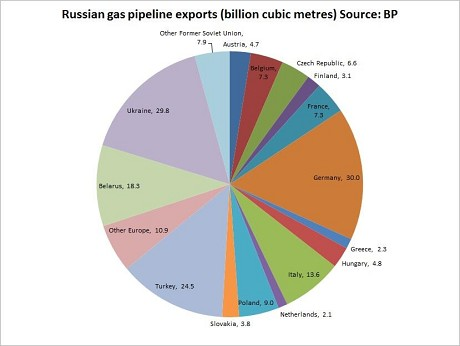
12) Russia sells approximately 80% of its oil and gas exports to the European Union through pipelines that pass directly through Ukraine.  The European Union receives 25% of its oil and gas from Russian sources through these conduits.

Image
13) Ukraine also happens to be Russia’s second-largest customer of petro-fuels.

14) Russia is drilling for oil in the shallow waters of the Black Sea near the Crimean Peninsula, which shows promise of having significant reserves.

15) Among others drilling in the same area: Chevron and Shell Oil.  If they begin production under the Ukrainian flag, it would significantly undercut Russia’s oil and gas market share and prices, simultaneously boosting Ukraine’s economy.

16)  When the Russians (as the Soviet Union) invaded Afghanistan in 1979, the U.S. and many Western nations boycotted the 1980 Olympic games, which were hosted in Russia.  Is it interesting that Russia decided to move forces into Ukraine immediately AFTER the Sochi Olympics were finished?

17) Among the most likely responses to the Russian/Ukrainian crisis is the cancellation of the upcoming G8 summit in Sochi.  Another possible response might remove Russia from the G8 club.  This would embarrass Russian strongman Vladimir Putin at home and isolate him (and Russia’s economy) abroad.

19)  Russia’s economy could be the big loser in the aftermath of the Ukrainian crisis.  Share prices for companies based in Russia declined by 10 percent the day after mysterious soldiers took over the Crimean peninsula, also triggering an outflow of domestic currency that Russia desperately needs to invest in modernizing an economy largely (today) based on selling abroad what is pumped or mined out of the ground.

20) The threat of disruption of trade between Western nations and Russia (either due to sanctions or reluctance to deal with a country that doesn’t seem to be focused on following international law) cost the Russian economy $60 billion in a matter of days–more than the total cost to stage the Sochi Olympics.

21) (bonus) Let’s assume that we are not headed toward a world war.  Several commentators have unhelpfully pointed out that the Crimea became the flashpoint for World War I, but the world is somewhat different today.  There could be some impact from higher energy prices in Europe if the Ukraine pipelines are disrupted temporarily, but Russia needs to sell its oil and gas as much as Europe needs to buy it.  Unless someone is heavily invested in Russian stocks, the crisis will likely be seen as a portfolio non-event.

Image

Sources:

http://www.cnbc.com/id/101458530

http://redmoneyupdate.com/tag/ukranian-crisis-and-how-it-may-impact-investments/

http://www.fool.com/investing/general/2013/12/10/growing-uncertaintly-in-the-ukraine-could-impact-l.aspx

http://en.wikipedia.org/wiki/List_of_largest_producing_countries_of_agricultural_commodities

http://en.wikipedia.org/wiki/Ukraine

http://www.reuters.com/article/2014/03/03/us-urkaine-crisis-russia-economy-analysi-idUSBREA221D020140303

Is myRA Your Next Retirement Plan?

Chances are, you’ve heard about the new myRA retirement savings program that was proposed by President Obama during his State of the Union speech.  But what is it, and how does it relate to the array of other retirement savings options you already have–including, of course, traditional and Roth IRAs, 401(k) or 403(b) plans?  Is this something you need to be looking at in addition to, or instead of one of these other options?
 
The new account, which is scheduled to be introduced later this year, will be offered to workers who currently don’t have access to any kind of retirement program through their employers.  Remarkably, this underserved population is actually about half of all workers, mostly those who work for small companies which have trouble affording the cost of creating and administering a 401(k) plan.  The idea is that a myRA would be so easy to install and implement (employers don’t have to administer the invested assets), and cost so little (virtually nothing), that all of these smaller companies would immediately give their employees this savings option.
 
Only some of the employees would be eligible, however.  Married couples earning more than $191,000, or singles earning more than $129,000, would be excluded from making myRA contributions.  And there is currently no law which says that employers would be required to offer these plans.
 
So the first thing to understand is that people who already have a retirement plan at work, or who earn more than the thresholds, shouldn’t give the myRA option a second thought.
 
Nor, frankly, would those people want to shift over to this option.  Why?  myRA functions much like a Roth IRA, which means that contributions are taxed before they go into the account just like the rest of a person’s salary, but the money will come out tax-free.
 
Anybody can make annual contributions to a Roth IRA; the 2014 maximum is $5,500 for persons under age 50; $6,500 if you’re 50 or older–and these are the same limits that will be imposed on the myRA.  BUT–and this is a big issue–the myRA is not really an investment account.  Any funds that are contributed to a myRA account earns interest from the federal government at the same rate that federal employees earn through the Thrift Savings Plan Government Securities Investment Fund–which is another way of saying that the money will be invested in government bonds.
 
Why does that matter?  Retirement accounts that invested solely in the stock market earned close to 30% from their stock investments last year.  The government bond investments that would have gone into a myRA earned 1.89% last year–which is below the inflation rate.  In real dollars, that was a losing investment.
 
Another big issue is the employer match.  Many workers who have a traditional 401(k) account get some of their contributions matched by their company, which effectively boosts their earnings.  myRA accounts will get no such match.
 
The Obama Administration clearly understands the difference between saving in a government bond account and actual investing.  Accordingly, there is a provision that whenever a myRA account reaches $15,000, it has to be rolled into a Roth IRA, where the money can be deployed in stocks, bonds or anywhere else the account holder chooses.  The program seems to be designed to encourage younger workers to start saving much earlier than they currently do.  Statistics show that the median retirement account for American workers age 25-32 is just $12,000, and 37% have less than $5,000. 
 
Will they be motivated to save when myRAs roll out at the end of the year?  Some commentators have noted that the money can be taken out of the account, for any reason, at any time, with no tax consequences.  That’s not a great formula for long-term savings.  But it does make the myRA account a convenient way for a worker just starting out to build up a cash reserve which could serve as a cushion against job loss or unexpected expenses like car repairs.  If it is not needed, the account could eventually grow into a retirement nest egg.
 
If you have any questions about the myRA or any other investment, retirement or financial planning matter, please don’t hesitate to ask.  We are a fee-only financial planning firm that always puts your interests first.

Expiring Tax Provisions: How You Probably WON’T Be Affected

Happy Thanksgiving! I hope that your families and you have an enjoyable holiday and (hopefully) extended weekend.

You may have read that the last day of 2013 is scheduled to be the last day for an estimated 57 different tax deductions–unless the U.S. Congress turns its attention away from the next potential government shutdown and extends some or all of them.  All of these deductions will be available to the 2013 tax return that you file by April 15.  But as it stands now, they won’t be available next year, creating another potential stealth tax increase in 2014.
 
How will this impact you?  Only a few of the 57 are relevant to you at all, unless you qualify for the American Samoa Economic Development Credit, the “special expensing” rules for film and television production, the mine rescue team training credit or special three-year depreciation for your race horses that happen to be two years or younger.
 
You probably do, however, claim deductions for state and local taxes, which expire at the end of the year, and people with kids and/or grandkids in college might miss the above-the-line deduction for tuition and related educational expenses.  Many Americans will be at least slightly affected by the loss of the deduction for mortgage insurance premiums, and some retired Americans over age 70 1/2 will be distressed to learn that they can no longer make tax-free distributions of up to $100,000 from an IRA account to their favorite charity.  School teachers will lose their classroom expense deductions of up to (a whopping) $250 for un-reimbursed expenses.
 
And thousands of homeowners whose homes are listing below what they paid for them should realize that, at the end of December, they will lose a provision that lets them exclude from their taxable income any reduction in their mortgage obligation (through debt modification or a short sale) up to a maximum of $2 million.
 
Other expiring tax breaks that may affect some people reading this:
 
-Enhanced tax breaks for people who donate property (or easements on their property) to the Nature Conservancy or a local land trust.
 
-Tax credits for the purchase of 2- or 3-wheeled electric vehicles and a separate credit of $7,500 for those who buy certain 4-wheeled electric vehicles like the Ford Focus Electric and the Nissan Leaf.
 
-A maximum $500 tax credit for making certain energy-efficiency improvements in your home (like adding insulation), plus other credits for constructing new energy-efficient homes and a credit for energy-efficient appliances.
 
The biggest expiring corporate tax break is the research and development tax credit.  At the end of the year, companies will also lose the additional first-year depreciation for 50% of the basis of qualified property.
 
In the past, Congress has allowed tax provisions to expire and then, retroactively, extended them for another year or two–and many tax observers believe this will almost certainly happen with the state/local tax deduction and corporate R&D tax credits, and quite possibly for the tuition tax credit as well. 

So when you read about the 57 expiring provisions, and you are not in the biodiesel fuel business (four expiring credits) or planning to claim the electricity production credit for building a renewable power plant, or actively mining coal on Indian lands, you shouldn’t get too worried.  Chances are you aren’t going to get hammered on next year’s taxes–and Congress may even get around to extending the provisions that you really care about, at the very last minute of course.

Whether you’re looking for year-end tax planning, financial planning or money management help, please get in touch with us for unbiased, fiduciary advice that always puts your interests first.

I welcome your feedback, questions and comments. Have a great long weekend!

Source: https://www.jct.gov/publications.html?func=startdown&id=4499


My thanks to Bob Veres, publisher of Inside Information, for his help with this post


2013 Year-End Tax Planning Tips

As we approach year-end, it’s again time to focus on last-minute moves you can make to save taxes—both on your 2013 return and in future years.

For most individuals, the ordinary federal income tax rates for 2013 will be the same as last year: 10%, 15%, 25%, 28%, 33%, and 35%. However, the fiscal cliff legislation, passed early this year, increased the maximum rate for higher-income individuals to 39.6% (up from 35%). This change affects taxpayers with taxable income above $400,000 for singles, $450,000 for married joint-filing couples, and $425,000 for heads of households. In addition, the new 0.9% Medicare tax and 3.8% Net Investment Income Tax (NIIT) potentially kick in when modified adjusted gross income (or earned income in the case of the Medicare tax) goes over $200,000 for unmarried, $250,000 for married joint-filing couples, which can result in a higher-than-advertised federal tax rate for 2013.

Despite these tax increases, the current federal income tax environment remains relatively favorable by historical standards. This article presents several tax-saving ideas to get you started. As always, you can call on us to help you sort through the options and implement strategies that make sense for you.

Ideas for Maximizing Non-business Deductions

One way to reduce your 2013 tax liability is to look for additional deductions. Here’s a list of suggestions to get you started:

Make Charitable Gifts of Appreciated Stock. If you have appreciated stock that you’ve held more than a year and you plan to make significant charitable contributions before year-end, keep your cash and donate the stock (or mutual fund shares) instead. You’ll avoid paying tax on the appreciation, but will still be able to deduct the donated property’s full value. If you want to maintain a position in the donated securities, you can immediately buy back a like number of shares. (This idea works especially well with no load mutual or exchange traded funds because there are no transaction fees involved.)

However, if the stock is now worth less than when you acquired it, sell the stock, take the loss, and then give the cash to the charity. If you give the stock to the charity, your charitable deduction will equal the stock’s current depressed value and no capital loss will be available. Also, if you sell the stock at a loss, you can’t immediately buy it back as this will trigger the wash sale rules. This means your loss won’t be deductible, but instead will be added to the basis in the new shares. You must wait more than 30 days to buy back shares sold at a loss to avoid the wash sale rules.

Don’t Lose a Charitable Deduction for Lack of Paperwork. Charitable contributions are only deductible if you have proper documentation. For cash contributions of less than $250, this means you must have either a bank record that supports the donation (such as a cancelled check or credit card receipt) or a written statement from the charity that meets tax-law requirements. For cash donations of $250 or more, a bank record is not enough. You must obtain, by the time your tax return is filed, a charity-provided statement that shows the amount of the donation and lists any significant goods or services received in return for the donation (other than intangible religious benefits) or specifically states that you received no goods or services from the charity.

Maximize the Benefit of the Standard Deduction. For 2013, the standard deduction is $12,200 for married taxpayers filing joint returns. For single taxpayers, the amount is $6,100. Currently, it looks like these amounts will be about the same for 2014. If your total itemized deductions are normally close to these amounts, you may be able to leverage the benefit of your deductions by bunching deductions in every other year. This allows you to time your itemized deductions so that they are high in one year and low in the next. You claim actual expenses in the year they are bunched and take the standard deduction in the intervening years.

For instance, you might consider moving charitable donations you normally would make in early 2014 to the end of 2013. If you’re temporarily short on cash, charge the contribution to a credit card—it is deductible in the year charged, not when payment is made on the card. You can also accelerate payments of your real estate taxes or state income taxes otherwise due in early 2014. But, watch out for the AMT, as these taxes are not deductible for AMT purposes.

Manage Your Adjusted Gross Income (AGI). Many tax breaks are only available to taxpayers with AGI below certain levels. Some common AGI-based tax breaks include the child tax credit (phase-out begins at $110,000 for married couples and $75,000 for heads-of-households), the $25,000 rental real estate passive loss allowance (phase-out range of $100,000–$150,000 for most taxpayers), and the exclusion of social security benefits ($32,000 threshold for married filers; $25,000 for other filers). In addition, for 2013 taxpayers with AGI over $300,000 for married filers, $250,000 for singles, and $275,000 for heads-of-households begin losing part of their personal exemptions and itemized deductions. Accordingly, strategies that lower your income or increase certain deductions might not only reduce your taxable income, but also help increase some of your other tax deductions and credits.

Making the Most of Year-end Securities Transactions

For most individuals, the 2013 federal tax rates on long-term capital gains from sales of investments held over a year are the same as last year: either 0% or 15%. However, the maximum rate for higher-income individuals is now 20% (up from 15% last year). This change affects taxpayers with taxable income above $400,000 for singles, $450,000 for married joint-filing couples, $425,000 for heads-of-households, and $225,000 for married individuals who file separate returns. Higher-income individuals can also get hit by the new 3.8% NIIT on net investment income, which can result in a maximum 23.8% federal income tax rate on 2013 long-term gains.

As you evaluate investments held in your taxable brokerage firm accounts, consider the tax impact of selling appreciated securities (currently worth more than you paid for them). For most taxpayers, the federal tax rate on long-term capital gains is still much lower than the rate on short-term gains. Therefore, it often makes sense to hold appreciated securities for at least a year and a day before selling to qualify for the lower long-term gain tax rate.

But be smart about this and don’t let the tax “tail” wag the investment “dog”; you don’t want hold the investment long term just to gain tax benefits at the cost of a possible loss of the accumulated gain.

Biting the bullet and selling some loser securities (currently worth less than you paid for them) before year-end can also be a tax-smart idea. The resulting capital losses will offset capital gains from other sales this year, including high-taxed short-term gains from securities owned for one year or less. For 2013, the maximum rate on short-term gains is 39.6%, and the 3.8% NIIT may apply too, which can result in an effective rate of up to 43.4%. However, you don’t need to worry about paying a high rate on short-term gains that can be sheltered with capital losses (you will pay 0% on gains that can be sheltered).

If capital losses for this year exceed capital gains, you will have a net capital loss for 2013. You can use that net capital loss to shelter up to $3,000 of this year’s high-taxed ordinary income ($1,500 if you’re married and file separately). Any excess net capital loss is carried forward to next year.

Selling enough loser securities to create a bigger net capital loss that exceeds what you can use this year might also make sense. You can carry forward the excess capital loss to 2014 and beyond and use it to shelter both short-term gains and long-term gains recognized in those years.

Identify the Securities You Sell. When selling stock or mutual fund shares, the general rule is that the shares you acquired first are the ones you sell first. However, if you choose, you can specifically identify the shares you’re selling when you sell less than your entire holding of a stock or mutual fund. By notifying your broker of the shares you want sold at the time of the sale, your gain or loss from the sale is based on the identified shares. This sales strategy gives you better control over the amount of your gain or loss and whether it’s long-term or short-term.

Secure a Deduction for Nearly Worthless Securities. If you own any securities that are all but worthless with little hope of recovery, you might consider selling them before the end of the year so you can capitalize on the loss this year. You can deduct a loss on worthless securities only if you can prove the investment is completely worthless. Thus, a deduction is not available, as long as you own the security and it has any value at all. Total worthlessness can be very difficult to establish with any certainty. To avoid the issue, it may be easier just to sell the security if it has any marketable value. As long as the sale is not to a family member, this allows you to claim a loss for the difference between your tax basis and the proceeds (subject to the normal rules for capital losses and the wash sale rules restricting the recognition of loss if the security is repurchased within 30 days before or after the sale).

Ideas for Seniors Age 701/2 Plus

Make Charitable Donations from Your IRA. IRA owners and beneficiaries who have reached age 701/2 are permitted to make cash donations totaling up to $100,000 to IRS-approved public charities directly out of their IRAs. These so-called Qualified Charitable Distributions, or QCDs, are federal-income-tax-free to you, but you get no itemized charitable write-off on your Form 1040. That’s okay because the tax-free treatment of QCDs equates to an immediate 100% federal income tax deduction without having to worry about restrictions that can delay itemized charitable write-offs. QCDs have other tax advantages, too. Contact us if you want to hear about them.

Be careful—to qualify for this special tax break, the funds must be transferred directly from your IRA to the charity. Also, this favorable provision will expire at the end of this year unless Congress extends it. So, this could be your last chance.

Take Your Required Retirement Distributions. The tax laws generally require individuals with retirement accounts to take withdrawals based on the size of their account and their age every year after they reach age 701/2. Failure to take a required withdrawal can result in a penalty of 50% of the amount not withdrawn. There’s good news for 2013 though—QCDs discussed above count as payouts for purposes of the required distribution rules. This means, you can donate all or part of your 2013 required distribution amount (up to the $100,000 limit on QCDs) and convert taxable required distributions into tax-free QCDs.

Also, if you turned age 701/2 in 2013, you can delay your 2013 required distribution to 2014, if you choose. However, waiting until 2014 will result in two distributions in 2014—the amount required for 2013 plus the amount required for 2014. While deferring income is normally a sound tax strategy, here it results in bunching income into 2014. Thus, think twice before delaying your 2013 distribution to 2014—bunching income into 2014 might throw you into a higher tax bracket or have a detrimental impact on your other tax deductions in 2014.

Ideas for the Office

Maximize Contributions to 401(k) Plans. If you have a 401(k) plan at work, it’s just about time to tell your company how much you want to set aside on a tax-free basis for next year. Contribute as much as you can stand, especially if your employer makes matching contributions. You give up “free money” when you fail to participate to the max for the match.

Take Advantage of Flexible Spending Accounts (FSAs). If your company has a healthcare and/or dependent care FSA, before year-end you must specify how much of your 2014 salary to convert into tax-free contributions to the plan. You can then take tax-free withdrawals next year to reimburse yourself for out-of-pocket medical and dental expenses and qualifying dependent care costs. Watch out, though, FSAs are “use-it-or-lose-it” accounts—you don’t want to set aside more than what you’ll likely have in qualifying expenses for the year.

Married couples who both have access to FSAs will also need to decide whose FSA to use. If one spouse’s salary is likely to be higher than what’s known as the FICA wage limit (which is $113,700 for this year and will likely be somewhat higher next year) and the other spouse’s will be less, the one with the smaller salary should fund as much of the couple’s FSA needs as possible. The reason is that the 6.2% social security tax levy for 2014 is set to stop at the FICA wage limit (and doesn’t apply at all to money put into an FSA). Thus, for example, if one spouse earns $120,000 and the other $40,000 and they want to collectively set aside $5,000 in their FSAs, they can save $310 (6.2% of $5,000) by having the full amount taken from the lower-paid spouse’s salary versus having 100% taken from the other one’s wages. Of course, either way, the couple will also save approximately $1,400 in income and Medicare taxes because of the FSAs.

If you currently have a healthcare FSA, make sure you drain it by incurring eligible expenses before the deadline for this year. Otherwise, you’ll lose the remaining balance. It’s not that hard to drum some things up: new glasses or contacts, dental work you’ve been putting off, or prescriptions that can be filled early.

Adjust Your Federal Income Tax Withholding. As stated at the beginning of this article, higher-income individuals will likely see their taxes go up this year. This makes it more important than ever to do the calculations to see where you stand before the end of the year. If it looks like you are going to owe income taxes for 2013, consider bumping up the federal income taxes withheld from your paychecks now through the end of the year. When you file your return, you will still have to pay any taxes due less the amount paid in. However, as long as your total tax payments (estimated payments plus withholdings) equal at least 90% of your 2013 liability or, if smaller, 100% of your 2012 liability (110% if your 2012 adjusted gross income exceeded $150,000; $75,000 for married individuals who filed separate returns), penalties will be minimized, if not eliminated.

Watch Out for the Alternative Minimum Tax

Recent legislation slightly reduced the odds that you’ll owe the alternative minimum tax (AMT). Even so, it’s still critical to evaluate all tax planning strategies in light of the AMT rules before actually making any moves. Because the AMT rules are complicated, you may want our assistance.

Don’t Overlook Estate Planning

For 2013, the unified federal gift and estate tax exemption is a historically generous $5.25 million, and the federal estate tax rate is a historically reasonable 40%. Even if you already have an estate plan, it may need updating to reflect the current estate and gift tax rules. Also, you may need to make some changes for reasons that have nothing to do with taxes.

Ideas for Your Business

Take Advantage of Tax Breaks for Purchasing Equipment, Software, and Certain Real Property. If you have plans to buy a business computer, office furniture, equipment, vehicle, or other tangible business property or to make certain improvements to real property, you might consider doing so before year-end to capitalize on the following generous, but temporary tax breaks:

  • Bigger Section 179 Deduction. Your business may be able to take advantage of the temporarily increased Section 179 deduction. Under the Section 179 deduction privilege, an eligible business can often claim first-year depreciation write-offs for the entire cost of new and used equipment and software additions. (However, limits apply to the amount that can be deducted for most vehicles.) For tax years beginning in 2013, the maximum Section 179 deduction is $500,000. For tax years beginning in 2014, however, the maximum deduction is scheduled to drop to $25,000.
  • Section 179 Deduction for Real Estate. Real property costs are generally ineligible for the Section 179 deduction privilege. However, an exception applies to tax years beginning in 2013. Under the exception, your business can immediately deduct up to $250,000 of qualified costs for restaurant buildings and improvements to interiors of retail and leased nonresidential buildings. The $250,000 Section 179 allowance for these real estate expenditures is part of the overall $500,000 allowance. This temporary real estate break will not be available for tax years beginning after 2013 unless Congress extends it.

Note: Watch out if your business is already expected to have a tax loss for the year (or be close) before considering any Section 179 deduction, as you cannot claim a Section 179 write-off that would create or increase an overall business tax loss. Please contact us if you think this might be an issue for your operation.

  • 50% First-year Bonus Depreciation. Above and beyond the bumped-up Section 179 deduction, your business can also claim first-year bonus depreciation equal to 50% of the cost of most new (not used) equipment and software placed in service by December 31 of this year. For a new passenger auto or light truck that’s used for business and is subject to the luxury auto depreciation limitations, the 50% bonus depreciation break increases the maximum first-year depreciation deduction by $8,000 for vehicles placed in service this year. The 50% bonus depreciation break will expire at year-end unless Congress extends it.

Note:First-year bonus depreciation deductions can create or increase a Net Operating Loss (NOL) for your business’s 2013 tax year. You can then carry back a 2013 NOL to 2011 and 2012 and collect a refund of taxes paid in those years. Please contact us for details on the interaction between asset additions and NOLs.

Evaluate Inventory for Damaged or Obsolete Items. Inventory is normally valued for tax purposes at cost or the lower of cost or market value. Regardless of which of these methods is used, the end-of-the-year inventory should be reviewed to detect obsolete or damaged items. The carrying cost of any such items may be written down to their probable selling price (net of selling expenses). [This rule does not apply to businesses that use the Last in, First out (LIFO) method because LIFO does not distinguish between goods that have been written down and those that have not].

To claim a deduction for a write-down of obsolete inventory, you are not required to scrap the item. However, in a period ending not later than 30 days after the inventory date, the item must be actually offered for sale at the price to which the inventory is reduced.

Employ Your Child. If you are self-employed, don’t miss one last opportunity to employ your child before the end of the year. Doing so has tax benefits in that it shifts income (which is not subject to the Kiddie tax) from you to your child, who normally is in a lower tax bracket or may avoid tax entirely due to the standard deduction. There can also be payroll tax savings since wages paid by sole proprietors to their children age 17 and younger are exempt from both social security and unemployment taxes. Employing your children has the added benefit of providing them with earned income, which enables them to contribute to an IRA. Children with IRAs, particularly Roth IRAs, have a great start on retirement savings since the compounded growth of the funds can be significant.

Remember a couple of things when employing your child. First, the wages paid must be reasonable given the child’s age and work skills. Second, if the child is in college, or is entering soon, having too much earned income can have a detrimental impact on the student’s need-based financial aid eligibility.

Conclusion

Through careful planning, it’s possible your 2013 tax liability can still be significantly reduced, but don’t delay. The longer you wait, the less likely it is that you’ll be able to achieve a meaningful reduction. The ideas discussed in this article are a good way to get you started with year-end planning, but they’re no substitute for personalized professional assistance. Please don’t hesitate to contact us with questions or for additional strategies on reducing your tax bill. We’d be glad to set up a planning meeting or assist you in any other way that we can. You can find us at http://ydfs.com

Possible Consequences of the Government Shutdown & Default

It’s possible that you’ve heard a news report or two about the government shutdown  that started October 1, and now a dispute over raising the U.S. debt ceiling and possibly defaulting on the government’s debt obligations as soon asOctober 17.  The question for an increasingly nervous investing public is: how will this affect the U.S. economy and (not to be too selfish here) my retirement portfolio?
 
Interestingly, it is starting to look like the government shutdown, if it runs for weeks instead of months, might have almost no effect on the economy at all.  Why?  The economic impact that had economists worried was the loss of income suffered by tens of thousands of federal employees.  But the Defense Department has continued paying all of its civilian personnel, simply by declaring all of them “essential employees.”  Not only were the leaders of the House of Representatives not inclined to argue; they have quietly passed legislation that would give back-pay to all federal workers who have been furloughed, just as soon as the stalemate ends.  The Senate and the President are likely to go along, giving the country the worst of all worlds: paying most government employees for staying home and not providing a wide variety of services to the public.
 
Ironically, the way the politics are working, one can almost guarantee that there will continue to be a stock market selloff before the shutdown ends.  For the Republican leaders in the House, there is little cost to holding their ground so long as there is not a public outcry and loss of voter confidence.  One of the sources of that pain would be a big drop on Wall Street.  Indeed, if you listen closely to the speeches by President Obama and the Democratic leadership, you hear dire warnings of a market drop as a result of the shutdown–which is their way of focusing the public’s attention on who to blame as it happens. 
 
What is interesting about that is that the markets often deliver corrections after long, accelerating uptrends like what we have experienced in the U.S. since March of 2009, and with the 20+% returns that Wall Street has delivered so far this year.  It wouldn’t have surprised anyone to see some kind of a quick downturn this Fall regardless of whether the government was operating at full capacity or at a standstill.  A week of small leaks in stock prices could lead to something larger as people realize they are sitting on nice gains and have no idea what Congress will or won’t do next.  The last time the government was shut down, stocks dropped almost 20%, the Republican leadership realized it wasn’t winning any popularity contests and the stalemate ended.  We’ve seen this script before.
 
A more consequential issue is the debt ceiling.  Congress must raise the total amount that the U.S. government can borrow (by selling Treasury bonds) to pay its various obligations, including, of course, interest on its current Treasury bonds.  Contrary to popular belief, raising the debt ceiling does not increase the federal debt; that debt exists whether or not Congress authorizes additional borrowing.
 
Failure to authorize the government to pay its legal obligations would create a self-induced fiscal crisis–ironic for a country whose representatives claim that they never want to become another Greece, and then talk about voluntarily defaulting on the nation’s debt obligations, which even Greece has avoided. 
 
One recent article suggested that a default on Treasuries would ripple through the global economy, among other things, causing anxious investors to demand higher interest rates and dramatically raise U.S. borrowing costs.  That, in turn, would raise rates on mortgages, credit cards and student loans, pushing the U.S. toward or into recession, and putting pressure on the stock market.  One report suggests that if the U.S. misses just one interest payment, the downward impact on stock prices would be greater than the Lehman Brothers bankruptcy.  In THAT aftermath, the stock market lost more than half its value.
 
Bigger picture, a default would undermine the role of the U.S. in the world economy.
 
As I previously wrote, the irony of the debt ceiling debate is that the gap between government spending and tax revenues has been closing rapidly on its own.  In July, the Congressional Budget Office reported that the deficit had fallen by 37.6%, the result of tax increases and sequester-related cuts in spending.  As a percentage of America’s GDP, the deficit has fallen from more than 10% at the end of 2009 to somewhere around of 4% currently.  Last June, the government actually posted a surplus of $117 billion, paying down the overall deficit, and the Congressional Budget Office has projected that September will also bring government surpluses.
 
Most observers seem to think that all of this will get worked out.  After all, what rational person–in Congress or elsewhere–wants to self-impose these problems when we have plenty of economic challenges already?  The stock market’s relatively calm trading days tell us that investors expect a compromise on the government shutdown in the near future.  Nonetheless, it may take a sharp day of selling to prod Congress off the dime.  Foreign investors are still lending to the U.S. government at astonishingly low interest rates (despite modest increases over the past week), which tells us they aren’t worried about a default.
 
The previous times we went through events similar to this, the stock market plunges proved to be buying opportunities for investors.  One of the great things about uncertainty and volatility is that it causes investments to periodically go on sale, and creates such anxiety that only disciplined (and perhaps brave) investors are able to take advantage.  There’s no reason to think this won’t be more of the same.

Sources:
 
http://www.washingtonpost.com/blogs/wonkblog/wp/2013/10/06/maybe-the-government-shutdown-wont-clobber-the-economy-after-all/
 
http://www.cbsnews.com/8301-505123_162-57606253/debt-ceiling-understanding-whats-at-stake/
 
http://krugman.blogs.nytimes.com/2013/08/13/what-people-dont-know-about-the-deficit/
 
http://www.moneynews.com/newswidget/default-Catastrophe-lehman-demise/2013/10/07/id/529564?promo_code=125A8-1&utm_source=125A8Moneynews_Home&utm_medium=nmwidget&utm_campaign=widgetphase1


My thanks to Bob Veres of Inside Information for his help with this post

Scary Headlines, Remarkable Returns-3rd 2013 Quarterly Financial Review

The threat of a government shutdown virtually guaranteed that the investment markets would close out the third quarter with a whimper rather than a bang.  The S&P 500 index lost 1.1% of its value in the final week of the quarter as the U.S. Congress seemed to be lurching toward a political standstill that would shut down the U.S. government.  All the uncertainty has tended to obscure the fact that most U.S. stock market investors have experienced significant gains so far this year.
 
And the recent quarter was no exception.  Despite the rocky final week, the Wilshire 5000–the broadest measure of U.S. stocks and bonds–rose 6.60% for the third quarter–and now stands at a 22.31% gain for the first nine months of the year.  The comparable Russell 3000 index gained 6.35% in the most recent three months, posting a 21.30% gain as we head into the final stretch of 2013.
 
Other U.S. market sectors experienced comparable gains.  Large cap stocks, represented by the Wilshire U.S. Large Cap index, gained 6.24% in the second quarter, and are up 20.77% so far for the year.  The Russell 1000 large-cap index returned 6.02% for the quarter, up 20.76% for the year, while the widely-quoted S&P 500 index of large company stocks gained 5.32% for the quarter and is up 18.62% since January 1.
 
The Wilshire U.S. Mid-Cap index index rose 9.02% in the latest three months of the year, and is up 26.19% as we enter the final quarter.  The Russell midcap index was up 7.70% for the third quarter, and now stands at a 24.34% gain so far this year.
 
Small company stocks, as measured by the Wilshire U.S. Small-Cap, gained 9.68% in the third quarter; the index is up 27.53% so far this year.  The comparable Russell 2000 small-cap index was up 10.21% in the second three months of the year, posting a 27.69% gain in the year’s first nine months.  The technology-heavy Nasdaq Composite Index was up 11.16% for the quarter, and has gained 25.24% for its investors so far this year.

Keep in mind that while a diversified portfolio of cash, stocks, bonds, real estate and other asset classes may not provide you with the full returns shown above, you are also not taking on the risk of a 100% equity portfolio. That’s just smart money and risk management.
 
In the first half of the year, any diversification into investments other than U.S. stocks were dragging down returns.  That was no longer the case in the 3rd quarter.  The broad-based EAFE index of larger foreign companies in developed economies rose 10.94% in dollar terms during the third quarter of the year, and is up 13.36% so far this year.  The biggest surprise is Europe: a basket of European stocks rose 13.16% over the past three months, which accounts for virtually all of their returns this year; the index is now up 13.17% for the year. 
 
Emerging markets stocks are climbing out of a deep hole that they fell into earlier in the year, returning 5.01% in the past three months, even though the EAFE Emerging Markets index is still down 6.42% for the year. 
 
Other investment categories are not faring so well.  Real estate, as measured by the Wilshire REIT index, fell 1.98% for the quarter, though it is still standing at a 3.84% gain for the year.  Commodities, as measured by the S&P GSCI index, reversed their recent slide and rose 5.44% this past quarter, taking them to nearly even, just down 0.27% so far in 2013.  Gold prices perked up on the uncertainty over the government shutdown, gaining 9.26% in the recent quarter, though gold investors have lost 20.48% on their holdings so far this year. 
 
Bonds have continued to provide disappointing returns both in terms of yield and total return.  The Barclay’s Global Aggregate bond index is down 2.24% so far this year, and the U.S. Aggregate index has lost 1.87% of its value in the same time period. 
 
In the Treasury markets, the year has seen a bifurcated market; declining yields in bonds with 12 month or lower maturities, while longer-term bonds have experienced rising yields and a corresponding decline in the value of the bonds held by investors.  In the past year, the yield on 10-year Treasuries have risen almost a percentage point, to 2.65%, and 30-year bonds are now yielding 3.73%, up 86 basis points over the past 12 months.    
 
Municipal bonds have seen comparable rate rises; a basket of state and local bonds with 30-year maturities are now yielding 4.32% a year; 10-year munis are returning an average of 2.56% a year.  The rises, of course, have caused losses in muni portfolios.
 
Perhaps the most interesting thing to notice about America’s 20+% stock market returns so far this year–extraordinary by any measure–is that they were accomplished at a time when investors seemed to be constantly skittish.  Just a few weeks ago, everybody seemed to be worried that the Federal Reserve would end its QE3 program and let interest rates find their natural balance in the economy.  One might wonder why this would be such a scary event, since it is the Fed’s economists way of telling us that the U.S. economy is finally getting back on its feet.
 
All eyes are still on Washington, but now they’ve moved from the Fed to the Capitol Building.  The question everybody has been asking in the final days of the quarter is: what would be the investment and economic impact of a government shutdown?  This question might be one to consider going forward, since the two parties seem to have a lot of fundamental disagreements over spending priorities, and budget battles could become quarterly events.
 
An article in the Los Angeles Times says that most economists and analysts seem to expect a partial two-week government shutdown.  The lost pay for hundreds of thousands of furloughed federal workers would cut 0.3 to 0.4 percentage points off of fourth quarter growth–the difference between weak 2% growth annual growth that the economy is currently experiencing and an anemic 1.6% growth rate that would be flirting with recession.  An estimate by Goldman Sachs puts the potential lost GDP at 0.9%.
 
A longer shutdown could cause disruptions in private-sector production and investments, and would almost certainly lead to stock market declines.  The L.A. Times article notes that stocks lost about 4% of their value during the December 1995-January 1996 shutdown.  Job growth stalled, and the GDP gained just 2.7% in that first quarter. Interestingly, in all cases of past government shutdowns, the stock market recovered all of the losses and then some. That could be why the market is holding up well right now, but a protracted shutdown creates uncertainty and the markets hate uncertainty.
 
Interestingly, Congress has quietly moved away from the issue that has triggered the last few budget stalemates, focusing this time on whether or not to fully fund President Obama’s health care legislation.  In the past, the issue was budget deficits, but it turns out that the budget deficit has come down dramatically over the past 12 months.  The U.S. government posted a $117 billion surplus in June, and the Congressional Budget Office expects to run a surplus again in September–the result of revenue gains as a result of tax hikes plus the growing economy, coupled with a 10% reduction in spending. 
 
What does all this mean for your investments in the final 2013 quarter?  Who knows?  Nobody could have predicted, at the start of the year, with all the hand-wringing over the fiscal cliff and new tax legislation, that we would be standing nine months into 2013 with significant investment gains in the U.S. markets and a resurgence in global investments led by, of all places, Europe.
 
This much we can predict: the recent uncertainties–the paralysis in Congress, worries about the direction of interest rates and whether the Fed is going to stop intervening in the markets–will give way to new worries, new uncertainties, which will make all of us feel in our guts like the world is going to hell in a handbasket. With that said, the bull market that started in March 2009 is getting long in the tooth and is overdue for a longer period of rest (10% or more correction, or even a bear market)
 
Nonetheless, the headlines obscure the fact that investment returns are created the hard way, by millions of people getting up in the morning and going to work and spending their day finding ways to improve American businesses, generate profits, create new products and new markets, day after day after day. 
 
Whatever ups and downs you experience–and you WILL experience them, perhaps in the next quarter or the next year–that underlying driver of business enterprises and stock value is constantly working on your behalf.  That will be true no matter what the headlines say, no matter how spooked you feel about whatever scary thing is going on in the world.  Nobody enjoys the investment ride the way children enjoy the thrills of a roller coaster, but both seem to ultimately deliver their riders to a semblance of safety in the end.

I hope you’re having a great week and I welcome your questions, feedback and comments. If you or someone you know is looking for a fee-only fiduciary advisor or money manager who puts your interests first, please don’t hesitate to get in touch with me.


Sources:
 
Wilshire index data: http://www.wilshire.com/Indexes/calculator/
 
Russell index data: http://www.russell.com/indexes/data/daily_total_returns_us.asp
 
S&P index data: http://www.standardandpoors.com/indices/sp-500/en/us/?indexId=spusa-500-usduf–p-us-l–
 
Nasdaq index data: http://quicktake.morningstar.com/Index/IndexCharts.aspx?Symbol=COMP
 
International indices:http://www.mscibarra.com/products/indices/international_equity_indices/performance.html
 
Commodities index data: http://us.spindices.com/index-family/commodities/sp-gsci
 
Treasury market rates: http://www.bloomberg.com/markets/rates-bonds/government-bonds/us/
 
Aggregate corporate bond rates: http://finance.yahoo.com/bonds/composite_bond_rates
 
Government shutdown impact:  http://www.latimes.com/business/la-fi-shutdown-economy-20131001,0,155302.story
 
Budget surpluses:  http://www.cnbc.com/id/100880536
 
http://www.cnbc.com/id/101030631
 
 
My thanks to Bob Veres, publisher of Inside Information for his help with this article.