Did You Exit After Brexit?

The pundits had it all wrong with the Brexit vote (I too was wrong on the British vote to exit from the European Union).

With the benefit of hindsight, we can see that it would have been a bad idea to sell your stock holdings after the Brexit vote; you would have locked in a 5% to 10% loss in a market that has trended upward to new record highs.  The same is true of the aftermath of the World Court decision that slapped China in the face by declaring that man-made islands don’t transform an ocean into territorial waters, the attempted coup in Turkey, or, really, any other alarming headline which doesn’t materially affect a company’s ability to run its operations or earn a profit.

But the bigger issue is that, even if you knew the outcome of the vote, you still wouldn’t have known how markets were going to react.  How would you know whether quick-twitch traders would buy or sell the event?  After the Brexit vote, it took a weekend for investors and traders to realize that this was Britain’s problem, not theirs.  Realistically, it could have taken a month, or even a year to play out.

The same is true for the time period that we’re heading into now.  As you can see from the accompanying chart, the average return for various months of the year has been pretty much the same across the spectrum.  But August, September and October have seen bigger highs and (most alarmingly) also deeper lows, on average, than other months.  This additional volatility seems to be random, and is, once again, impossible to time.  People who decide to side-step the late summer and early fall would miss out on average yearly gains for September and October of 1.05% and 1.21%.  (Skipping August would have saved you modest losses of less than 1%, on average, but one suspects that this is a statistical anomaly.) The month of August in election years, even during the bear market of 2008, tends to have a positive bias; will this year be one of them?

CA - 2016-8-3 - Riding the coaster

Finally, biggest picture of all, the current bull market, which started March 9, 2009, has now become the second-longest bull market on record, beating the June 1949 to August 1956 rally.  It is second only to the December 1987 to March 2000 advance.  In terms of percentage change, we are experiencing the fourth strongest bull market on record.

Doesn’t that mean it’s time to take our chips off the table?  If we knew how to consistently time the market, if we could be sure that the market run won’t continue to run up for another few years, then the answer would be yes.  But with the economy continuing to churn out positive gross domestic product (GDP–the measure of our output of goods and services), with inflation low and unemployment continuing to fall, and central bankers supplying liquidity and stimulus to the markets, it’s hard to see what would cause U.S. stocks to be less valuable in the near future than they are today.

Meanwhile, once again, even if we did exit, how would we know when to get back in?  Investors who bailed during the 2008 downturn missed much of the surprise upturn that began this current bull run.  Those who hung on more than made up for their losses, even though it seemed like every year would be the bull market’s last. One thing that I’ve learned from doing this for so long, is that moves in the market (in both directions) usually go on far longer than most people can imagine.

There isn’t a day where some market “expert” or pundit comes out and says he likes nothing in this market and to sell everything? … Really?? Sell everything?! It angers me how reckless these statements are. Giving blanket advice to people is irresponsible. You don’t know the person’s goals, age, risk tolerance, time-frame, etc. But fearful headlines will always attract eyeballs, and most of these pundits have something to sell you. Don’t buy it. Maybe you should sell some things, but always do your own due diligence and always keep in mind your long-term goals.

It’s nearly certain that there will be a lot of scary headlines between now and the end of the year, and it’s quite likely that the investment roller coaster is about to get bumpy.  All of us wish that we had a working crystal ball to help us navigate through uncertainty, but all we have is the historical record, which says that after the next downturn, the market will eventually experience a new high (yes, this will happen regardless of who becomes our next president).  We want to be there to celebrate it.

If you would like to review your current investment portfolio or discuss any other financial planning matters, please don’t hesitate to contact us or visit our website at http://www.ydfs.com. We are a fee-only fiduciary financial planning firm that always puts your interests first.  If you are not a client yet, an initial consultation is complimentary and there is never any pressure or hidden sales pitch. We start with a specific assessment of your personal situation. There is no rush and no cookie-cutter approach. Each client is different, and so is your financial plan and investment objectives.

Sources: 

https://www.washingtonpost.com/business/get-there/given-the-brexit-brouhaha-how-did-your-investments-hold-up/2016/07/22/a7bc1198-4d03-11e6-a7d8-13d06b37f256_story.html

http://www.investmentnews.com/article/20160801/FREE/160809992/if-history-is-a-guide-market-volatility-is-about-to-spike

http://www.cnbc.com/2016/07/13/merrill-second-longest-bull-market-ever-has-further-to-run.html

The MoneyGeek thanks guest writer Bob Veres for his contribution to this post

A College Education Still Pays

These days, it’s hard not to hear about the student loan mess and how it’s the next financial crisis that’s currently brewing (some are already calling it a bubble).  Students and parents write stories of how they were lured into borrowing far more money for college than they could ever pay back, even after throwing three or four years worth of salary at it. That is, if they could even find a job after graduation. Despite a student debt level that continues to grow, a college education is still one of the most worthwhile investments a high school graduate can make.

According to the Student Loan Marketing Association (more commonly known as Sallie Mae Bank), the average tuition, room and board at a private college comes to $43,921.  Public tuition for in-state students at state colleges amounted to $19,548, with out-of-state students paying an average of $34,031.

How are parents and students finding the cash to afford this expense?

Sallie Mae breaks it down as follows: 34% from scholarships and grants that don’t have to be paid back, coming from the college itself or the state or federal government, often based on need and academic performance.

Parents typically pay 29% of the total bill (an average of $7,000) out of savings or income, and other family members (think: grandparents) are paying another 5%.

The students themselves are paying for 12% of the cost, on average.

The rest, roughly 20% of the total, is made up of loans.  The federal government’s low-interest loan program offers up to $5,500 a year for freshmen, $6,500 during the sophomore year, and $7,500 for the junior and senior years.  If that doesn’t cover the remaining cost, then students and parents will borrow from private lenders.  The average breakdown is students borrowing 13% of their total tuition costs and parents borrowing the other 7%.

Is the cost worth it?  The Federal Reserve Bank of New York recently published a report on the labor market for college graduates.  The conclusion, in graphical format, is that younger workers have experienced much higher unemployment rates than their college graduate peers—the figures currently are 9.5% unemployment for all young workers, vs. just 4.2% for recent college graduates.  Overall, the unemployment rate for people who have graduated with a 4-year degree is 2.6%, and even during the height of the Great Recession, it never went over 5%.

And income is higher as well.  The average worker with a bachelor’s degree earns $43,000, vs. $25,000 for people with a high school diploma only.  The highest average incomes are reported for people with pharmacy degrees ($110,000 mid-career average), computer engineering ($100,000), electrical engineering ($95,000), chemical engineering ($94,000), mechanical engineering ($91,000) and aerospace engineering ($90,000).

Lowest average mid-career incomes: social services ($40,000), early childhood education ($40,000), elementary education ($42,000), special education ($43,000) and general education ($44,000).

Among the lowest unemployment rates: miscellaneous education (1.0%), agriculture (1.8%), construction services (1.8%) and nursing (2.0%).

Yes, there are some themes here, and of course people in every career can fall above or below these averages.  Nor does everybody who graduates with a particular degree end up in a career that tracks that degree.  (Of particular note: the list does not include a financial planning or investment advisory degree.)  The point is that despite the cost, a college degree does seem to provide significantly better odds of getting a job, and getting paid more for the job you do get.

I plan to expand on some of the finer aspects and stories about student loan debt in an upcoming article-stay tuned.

If you would like to discuss college planning, review your current investment portfolio or discuss any other financial planning matters, please don’t hesitate to contact us or visit our website at http://www.ydfs.com. We are a fee-only fiduciary financial planning firm that always puts your interests first.  If you are not a client yet, an initial consultation is complimentary and there is never any pressure or hidden sales pitch. We start with a specific assessment of your personal situation. There is no rush and no cookie-cutter approach. Each client is different, and so is your financial plan and investment objectives.

Sources:  http://money.cnn.com/2016/06/29/pf/college/how-to-pay-for-college/index.html?iid=SF_LN

https://www.newyorkfed.org/research/college-labor-market/college-labor-market_unemployment.html

The MoneyGeek thanks guest writer Bob Veres for his contribution to this post

Learn to Embrace New Highs

It’s been an interesting start of the week for those of us watching the stock markets. In case you hadn’t noticed, the S&P 500 index reached record territory on Monday, and the NASDAQ briefly crossed over the 5,000 level before settling back with a more modest gain.  At 2,137.6, the S&P 500 finished above the previous high of 2,130.82, set on May 21, 2015.

We’ve waited more than a year for the markets to get back to where they were before the downturn this January, before Brexit, and before a lot of uncertainties in the last 12 months.  The market top itself is an uncertainty; after all, many investors regard market tops warily.  When stocks are more expensive than they’ve ever been (or so goes the thinking) it may be time to sell and take your profits.  However, if you followed this logic and sold every time the market hit a new high, you’d probably have been sitting on the sidelines during most of the long ride from the S&P at 13.55 in June 1949, which was the bull market high after the index started at 10.  New highs are a normal part of the market, and it is just as likely that tomorrow will set a new one as not.  In fact, overall, the market spends roughly 12% of its life at all-time highs.

We all know that the next bear market will start with an all-time high, but we can never know which one in advance.  That’s why in this business we say that there’s nothing better than a new high, except the one that marks “the top”.  But new market highs do not necessarily become market tops.  Let’s see if we can all celebrate this milestone without the usual dose of fear that often comes with new records.

If you would like to review your current investment portfolio or discuss any other financial planning matters, please don’t hesitate to contact us or visit our website at http://www.ydfs.com. We are a fee-only fiduciary financial planning firm that always puts your interests first.  If you are not a client yet, an initial consultation is complimentary and there is never any pressure or hidden sales pitch. We start with a specific assessment of your personal situation. There is no rush and no cookie-cutter approach. Each client is different, and so is your financial plan and investment objectives.

Sources:

http://www.forbes.com/sites/shreyaagarwal/2016/07/11/sp-500-closes-at-record-high/?utm_source=yahoo&utm_medium=partner&utm_campaign=yahootix&partner=yahootix#7f74bf29721d

http://www.marketwatch.com/story/us-stock-futures-climb-with-sp-near-record-high-2016-07-11?siteid=yhoof2

http://www.usatoday.com/story/money/columnist/waggoner/2014/06/19/new-highs-dont-mean-you-have-to-sell/10921973/

The MoneyGeek thanks guest writer Bob Veres for his contribution to this post

Second Quarter 2016 YDFS Market Review

The official start of summer was only a few days ago, but the market already feels like it’s taken us on a wild roller coaster ride this year. It certainly makes us feel like we’re in a bear (sideways to down) market, what with the surprising “Brexit” vote in the UK, the dismal first few weeks of the year and increased volatility across the board.  So it may come as a surprise that the second quarter of 2016 eked out small positive returns for many of the U.S. market indices, and most of them are showing positive (though hardly exciting) gains over the first half of the year.

The Wilshire 5000 Total Market Index–the broadest measure of U.S. stocks and bonds—was up 2.84% for the quarter, and is now up 3.69% for the first half of the year.  The comparable Russell 3000 index gained 1.52% for the quarter and is up 2.20% so far this year.

The Wilshire U.S. Large Cap index gained 2.65% in the second quarter of 2016, putting it at a positive 3.94% since the beginning of January.  The Russell 1000 large-cap index provided a 1.44% return over the past quarter, with a gain of 2.34% so far this year, while the widely-quoted S&P 500 index of large company stocks posted a gain of 1.90% in the second quarter, and is up 2.69% for the first half of 2016.

The Wilshire U.S. Mid-Cap index gained 4.33% for the quarter, and is sitting on a positive gain of 6.67% for the year.  The Russell Midcap Index is up 1.54% for the quarter, and is sitting on a positive gain of 3.82% for the year.

Small company stocks, as measured by the Wilshire U.S. Small-Cap index, gave investors a 4.09% return during the second quarter, up 4.98% so far this year.  The comparable Russell 2000 Small-Cap Index gained 1.96%, erasing gains in the first quarter and posting a 0.41% gain so far this year, while the technology-heavy Nasdaq Composite Index lost 0.56% for the quarter and is down 3.29% for the first half of 2016.

When you look at the global markets, you realize that the U.S. has been a haven of stability in a very messy world.  The broad-based EAFE index of companies in developed foreign economies lost 2.64% in dollar terms in the first quarter of the year, and is now down 6.28% for the first half of the year.  In aggregate, European Union stocks lost 7.60% in the first half of 2016.  Emerging markets stocks of less developed countries, as represented by the EAFE EM index, lost 0.32% for the quarter, but are sitting on gains of 5.03% for the year so far.

Looking over the other investment categories, real estate investments, as measured by the Wilshire U.S. REIT index, was up 5.60% for the second quarter, with a gain of 11.09% for the year.  Commodities, as measured by the S&P GSCI index, gained 12.67% of their value in the second quarter, giving the index a 9.86% gain for the year so far.  The biggest mover, unsurprisingly, is Brent Crude Oil, which has risen more than 15% in price over the quarter.

Meanwhile, interest rates have stayed low, once again confounding prognosticators who have been expecting significant rate rises for more than half a decade now.  The Bloomberg U.S. Corporate Bond Index is yielding 2.88%, while the Bloomberg U.S. Treasury Bond Index is yielding 1.11%.  Treasury yields are stuck near the bottom of historical rates; 3-month notes yielded 0.26% at the end of the quarter, while 12-month bonds were yielding just 0.43%.  Go out to ten years, and you can get a 1.47% annual coupon yield.  Low?  Compared with rates abroad, these yields are positively generous.  If you’re buying the German Bund 10-year government securities, you’re receiving a guaranteed -0.13% yield (yes, that’s a negative yield).  The 5-year yield is actually worse: -0.57%.  Japanese government bonds are also yielding -0.3% (2-year) to -0.23% (10-year). Can you imagine paying someone to hold your money for you?

On the first day of July, the Dow, S&P 500 and Nasdaq indices were all higher than they were before the Brexit vote took investors by surprise, which suggests that, yet again, the people who let panic make their decisions, lost money while those who kept their heads in it, sailed through.  There will be plenty of other opportunities for panic in a future where terrorism, a continuing mess in the Middle East, a refugee crisis in Europe and premature announcements of the demise of the European Union will deflect attention away from what is actually a decent economic story in the U.S.

How decent?  The American economy is on track to grow at a 2.0% rate this year, which is hardly dramatic, but it is sustainable and not likely to overheat different sectors and lead to a recession.  Manufacturing activity is expected to grow 2.6% for the year based on the numbers so far, and the unemployment rate has fallen to 4.7%, which is actually below the Federal Reserve target.  Inflation is also low: running around 1.4% this year.  The unemployment statistics are almost certainly misleading in the sense that many people are underemployed, and a sizable number of working-age men are no longer participating in the labor force, but for many Americans, there’s work if you want it.  Historically low oil prices and high domestic production have lowered the cost of doing business and the cost of living across the American economic landscape.

Despite all this good news, the market is struggling to keep its head above water this year, and is not threatening the record highs set in May of last year. But we’re close, and I suspect that we will challenge and rally above the old highs soon.

Questions remain.  The biggest one in many peoples’ minds is: WILL the European Union break up now that its second-largest economy has voted to exit?  There is already renewed talk of a Grexit, along with clever names like the dePartugal, the Czechout, the Big Finnish and even discussion about Texas (Texit?) leaving the U.S.  How long before we hear about (cue the sarcasm) some localities declaring independence from their states?  With active political movements in at least a dozen Eurozone countries agitating for an exit, is it possible that someday we’ll view the UK as the first domino?

A recent report by Thomas Friedman of Geopolitical Futures suggests that the EU, at the very least, is going to have to reform itself, and the vote in Britain could be the wake-up call it needs to make structural changes.  The Eurozone has been struggling economically since the common currency was adopted.  It is still dealing with the Greek sovereign debt crisis, a potential banking crisis in Italy, economic troubles in Finland, political issues in Poland and, in general, a huge wealth disparity between its northern and southern members.  Is it possible that a flood of regulations coming out of Brussels is imposing an added burden on European economies?  Should different nations be allowed to manage their policies and economies with greater independence and focus?

Friedman thinks the UK will be just fine, because Europe needs it to be a strong trading partner.  Britain is Germany’s third-largest export market and France’s fifth largest.  Would it be wise for those countries to stop selling to Britain or impose tariffs on British exports?  And more broadly, with the political turmoil in the UK, is it possible that there will be a re-vote, particularly if the European Union decides to make reforms that result in a less-stifling regulatory regime?

You’ll continue to see dire headlines, if not about Brexit or the Middle East, then about China’s debt situation and the Fed either deciding or not deciding to raise rates in the U.S. economy (it won’t).  Oil prices are going to bounce around unpredictably.  The remarkable thing to notice is that with all the wild headlines we’ve experienced so far, plus the worst start to the year in U.S. market history, the markets are up slightly here in the U.S., and the economy is still growing.  The chances of a U.S. recession starting in the next nine months are 10% or less.  Yes, your international investments are down right now, but eventually, you can expect them to come to the rescue when the American bull market finally turns.

When will that be?  If we knew how to see the future for certain, we would be in a different business.  All of us are going to have to resign ourselves to being surprised by whatever the rest of the year brings us, headline by headline. That, however, doesn’t stop me from making my own prognostication about what the market might bring.  By the end of the year, I think we’ll see mid-single digit gains for the year, after some hand-wringing over the election, in what I expect to be a rough September and October in the markets. But then again, I thought the Brexit would be voted down, so don’t bet your chips on any predictions anyone has, including me. This keeps us mostly invested with good hedges to absorb whatever volatility the market throws at us.

If you would like to review your current investment portfolio or discuss any other financial planning matters, please don’t hesitate to contact us or visit our website at http://www.ydfs.com. We are a fee-only fiduciary financial planning firm that always puts your interests first.  If you are not a client yet, an initial consultation is complimentary and there is never any pressure or hidden sales pitch. We start with a specific assessment of your personal situation. There is no rush and no cookie-cutter approach. Each client is different, and so is your financial plan and investment objectives.


Sources:

Wilshire index data.  http://www.wilshire.com/Indexes/calculator/

Russell index data: http://indexcalculator.russell.com/

S&P index data: http://www.standardandpoors.com/indices/sp-500/en/us/?indexId=spusa-500-usduf–p-us-l–

Nasdaq index data: http://quicktake.morningstar.com/Index/IndexCharts.aspx?Symbol=COMP

International indices: http://www.mscibarra.com/products/indices/international_equity_indices/performance.html

Commodities index data: http://us.spindices.com/index-family/commodities/sp-gsci

Treasury market rates: http://www.bloomberg.com/markets/rates-bonds/government-bonds/us/

Aggregate corporate bond rates: https://indices.barcap.com/show?url=Benchmark_Indices/Aggregate/Bond_Indices

Aggregate corporate bond rates: http://www.bloomberg.com/markets/rates-bonds/corporate-bonds/

http://useconomy.about.com/od/criticalssues/a/US-Economic-Outlook.htm

http://www.marketwatch.com/story/first-quarter-us-gdp-raised-to-11-2016-06-28?siteid=bulletrss

The MoneyGeek thanks guest writer Bob Veres for his contribution to this post

You Only Brexit Once (YOBO)

Not even a month ago, I wrote to you and shared my thoughts on Britain leaving the European Union (EU).  I guess I was wrong.

Thursday’s 52%-48% vote by the British electorate to end its 43-year membership in the European Union seems to have taken just about everybody by surprise, but the aftermath could not have been more predictable.  The uncertainty of how, exactly, Europe and Britain will manage a complex divorce over the coming decade, sent global markets reeling.   London’s blue chip index, the Financial Times Stock Exchange 100, lost 4.4% of its value in one day, while Germany’s DAX market lost more than 7%.  The British pound sterling is getting crushed (down 14% against the yen, 10% against the dollar).

Compared to the global markets, the reaction among traders on U.S. exchanges seems muted; down roughly 3%, though nobody knows if that’s the extent of the fall or just the beginning. I think after a bit of a hangover on Monday, Wall Street will move on to the next brick in the Wall of Worry that builds bull markets.

The important thing to understand is that the current market disruptions represent an emotional roller coaster, an immediate panic reaction to what is likely to be a very long-term, drawn out, ultimately graceful accommodation between the UK and Europe.  German companies are certainly not 7% less valuable today than they were before the vote, and the pound sterling is certainly not suddenly a second-rate currency.  When the dust settles, people will see that this panicky Brexit aftermath was a buying opportunity, rather than a time to sell.  People who sell will realize they were suckered once again by panic masquerading as an assessment of real damage to the companies they’ve invested in.

What happens next for Britain and its former partners on the continent?  Let’s start with what will NOT happen.  Unlike other European nations, Britain will not have to start printing a new currency.  When the UK entered the EU, it chose to retain the British pound—that, of course, will remain.  Stores and businesses will continue accepting euros.

On the trade and regulatory side, the actual split is still years away. One of the things you might not be hearing about in the breathless coverage in the press, is that the British electorate’s vote is actually not legally binding.  It will not be until and unless the British government formally notifies the European Union of its intention to leave under Article 50 of the Lisbon Treaty—known as the “exit clause.”  If that happens, Article 50 sets forth a two-year period of negotiations between the exiting country and the remaining union.  Since British Prime Minister David Cameron has officially resigned his post and called for a new election, that clock probably won’t start ticking until the British people decide on their next leader.

After notification, attorneys in Whitehall and Brussels would begin negotiating, piece by piece, a new trade relationship, including tariffs, how open the UK borders will be for travel, and a variety of hot button immigration issues.  Estimates vary, but nobody seems to think the process will take less than five years to complete, and current arrangements will stay in place until new ones are agreed upon.

The exit agreement also requires obtaining the consent of the EU Parliament.  When was the last time the EU parliament got anything done quickly? The answer is never. Heck, even Prime Minister David Cameron’s splashy Friday morning resignation is not effective until October. For the foreseeable future, despite what you read and hear, the UK is still part of the Eurozone.

An alternative that is being widely discussed is a temporary acceptance of an established model—similar to Norway’s. Norway is not an EU member, but it pays EU dues, and has full access to the single market as if it was a member.  However, that would require the British to continue paying EU budget dues and accept free movement of workers—which were exactly the provisions that voters rejected in the referendum.

Meanwhile, since the Brexit vote is not legally binding, it’s possible that the new government might decide to delay invoking Article 50.  Or Parliament could instruct the prime minister not to invoke Article 50 until the government has had a chance to further study the implications.  There could even be a second referendum to undo the first.

The important thing for everybody to remember is that the quick-twitch traders and speculators on Wall Street are chasing sentiment, not underlying value, and the markets right now are being driven by emotion to what is perceived as an event, but is really a long process that will be managed by reasonable people who aren’t interested in damaging their nation’s economic fortunes.  Nobody knows exactly how the long-term prospects of Britain, the EU or American companies doing business across the Atlantic will be impacted by Brexit, but it would be unwise to assume the worst so quickly after the vote.

When I want to gauge the intermediate-term economic outlook, I often look at how the large commercial traders are positioned in copper. Being the most basic component of the home/commercial building engine, how they’re positioned in copper tells me how optimistic they are on the economy. As of this week, they’re positioned more bullishly in copper than they have been in the past few years. I would say that offers us some degree of hope about the future of the global economy, even if one country amounting to less than 1% of the global population decides that it doesn’t want to be in an economic union anymore with the rest of Europe.

But you can bet that, long-term, everybody will find a way to move past this interesting, unexpected event without suffering—or imposing—too much damage.  My guess is that the market will get back to its normal course of business by Tuesday or Wednesday and will have moved past this event. Meanwhile, hang on, because the market roller coaster seems to have entered one of those wild rides that we all experience periodically.

Sources:

https://www.yahoo.com/news/brexit-shows-global-desire-throw-142925862.html

https://www.washingtonpost.com/opinions/global-opinions/after-brexit-what-will-and-wont-happen/2016/06/24/c9f7a2f6-39f1-11e6-8f7c-d4c723a2becb_story.html

http://www.businessinsider.com/global-market-brexit-reaction-2016-6

http://www.ft.com/cms/s/0/f0c4f432-371d-11e6-9a05-82a9b15a8ee7.html#ixzz4CVixCz25

http://www.ft.com/cms/s/0/f0c4f432-371d-11e6-9a05-82a9b15a8ee7.html?ftcamp=traffic/partner/brexit/dianomi/row/auddev#axzz4CVide1Sz

http://www.newser.com/story/227149/brexit-now-what-happens-welcome-to-article-50.html

The MoneyGeek thanks guest writer Bob Veres for his contribution to this post

Is the Weak Jobs Report Foretelling a Recession?

In case you hadn’t heard on Friday, the Bureau of Labor Statistics (BLS) Employment Report for the month of May was disappointing.  Economists who follow job growth in the U.S. economy were expecting 123,000 new jobs to be created.  The actual number, according to the BLS, was 38,000—the smallest gain since September of 2010.

What’s going on?  On a scale of 1 to Lehman, how worried should we be?  Is an 85,000 shortfall in job growth, in a single month, telling us that the U.S. economy is about to plunge into a deep recession? The short answer is no.

CA - 2016-6-3 - That Jobs Report

As it turns out, the investment markets largely shrugged off the surprising number—for a variety of reasons.  First of all, a strike affecting 35,000 Verizon employees was somehow factored into the data, so unless all the striking workers are never coming back to work, a real count would have put the job-adding number at around 73,000.  Second, the employment data comes with a huge asterisk: these are estimates with a margin of error of 100,000 jobs.  That means we won’t actually know how many jobs were created until sometime in the future. There are at least two revisions to be made in the future.

Third: despite the low job creation figure, the Bureau of Labor Statistics also told us that the unemployment rate is dropping, currently to 4.7%, the lowest rate since November 2007.  How can that be?  BLS statistics say that people are leaving the workforce at a faster rate than previously, but the economy has also been adding 180,000 to 200,000 jobs almost every month for the past five years.  Is it possible that it has finally given a job to most of the people who want one?

As evidence, the BLS has reported that hourly earnings by workers are up 3.2% for the first five months of 2016, which suggests that workers have a bit more pricing power than they did, say, last year.  That suggests that we are experiencing a tighter labor market, not one where jobs are falling off the table and many people are too discouraged to apply for a job.

Finally, the uncertainty over jobs has almost certainly delayed the rise in interest rates that had, before the report, been widely expected from the U.S. Federal Reserve Board in June or July.  You can expect the Fed to be more cautious about adding any costs to the economy until its economists can get a handle on what that odd job statistic means for the overall health of U.S. businesses.  That would give the economy a slight boost, and might lead to higher jobs growth figures in the future.

So how much did Friday’s employment news change the fundamental picture of economic growth or the prospects for stocks?

Not very much.

If you would like to review your current investment portfolio or discuss any other financial planning matters, please don’t hesitate to contact us or visit our website at http://www.ydfs.com. We are a fee-only fiduciary financial planning firm that always puts your interests first.  If you are not a client yet, an initial consultation is complimentary and there is never any pressure or hidden sales pitch. We start with a specific assessment of your personal situation. There is no rush and no cookie-cutter approach. Each client is different, and so is your financial plan and investment objectives.


Sources:

Wall Street Stunned!

http://www.businessinsider.com/wall-street-on-may-2016-jobs-report-2016-6

http://www.businessinsider.com/us-jobs-report-may-2016-2016-6

http://www.forbes.com/sites/samanthasharf/2016/06/03/jobs-report-u-s-adds-just-38000-jobs-in-may-unemployment-rate-down-to-4-7/?linkId=25155735#22a015b216da

https://www.washingtonpost.com/news/wonk/wp/2016/06/03/what-just-happened-with-jobs-in-america/?tid=sm_tw

http://www.ft.com/fastft/2016/06/03/us-markets-shake-off-grim-jobs-report/

The MoneyGeek thanks guest writer Bob Veres for his contribution to this post


Will Britain Bid the European Union Cheeri-EU?

While we celebrate the Memorial Day holiday in the United States, the big question on European minds is how the British people will vote on June 23.  Will they vote to leave the European Union (what’s being called the “Brexit”) or decide to continue to be part of the 28-nation economic alliance?

What’s at stake?  It’s hard to know, exactly.  Great Britain already maintains its own currency, separate from the euro, so the vote will be about whether the country continues to pay into the EU budget and adhere to the eurozone’s regulations.  Norway is also living outside the EU, yet it contributes to the budget, adheres to the regulations and seems to get most of the benefits of membership—and thereby offers a way for Britain to exit and still maintain all the trappings of membership.  The uncertainty over the seven years that would be required to transition out of membership would be over how, exactly, a new relationship would be structured.

The eurozone is suffering from high unemployment, low economic growth and a disparity between the richer (UK, Germany, Scandinavia) and poorer (Greece, Spain) nations.  All European Union members are governed by policies created by the European Commission and the European parliament, and subject to the dispute resolution powers of the European Court of Justice.  British voters might decide they don’t like the shared sovereignty and ties to the economic problems.

Naturally, there is a lot of lobbying on both sides in the run-up to the vote.  Economists seem to be uniformly against a Brexit, pointing out the obvious: that it would be hard for London to continue its role as the financial capital of Europe if its nation is not actually a part of the European Union.  They point out that, unlike Greece, Britain already controls its own currency, and it is not a part of the passport-free zone, which is shorthand for having control over its own policies in regard to the Middle Eastern refugee crisis.

Those in favor of Brexit say that Britain would be freer to enter into trade deals with other countries (think: China) than it is today, and of course there is a lot of nationalist sentiment about reducing foreign influence over British affairs.

Who will win?  The most recent polls show 46% of British voters will cast a ballot to leave the EU, vs. 44% who will vote to remain—and 10% who say they don’t know how they’ll vote.  A little less than a month from the actual Brexit election, there appears to be plenty of time for either side to continue pressing their case.

Ultimately, hand-wringing over the vote during the month of June will likely contribute to stock market volatility until the vote is settled. My personal opinion is that British Citizens will vote to remain in the Union. Europeans, including the British, fought hard for decades to unite; they likely won’t give up on that union that easily.

If you would like to review your current investment portfolio or discuss any other financial planning matters, please don’t hesitate to contact us or visit our website at http://www.ydfs.com. We are a fee-only fiduciary financial planning firm that always puts your interests first.  If you are not a client yet, an initial consultation is complimentary and there is never any pressure or hidden sales pitch.

Enjoy your Memorial Day Holiday. We are grateful to the soldiers and families who paid the ultimate price for our freedom.

Sources:

http://www.ft.com/intl/cms/s/2/70d0bfd8-d1b3-11e5-831d-09f7778e7377.html#axzz40tXOLR6p

http://www.ft.com/intl/cms/s/2/e7b2d4d4-daea-11e5-98fd-06d75973fe09.html#axzz48O9tGx46

http://www.economist.com/node/21697253

http://www.express.co.uk/news/politics/668624/EU-referendum-ICM-poll-UK-on-course-for-Brexit-Europe-Day

The MoneyGeek thanks guest writer Bob Veres for his contribution to this post

Work Longer, Live Longer

There’s finally an answer to an age-old question: How can you live a longer, more satisfying life?

The answer: work past the traditional retirement age of 65.

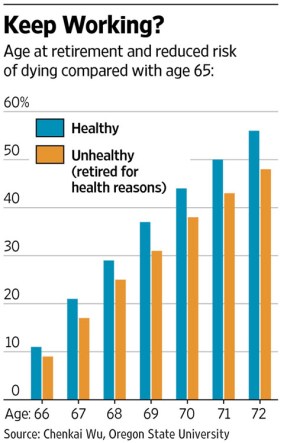
A new study published in the Journal of Epidemiology & Community Health looked at the risk of dying for different age groups of Americans, and compared it to their retirement age.  The researchers found that the likelihood of dying in any given year was 11% lower among people who delayed retirement for just one single year—from age 65 to age 66.  By age 70, people who continued working experienced a 38% lower risk of dying than people of the same age who had retired at age 65.  By age 72, the risk was 44% lower.  These results seemed not to be affected by other variables, like gender, lifestyle, education, income and even occupation.

CA - 2016-5-6 - Work longer, live longer

Why is working longer good for your health?  The article suggested that when you continue working, even part-time, your normal age-related decline in physical and mental functioning happens more slowly.  You’re having to stay engaged in the complicated work-world, which keeps you sharp—and, apparently, alive.

If you would like to discuss your retirement age or any other financial planning matters, please don’t hesitate to contact us or visit our website at http://www.ydfs.com. We are a fee-only fiduciary financial planning firm that always puts your interests first.  If you are not a client yet, an initial consultation is complimentary and there is never any pressure or hidden sales pitch.

Sources:
http://www.wsj.com/articles/retiring-after-65-may-help-people-live-longer-1462202016

The MoneyGeek thanks Bob Veres for his contribution to this post.

Last Call for Social Security Benefits File-And-Suspend – April 29 2016

Last fall, the Bipartisan Budget Act of 2015 changed the rules to eliminate two popular Social Security claiming strategies for married couples: File-and-Suspend, and Restricted Application.

Who should be considering this?

Anyone who has at least met the full retirement age of 66, and is not yet age 70, should be considering whether to submit a file-and-suspend request by April 29.  If you or someone you know is within this age range, please share this article and be aware that you/they have a very short window to meet the deadline. Anyone who wants to be “grandfathered” under the old (current, and more favorable) rules has only one week left to complete their Social Security application and suspension request by the April 29 deadline!

What is File-and-Suspend?

On the surface, it seems too good to be true.  Let’s say you have a married couple, where (let’s say) the husband has earned higher yearly income than his wife.  That means he has contributed more to Social Security over his working life.  The husband files for Social Security benefits at full retirement age (currently age 66) and then immediately files to suspend those benefits.

As a result of this simple maneuver, the wife is now entitled to immediately receive Social Security spousal benefits equal to half of the husband’s full retirement benefits that were just suspended.  She would do this if 50% of the husband’s benefit is higher than she would have received if she had simply claimed her own Social Security payments.

Because he suspended his benefits, the husband can continue working, and wait until age 70 to start receiving Social Security checks in his own name.  Why would he do that?  Because each year of deferral allows him to accumulate more credits—effectively raising his monthly benefits 8% a year, which is considerably higher than the inflation rate.  At that time, the wife would stop claiming the husband’s benefits and start receiving her own Social Security checks.  If she was working at the time, she might have raised the amount she could claim under her own name.

Presto!  More money now, more money later.

The original rationale behind the file and suspend strategy was to encourage more seniors to continue working.  The rationale behind ending it is that it was becoming a drain on the Social Security system.  Moreover, Congress was looking for money to offset a huge increase in Medicare Part B premiums for individuals not yet receiving Social Security payments.

Notably, the tactic is a moot point for anyone who has already claimed benefits, or who doesn’t plan to delay benefits going forward. Nor is file-and-suspend relevant for widows (who don’t need file-and-suspend to coordinate between retirement and survivor benefits), nor for divorcees (who rely on the Restricted Application strategy instead, which remains available after April 29 for anyone who was born in 1953 or prior).

Nonetheless, for married couples (and some parents with children) who are in the age 66-70 window and have not yet claimed their benefits, but where one person could activate a spousal or dependent child benefit for someone else while delaying their own benefit, only a small time window remains to submit a File-and-Suspend request before the rules are changed forever! And arguably, anyone who is single and doesn’t care about spousal benefits, but simply wants to preserve the right to “undo” and reinstate their delay decision in the next few years, may want to consider submitting a request to File-and-Suspend by April 29 as well!

If you or someone you know wishes to inquire or apply for this benefit, you should visit www.ssa.gov or call your local social security office.

If you would like to discuss your social security benefits situation or any other financial planning matters, please don’t hesitate to contact us or visit our website at http://www.ydfs.com. We are a fee-only fiduciary financial planning firm that always puts your interests first.  If you are not a client yet, an initial consultation is complimentary and there is never any pressure or hidden sales pitch.

An Estate Plan for your Digital Assets

In recent years, a new category of assets has appeared on the scene, which can be more complicated to pass on at someone’s death than stocks, bonds and cash.  The list includes such valuable property as digital domain names, social media accounts, websites and blogs that you manage, and pretty much anything stored in the digital “cloud.”  In addition, if you were to die tomorrow, would your heirs know the pass-codes to access your iPad or smartphone?  Or, for that matter, your e-mail account or the Amazon.com or iTunes shopping accounts you’ve set up?  Would they know how to shut down your Facebook account, or would it live on after your death?

A service called Everplans has created a listing of these and other digital assets that you might consider in your estate plan, and recommends that you share your logins and passwords with a digital executor or heirs.  If the account or asset has value (airline miles or hotel rewards programs, domain names) these should be transferred to specific heirs—and you can include these bequests in your will.  Other assets should probably be shut down or discontinued, which means your digital executor should probably be a detail-oriented person with some technical familiarity.

The site also provides a guide to how to shut down accounts; click on “F,” select “Facebook,” and you’re taken to a site (https://www.everplans.com/articles/how-to-close-a-facebook-account-when-someone-dies) which tells you how to deactivate or delete the account.  Note that each option requires the digital executor to be able to log into the site first; otherwise that person would have to submit your birth and death certificates and proof of authority under local law that he/she is your lawful representative.  (The executor can also “memorialize” your account, which means freezing it from outside participation.)

The point here is that even if you know who would get your house and retirement assets if you were hit by a bus tomorrow, you could still be leaving a mess to your heirs unless you clean up your digital assets as well.

If you would like to review your current investment portfolio or discuss any other financial planning matters, please don’t hesitate to contact us or visit our website at http://www.ydfs.com. We are a fee-only fiduciary financial planning firm that always puts your interests first.  If you are not a client yet, an initial consultation is complimentary and there is never any pressure or hidden sales pitch.

Sources:

https://www.everplans.com/articles/a-helpful-overview-of-all-your-digital-property-and-digital-assets

The MoneyGeek thanks guest writer Bob Veres for his contribution to this post