Should You “Fix” Variable Rate Debt?

While investors are keeping a close watch on the Federal Reserve for indications of when it will start raising interest rates, the consensus among economists is that it will begin its credit-tightening cycle at some point this year.

Of course there are two sides to the interest rate coin: the investor and the borrower. Rising rates are generally good news for savers and investors, but they represent an expense for borrowers and increase the cost of taking out loans and mortgages.

In the current environment, individuals may be evaluating the potential benefits of converting variable-rate loans, including adjustable rate mortgages (ARMs), home equity lines of credit, and student loans, to a fixed rate.

Only One Way to Go

Interest rates are still at historic lows and are only likely to go up from here. Personal finance experts typically favor refinancing, when practical, to a fixed rate for the stability it provides the borrower. With a fixed-rate loan the borrower will not have to be concerned if there is a sudden spike in interest rates. What’s more, individuals with fixed-rate debt have much more control over their budget and can plan ahead with more confidence, as they have a clear, predictable picture of their monthly income and expenses.

While adjustable-rate loans may have lower initial interest rates than fixed-rate loans, the lower interest rate is only for a set period of time. At the end of the fixed period, the monthly loan amount “adjusts” based on the market rate or index. In this case, refinancing may be a smart choice if your ARM is adjusting to an interest rate that is higher than the current market rate.

How Low Are Rates?

Just how low are short-term rates now, historically speaking? Most lenders base their variable rates off a LIBOR rate, which stands for London Interbank Offered Rate and works as a benchmark rate for banks internationally.1 As the LIBOR changes, so does the variable rate. The LIBOR is low today, compared to its 10-year and 20-year averages (see table below), but once it begins to increase, borrowers holding adjustable rate loans will see an increase in their regular payments. While most variable rate loans will have an upper interest rate cap, it is important to know what that maximum rate is — and whether you could handle that potential debt load — before signing any documents.

LIBOR — Then and Now

10-year average 20-year average July 6, 2015
6-month LIBOR 1.95% 3.09% 0.44%
12-month LIBOR 2.17% 3.29% 0.76%

Source: Federal Reserve Economic Data (FRED). For the dates indicated. The 10-year and 20-year averages are for the period ended July 6, 2015.

Generally, a variable rate loan is a safe bet for individuals who plan to repay their loan quickly, or have a short time horizon for underlying property ownership. For example, if you plan to move within 3-5 years, refinancing to a fixed rate mortgage may not be worthwhile, when you take into account the cost of refinancing compared with your monthly potential payment (interest) savings. In general, you should be able to recoup your refinancing costs within two years to make it worthwhile in the short term.

While the Federal Reserve is expected to begin raising rates soon, it is likely to take a very measured, slow path, so there’s really no need to rush into a refinancing.

If you would like to review your current loans or discuss any other financial planning matters, please don’t hesitate to contact us or visit our website at http://www.ydfs.com. We are a fee-only fiduciary financial planning firm that always puts your interests first.  If you are not a client yet, an initial consultation is complimentary and there is never any pressure or hidden sales pitch.

Source:

1 U.S. News.com, “Fixed or Variable: Which Interest Rate Should You Choose?” July 14, 2015

Rent or Buy?

If you read articles that offer budgeting advice, you might see an item that says you shouldn’t spend more than 25% of your income on housing costs. These days, that advice doesn’t apply.

Why? According to the latest report from Zillow Group, which tracks rental housing affordability, the typical renter making the median income in the U.S. spent 30.2% of her income on a median-priced apartment. This is the highest rate since Zillow started keeping statistics in 1979. The average from 1985 to 1999 was 24.4%.

The rise appears to be driven by greater demand for apartments and rental units. In the second quarter of this year, due to strict lending standards, the U.S. homeownership rate fell to the lowest level in almost five decades, forcing a greater number of people into the rental market. However, those fortunate enough to obtain mortgage loans appear to be much better off than renters. With today’s low interest rates, homeowners are paying, on average, 15% of their income in mortgage payments, well below the historical average of 21%.

Zillow found that rents were least affordable in Los Angeles, where residents were paying 49 percent of monthly income. The share in San Francisco was 47 percent, 45 percent in Miami, and 41 percent in the New York metro area.

If you would like to discuss whether renting or buying makes more sense for you or talk about any other financial planning matters, please don’t hesitate to contact us or visit our website at http://www.ydfs.com. We are a fee-only fiduciary financial planning firm that always puts your interests first.  If you are not a client yet, an initial consultation is complimentary and there is never any pressure or hidden sales pitch.

Sources:

http://www.bloomberg.com/news/articles/2015-08-13/renting-in-america-has-never-been-this-expensive

The MoneyGeek thanks guest writer Bob Veres for his contribution to this post

What’s Going on in the Markets September 7 2015

Chances are, these days you’re sneaking a peak at the investment markets, probably more than once a day. They’ve certainly been providing their share of excitement: down 4% one day, up more than 2% the next day or two, and who knows what’s causing the turmoil? Last week, the S&P 500 index and Dow Jones Industrial Averages (DJIA) were both down about 3%.

In August, the direction was mostly down, turning what had been tentative gains for the year into (as yet) relatively modest losses. And there wasn’t a lot of value in diversification. Large cap, midcap and small cap U.S. stock indices all dropped between 5.5% and 6%, real estate fell about the same and foreign stocks dropped roughly 7% over the same time period. Commodities did worse.

Analysts are scrambling to tell us why, one day, the markets are down sharply, and then come up with a reason why, the next day, they’re back up again. One long-term trader remarked, watching these swings, that the fact that the Dow can fall 1,000 points and then recover 700 in the space of four hours is prima facie evidence that there is no rational explanation for what’s going on. We hear that the weakness in the Chinese economy, or its stock market, are causing U.S. stocks to somehow be less valuable, but does anybody really believe that?

Meanwhile, the doomsayers are predicting catastrophe—which is not well-defined, but seems to mean that U.S. companies will be 30% to 50% less valuable in a few weeks than they are today. Their solution? Buy gold! It’s helpful to remember that $10 invested in gold in 1926 would be worth $615 today. Ten dollars invested in the stock market would be worth $55,000.

Perhaps the most interesting analysis came from Jason Zweig, who writes an investment column for the Wall Street Journal. He said that this would never happen, but what if there were a Ben Graham TV channel, which provided market commentary based on the teachings of the father of value investing? You’d have the host coming on to announce some great news: stocks today are unexpectedly on sale, selling, on average, 4% cheaper than they did yesterday. Will this great news continue, or should we take advantage of the buying opportunity while it lasts?

The guest that day offers his hope that the markets will continue their downward rally, making stocks even cheaper to buy. But he’s not optimistic, given the fact that stocks seem to get relentlessly more expensive over time, and have been doing this, with some regularity, since the early 1800s. Still, one can hope for a sustained downturn that would provide a chance to buy at prices even lower than they are today.

The host and guest console themselves with the thought that finally, for the first time in seven years, we may finish out the year with an opportunity to buy stocks for less than they cost on January 1.

We may not get that lucky, and the markets may continue their bull run. Nobody knows what you’re going to see the next time you check the investment tables, or what will happen between now and the end of the year—except this: the actual value of American and global companies won’t be affected by the mood swings of investors who lurch between an inclination to buy and an inclination to sell. Whatever those underlying values are, the markets will eventually return to them, however much of a bargain the market decides to offer us between now and then.

From an economic standpoint, the data still supports further growth in the U.S. economy. Even though both the Institute for Supply Management surveys for manufacturing and services ticked down slightly in August, they remain in expansion territory. August’s employment report released last Friday, showed that the unemployment rate moved down to 5.1%. Job creation was less than economists had expected; however, figures for June and July were revised upward, and it’s possible that the August (estimate) could also be adjusted higher, once the start of the school year is taken into account.

There has been little change in the technical picture of the markets. The Advance-Decline Line (number of stocks going up versus going down) is still weak. However, downside leadership eased somewhat during the week, and selling pressure hit an extreme last Tuesday, which was followed by a triple-digit rebound in the DJIA on Wednesday.  Extreme oversold readings, which often occur at the end of a downward move, can indicate that the bottom of a correction is imminent. However, a failure of the market to bounce in view of extreme oversold readings, can be a bear market warning sign. We’re watching this closely.

In view of the volatility still present in equity markets, it’s important to stay objective. The economic data is solid; yet we are concerned with the technical market picture and the Federal Reserve policy announcement on September 17. Currently, our client portfolios are defensively positioned, and further defensive adjustments will depend on how the evidence emerges in coming weeks. Once again, if you find yourself uncomfortable with the market gyrations, or you’re losing sleep, then perhaps you should take advantage of the rallies in the markets to lighten up on some of your positions (this is not to be construed as investment advice; please consult with your financial adviser, or better yet, call us!).

If you would like to review your current investment portfolio or discuss any other financial planning matters, please don’t hesitate to contact us or visit our website at http://www.ydfs.com. We are a fee-only fiduciary financial planning firm that always puts your interests first.  If you are not a client yet, an initial consultation is complimentary and there is never any pressure or hidden sales pitch.

Sources:

Wilshire index data: http://www.wilshire.com/Indexes/calculator/

Russell index data: http://www.russell.com/indexes/data/daily_total_returns_us.asp

S&P index data: http://www.standardandpoors.com/indices/sp-500/en/us/?indexId=spusa-500-usduf–p-us-l–

http://www.tradingeconomics.com/united-states/unemployment-rate

Nasdaq index data: http://quicktake.morningstar.com/Index/IndexCharts.aspx?Symbol=COMP

International indices: http://www.mscibarra.com/products/indices/international_equity_indices/performance.html

http://finance.yahoo.com/news/dow-briefly-drops-150-points-135905615.html

Investech Research

The MoneyGeek thanks guest writer Bob Veres for his contribution to this post

What’s Going On in the Markets August 23, 2015

Some of the most entertaining times to be a long-term investor are those periods when short-term investors are looking over their shoulders for an excuse to sell. They’re convinced that the market is heading down before they can get out, and so they jump on any bad news that comes across their Bloomberg screen.

Last Thursday and Friday was a marvelous time to see this in action. With all the economic drama playing out in the world, there were plenty of opportunities to panic. The Greek Prime Minister has resigned! Sell! … China devalued its currency a few days ago by 2%! Head for the hills! … Chinese stocks are tanking yet again! Get out of American stocks while you can! … The Fed might raise short-term interest rates from zero to very nearly zero! It’s the end of the world!

Of course, a sober analyst might wonder whether a change in governance in a country whose GDP is a little less than half the market capitalization of Apple Corporation, is really going to move the needle on the value of U.S. stocks—especially now that Greece seems to have gotten the bailout it needs to stay in the Eurozone. Chinese speculators are surely feeling pain as the Shanghai Composite Index goes into free-fall, but most U.S. investors are prohibited from investing in most companies in this tanking market. If the market value of PetroChina, China Petroleum & Chemical and China Merchants Bank are less valuable today than they were a week or a month ago, does that mean that one should abandon U.S. stocks? Does it mean that American blue chips are somehow less valuable?

What makes this dynamic entertaining—and sometimes scary—is the enhanced volatility around very little actual movement. You see the market jump higher and faster, lower and faster, but generally returning to the starting point as people realize a day or two later that the panic was an overreaction; and so was the false exuberance of realizing that the world isn’t going to come to an end just because we’re paying less at the gas pump than we were last year. Despite all the jitters investors have experienced over the past nine months, and despite the drop last week, the S&P 500 is only down about 4% for the year, and was in positive territory as recently as August 19.

Let’s summarize a few of the facts about this current sell-off:

  • Friday’s decline was 500 points in the Dow Jones Industrial Average (DJIA), which was 3.1%. During this bull market there have been 11 similar daily declines of that size (or larger), and in every instance the market went on to new highs. So Friday’s decline, by itself, does not mean that we’re in a bear market.
  • Last week’s loss in the S&P 500 Index was 5.77%. Since 1940, there have been 38 weekly declines of this size (or larger). Surprisingly, there were three times as many double-digit gains three months later than there were double-digit losses. So last week’s decline doesn’t necessarily indicate more big losses ahead.
  • Market readings are at the most oversold level since the 2011 correction lows. Historically, readings this low indicate a high probability of a rally or bounce in the week ahead.
  • For perspective… from the market peak earlier this year, the DJIA is off 10.1% through Friday’s close, and the S&P 500 Index is off only 7.5%. So far, this barely qualifies as a correction. And the last 10% correction was in 2011, so this was overdue. Since the year 1900, there have been 35 declines of 10% or more in the S&P 500. Of those 35 corrections the index fully recovered its value after an average of about 10 months. Sure, there’s no guarantee that the length of future recoveries will happen in a similar time frame, but the long term bias of the market is always up.

I’m not telling these facts to downplay the market’s weakness (which I’ve been telling clients to expect), but to convey that this correction may not be a full scale bear market. Bull market tops are long, drawn-out affairs. And while negative technical market signals have been building for the past few months, I cannot say with certainty that we are in a bear market…at least not yet.

Another positive development –not yet considered by today’s panicked sellers– is that this market weakness has likely taken the chance of any September interest rate hike by the Federal Reserve completely off the table. In fact, we’ll be surprised if Fed officials are not cajoling the markets with dovish comments this coming week to calm investor nerves and stabilize Wall Street.

If you want a broader, more rational picture of our current economic situation, read this analysis by a long-term trader who now refers to himself as a “reformed broker” in Fortune magazine: http://fortune.com/2015/08/20/american-economy-worries/. He talks about the “terrible news” that it hasn’t been this cheap to fill your gas tank in over a decade, and businesses that rely on energy to manufacture their goods, are now forced to figure out what to do with the excess capital they’re not spending on fuel. (warning: sarcasm to follow).

Oh, but it gets worse. American corporations are struggling under the burden of enormous piles of cash they don’t have a use for. They may have no choice but to return some of that money back to shareholders in the form of record dividends or stock buybacks. Of course, you read about the risk to corporate profit margins. It seems that unemployment is so low that wages for American workers are going up, and that could raise consumption and demand for products and services.

Meanwhile, contributions to 401(k) and other retirement plans are up dramatically, housing starts and the construction sector are booming, America’s biggest global economic competitor (China) is reeling, and the Federal Reserve might decide that it no longer has to keep short-term interest rates low because the emergency is over and the economy has recovered.

The author apologizes (tongue in cheek) for bringing us all this terrible news, but hey, we can always sell our stocks and get out until conditions improve. Right?

Nobody would be surprised if the U.S. stock market suffered a 10% or even a 20% short-term decline (correction) this year, or perhaps next year. Besides, we haven’t had a 10%+ correction in nearly four years. But what can you do with that information?

Nobody would have been surprised if this had happened at any point in the long bull market that may have doubled your stock investments, and nobody can predict whether Friday was a signal that the market will take a pause, or if Monday will bring us another wave of short-term euphoria measured mostly in sighs of relief. And if you don’t know when to sell in this jittery market, how will you know when to buy back in?

These short-term swings provide entertainment, but very little useful information for a mature investor. If you aren’t entertained by watching people sell in a panic and then panic-buy their way back in when they realize things aren’t as dire as the headlines made them out to be, then you should probably watch a movie instead.

What To Do

It is likely the media will have a heyday with the recent losses, and perhaps showcase predictions of much more dire things to come. The media is all about getting you to tune in, not to help you with investment decisions. When things are good, they highlight how great things are, and when things turn south they jump on the bandwagon and act like there won’t be a tomorrow. It’s best to tune them out.

As mentioned above, we are way overdue for a correction. Over the past six years, there has been much less volatility in the markets than there usually is. We have become a bit desensitized to how stock markets actually move. Losing 10% – 20% over a period of months is not unique. Markets go up and down; that’s why stocks pay us a premium to own them. Every time something different causes it and each time it instills a lot of fear. This time and times in the future will be no different.

If you have at least five to seven years until you plan to fully cash out of your account, then you have nothing to worry about. Even if we were to get a protracted downturn, it wouldn’t matter for long-term investors; in fact it can benefit you.

If the markets go down significantly more, expect to take advantage of the weakness and buy high quality stocks “on sale”. It’s never easy to buy stocks after seeing them go down, but it can really help your returns over time. A 5% correction is not sufficient to do this. I’d be looking for a 10% – 20% correction before putting more money to work.

Diversified portfolios, which you must have, ensure that your investments don’t move in line with the market. Sure, you don’t go up as much as the market, but you also don’t go down as much. And by having assets that do well in tough times such as cash, short-term bonds and inverse funds, we have the ability to actually purchase stocks on sale – to take advantage of temporary losses for your long term gain. The key is to think long term (five years or more) and ignore the short term stuff.

While I have no specific knowledge (or a working crystal ball), my guess is that the market highs are in for this year. That doesn’t mean we go down from here; it just means that it gets harder to make new highs before year end. Of course, I could be wrong!

In our client portfolios, we have been building up cash positions, taking profits on some positions, increasing our allocations to defensive sectors, and adding to our hedges for months now. If you’re wondering what to do, you might consider lightening up on some profitable positions into the next rebound if you haven’t already done so (this is not intended as investment advice-please check with your advisor so that changes made to your investments are consistent with your financial plan, risk tolerance and time horizon).

Because Friday closed on the lows, we could very well see selling pressure spill over into this week. Even so, we do not see last week’s swoon as the start of a waterfall decline or market crash. Taking into account how bull market tops unfold, we believe this top (if it indeed is one) will take more time to develop and offer more convincing evidence of a bear market.

We will be closely watching the coming rebound. If we continue to see deterioration in breadth/leadership (the number of stocks going up are less than those going down), and the technical health of the markets deteriorate, then we will increase our cash reserves, hedges and defensive sector allocations. If this turns out to be a wonderful buying opportunity, then we may not catch the absolute bottom, but there will be plenty of time to take advantage of this latest “dip”.

If you would like to review your current investment portfolio or discuss any other financial planning matters, please don’t hesitate to contact us or visit our website at http://www.ydfs.com. We are a fee-only fiduciary financial planning firm that always puts your interests first.  If you are not a client yet, an initial consultation is complimentary and there is never any pressure or hidden sales pitch.

Sources:

Bob Veres, Inside Information

Investech Research

Devaluation Panic: Bear in the China Shop

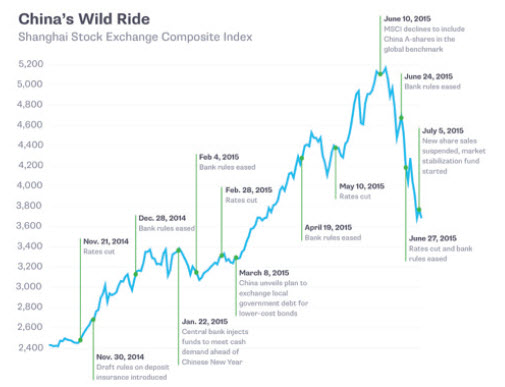
Earlier this summer, China’s stock market appeared to be in free-fall, despite the Chinese government’s efforts to control stock prices and stem the panic. The chief culprit appears to be leverage: investors last year and in the first half of this year borrowed billions in order to buy stocks on margin, offering little or no collateral except the shares themselves. As prices fall and stock values drop below the level of debt, it triggers margin calls from the lenders, which forces investors to sell at any price, further depressing prices, causing more margin calls in a downward spiral whose bottom is not easy to see from here.

A recent report said that the volume of these margin loans dropped by 6%, or $23 billion over five trading days, which implies that there is still $383 billion more that could be called over the next months or years, an alarming 9% of the roughly $4 trillion in total market value on the Shanghai market.

But leverage is only part of the problem. The CSI Information Technology Index, a mix of high-tech names in China similar to the NASDAQ in the U.S., is still trading at a multiple of around 75 times earnings (PE), while NASDAQ’s PE is closer to 30. If the two indices were to normalize, it would imply that Chinese stocks could drop an additional 60% in value before the current bear market has run its course—and that’s assuming the debt situation doesn’t cause the market to overshoot on the downside. Some compare the situation in China to the dot-com bust in the year 2000.

One complication in the situation is the fact that, since late last year, foreign investors have been allowed to invest directly in Shanghai-listed stocks. Savvy market traders with years of experience in these death spiral events have been making program trades which bet on further drops. Chinese regulators recently suspended 34 U.S.-based hedge fund accounts from trading, including the Citadel Fund, and short selling is now totally forbidden.  Arrests for selling stocks short have been reported.

Currency Devaluation

This past week, investors across the globe were sent into a panic when the Chinese Central Bank devalued the nation’s currency, the yuan. The U.S. market temporarily lost more than 1% of its total value, oil prices fell, and global shares plummeted on news that China decided to make its currency two percent cheaper than it was before. Despite the Central Bank’s assertion that it was a one-and-done devaluation, they proceeded to further devalue the yuan two more times within a matter of days.

You actually read that right. Headlines raised the prospect of a global currency war, and there were hints in the press that nations might resort to trade barriers, which would slow down global trade in all directions. If you’re following the story, you probably didn’t read that the Chinese yuan, even after the devaluation, was actually more valuable against global currencies than it was a year ago in trade-weighted terms. Nor did you read that China actually intervened in the global markets to make sure the devaluation didn’t go any further in open market trading.

The background for the devaluation is China’s slowing economic growth and its recent stock market volatility. The Caixin China Manufacturing Purchasing Manager’s Index recently fell to levels which indicate economic contraction, and industrial output is at the weakest level since November of 2011. If you can believe the numbers, the country is on track for a 7% growth rate this year—three times the U.S. rate, but sluggish by recent Chinese standards, and quite possibly unacceptable to the country’s leaders.

You probably already know that the Chinese stock market climbed to impossibly high levels earlier this year and then fell just as far in a matter of weeks. As you can see from the below chart (and as mentioned above), the Chinese government marched into the chaos with a heavy hand, outlawing short sales, banishing hedge funds to the sidelines, suspending margin calls and even buying stocks directly in an effort to put a floor on prices. The theory was that the devaluation was part of this intervention, since it would make exports cheaper and boost sales, raising profit margins of those companies whose stocks were recently free-falling. Some believe that the Chinese won’t quit until they devalue the yuan by at least 10%.

CA - 2015-8-14 - China Devaluation1

A more nuanced view of the situation is that the recent depreciation is a small step to keep the yuan’s value in line with those of its peers, not a dramatic shift in exchange-rate policy or a part of the Great Shanghai Market Panic. Indeed, if you look at the below chart, you can see that China’s percentage of world exports has been steadily growing for this entire century, without any need to add the stimulus of a weaker currency.

CA - 2015-8-14 - China Devaluation2

A scarier scenario, which nobody seems to be talking about, is that China’s endgame goal is to make the yuan the reserve currency for global trade—replacing the U.S. dollar. China is already lobbying to join the list of reserve currencies recognized by the International Monetary Fund. The new exchange rate is more in line with basic economic fundamentals, strengthening the argument that the yuan is not under the total control of an interventionist central government. But so long as China imposes strict limits on the amount of its currency that can flow into and out of the country, and attempting to manipulate its own stock market, this will be a difficult argument to make.

You don’t often see a market rally when an economy is sliding into recession, so at these valuations, you aren’t likely to find many bulls left in the Shanghai China shop either.

If you would like to review your current investment portfolio or discuss any other financial planning matters, please don’t hesitate to contact us or visit our website at http://www.ydfs.com. We are a fee-only fiduciary financial planning firm that always puts your interests first.  If you are not a client yet, an initial consultation is complimentary and there is never any pressure or hidden sales pitch.

Sources:

http://fortune.com/2015/08/03/china-looks-for-scapegoats-in-continued-stock-market-decline/

http://fortune.com/2015/06/29/china-stocks-crash-into-bear-territory-as-margin-calls-bite/

http://www.ft.com/intl/fastft/242222/china-overtake-japan-stock-market-cap

http://www.economist.com/news/finance-and-economics/21661018-cheaper-yuan-and-americas-looming-rate-rise-rattle-world-economy-yuan-thing?fsrc=scn/tw/te/pe/ed/yuanthingafteranother

http://www.bloombergview.com/quicktake/chinas-managed-markets

http://finance.yahoo.com/news/global-markets-china-devaluation-hits-165238168.html

http://www.bloomberg.com/news/articles/2015-08-13/china-citigroup-agree-there-s-no-need-for-big-yuan-devaluation

The MoneyGeek thanks guest writer Bob Veres for his contribution to this post

Surprise! Doom and Gloom Sells

Maybe you saw the alarming headline in the middle of the other stories on Yahoo! News, which told you that the U.S. dollar was about to collapse, as a result of H.R. 2847—or, sometimes, simply “the new currency law.” Write down this date, the frightening article said: July 1, 2014.

More recently, you might have seen/heard TV and radio advertisements or ubiquitous Internet warnings where Dr. Ron Paul urgently reveals “a real currency crisis” that will usher in the greatest economic meltdown this country has seen in 50 years—including civil unrest, pension fund collapses, the erosion of personal liberties, bank and brokerage closings, and mass rejection of the U.S. dollar in favor of “non-paper alternatives.”

In case you were wondering, the U.S. dollar did not collapse in July of last year, nor did it collapse in 2009, which is when Ron Paul began predicting doomsday. But if you watch the 54-minute Ron Paul infomercial, you will eventually be offered a “survival blueprint” published by Stansberry & Associates Investment Research—interestingly, the same company that told us that the U.S. currency would melt down last year. To avoid financial armageddon, you simply need to pay $49.50.

Who is Stansberry & Associates? The owner and publisher is Frank Porter Stansberry, who, among his credentials, has been prosecuted by the Securities & Exchange Commission for investment fraud, and fined $1.5 million for selling $1,000 reports with information that a panel of judges determined that he knew not to be true. Using the pseudonym “Jay McDaniel,” Stansberry offered a “Super Insider Tip” telling gullible investors that on May 14, 2002, there would be a major announcement which would instantly double their money. As it turned out, the uranium processing company that was being touted in the $1,000 report made no significant announcement on the date in question, and in fact investors testified that they lost 20-25% of their investment portfolio after purchasing the stock and options.

In the judge’s opinion, “The gravity of the harm in this case is not limited to the amount of money each purchaser spent for the Special Report. Approximately 1,217 investors bought the Special Report with the expectations, as promised, by the Super Insider Solicitation.” Stansberry and his publisher were enjoined from conducting any additional “deliberate fraud.” An investigative website also notes that he predicted the demise of AT&T, General Motors, the FNMA quasi-governmental guarantor of mortgages, Continental Airlines and… General Electric. One thing these predictions have in common with the prediction of the collapse of the dollar: they never happened. In 2011, Stansberry’s online infomercial predicted “The End of America,” and also that Germany would leave the European Union. To our knowledge, those things haven’t happened yet either.

In case you were wondering, H.R. 2847 is a provision that requires Americans living abroad to comply with tighter reporting requirements on their offshore income—and has very little to do with anything related to the dollar.

Predicting disaster is a reliable way to make money, because the human mind is wired to pay more attention to threats than to the more benign elements in our environment. In the future, you’ll probably see Stansberry predicting all sorts of other scary things, and probably a few more “can’t miss” investment opportunities. What you won’t see is any clear accounting of his track record.

Write down this date about the collapse of America, the extinction of the dollar, the demise of senior members of the Fortune 500, the total breakup of the European Union and a great chance to double your money in a day: Not on Porter Stansberry’s timetable.

Another outlet of bearishness, Casey Research, was recently acquired by Stansberry and Associates. Casey is also a flamboyant (and spammy) research firm, so I don’t expect the doom and gloom headlines to die down any time soon. These folks have been calling for the demise of the United States and the dollar for years, and people love to read fearful headlines. Most of these outfits have caused their readers to miss out on the last six years of stock market gains. Instead, they have led folks to invest in gold, gold mining stocks, commodities and other precious metals that have lost half or more of their value since 2011. You can save your time and safely ignore this trash designed to get you scared witless.

Just like in the media, fear sells, but if the dollar is doomed, we all have bigger problems to deal with. Instead of cash or gold, I’d rather have my home stocked with drinking water, flour, cans of tuna fish and the finest shot gun I can find if the dollar or market collapses. Oh and some fine beer or wine too, if that’s what you fancy.

While I personally believe that the market is way overdue for a 10% or more correction, the market doesn’t care what I believe.  Still, I don’t consider the situation as dire and desperate as these doom and gloomers describe it. The country’s economy is doing great, unemployment is the lowest it’s been and there are currently no signs of an impending recession. Nonetheless, while a crisis could develop anytime without notice somewhere around the world, our client portfolios are hedged and positioned defensively for whatever the market throws at us.

If you would like to review your current investment portfolio or discuss any other financial planning matters, please don’t hesitate to contact us or visit our website at http://www.ydfs.com. We are a fee-only fiduciary financial planning firm that always puts your interests first.  If you are not a client yet, an initial consultation is complimentary and there is never any pressure or hidden sales pitch.

Sources:

http://briandeer.com/vaxgen/stansberry-fraud.htm

http://thecrux.com/porter-stansberry-predicts-the-next-major-company-to-go-bust/

http://wealthymatters.com/2011/09/20/porter-stansberry/

http://thecrux.com/dyncontent/ron-paul-one-step-prepare/?cid=MKT033949&eid=MKT057529

http://www.snopes.com/politics/conspiracy/hr2847.asp

The MoneyGeek thanks guest writer Bob Veres for his contribution to this post

Are There Any Disadvantages Associated With Paying off a Mortgage Early?

I’m often asked if it makes sense to pay off a mortgage early or invest the cash in the markets. As is often the case in personal finance, the answer is, wait for it…..it depends.

The disadvantages, if any, may stem from the financial trade-offs that a mortgage holder needs to make when paying off the mortgage. Paying it off typically requires a cash outlay equal to the amount of the principal. If the principal is sizeable, this payment could potentially jeopardize a middle-income family’s ability to save for retirement, invest for college, maintain an emergency fund, and take care of other financial needs.

If you have the financial means to pay off a mortgage, consider the following:

  • Your feelings about debt — Some homeowners like the feeling of security that comes with owning a home free and clear. Knowing this may help you sleep better at night.  If this describes you, it may be to your benefit to pay off or reduce the size of your mortgage. Should conditions in your local real estate market decline, there’s less of a chance of owing more than you own.
  • Your current interest rate — If you currently have a low fixed interest mortgage rate, and having mortgage debt doesn’t bother you much, then investing the sum may yield better after-tax returns. Just keep in mind that markets may move down, so there is a risk here. You should discuss this option with your financial planner so you understand it well.
  • Your timeline until retirement — If your mortgage is relatively small and you pay it off, you may be able to invest the money formerly used for mortgage payments for retirement or other long-term goals. Your timeline until retirement may be a factor when making this decision. With 10 years or more remaining until you expect to retire, you could have time to build a nest egg if you invest the money formerly used to pay a mortgage. If you plan to retire sooner, entering retirement without a mortgage could provide you with more flexibility during your later years.
  • Your tax savings — Mortgage interest typically is tax deductible. During the early years of a mortgage, when the interest payments are highest, many homeowners benefit from a sizeable deduction. This could be important if you are in a higher tax bracket. If your interest payments are relatively low, the tax savings could be less of a factor. The amount of your other itemized deductions may be a factor if their total is close to your standard deduction.
  • Your future plans — Owning a home outright could be an advantage if you plan to sell it during the next few years. You could potentially leave your existing residence with more home equity.
  • Your overall debt load — If you are carrying other forms of debt, such as credit card balances or a college loan, consider whether you could benefit from paying off other debt first before reducing or eliminating your mortgage.

There is no “right” answer for everyone when it comes to potentially paying off a mortgage. Consider your feelings about debt, current interest rate, your timeline with respect to long-term goals, your tax savings, and other factors before making a decision that is in your best interest.

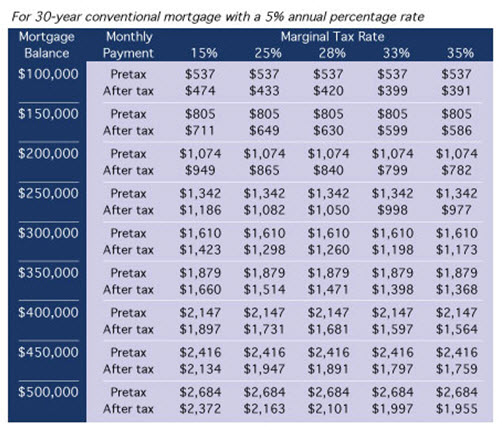
After-Tax Value of Home Mortgage Deduction

One of the big benefits of home ownership is the mortgage interest deduction. The federal government lets you deduct mortgage interest on a first or second home, up to $1 million per year.

30-year conventional mortgage pix

Source:

Wealth Management Systems Inc. Monthly payments assume a conventional 30-year fixed-rate mortgage at 5% APR, excluding escrows for taxes, insurance, or other fees. Mortgage deductions are based on first month’s interest. Assumes that other deductions exceed the standard deduction. (CS0000218)

If you would like to review your current mortgage payoff options, your investment portfolio or discuss any other financial planning matters, please don’t hesitate to contact us or visit our website at http://www.ydfs.com. We are a fee-only fiduciary financial planning firm that always puts your interests first.  If you are not a client yet, an initial consultation is complimentary and there is never any pressure or hidden sales pitch.

The Bears Invade Shanghai

With all eyes on Greece, a bigger and potentially more disturbing market disruption is taking place—in a much larger economy. As you read this, the Chinese stock market is experiencing the kind of free-fall not seen since the 2008 drop in global markets. Some are comparing it to the 1929 crash in U.S. stocks.

Bears in Shanghai

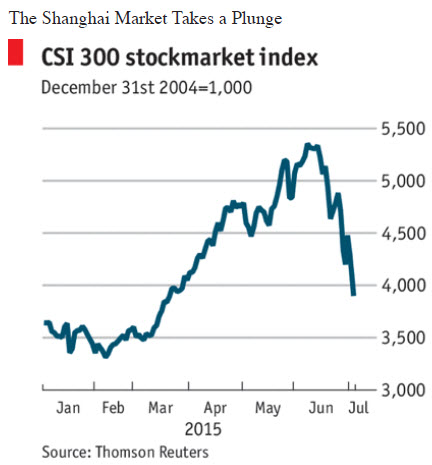
As you can see from the chart, the fall has been fairly dramatic, even if it has not yet taken share prices on the Shanghai Composite Index below where they were previous to a perilous bull run that began in February. The fall has apparently alarmed the Chinese government, which has authorized extraordinary interventions. Among them: twenty one Chinese brokerage firms have agreed to invest the equivalent of $19 billion in stocks, in an effort to create more demand. The stock exchanges suspended initial public offerings so as not to put any more shares on the market. The Chinese central bank has cut its benchmark lending and interest rates rates. And the government itself, through its pension system, has now been authorized to “play” the market.

Perhaps the most ominous intervention, however, came when China’s market regulator decided that brokers should not force people who have bought stocks on margin (borrowed funds) to engage in forced selling in order to cover their debts. Instead, the brokers were told to extend additional margin loans that would be collateralized by investors’ homes. If the market continues to plunge, observers wonder, how will investors (or banks) liquidate those houses? Is it wise to spread the risk from the stock sector to real estate valuations?

The brokerage pledge to buy shares is reminiscent of 1929 Wall Street, when the great banking houses of J.P. Morgan and Guarantee Trust Company committed their resources to propping up the U.S. stock market. That experiment was not a notable success; the Dow Jones Industrial Average fell 13% the following Monday and dropped another 34% over the next three weeks. The Chinese intervention fund, led by Citic Securities Co. and Guotai Junan Securities Co., faces a similar uphill battle; the war chest represents only one-fifth of the Chinese market’s daily trading volume.

So far, Chinese investors have lost $2.7 trillion of stock value—the equivalent of six times Greece’s entire foreign debt. Much of the pain has been borne by individuals, who own four-fifths of China’s stocks, far more than in Western markets where institutional investors are the dominant owners. Many of these common folk borrowed money to buy their shares, contributing to a nine-fold increase in margin lending by brokerage firms over the past two years. This dramatic rise in speculative investing has echoes both in the runup to 1929 and 2008, two periods when reckless betters (individuals in the earlier era, Wall Street in the latter) were able to borrow 90% of the money they “invested.”

Moreover, the margin loans carry annual interest rates as high as 20%. Total margin debt, when you add up the brokerage firms, banks and informal loans, could amount to as much as $1 trillion. As share prices fall, investors would be left with far less in stock value than the high-interest loans they owe—making repayment problematic, potentially putting $1 trillion worth of stress on the Chinese banking system.

It gets worse. Many smaller Chinese companies have financed their expansion by taking out loans against the value of their shares. The companies have had to post additional collateral as the share value dropped down to the outstanding balance on the loan. Additional market losses could put these companies in real danger of default, adding to the stress.

Nobody knows if the free-fall will continue to feed on itself, or if the government will somehow manage to slow the descent. But highly-leveraged investing on a mass scale seldom ends well, as most of us remember from the subprime crisis when we had to reach into our pockets to make Wall Street whole again on its disastrous speculations.

Fortunately, none of this is likely to directly affect the portfolios of American investors, since foreigners account for only about 4% of the Chinese stock market. But as the crisis deepens, and especially if the defaults start to mount, companies go under and the banks stop lending into the economy, you could see commodity prices fall on weaker demand, and there could be a hit to large American companies that do a lot of business in the Asian markets. As an emerging market, China’s setback could pressure emerging market funds, which many of us are exposed to in our portfolios. Finally it could be a long time before individual Chinese investors trust the stock market again. That would be exactly the opposite of the Chinese government’s plan.

If you would like to review your current investment portfolio or discuss any other financial planning matters, please don’t hesitate to contact us or visit our website at http://www.ydfs.com. We are a fee-only fiduciary financial planning firm that always puts your interests first.  If you are not a client yet, an initial consultation is complimentary and there is never any pressure or hidden sales pitch.

Sources:

http://www.economist.com/news/business-and-finance/21657036-measures-prop-up-share-prices-appear-be-failing-bear-wrestling

http://www.bloomberg.com/news/articles/2015-07-06/timeline-china-s-efforts-to-stem-3-2-trillion-stock-rout

http://www.nytimes.com/2015/07/06/business/international/chinas-market-rout-is-a-double-threat.html?_r=0

http://www.bloombergview.com/articles/2015-07-06/china-steers-toward-a-subprime-economy

The MoneyGeek thanks guest writer Bob Veres for his contribution to this post


The Brink of Grexit

Well, the Greek voters were asked, once again, whether they would accept additional austerity measures that were demanded by their creditors, including the European Central Bank, the International Monetary Fund and the European Commission. And once again they voted—this time overwhelmingly (61.31% to 38.69%)—to hunker down and move the country to the brink of a Grexit from the euro currency.

Their choice may not have been hard to make. Virtually all of the $264 billion that has been loaned to the Greek government have actually been paid to the European banks who unwisely loaded up on Greek debt before 2009—and the loans and extensions, to them through Greece, has kept the European banking system solvent during the crisis. Virtually none of that money has gone back into the ailing Greek economy.

Over the past three years, the Greek government, following many of the demanded austerity measures, has actually reached the point of budget surplus, aside, of course, from the debt repayments. The cost: a skyrocketing unemployment rate that has reached 25.6%, including 60% of the nation’s young workers, and a steep recession which economists seem to agree would only get steeper if the country accepts the austerity demands. The Greek economy has shrunk by 25% over the last five years.

But the hardship continues. Anticipating a currency shift from euros to drachma, Greek citizens have staged the mother of all bank runs, trying to get as many euros out of the system as they could before they are potentially exchanged for lesser-value drachmas. The government limited the amount of their own money that citizens could withdraw to approximately $67 a day, and has now shut down the Greek banking system at least through end of the week.   Re-opening the banks could be problematic, since they don’t hold nearly as many euros as depositors have put into them.

Some are betting that the European Central Bank will provide guarantees and financial support to keep the banks from collapsing and taking the Greek economy down with them. But you can expect Germany to push back hard on this idea.

Will Greece leave the Eurozone? Nobody knows, but the vote suggests that the citizens of Greece have had enough of European (read: German) control over their economy and political decisions; indeed, some observers saw the extremely hard line at the negotiating table as a ploy to destroy Greek’s ruling Syriza party by forcing Greek voters to abandon it. There are sizable numbers of people in other European countries who feel the same way about losing control over their own affairs, who are closely watching how the European Union responds.

The discussions will be tricky. If the European Union offers further concessions, then you can expect Spain (unemployment rate: 23.1%) to ask for less stringent austerity and some space to get its own economy moving again. Portugal could be next.

And, of course, if Greece leaves, and begins to experience economic growth again, then those citizens in other countries could demand that their leaders also cast off the layer of oversight and control coming from Brussels.

What should you watch for? Greece is already technically in default as of last Tuesday, on $1.7 billion in payments. At the end of July, it will owe the next payment, in the amount of just under $4 billion. One compromise possibility is that the European Union, led by Germany, will reluctantly allow Greece to extend its payments, and also put together some kind of an aid package for the Greek economy that would help it become more able to make payments in the future.

How does this affect you? Once again, you’re going to see turmoil in the markets, and a temporary decline in the value of the euro on international markets. You’ll hear pundits and economists speculate about the “fate of the Eurozone,” and eventually, one way or another, everything will settle down again without affecting in any way the underlying value of the stocks you own. We’ve all seen this crisis a few times before, and each time the predictions of some form of doom haven’t come true. This “crisis” is very real to the Greek people, but the world will go on no matter how it’s resolved.

Now the current severe correction in the Chinese stock markets is a matter for another article, and that could prove much more important than the whole Grexit, if officials don’t wrest control of their markets.

If you would like to review your current investment portfolio or discuss any other financial planning matters, please don’t hesitate to contact us or visit our website at http://www.ydfs.com. We are a fee-only fiduciary financial planning firm that always puts your interests first.  If you are not a client yet, an initial consultation is complimentary and there is never any pressure or hidden sales pitch.

Sources:

http://finance.yahoo.com/news/greece-says-oxi-heres-happens-180726938.html

http://www.nytimes.com/interactive/2015/business/international/greece-debt-crisis-euro.html?_r=0

http://www.nytimes.com/2015/07/06/business/international/eurozone-central-bank-now-controls-destiny-of-greeces-battered-banks.html?rref=business/international&module=Ribbon&version=context&region=Header&action=click&contentCollection=International%20Business&pgtype=Multimedia

http://www.nytimes.com/2015/07/06/business/international/eurozone-central-bank-now-controls-destiny-of-greeces-battered-banks.html?rref=business/international&module=Ribbon&version=context&region=Header&action=click&contentCollection=International%20Business&pgtype=Multimedia

The MoneyGeek thanks guest writer Bob Veres for his contribution to this post

“Grexit” Vote Coming

Any way you look at it, the standoff between the nation of Greece and the leaders of the European Union is a mess. But it may not be quite the problem that the press is making it out to be. In case you haven’t been following the story, the gist of it is that the Greek government, over a period of years that included the time it hosted the Summer Olympics, issued more bonds than, in retrospect, it could possibly pay back. The total debt outstanding peaked at somewhere around $340 billion, which is actually more than the $242 billion in goods and services that the entire Greek economy produces in a year.  You’ve no doubt heard about a series of bailouts organized by the European Union, the International Monetary Fund and other groups which have collectively extended loans and extensions amounting to $217 billion to date. As you can see from Figure 2, on the right-hand side, roughly $4 billion in payments are due in July and more than $3 billion in August, after which time the payment schedule becomes somewhat more forgiving through 2022. Grexit 2015-06-29 There are three problems with this picture. First, it has become apparent that Greece doesn’t have the money to make the July and August payments. Second, in return for additional debt relief, the various creditors are asking that the Greek government do more than just balance its budget (which it has). Their demands seem a bit harsh and somewhat picky when they’re organized in a list: Greece would have to reduce pension payments to current and retired workers by 40%, raise the retirement age to 67 in 2022 rather than 2025, phase out supplemental bonuses for poorer retirees in 2017 rather than 2018, and cut back on early retirement immediately. (The proposals also include additional taxes on consumers but not businesses.)   And third: the newly-elected Greek government, led by Alexis Tsipras of the Syriza party, ran on a platform of rejecting any further budget concessions and compromises. This turned out to be an extremely successful political strategy: the party won 149 out of the 300 seats in the Greek Parliament in what is regarded as a rousing popular mandate. Negotiations predictably broke down, and now the Syriza leaders are asking the Greek citizens to vote on whether they will accept the or reject the austerity measures that the EU creditors are demanding. Polls suggest that the voters would like to keep their country in the Eurozone but that they oppose any additional budget reductions. In other words, nobody knows how the referendum will end. If the citizens of Greece reject austerity, it will present the European Union with a difficult choice: back down and continue to help Greece ease out of the crisis (which would be politically difficult to sell, especially to German voters), or deny the concessions that Greece needs, and effectively force Greece out of the Eurozone. If the latter happens, then the future becomes a bit murky. Greek banks have been shut down in advance of the July 5 vote, strongly suggesting that Greek leaders, holding a “no” vote, would no longer use the euro as its currency. They would print drachmas, which, in those frozen bank accounts, would replace euros at par. The drachmas would immediately lose value on the international markets, which would allow Greece to undercut its competitors in the export markets. Meanwhile, Greece could default on all or portions of its debt, and offer to pay drachmas instead. Who loses in this scenario? Everybody. The European banks holding Greek debt and private investors, are the obvious losers. But closer to home, any Greek citizen who didn’t get his/her money out of the bank before the freeze, will have to accept a haircut on the deposits, as drachmas will inevitably be worth less than euros. At the same time, many Greek banks are holding massive amounts of Greek government debt, which they need as collateral for European Central Bank loans that are keeping THEM (the banks) afloat. Alternatively, Greece could offer everyone 50-70 cents on the dollar in debt repayments, and would probably get mostly takers from creditors who would like to put this whole saga behind them. Do YOU lose in any of these scenarios? If either side blinks, then the situation goes back to business as usual. If Greek voters agree to give the EU what it wants, then some economists believe that the Greek economy will go into a steep recession, but your personal exposure to Greek companies is almost certainly minimal, and the problem will be temporary. If Greek voters vote “no”, the EU negotiators remain intractable and Greece leaves the Eurozone, then you can expect breathless and sometimes scary headlines and short-term turmoil in European stocks, with some investors panicking and others uncertain. But the smart money says that the Eurozone is strong enough to sustain the loss of one of its smallest economies, and Greece, too, will survive. The irony, which nobody seems to have noticed, is that after accepting many of the earlier austerity measures, the Greek government is actually running a budget surplus without the debt payments—something U.S. citizens can only dream of. If the additional austerity measures do, eventually, get put in place, the subsequent recession would reduce tax receipts and push Greece back into deficits again. If you’re a Greek citizen who hit the ATM after they had run out of money, then this is a pretty big crisis for your long-term financial situation. Otherwise, like most so-called “crises,” the possibility of a “Grexit” and the upcoming special election in Greece is more about entertainment than about making or losing money in your long-term portfolio.  There may even be opportunities to buy some good solid companies or funds from those panicking out of their positions. So the Grexit is a non-issue for anyone not living and working in Greece. Our financial system had five years to manage, hedge, and otherwise reduce exposure to a Greek default. Most Greek debt is now held by European governments who can weather these losses. For them it isn’t a big deal because they didn’t enter into these positions expecting a profit, or even their money back. All they were doing is buying stability and time. And given that they delayed the inevitable Greek default by five years, they did a pretty good job. While a few politicians might lose their jobs and damage their legacy over this, the financial system will survive without Greece because of the time they bought us. If you would like to review your current investment portfolio or discuss any other financial planning matters, please don’t hesitate to contact us or visit our website at http://www.ydfs.com. We are a fee-only fiduciary financial planning firm that always puts your interests first. If you are not a client yet, an initial consultation is complimentary and there is never any pressure or hidden sales pitch. Sources: https://en.wikipedia.org/wiki/Economy_of_Greece http://confluenceinvestment.com/assets/docs/2015/daily_Jun_29_2015.pdf http://www.zerohedge.com/news/2015-02-03/who-owns-greek-debt-and-when-it-due http://www.washingtonpost.com/blogs/wonkblog/wp/2015/06/25/europe-strikes-back-it-seems-to-be-trying-to-push-greece-out-of-the-euro/ TheMoneyGeek thanks guest writer Bob Veres for his help writing this post