10 Investment Mistakes to Avoid

There are many ways to lose money while investing your money. Here’s a look at 10 proven ways to manage your stock portfolio into the ground in no time.

The temptation to sell is always highest when the market drops the furthest.

Who needs a pyramid scheme or a crooked money manager when you can lose money in the stock market all by yourself?  If you want to help curb your loss potential, avoid these 10 strategies:

  1. Go with the herd. If everyone else is buying it, it must be good, right? Wrong. Investors tend to do what everyone else is doing and are overly optimistic when the market goes up and overly pessimistic when the market goes down. For instance, in 2008, the largest monthly outflow of U.S. domestic equity funds occurred after the market had fallen over 25% from its peak. And in 2011, the only time net inflows were recorded was before the market had slid over 10%.
  2. Put all of your bets on one high-flying stock. If only you had invested all your money in Apple ten years ago, you’d be a millionaire today. Perhaps, but what if, instead, you had invested in Enron, Conseco, CIT, WorldCom, Washington Mutual, or Lehman Brothers? All were high flyers at one point, yet all have since filed for bankruptcy, making them perfect candidates for the downwardly mobile investor.
  3. Buy only when the market is up. If the market is on a tear, how can you lose? Just ask the hordes of investors who flocked to stocks in 1999 and early 2000—and then lost their shirts in the ensuing bear market.
  4. Sell when the market is down. The temptation to sell is always highest when the market drops the furthest. And it’s what many inexperienced investors tend to do, locking in losses and precluding future recoveries.
  5. Stay on the sidelines until markets calm down. Since markets almost never “calm down,” this is the perfect rationale to never get in. In today’s world, that means settling for a miniscule return that may not even keep pace with inflation.
  6. Buy on tips from friends. Who needs professional advice when your new buddy from the gym can give you some great tips? If his stock suggestions are as good as his abs workout tips, you can’t go wrong.
  7. Rely on the pundits for advice. With all the experts out there crowding the airwaves with their recommendations, why not take their advice? But which advice should you follow? Jim Cramer may say buy, while Warren Buffett says sell. Does their time frame and risk tolerance even come close to yours? How would you know? Remember that what pundits sell best is themselves.
  8. Go with your gut. Fundamental research may be OK for the pros, but it’s much easier to buy or sell based on what your gut tells you. Had problems with your laptop lately? Maybe you should sell that Hewlett Packard stock. When it comes to hunches, irrationality rules.
  9. React frequently to market volatility. Responding to the market’s daily ups and downs is a surefire way to lock in losses. Even professional traders have a poor track record of guessing the market’s bigger shifts, let alone daily fluctuations. Market volatility is a good teacher of bad short-term investing habits. Refuse to be a student.
  10. Set it and forget it. Ignoring your portfolio until you’re ready to cash it in gives it the perfect opportunity to go completely out of balance, with past winners dominating. It also makes for a major misalignment of original investing goals and shifting life-stage priorities. Instead, re-balance your portfolio on a regular basis and keep cash available so you can buy when others are panicking.  Ignoring your quarterly statements definitely won’t improve your investment performance.

If you would like to review your current investment portfolio or discuss any other financial planning matters, please don’t hesitate to contact us or visit our website at http://www.ydfs.com. We are a fee-only fiduciary financial planning firm that always puts your interests first.  If you are not a client yet, an initial consultation is complimentary and there is never any pressure or hidden sales pitch. We start with a specific assessment of your personal situation. There is no rush and no cookie-cutter approach. Each client is different, and so is your financial plan and investment objectives.

Sources:

ICI; Standard & Poor’s. The stock market is represented by the S&P 500, an unmanaged index considered representative of large-cap U.S. stocks. These hypothetical examples are for illustrative purposes only, and are not intended as investment advice.

Crypto-Currency: The Next Tulip Craze?

Imagine transacting business or buying goods and services one day without using a single dollar bill or other country currency.  Imagine further that no one country or organization controls the currency and no one can create further units to dilute the value of your buying power. That’s the promise of crypto-currencies, which, since the first one was introduced in 2009, have been gaining much attention and buying.

In fact, one candidate for the greatest bull market run (uptrend) in financial history is the recent run-up in price of the Bitcoin—the crypto-currency favored by international arms dealers and drug cartels, but also gaining acceptance at some retail locations. The so-called “internet of money” is not backed by any government, which its promoters say is a good thing, because the currency is not subject to quantitative easing, better known as the over-caffeinated money printing presses in Washington, the U.K., Brussels or Tokyo. Ironically, to acquire bitcoins, you’ll have to exchange your dollars, pounds, euros or yen.

Of course, these are not actual coins; the currency exists in “wallets” that are tracked through a global system that updates everyone’s holdings; your “wallet” is on your computer, and sophisticated computers can “mine” new “coins” by solving complex algorithms that also help keep the money tracked. In the early days, there were lurid stories of peoples’ wallets getting hacked, but the crypto-processing seems to be safer now.

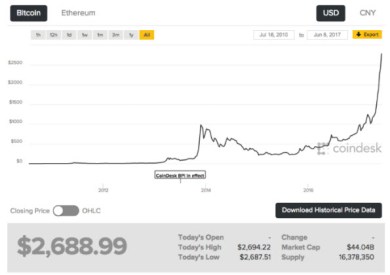
As recently as 2011, you could have bought any number of bitcoins for practically $0. In fact, seven years ago, a programmer spent 10,000 bitcoins to purchase two Papa John’s pizzas. Today, a single “coin” is selling for about $2,513, no doubt causing the programmer to wish that he’d held onto his coins for a few more years. But as you can see on the chart, the ride for bitcoin holders has been bumpy, and much of the price run-up has been recent. If you’ve ever experienced a market bubble, you know this is what they look like (and two inquiries about buying bitcoin at my office in the last two weeks tells me that a “correction” in the price is likely not too far off).

CA - 2017-6-8 - Crypto-Bubble

But why would the price ever drop? For one thing, the Bitcoin currency now has crypto-currency rivals, among them a similar technology and market system called Ethereum. For the first time, Bitcoins actually make up less than 50% of the crypto-marketplace. For another, costs per transaction—which are supposed to be zero—have risen to an average of $4.75, and it sometimes takes a month for the transaction to settle.

Beyond that, there’s a long-running dispute between the developers of Bitcoin who process transactions, and the “miners” who create the coins, which doesn’t look likely to be settled any time soon. It’s been speculated that Bitcoin will split into two factions, which users will have to choose between. A possible glimpse into the future happened when a new startup called Coinbase was touted as the marketplace that would finally bring Bitcoin to the mainstream. Coinbase was backed by the New York Stock Exchange. After considering its options, Coinbase decided to create a new currency alternative to Bitcoin, called Token—which will be built on Ethereum technology.

The conclusion: This is not a bandwagon you want to jump on at current prices. While prices might work their way higher in the short term, you’ll want to wait for more clarity on which ones will survive, and how governments will respond and attempt to regulate the exchanges. Our traditional currencies aren’t going anywhere anytime soon.

If you would like to review your current investment portfolio or discuss any other financial planning matters, please don’t hesitate to contact us or visit our website at http://www.ydfs.com. We are a fee-only fiduciary financial planning firm that always puts your interests first. If you are not a client yet, an initial consultation is complimentary and there is never any pressure or hidden sales pitch. We start with a specific assessment of your personal situation. There is no rush and no cookie-cutter approach. Each client is different, and so is your financial plan and investment objectives.

sources:

http://www.coindesk.com/price/

http://www.cnbc.com/2017/05/22/bitcoin-price-hits-fresh-record-high-above-2100.html

https://www.forbes.com/sites/laurashin/2017/06/07/bitcoin-is-at-an-all-time-high-but-is-it-about-to-self-destruct/?utm_source=TWITTER&utm_medium=social&utm_content=929485744&utm_campaign=sprinklrForbesMainTwitter#4fa5a25dcb31

The MoneyGeek thanks guest writer Bob Veres for his contribution to this post

Second Quarter 2017 YDFS Market Review

The doom and gloom crowd will have to re-up their calls for an economic and market crash until next quarter. As is their MO, “early and often” calls of demise, until they ultimately get it right, will continue. Much to their dismay, the 2nd quarter of 2017 was a good one for markets worldwide.

The U.S. stock market has more than tripled in value during the runup that started in March 2009, and the most recent quarter somehow managed to accelerate the upward trend. We have just experienced the 3rd best first half, in terms of U.S. market returns, of the 2000s.

The Wilshire 5000 Total Market Index—the broadest measure of U.S. stocks—rose 2.95% for the quarter, finishing the first half of the year up 8.73%. The comparable Russell 3000 index is up 8.93% for the year so far.

Looking at large cap stocks, the Wilshire U.S. Large Cap index gained 3.08% in the second quarter, to stand at a 9.27% gain for the first two quarters. The Russell 1000 large-cap index finished the first half of the year with a similar 9.27% gain, while the widely-quoted S&P 500 index of large company stocks gained 2.41% for the quarter and is up 8.08% in the first half of 2017.

Meanwhile, the Russell Midcap Index gained 7.99% in the first two quarters of the year.

As measured by the Wilshire U.S. Small-Cap index, investors in smaller companies posted a relatively modest 1.65% gain over the second three months of the year, to stand at a 3.95% return for 2017 so far. The comparable Russell 2000 Small-Cap Index finished the first half of the year up 4.99%, while the technology-heavy Nasdaq Composite Index broke the 6,000 barrier in April, rose 4.18% for the quarter and is up 14.14% in the first half of the year.

International investments are finally delivering returns to our portfolios. The broad-based EAFE index of companies in developed foreign economies gained 5.03% in the recent quarter, and is now up 11.83% for the first half of calendar 2017. In aggregate, European stocks have gone up 14.49% so far this year, while EAFE’s Far East Index has gained 10.45%. Emerging market stocks of less developed countries, as represented by the EAFE EM index, rose 5.47% in the second quarter, giving these very small components of most investment portfolios a remarkable 17.22% gain for the year so far.

Looking over the other investment categories, real estate, as measured by the Wilshire U.S. REIT index, gained 1.78% gain during the year’s second quarter, posting a meager 1.82% rise for the year so far. The S&P GSCI index, which measures commodities returns, lost 7.25% for the quarter and is now down 11.94% for the year, in part due to a 20.43% drop in the S&P petroleum index. Gold prices are up 7.69% for the year, and silver has gained 3.28%.

In the bond markets, longer-term Treasury rates haven’t budged, despite what you might have heard about the Fed tightening efforts. Coupon rates on 10-year Treasury bond rates have dropped a bit to stand at 2.30% a year, while 30-year government bond yields have dropped in the last three months from 3.01% to 2.83%.

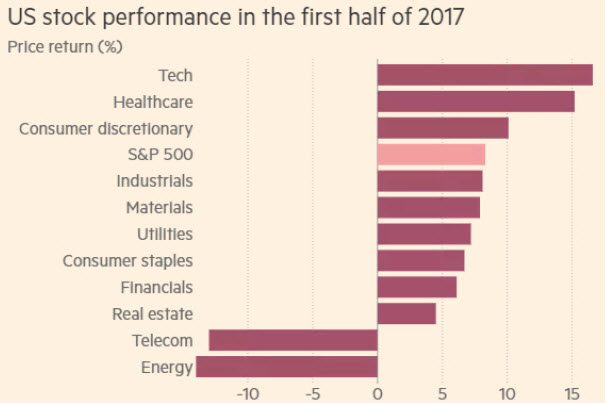
By any measure, this represents a strong first half of the year, driven (as you can see by the graph) by the S&P 500 tech sector, biotech firms and information technology companies generally. What is interesting is that investors appear to be flooding into these business categories because they are the ones most likely to grow their sales even if the economic environment were to turn sour—which suggests a growing bedrock of pessimism about future economic growth among seasoned investors.

2nd Quarter 2017 Review US Stock Performance

Is that justified? Economic growth was admittedly meager in the first quarter—U.S. GDP (gross domestic product) grew just 1.4% from the beginning of January to the end of March, a figure that was actually revised upwards from initial estimates of 0.7%. That represents a slowdown from the 2.1% growth in the fourth quarter of last year, when the country was being managed by a different Presidential Administration. It might be helpful to note that the budget proposals floating around Washington, D.C. make the optimistic assumption of an economic growth rate of 3.0%. If the economy fails to achieve that rate, then watch out for a significant rise in the federal deficit. I suspect economic growth will come in closer to 2.4%

There is room for hope. The Atlanta Federal Reserve recently forecasted that the U.S. economy will grow at a 2.9% rate for the year’s third quarter. We won’t have definitive evidence of that until sometime in October, but our fingers are crossed. More good news: the unemployment rate is at a near-record low of 4.7%, and wages grew at a 2.9% rate in December, the best increase since 2009. The underemployment rate, which combines the unemployment rate with part-time workers who would like to work full-time, has fallen to 9.2%–the lowest rate since 2008.

Meanwhile, the energy sector, which was a big winner last year, has dragged down returns in 2017. This proves once again the value of diversification; just when you start to question the value of holding a certain investment, or wonder why the entire portfolio isn’t crowded into one that is outperforming, the tide turns and the rabbit becomes the hare and the hare becomes the rabbit. If only this were predictable. I like to say that the only problem with consistently accurate market timing is getting the timing right :-).

There are many uncertainties to watch in the days ahead. The U.S. Congress is still debating a health care package, and has promised to revise our corporate and individual income tax code later this year. There’s an infrastructure package somewhere on the horizon, and perhaps a round or two of tariffs on imported goods. Inflation often follows when the Fed raises rates, but we don’t know if or when the Fed will do that, or by how much.

2nd Quarter 2017 Review S&P500 Recovery

Meanwhile, the current bull market is aging, and as you can see from the accompanying chart, the runup has lasted for longer than anybody would have expected when we came out of the gloomy period after the 2008 crisis. However, bull markets don’t die of old age; they die of overexuberance, something we don’t currently have in the current market environment, as many are still quite pessimistic on the market and our economic prospects, and are therefore still on the sidelines or woefully underinvested. What I can say is that stock valuations are a bit stretched by some traditional measures, but I could have said that for the last 2-3 years. Market (over)valuation is not a very good market timing tool.

Nonetheless, we are moving ever closer to a period when stock prices will inevitably go down. That day cannot be predicted in advance, but it is always good to spend a moment and ponder how much of a downturn you would be comfortable with when markets finally turn against us. If your answer is less than 20%, or close to that figure (which is the definition of a bear market), this might be a good time to revisit your stock and bond allocations. It never hurts to take some profits off the table during the good times, to have some cash to re-deploy after a protracted downturn. On the other hand, if you’re not fearful of a downturn, then the next bear market will be a terrific buying opportunity for all of us.

If you would like to review your current investment portfolio or discuss any other financial planning matters, please don’t hesitate to contact us or visit our website at http://www.ydfs.com. We are a fee-only fiduciary financial planning firm that always puts your interests first. If you are not a client yet, an initial consultation is complimentary and there is never any pressure or hidden sales pitch. We start with a specific assessment of your personal situation. There is no rush and no cookie-cutter approach. Each client is different, and so are your financial plan and investment objectives.


Sources:

Wilshire index data: http://www.wilshire.com/Indexes/calculator/

Russell index data: http://www.ftse.com/products/indices/russell-us

S&P index data: http://www.standardandpoors.com/indices/sp-500/en/us/?indexId=spusa-500-usduf–p-us-l–

Nasdaq index data:

http://quotes.morningstar.com/indexquote/quote.html?t=COMP

http://www.nasdaq.com/markets/indices/nasdaq-total-returns.aspx

International indices: https://www.msci.com/end-of-day-data-search

Commodities index data: http://us.spindices.com/index-family/commodities/sp-gsci

Treasury market rates: http://www.bloomberg.com/markets/rates-bonds/government-bonds/us/

Bond rates:

http://www.bloomberg.com/markets/rates-bonds/corporate-bonds/

General:

https://www.ft.com/content/cb5b1156-5d9e-11e7-b553-e2df1b0c3220

https://wdef.com/2017/06/29/economy-grew-1-4-in-first-quarter-higher-than-previous-estimates/

http://money.cnn.com/2017/01/06/news/economy/december-jobs-report-2016/index.html?iid=EL

The MoneyGeek thanks guest writer Bob Veres for his contribution to this post


Why Short-term Investment Performance Doesn’t Matter

The phone rings from a prospect looking for a new advisor and, after exchanging a bit of information on how financial planning and investment planning are long term endeavors that go hand in hand, the prospect inevitably asks about performance. Do we beat the S&P 500 index? What kind of returns can he expect as a client? What have been my historical rates of return? How often will I report on portfolio performance?

After explaining that every client is unique, and past performance has no bearing on the future, the prospect persists in pursuing performance information. I then emphasize the perils of a focus on short-term performance, the superior benefits of a focus on goals & dreams, risk tolerance, asset allocation and time frame.  Mostly I then get a thank you and don’t hear from the prospect ever again.

If you’re a client of a financial planner, you probably receive portfolio reports every three months—a form of transparency that financial planning professionals introduced at a time when the typical brokerage statement was impossible to decipher. But it might surprise you to know that most professionals think there is actually little value to any quarterly reporting or performance information, other than to reassure you that you actually do own a diversified portfolio of investments. It’s very difficult to know if you’re staying abreast of the market, and for most of us, that’s not really relevant anyway.

Why?

The only way to know if your investments are “beating the market” is to compare their performance to “the market,” which is not easy. You can compare your return to the Dow Jones Industrial Average, but that index represents only 30 stocks, all of them large companies. Most people’s investment portfolios include a much larger variety of assets: U.S. stocks and bonds, foreign stocks and bonds, both including stocks of large companies (large cap), companies that are medium-sized (midcap) and smaller firms (small cap). There may be stocks from companies in emerging market countries like Sri Lanka and Mexico. There may be real estate investments in the form of REITs and investment exposure to shifting commodities prices, like wheat, gold, oil and live cattle.

In order to know for sure that your particular batch of investments out-performed or under-performed “the market,” you would need to assemble a “benchmark” portfolio made up of index funds in each of these asset categories, in the exact mix that is in your own portfolio. Even if you could do that precisely, daily, weekly and monthly, market movements would distort the original portfolio mix by causing some of your investments to gain value (and become larger pieces of the overall mix) and others to lose value (and become smaller pieces), and those movements could be different from the movements inside the benchmark. After a month, your portfolio would be less comparable to the benchmark you so painstakingly created and would be rendered virtually useless.

Many professionals believe that there are several keys to evaluating portfolio performance in a meaningful way—and the approach is very different from comparing your returns with the Dow’s.

1) Take a long view: What your investments did last month or last quarter is purely the result of random movements in the market, what professionals call “white noise.” But you might be surprised to know that even one-year returns fall into the “white noise” category. It’s better to look at your performance over five years or more; better still to evaluate through a full market cycle, from, say, the start of a bull (up-trending) market, through a bear (down-trending) market, and to the start of a new bull market. However, you should remember that there are no clear markers on the roadside that say: “This line marks the start of a new bull market.”

2) Compare your performance to your goals, not to your friends’ portfolio: Let’s suppose that our financial plan indicated that your investments needed to generate 5% returns above the rate of inflation in order for you to have a great chance of affording a long, comfortable retirement. If that’s your goal, then chances are, your portfolio is not designed to beat the market; it represents a best guess as to which investments have the best chance of achieving that target return, through all the inevitable market ups and downs between now and your retirement date. If your returns are negative over three to five years, that means you’re probably falling behind on your goals—and you might be taking too much risk in your portfolio.

3) Recognize that some of your investments will go down, even in strong bull markets:  The concept of diversification means that some of your holdings will inevitably move in opposite directions, return-wise, from others (believe it or not, this is a good thing!). If all of your investments are going up in a strong market, chances are they will all be going down in a weak one. Ideally, the overall trend will be upward—the investments are participating in the growth of the global economy, but not all at the same rate and with a variety of setbacks along the way. If you see some negative returns, understand that those are the investments you’re counting on to give you positive returns if/when other parts of your investment mix are suddenly, probably unexpectedly, turning downward.

A focus on under-performing funds or stocks in the short-term can cause you to make short-term detrimental moves with your portfolio. If the underlying fundamentals of the stock or fund are intact, just perhaps out-of-favor in the short term (1-3 years), you shouldn’t tinker with them (assuming your reason for buying hasn’t changed). Treat your portfolio as a combination of ingredients that individually come together to make a tasty treat. Removing or focusing on one or more individual ingredients (say because it’s too salty or sour) can turn a tasty treat into a bland dish.

Too often I see clients focus on individual funds or sectors that are under-performing in the short term, and they want to sell them at what may turn out to be the bottom.  This is one reason why numerous Dalbar studies of individual investor behavior show that most of them under-perform even the funds they own (let alone the markets overall).  I try to explain that markets, industries and sectors are cyclical. They come in and out of favor as large portfolio managers make decisions based on their perception of the stage of the economic cycle. You shouldn’t try and emulate them.

That doesn’t mean you shouldn’t look at your portfolio statement when it comes out. Make sure the investments listed are what you expected them to be, and let your eye drift toward the longer time periods. Notice which investments rose the most and which were down and you’ll have an indication of the overall economic climate. And if your overall portfolio beat the Dow this quarter, or over longer periods of time, well, that probably only represents “white noise” …

If you would like to review your current investment portfolio or discuss any other financial planning matters, please don’t hesitate to contact us or visit our website at http://www.ydfs.com. We are a fee-only fiduciary financial planning firm that always puts your interests first. If you are not a client yet, an initial consultation is complimentary and there is never any pressure or hidden sales pitch.

The MoneyGeek thanks guest writer Bob Veres for his contribution to this post.

What’s the Government Buying with your Money?

Tax time is over for another year for millions of Americans (who didn’t ask for an extension), and as you look over your tax payments for calendar 2016, you’re undoubtedly wondering where those dollars are being spent by Uncle Sam.

The Wall Street Journal recently published a chart which breaks down spending for every $100 of tax receipts—and concludes that the U.S. government is actually a very large insurance company, that also happens to have an army. Chances are, the check or checks that you wrote for the year barely keep the government running for a fraction of a second.

For every $100 you pay in taxes, $23.61 goes to Social Security payments and administration—basically old age insurance for retirees.  Another $15.26 goes to Medicare, the government health insurance program.  Medicaid, the health insurance program for the poor, accounts for another $9.55 of that $100 tax bill—bringing the total costs for various civilian insurance programs to 48% of the total budget.  And that army?  It costs $15.24 of every $100 the government collects in taxes, not counting veterans benefits.

In all, the 2016 federal budget fell $15.24 out of every $100 short of revenues equaling expenses.  Where would you cut?

Things like federal expenditures and grants for education ($2.08), food stamps ($1.89), affordable housing ($1.27) and foreign aid ($1.14) actually make up a very small part of the budget, smaller than interest payments on the national debt ($6.25).

There has been talk about helping reduce the budget by lowering expenditures on the National Endowments for the Arts and Humanities, which together represent eight tenths of one cent of that $100 tax bill.  This would be comparable to someone trying to pay off his mortgage by looking for coins under the sofa cushions.

As for us, we’re just glad that we survived another very busy tax season, with more compliance requirements imposed on preparers and taxpayers than ever before. Tax simplification? Doesn’t seem to ever be in the cards.

If you would like to review your current investment portfolio or discuss any other tax or financial planning matters, please don’t hesitate to contact us or visit our website at http://www.ydfs.com. We are a fee-only fiduciary financial planning firm that always puts your interests first.  If you are not a client yet, an initial consultation is complimentary and there is never any pressure or hidden sales pitch. We start with a specific assessment of your personal situation. There is no rush and no cookie-cutter approach. Each client is different, and so is your financial plan and investment objectives.

Source:

https://www.wsj.com/articles/how-100-of-your-taxes-are-spent-8-cents-on-national-parks-and-15-on-medicare-1492175921

The MoneyGeek thanks guest writer Bob Veres for his contribution to this post

Higher short-term rates: What to Do

The U.S. Federal Reserve Board’s Open Market Committee just raised the short term Federal Funds rate from 0.75% to 1.00%—the second rate hike in three months.  The short term federal funds rate is what banks are charged for overnight borrowing and affects all manner of loans and credit cards. So what should you do with your investment portfolio in light of this change?

Nothing.

Why?  First of all, the rate change was laughably minor, considering all the press coverage it received.  In the mid-2000s, Fed Chairman Alan Greenspan raised interest rates 17 times in quarter-point jumps, finally taking Fed Funds to a 5% rate.  This time around, the economists at America’s central bank are behaving extremely cautiously.

Second, you may read that any raise in interest rates is depressing for stocks.  It’s true that borrowing will be incrementally more expensive for American corporations than they were last week.  But bigger picture, this move was actually a validation of the country’s economic progress in our long slow climb out of The Great Recession.

By raising rates, the Fed was indicating that it believes the companies that make up our economy are healthy enough to survive and prosper under slightly higher interest rates.  The markets apparently felt like this was a positive sign, that the economy no longer needs to be nursed back to health.  The widely-followed S&P 500 stock index rose a full percentage point on the news the day of announcement.

Third, and more good news, the Fed has now moved into a mode where it is fighting inflation, rather than trying desperately to stimulate it.  The worst thing that could happen to the economy is a bout of deflation, where prices fall and there are no policy remedies to fix the problem.  In the discussion accompanying the rate rise (the infamous Fed “minutes”) the Board of Governors expressed concern that inflation might rise above their “target” of 2%, hence the tightening.  If you read the message between the lines, they seem to feel that the threat of deflation is over.

Finally, the rate hike was expected, and already built into the price of stocks.  And more still are expected: at least two and possibly three 0.25% rises before the end of the year.  But the Fed also signaled that if there is any sign of economic backtracking, those plans will be scrapped.  The rate rises are anything but reckless. But given the strength in the unemployment rate, the jobs numbers and wage increases, I believe that at least two more rate increases are in store before the end of the year.

So what WILL be the effect of the rate hike?  Borrowing to buy a car or a house will be slightly more expensive going forward than it was last week.  The average thirty year fixed mortgage rate this time last year was 3.68%; it’s now up to 4.21%.

Most credit cards charge variable rates of interest, which likely means a 0.25 percent rise in the rates you pay on any balances you carry from month to month.

And private student loans with variable interest rates will likely increase each time the Fed raises rates.  Balances on Stafford, Graduate Plus or Parent Plus loans will remain at their current interest rates, but the rates on new loans will probably rise.

If your portfolio is well-diversified, there’s not much more you can do to ride out a (slowly) rising-rate environment.  Ignore the headlines and celebrate the fact that even the most cautious economists in Washington are finally admitting that the economy is on solid ground.

If you would like to review your current investment portfolio or discuss any other financial planning matters, please don’t hesitate to contact us or visit our website at http://www.ydfs.com. We are a fee-only fiduciary financial planning firm that always puts your interests first.  If you are not a client yet, an initial consultation is complimentary and there is never any pressure or hidden sales pitch. We start with a specific assessment of your personal situation. There is no rush and no cookie-cutter approach. Each client is different, and so is your financial plan and investment objectives.

Sources:  

https://www.theguardian.com/business/2017/mar/15/us-federal-reserve-raises-interest-rates-to-1

http://www.chicagotribune.com/business/ct-fed-interest-rate-impact-0316-biz-20170315-story.html

https://www.ft.com/content/9ea0e1bd-8c45-31ff-9d7c-241023fd5e12

https://www.nerdwallet.com/blog/investing/fed-rate-hike-4-ways-to-ride-rising-interest-rate-wave/#.WMmTRplBq6o.twitter

The MoneyGeek thanks guest writer Bob Veres for his contribution to this post

Are Millennials Risk Averse Savers?

The Millennials are the generation of kids born between the years 1981 and 1997. This year, Millennials will overtake the baby boomers as largest generation in United States history with 75.3 million people.

Millennial Americans are saving their money at a higher rate than their Baby Boomer counterparts at a similar age.  Research from the Transamerica Center for Retirement Studies shows that nearly three-quarters of Millennials are saving for retirement at an earlier age than past generations.  Half are putting away 6% of their income or more—a statistic that makes Millennials the best cohort of savers since the Great Depression, despite having to carry record high levels of student loan debt.  Those who participate in their workplace retirement plans are saving 7% a year, on average.

Alas, Millennials are not doing an equally good job of investing.  The research suggests that many younger Americans are frightened and confused by the topic of investing, and keep their money in their bank accounts.  That’s a problem, since low interest rates essentially drop the return on investment to 0% a year.  In the Transamerica survey, 25% of Millennial respondents said they weren’t sure how their retirement savings were invested, and, when they were promoted to check, they reported higher allocations to bonds, money market funds and other low-return investments than their Baby Boomer or Generation X counterparts.

There are a variety of prescriptions for the problem of being under-invested, which is much more easily fixed than bad savings habits.  Millennials need to be educated about investing—a subject which is not taught in high school or college.  They need to become more comfortable with risk, understanding that, although markets do go down from time to time, they have always recovered and beaten their previous highs. There is no shortage of web sites, blogs, books and podcasts available for them to take advantage of to educate themselves at little or no costs. A fee-only financial planner who is a fiduciary can be an invaluable resource to millennials who are skeptical or scared of investing.

If you are a millennial (or even if you aren’t one), and would like to review your current investment portfolio or discuss any other financial planning matters, please don’t hesitate to contact us or visit our website at http://www.ydfs.com. We are a fee-only fiduciary financial planning firm that always puts your interests first.  If you are not a client yet, an initial consultation is complimentary and there is never any pressure or hidden sales pitch. We start with a specific assessment of your personal situation. There is no rush and no cookie-cutter approach. Each client is different, and so is your financial plan and investment objectives.

Sources:

http://www.forbes.com/sites/arielleoshea/2017/02/21/5-essential-investing-moves-for-millennials/?ss=personalfinance#743c36582ab5

http://www.csmonitor.com/Business/Saving-Money/2017/0221/Why-Millennials-are-better-with-their-money-than-their-parents

The MoneyGeek thanks guest writer Bob Veres for his contribution to this post.

How to Find an Old 401(k) Account

Here’s the scenario: You worked for a company sometime in the past and contributed to the 401(k) or 403(b) plan.  When you left the company, you left the funds in the plan, forgot about it, but recently came across an old statement. Excited, you call the plan administrator, assuming that you can figure out who the current administrator is. You’re lucky enough to reach someone and are told that the company’s accounts had been transferred to another plan administrator years ago. You then call the new administrator and are told they also could not find your 401(k) using your social security number or other identifying information. How do you proceed?  What are your options?

A recent Q&A by personal finance columnist Liz Weston tackles this very question.

First off, prepare to make a lot more phone calls.

There’s no central repository for missing 401(k) funds — at least not yet. The Pension Benefit Guaranty Corp., which safeguards traditional pensions, has proposed rules that would allow it to hold orphaned 401(k) money from plans that have closed. However, that won’t start until 2018. Another proposal, by Sen. Elizabeth Warren (D-Mass.) and Sen. Steve Daines (R-Mont.), would direct the IRS to set up an online database so workers could find pension and 401(k) benefits from open or closed plans, but Congress has yet to take action on that.

If your balance was less than $5,000 (or was more than that when you left your employer, but the funds somehow declined below that balance due to market performance or fees), your employer could have approved a forced IRA transfer, and the money could be sitting with a financial services firm that accepts small accounts. If the plan was closed and your employer couldn’t find you, the money could have been transferred to an IRA, a bank account or a state escheat office. You can check state escheat offices at Unclaimed.org, the official site of the National Assn. of Unclaimed Property Administrators (NAUPA). NAUPA also endorses the site MissingMoney.com.  Searching for an IRA or bank account may require some additional help.

If your employer still exists, call to find out if anyone knows what happened to your money. If the company is out of business, you may be able to get free help tracking down your money from the U.S. Department of Labor (at askebsa.dol.gov or (866) 444-3272) or from the Pension Rights Center, a nonprofit pension counseling center (pensionrights.org/find-help).  Another place to check is the National Registry of Unclaimed Retirement Benefits, a subsidiary of a private company, called PenChecks, that processes retirement checks, at www.unclaimedretirementbenefits.com.

Your employer or a plan administrator could insist that you cashed in your account at some point. You may be able to prove otherwise if you’ve kept old tax returns, since those typically would show any distributions. Ultimately, you may have to seek legal help if you’re sure that your money is out there somewhere and you’re not getting any results.

If you do find your money, understand that you may still have missed out on a lot of growth. Your investments may have been converted to cash, which has earned next to nothing over the past decade or so, particularly after inflation.

Leaving a 401(k) account in an old employer’s plan can be a convenient option, but only if you’re willing to keep track of the money — and let the administrator know each time you change your address. Your retirement success depends on it.

This shows why it’s important not to lose track of old retirement accounts. Ultimately, your current employer may allow you to transfer old accounts into its plan, or, more preferable, you can roll the money into an IRA. Either way, it’s much better to keep on top of your retirement money than to try to find it years later.

If you would like to review your current investment portfolio or discuss any other financial planning matters, please don’t hesitate to contact us or visit our website at http://www.ydfs.com. We are a fee-only fiduciary financial planning firm that always puts your interests first.  If you are not a client yet, an initial consultation is complimentary and there is never any pressure or hidden sales pitch. We start with a specific assessment of your personal situation. There is no rush and no cookie-cutter approach. Each client is different, and so is your financial plan and investment objectives.

Source: How to track down an old retirement account by Liz Weston

2016 YDFS Investment Review

So President-elect Trump didn’t crash the market; the world didn’t fall apart after the Brexit vote; and the worst start to the year in history didn’t derail what ended up being a pretty good year in the stock markets. “Who da thunk it?”

You know you’re deep into a longstanding bull market when you see things like average pedestrians keeping one eye on the market tickers outside of brokerage houses to see when the Dow Jones Industrial Average has finally breached the 20,000 mark.  Who would have imagined record market highs at this point last year, when the indices ended the year in slightly negative territory?  Or when the new year 2016 got off to such a rocky start, tumbling 10% in the first two weeks—the worst start to a year since 1930?

The markets eventually bottomed in mid-February and began a long, slow recovery, turning positive by the end of March, suffering a setback when the U.K. decided to leave the Eurozone, and endured another hard bump right after the elections.  In the end, we were disappointed; the Dow finished at 19,762.60 for the year—but the bull market has continued for another year.

This was the second year in a row that the final quarter provided investors with solid gains. The Wilshire 5000–the broadest measure of U.S. stocks—was up 4.54% in the fourth quarter of 2016, ending the year up 13.37%.  The comparable Russell 3000 index gained 4.21% in the final quarter, to finish up 12.74% for the year.

Large cap stocks were up as well.  The Wilshire U.S. Large Cap index gained 4.14% in the fourth quarter, and finished the year up 12.49%.  The Russell 1000 large-cap index closed with a 3.83% fourth quarter performance, and finished the year up 12.05%, while the widely-quoted S&P 500 index of large company stocks was up 3.25% in the fourth quarter, finishing up 9.54% for calendar 2016.

The Wilshire U.S. Mid-Cap index gained 5.31% in the final quarter, finishing the year with a gain of 17.22%.  The Russell Midcap Index gained 3.21% in the fourth quarter, and was up 13.80% in calendar 2016.

This was a year to remember for investors in small company stocks.  As measured by the Wilshire U.S. Small-Cap index, investors posted an 8.30% gain over the last three months of the year, for a total return of 22.41% over the entire 12 months.  The comparable Russell 2000 Small-Cap Index finished the year up 21.31%, while the technology-heavy Nasdaq Composite Index rose 1.34% in the fourth quarter, to finish the year up 7.50%.

International investments contributed a slight decline to overall portfolio returns.   The broad-based EAFE index of companies in developed foreign economies lost 1.04% in the fourth quarter of the year, finishing the year down 1.88% in dollar terms (I expect these stocks to carry the winning torch any day now).  In aggregate, European stocks lost 3.39% for the year, while EAFE’s Far East Index gained just 0.14%.  Emerging markets stocks of less developed countries, as represented by the EAFE EM index, gained 8.58% for the year.

Looking over the other investment categories, real estate investments, as measured by the Wilshire U.S. REIT index, lost 2.28% during the year’s final quarter, but managed to finish up 7.24% for calendar 2016.

Last year, investors were wondering why they owned commodities in their portfolios, when their statements showed that the index delivered a whopping 32.86% loss.  This year, they may be wondering why they weren’t more committed to the asset class, as the S&P GSCI index gained 27.77%, fueled in part by a 45.03% rise in the S&P crude oil index.  Gold prices shot up 8.63% for the year and silver gained 15.84%.

In the bond markets, it’s possible that the decades-long bull market—which basically means declining interest rates—has ended, and the fixed-income world is experiencing rate rises.  But despite the nudge by the Federal Reserve Board, the moves have not exactly been dramatic.  Over the past year, rates on 10-year Treasury bonds have risen from 2.25% to 2.44%, while 30-year government bond yields have risen from 3.00% to 3.07%.  According to Barclay’s Bank indices, U.S. liquid corporate bonds with a 1-5 year maturity have seen yields rise incrementally from 2.4% to 2.8% on average. Despite the many cries and declarations that the 30 year bull market in bonds is over, rest assured that bonds won’t go down without a fight (winning streaks that last so long never die that quickly).

As always, there were many unpredictable anomalies in the investment world.  In the international markets, anyone lucky enough to have speculated on the Brazilian Bovespa index—comparable to the U.S. S&P 500—would have reaped a gain of 68.9% this year, despite all the headline drama around the Zika virus and political uncertainties that were reported on during the Olympic games.  Russian stocks were up 51% for the year, despite the recent sanctions from the U.S. government and the lingering international sanctions related to the invasion of the Crimean peninsula.

As is my obligation as a financial planner, I have to point out that while you may not have realized anywhere near the kinds of returns outlined above for the year, having a diversified and perhaps hedged portfolio means that you never have enough of the stuff that went up and too much of the stuff that came down or underperformed. Risk management of any kind during this bull market (read: diversification) tends to blunt returns during the good times, but is a welcome friend when the markets turn against us. Since no one knows when this is, you have to stick to your investment approach through thick and thin (you do have an investment approach, don’t you? We’re available to help you craft an investment approach if you need us).

What’s going to happen in 2017?  Short-term market traders seem to be expecting a robust economic stimulus combined with lower taxes and deregulatory policies that would boost the short-term profits of American corporations.  But it is helpful to remember that we are entering the ninth year of economic expansion, making this the fourth longest since 1900.  In addition, growth has not exactly been robust; the U.S. GDP has averaged just 2.1% yearly increases since the Great Recession, making this the most sluggish of all post-World War II expansions.

Slow but steady has not been a terrible formula for workers or stock investors.  The unemployment rate has slowly ticked down from a post-recession peak of 10% to less than 5% currently.  U.S. stock indices are posting record highs with double-digit gains, and that Dow 20,000 level, while essentially meaningless, is still catching a lot of attention.

It’s clear that the new President-elect wants to accelerate America’s economic growth, but the policy prescription has not always been clear.  Will we rip up longstanding trade agreements, cut back on immigration quotas and deport millions of workers who crossed the border without a visa?  Will there be a wall built between the U.S. and Mexico?  Will the government pay for huge infrastructure projects, at the same time reducing taxes and thus raising the national debt?  Will Congress raise the debt ceiling without protest if that happens?  Will the Fed raise rates more aggressively in the coming year, or cooperate with the President-elect in his efforts to drive the economy into a faster lane?

At the same time, there are many unknowns around the globe.  China’s economic growth has stalled for the second consecutive year, and you will soon be reading about a banking crisis in Italy that could force the country to leave the Eurozone—potentially a much bigger blow to European economic unity than Brexit or a still-possible Greek exit.  Russian hackers may have ushered in an era of unfettered global intrusions into our Internet infrastructure, and there will surely be a continuation of ISIS-sponsored terrorism in Europe and elsewhere.

Every year of this longstanding bull market, we have to look over our shoulders and wonder when and how it will end.  With the January downturn and so much uncertainty at this time last year, nobody could have predicted double-digit returns on U.S. stocks at year-end.  This year could bring more of the same, or it could fulfill the dire predictions many have made during the election cycle, including both Democrats and Republicans who believe the country is in worse shape than the numbers would indicate. Just remember that bull markets rarely die of old age; instead, they die from excessive enthusiasm and ebullience. This bull market is anything but ebullient.

What we have learned over the past few years is that the markets have a way of surprising us, and that trying to time the market, and get out in anticipation of a downturn, is a loser’s game.  At the county fair or amusement park, when we get on the roller coaster, we don’t bail out and jump over the side at some scary point on the track; we hang on for the remainder of the ride.  The history of the markets has been a general upward trend that benefits long-term investors, and looking out over the long-term, that—and a few hard bumps along the way–is probably the best outcome to expect.

This is not to say that you should commit 100% of your capital to the market or stay all in at all times. It never hurts to take a few chips off the table when things are going well so that you have some dry powder to deploy when those hard bumps come along. Rebalancing into underperforming investment classes at least once or twice a year is always a good idea as well.

If you would like to review your current investment portfolio or discuss any other financial planning matters, please don’t hesitate to contact us or visit our website at http://www.ydfs.com. We are a fee-only fiduciary financial planning firm that always puts your interests first.  If you are not a client yet, an initial consultation is complimentary and there is never any pressure or hidden sales pitch. We start with a specific assessment of your personal situation. There is no rush and no cookie-cutter approach. Each client is different, and so is your financial plan and investment objectives.

You can interact with Sam TheMoneyGeek and read his latest musings on Twitter at http://twitter.com/themoneygeek

Sources:

Wilshire index data: http://www.wilshire.com/Indexes/calculator/

Russell index data: http://www.russell.com/indexes/data/daily_total_returns_us.asp

S&P index data: http://www.standardandpoors.com/indices/sp-500/en/us/?indexId=spusa-500-usduf–p-us-l–

Nasdaq index data: http://quotes.morningstar.com/indexquote/quote.html?t=COMP

http://www.nasdaq.com/markets/indices/nasdaq-total-returns.aspx

International indices: https://www.msci.com/end-of-day-data-search

Commodities index data: http://us.spindices.com/index-family/commodities/sp-gsci

Treasury market rates: http://www.bloomberg.com/markets/rates-bonds/government-bonds/us/

Aggregate corporate bond rates: https://index.barcap.com/Benchmark_Indices/Aggregate/Bond_Indices

Aggregate corporate bond rates: http://www.bloomberg.com/markets/rates-bonds/corporate-bonds/

 Muni rates:  https://indices.barcap.com/show?url=Benchmark_Indices/Aggregate/Bond_Indices

http://www.wsj.com/articles/chinas-stock-market-still-a-draw-after-tumultuous-year-1451303164

http://www.marketwatch.com/story/these-are-the-bestand-worstperforming-assets-of-2016-2016-12-30?link=sfmw_tw

http://www.theworldin.com/article/10632/unsettling-year-markets

http://www.forbes.com/sites/maggiemcgrath/2016/12/30/markets-end-last-trading-day-of-2016-in-red-but-post-gains-for-the-year/#7db846fd7c07

The MoneyGeek thanks guest writer Bob Veres for his contribution to this post


Higher Interest Rates: One and Done or More to Come?

We all know that we’re paying more for almost everything these days. Everything, of course, except money. Interest rates have been at historical lows for more than eight years, even though the economy has steadily improved over this period.

So anybody who was surprised that the Federal Reserve Board (A.K.A. The Fed) decided to raise its benchmark short-term interest rate last week probably wasn’t paying attention.  The U.S. economy is humming along, the stock market is booming and the unemployment rate has fallen faster than anybody expected.  The incoming administration has promised lower taxes and a stimulative $550 billion infrastructure investment.  The question on the minds of most observers is: what were they waiting for?

The rate rise is extremely conservative: up 0.25%, to a range from 0.50% to 0.75%—which, as you can see from the accompanying chart, is just a blip compared to where the Fed had its rates ten years ago.

federal-funds-rate-2016-12-16

The bigger news is the announced intention to raise rates three times next year, and move rates to a “normal” 3% by the end of 2019—which is faster than some anticipated, although still somewhat conservative.  Whether any of that will happen is unknown; after all, in December 2015, the Fed was telegraphing four rate adjustments in 2016 , before backing off until now with just this one. Personally, I believe that three interest rate increases in 2017 will prove inadequate, especially if current signs of inflation intensify next year.

The rise in rates is good news for those who believe that the Fed has intruded on normal market forces, suppressed interest rates much longer than could be considered prudent, and even better news for people who are bullish about the U.S. economy.  The Fed may have been the last remaining skeptic that the U.S. was out of the danger zone of falling back into recession; indeed, its announcement acknowledged the sustainable growth in economic activity and low unemployment as positive signs for the future.  However, bond investors might be less pleased, as higher bond rates mean that existing bonds lose value.  The recent rise in bond rates at least hints that the long bull market in fixed-rate securities—that is, declining yields on bonds—may finally be over.

For stocks, the impact is more nuanced.  Bonds and other interest-bearing securities compete with stocks in the sense that they offer stable—if historically lower—returns on your investment.  As interest rates rise, the see-saw between whether you prefer stability or future growth tips a bit, and some stock investors move some of their investments into bonds, reducing demand for stocks and potentially lowering future returns.  None of that, alas, can be predicted in advance, and the fact that the Fed has finally admitted that the economy is capable of surviving higher rates should be good news for people who are investing in the companies that make up the economy. That’s not to say that the prospect of more interest rate hikes won’t cause volatility in the stock markets.

So there may be a lump of coal on the list for over-exuberant investors in the year ahead. Although the current weight of evidence points to a continuation of this economic recovery, pressures that have been synonymous with trouble in past cycles have been developing. Wage and commodity (oil, raw materials) price increases may be rising faster than anticipated, and the Fed could easily fall behind in their efforts to keep inflation in check.

The bottom line here is that, for all the headlines you might read, there is no reason to change your investment plan as a result of a 0.25% change in a rate that the Fed charges banks when they borrow funds overnight.  There is always too much uncertainty about the future to make accurate predictions, and today, with the incoming administration, the tax proposals, the fiscal stimulation, and the real and proposed shifts in interest rates, the uncertainty level may be higher than usual.

If you would like to review your current investment portfolio or discuss any other financial planning matters, please don’t hesitate to contact us or visit our website at http://www.ydfs.com. We are a fee-only fiduciary financial planning firm that always puts your interests first.  If you are not a client yet, an initial consultation is complimentary and there is never any pressure or hidden sales pitch. We start with a specific assessment of your personal situation. There is no rush and no cookie-cutter approach. Each client is different, and so is your financial plan and investment objectives.

Sources:

http://www.businessinsider.com/fed-fomc-statement-interest-rates-december-2016-2016-12

http://www.marketwatch.com/story/fed-to-hike-interest-rates-next-week-while-ignoring-the-elephant-in-the-room-2016-12-09

http://www.reuters.com/article/us-usa-fed-idUSKBN1430G4

http://www.usatoday.com/story/money/personalfinance/2016/12/15/fed-rate-hike-7-questions-and-answers/95470676/?hootPostID=32175354f7440337d62a767b3db92c68

The MoneyGeek thanks guest writer Bob Veres for his contribution to this post